Almost certainly not. A Star Trek-style transporter would have to measure the exact position and state of every particle in a human body (the Heisenberg uncertainty principle says it can’t), shuttle roughly 7 × 10²⁷ atoms of information without losing a single one, and rebuild them perfectly at the destination. Real quantum teleportation can transfer quantum states between particles, but transporting living beings remains pure science fiction.
“Beam me up, Scotty!”
This quote is something every science fiction lover will know (although it was never said in this manner on the show, interestingly enough).
Teleportation wasn’t exactly a new idea when Star Trek and Scotty made it famous. It was awe-inspiring to see the transporter in action, the idea that such a device could beam objects and people from place to place in a matter of seconds was mesmerizing.
It would certainly help us avoid traffic jams!
However, is such an ingenious device possible? Could people really beam themselves from country to country without suffering the jet lag? Before we come to that, let’s first see what a transporter actually is.
How Does The Transporter Work?
The infamous transporter breaks down the being or the object into subatomic particles with high-energy beams and sends it to the desired region. Once there, the constituents are then perfectly reassembled like Legos.
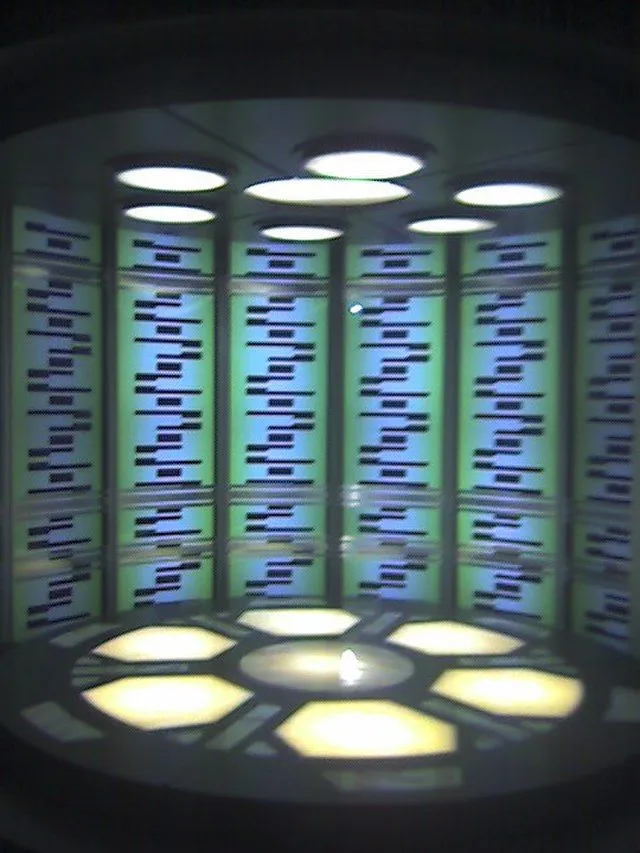
The principle is that the transporter breaks down matter into energy. The energy is then transported to a destination and assembled back into matter.
Now, could such an ingenious object be designed in reality?
According to our current understanding of science, not at all. There are many complicating issues we would face.
How Does The Star Trek Transporter Work In The Show?
On the show, the transporter follows a surprisingly detailed sequence once someone calls out “Energize.” Molecular imaging scanners first read the subject down to the quantum level, and the body is then dematerialized and converted into what the writers call a matter stream. That stream is held together by an annular confinement beam, a cylindrical force field that keeps your particles from drifting apart while they are in transit.

The stream is briefly parked in a pattern buffer, a component that stores your molecular pattern and corrects for the fact that the ship, the planet below, and everything else are all moving at different speeds. Just before you are rebuilt at the far end, a biofilter screens the pattern for dangerous microbes and viruses. Only then is the pattern beamed to the target and rematerialized.
There is one glaring problem the writers had to invent their way around. The Heisenberg uncertainty principle says you cannot pin down both the exact position and the exact momentum of a particle at the same time, which should make that initial scan impossible. Their fix was a fictional gadget called the Heisenberg compensator, which supposedly strips that uncertainty out of the measurement. When Time magazine asked technical adviser Michael Okuda how it works, he famously replied, “It works very well, thank you.” In other words, even the show’s own team knew this was the point where the science quietly stops and the storytelling takes over.
Physical And Chemical Limitations
Science fiction inspired a lot of inventions, such as automatic doors, mobile phones, tasers, and organ transplants. Sadly, teleportation devices remain out of our reach.
The main reason is our poor understanding of quantum mechanics. It’s hard to understand the position of a particle and the speed at which it is traveling.
For example, let’s say I took a puppy and the transporter broke it down into its subatomic particles.
We would have no idea where each of the puppy particles are, nor the direction in which they are moving. Without knowing that, how would we guide the puppy particles to their destination?
On top of that, we would also have to keep track of so many particles!
Suppose a few particles get lost on the way, the puppy therefore wouldn’t be reassembled correctly. It would be like losing a crucial Lego piece that holds the entire structure together.
Even with these obvious challenges, a few German scientists made a transporter… of sorts.
The machine, which they decided to call Scotty, breaks down an object placed inside it while scanning it simultaneously and sending this data to the receiver at a particular location. There is a relocate button that, when pressed, signals to the receiver to start making a 3-D replica of the scanned item.
As the sending unit scans and destroys the object, the receiving unit reconstructs it at the other end. Pretty cool, right?! Although you probably guessed already… a puppy definitely couldn’t be transported this way, at least not with any hopes of keeping it alive.
Another problem is that of material. Let’s say that you tried to teleport an expensive gold necklace. In the destructive scanning procedure, the necklace would be destroyed, while at the other end, you’d be left with a 3-D printed plastic replica. There goes the necklace’s value!
Biological Limitations
The whole dematerializing and rematerializing of matter isn’t something to which I’d like to subject my body. The idea that all my cells would be broken down into subatomic particles and then reassembled is freaky.
If by any chance my cells weren’t reconstructed properly and some DNA damage took place, it could lead to serious consequences, like cancer. How could we possibly ensure that the reconstruction process works perfectly?
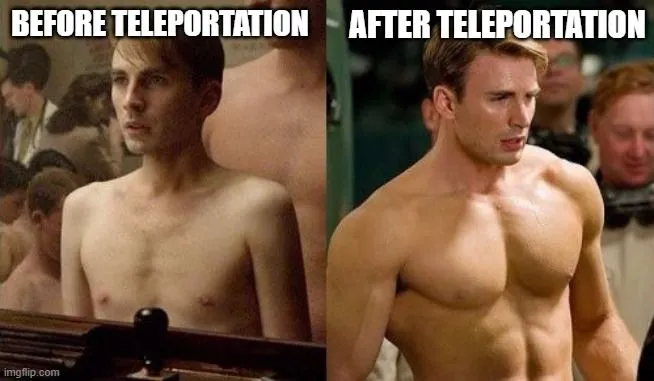
There is also the philosophical question of identity. If your body is destroyed at one end and an exact copy is built at the other, is the copy still you, or just a duplicate with your memories? Would consciousness be preserved through the destructive scan, or would the original person simply die and a new one appear?
What Is Real Quantum Teleportation?
Here is the twist that surprises most people: teleportation is genuinely real, just not the kind that whisks your body across the galaxy. Physicists call it quantum teleportation, and it was first spelled out in a 1993 paper by Charles Bennett and five co-authors. What it moves is not matter or energy at all, but information, specifically the exact quantum state of a single particle.

The whole trick leans on quantum entanglement. Two people, traditionally called Alice and Bob, start out sharing a pair of entangled particles. Alice takes the particle whose state she wants to send, measures it together with her half of the entangled pair (a step that destroys the original state in the process), and is left with two ordinary bits of information. She sends those two bits to Bob over a completely normal channel, like a phone call. Using them, Bob nudges his half of the pair, and it snaps into the exact state Alice began with.
Two details are worth pausing on. Because the original is wrecked during that measurement, you end up with a genuine move rather than a copy, which keeps the rules of quantum mechanics intact. And because Bob is stuck waiting for those two classical bits to arrive, the process can never outrun light, however magical it sounds. Real experiments keep stretching the distance: 600 meters across the Danube in 2004, 143 kilometers between two of the Canary Islands in 2012, and in 2017 China’s Micius satellite teleported a state from the ground up to orbit, roughly 1,400 kilometers away.
Would A Transporter Ever Be Possible?
I don’t think a transporter is something that humans will be able to create. I hope I’m wrong, but it seems almost impossible. The risks associated with it are far too great. We simply don’t understand enough about biology or quantum physics to ensure that our particles would be reassembled perfectly.
Plus, I don’t know how many would volunteer to test a transporter, particularly as an “early adopter”.
We could very well have a transporter for non-living objects, but I don’t think we’ll have a tool to beat the city traffic anytime soon.
Conclusion
Teleportation of small non-living objects is possible, but that will have to do for now. I’m afraid that the fictional Scotty and his transporter will stay fictional and the only way we’ll get to see it is by watching Star Trek.
There is still so much we don’t know about the process or the possibilities; we need unimaginable breakthroughs in all scientific fields to come up with such a machine to beam us around country to country. Or maybe even… planet to planet?
References (click to expand)
- Mueller, S., Fritzsche, M., Kossmann, J., Schneider, M., Striebel, J., & Baudisch, P. (2015, January 15). Scotty. Proceedings of the Ninth International Conference on Tangible, Embedded, and Embodied Interaction. ACM.
- Werbos, P. J. (2019, April 16). Quantum Measurement, Consciousness, and the Soul: a New, Alternative Position. Activitas Nervosa Superior. Springer Science and Business Media LLC.
- Beam Me Up? Teleporting Is Real, Even If Trekkie Transport Isn't. National Public Radio
- Transporter (Star Trek). Wikipedia
- Bennett, C. H., et al. (1993). Teleporting an Unknown Quantum State via Dual Classical and Einstein-Podolsky-Rosen Channels. Physical Review Letters.
- Quantum teleportation. Wikipedia