Table of Contents (click to expand)
Space and time really do trade roles in one place: inside a black hole. Cross the event horizon and, in Schwarzschild coordinates, the radial direction becomes time-like while time becomes space-like. The singularity stops being a point in space and becomes a moment in your future, which is why nothing that falls in can ever turn back.
When Einstein published the General Theory of Relativity in 1915, the world was not particularly friendly toward Germans or German science. The credit for this mistrust largely went to World War I, which was raging across Europe at the time.
But finally, when Einstein’s work made it into the world of science, people found it difficult to understand. Perhaps this was because it is indeed difficult to understand, but also because of what it implied…
It is true that the General Theory of Relativity conceived the universe in a better way. However, it also made people realize that nothing is as it seems in the night sky. In fact, when Subrahmanyan Chandrasekhar used it to argue that a dying massive star could collapse without limit, Einstein himself refused to believe such an object could exist!
Of all that it gave us, one of the most interesting and important concepts of the General theory of relativity was that of space-time.
Previously, no one had even imagined that space and time were inseparable, nor deeply considered their intriguing nature. It was mind-boggling to understand that they are not only conjoined, but also inconsistent throughout the universe.
Since then, we have come a long way in this field through the study of singularity, gravitational waves, and so much more. However, there are still many questions to answer about space-time, like the expansion of the universe, the Big Bang, and more. That being said, have you ever wondered what would happen if space and time exchanged positions? Would it affect the very fabric of the universe? And is it even possible?
Understanding Space And Time
Einstein’s theory of general relativity implied that space-time is composed of four inseparable dimensions. It is a malleable play dough at the hands of gravity.
For instance, imagine a massive star whose gravity will be just as massive. It is seen that light travels in a curved fashion around the star depending on its gravity. This is all thanks to curved space-time itself, because as we all know, light cannot bend. This is an example of gravity molding space-time!
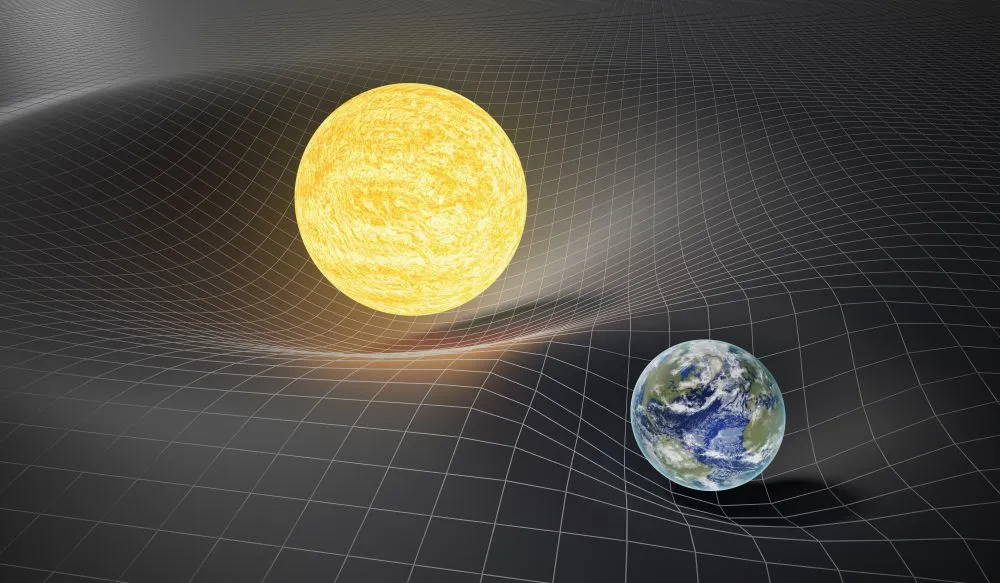
Now, even though space and time are a part of the same structure in which this universe lives, they both couldn’t be more different. Think of a set of twins for instance. These twins are always joined at the hip, so in tune that they complete the other’s thoughts, yet completely different in terms of their personalities.
Space and time can be imagined as such twins – inseparable, what affects one affects the other, but have completely different implications on the universe.
Voyage Through Space-time
Let’s imagine ourselves as astronauts in a spaceship. With space, it’s very straightforward. Yes, it will bend around heavy objects, just like time, but it is three-dimensional and allows our spaceship to travel in any direction. Thus, we can go in any direction we want.

But with time, it is much trickier. This fourth dimension is as malleable as space under gravity, but just as rigid. It will only allow the spaceship to travel in one direction, forward. Thus, the only option is to move forward in time, never backward. So as we move in whichever direction we want in space, in time we are only moving forward.
But what happens if the personalities of these twins are switched? And could it even happen? And if it can, how?
Switch In Space And Time
Let’s imagine being in this space-time with the switched personalities. Time was previously very rigid and allowed only forward motion, but now it behaves like space and allows movement in the forward and backward directions.
This means you can travel back in time! Hurray!
However, let’s not be so delighted yet, because what we see from the spaceship isn’t space. Rather it is like looking at an abstract collage painting of many different times. Some (or rather most) of these won’t even make sense! And space… that has become rigid. It will only allow movement in a particular direction, so now our spaceship is doomed.
Unless time also becomes a ‘physical’ dimension like space, the spaceship is going nowhere but the one direction that space is leading us. Creepy, right?

The good thing is, this switch has never ever been observed, but does that mean that it doesn’t happen? The truth is, this concept of switching is what helps in understanding the inside of a black hole.
So, if our spaceship somehow lands in a black hole, we will see snapshots of times around us, instead of space. Instead of seeing objects spread throughout space, we will see warped images of different times.
Whether or not these time snapshots would be relevant to us is completely a mystery. At that point, space will only move in one direction, just as time previously had. It would be warped by the gravity leading us in a single direction, all the way to the singularity. If time were physical here, maybe we could escape into one of the snapshots of time on the way to the singularity.
This switch is exactly what the math of general relativity predicts. The Schwarzschild solution that describes a black hole has a precise dividing line, the event horizon, which sits at the Schwarzschild radius (for our Sun, that would be about 3 km, or roughly 1.9 miles). Outside it, the radial direction behaves like space and the time coordinate behaves like time. Cross to the inside, and in these coordinates the two literally swap their mathematical roles: the radial direction becomes time-like and time becomes space-like. That is why the singularity stops being a place you could steer around and becomes a moment in your future instead. As physicist Sean Carroll puts it, once you are inside, you can no more stop moving toward the singularity than you can stop getting older.
One honest caveat: this neat “space and time trade places” picture depends on the particular coordinate map we use (the Schwarzschild coordinates). Coordinates are just labels we paint onto spacetime, and physicists can choose other maps in which the swap never appears so starkly. What is not a matter of bookkeeping is the part that actually matters to a doomed astronaut: once you cross the horizon, every possible path leads to the singularity, and no amount of thrust can turn you around. That much is real, no matter which coordinates you write it in.
If not, perhaps all we see is something that will not make any sense while we fall infinitely. It would be like falling into a mad kaleidoscope with time replacing the dazzling beads… provided that the black hole doesn’t kill us on the way to the event horizon itself!
Does Time Really Pass Differently In Space?
You don’t need to fall into a black hole to catch space and time bending the rules. Time genuinely ticks at different rates depending on where you are and how fast you’re moving, and we have measured it. Einstein’s relativity predicts two separate effects here. The first, from special relativity, says that the faster you travel, the slower your clock runs. The second, from general relativity, says that a clock sitting deeper inside a gravitational well runs slower than one higher up. Out in space, both effects are switched on at once, and they often pull in opposite directions.

Take the astronauts aboard the International Space Station. They circle Earth at roughly 28,000 km/h (about 17,500 mph), and at their low orbit the speed effect narrowly beats the weaker gravity up there, so their clocks run slightly slow. The gap is real but minuscule. After his 340-day mission, Scott Kelly returned home around 5 milliseconds younger than his identical twin brother Mark, who had stayed on the ground. It is the closest anyone has come to living out a real twin paradox.
Climb higher and gravity takes over. GPS satellites orbit about 20,000 km up, where Earth’s pull is far gentler. There, general relativity speeds their clocks up by roughly 45 microseconds a day, while their orbital motion slows them by about 7 microseconds a day. The net result is that each satellite clock gains around 38 microseconds every single day. That sounds trivial, but if engineers didn’t correct for it, your position on a map would drift by about 10 kilometers (roughly 6 miles) a day. Every time your phone pinpoints you, it is quietly accounting for the fact that time runs at a different pace out there.
So can time really be altered? In a sense it already is, all the time. Motion and gravity nudge the flow of time by tiny, precisely predictable amounts. Fall toward a black hole, though, and gravity’s grip on time runs away to the extreme, which is the very setting where, as we saw above, space and time can end up trading places altogether.
References (click to expand)
- Changing places – space and time inside a black hole. einstein-online.info
- The Schwarzschild Solution and Black Holes. Lecture Notes on General Relativity, Sean M. Carroll. Caltech
- Einstein's Spacetime. Gravity Probe B, Stanford University
- Real-World Relativity: The GPS Navigation System. Ohio State University
- In Space, Scott Kelly Aged Slower Than His Brother on Earth. ScienceAlert