Table of Contents (click to expand)
Caffeine is a CNS (central nervous system) stimulant. We know that people drink coffee because of the “buzz” it gives them, allowing them to concentrate better on the task at hand
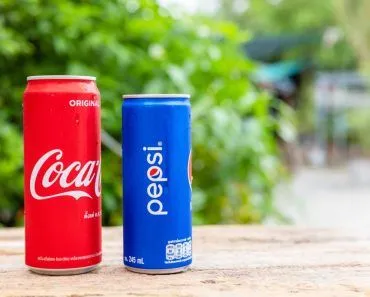
Some of the most popular beverages on the market today are fizzy soft drinks like colas (Coca-Cola, Pepsi etc) and other sodas of various flavors (Sprite, Fanta, Mountain Dew, etc.). These drinks are enjoyed by people around the world, and they seem like pretty straightforward concoctions. Water, sugar, carbon dioxide and the desired flavor appear to be the basic ingredients in these drinks. What’s fascinating, however, is that some of these drinks also happen to contain caffeine – a stimulant that most people associate with drinking their first cup of morning coffee.

Caffeine: A Natural Ingredient Of Cola Drinks
It’s worth noting that caffeine traditionally used to be a natural part of cola drinks, as soft drink manufacturers like Coca-Cola used the extract of the kola nut to prepare the drink, and caffeine is naturally present in the kola nut. Surprisingly, even extracts of the coca plant used to be included in Coca-Cola.
Neither of these natural sources are used anymore, so it makes sense that the fizzy colas would include caffeine to invoke the missing flavor of the kola nut. In fact, this is the very reason provided by soft drink manufacturers. In 1980, the US Food and Drug Administration proposed the elimination of caffeine from soft drinks. This proposal was met with a response from soft drink manufacturers that caffeine is included in the drinks to impart the requisite flavor.
Does Caffeine Add Flavor To Soft Drinks?
Here’s the catch: a few research studies have been conducted, one just before the turn of the century and the other a decade ago, which indicate that this claim of caffeine imparting flavor may actually be false. The study by Griffiths and Vernotica used beverages containing a range of caffeine concentrations in their research. They found that the test subjects detected the presence of caffeine more frequently as the caffeine concentration increased. Interestingly, only 2 subjects (8%) were able to detect caffeine when it was present in an amount that was normally found in caffeinated soft drinks. They concluded that this result did not support the claim that caffeine imparts flavor to soft drinks.

Let’s proceed to the more recent study by Keast and Riddell. In this situation, sweeteners were used as controls, so the caffeine concentration remained constant (at a similar amount to that found in cola soft drinks). The researchers found that their test subjects were able to distinguish between caffeinated and non-caffeinated sweeteners, but none of them were able to make the same distinction between caffeinated and non-caffeinated cola beverages. This led them to a similar conclusion as the previous study – that caffeine has no flavor activity in soft drinks.
So, if caffeine isn’t included in some of our favorite drinks for its flavor-enhancing properties, then why is it there?
Possible Explanations Of Why Caffeine Is Present In Soft Drinks
First off, let’s note that caffeine is a CNS (central nervous system) stimulant. We know that people drink coffee because of the “buzz” it gives them, allowing them to concentrate better on the task at hand. Therefore, it would be natural for people consuming caffeinated sodas to get a similar buzz, which would not only make them more attentive, but also improve their mood. Perhaps the combination of high sugar levels in fizzy soda, along with the small amount of caffeine they contain, could give drinkers the “pick me up” they desire.

Now, here are the caffeine contents of Coke, Pepsi and Mountain Dew: 34 mg, 38 mg and 54 mg, respectively. These are figures for a 350 ml (12 oz) can. There is scientific evidence showing that withdrawal symptoms can arise after staying away from a daily dose of only 100 mg of caffeine, which means that drinking 3 cans of Coke or Pepsi and 2 cans of Mountain Dew a day is enough to make you addicted.
Again, these are just some of the possible reasons why caffeine may be included in these fizzy drinks, as its flavor-enhancing properties don’t seem to be very effective. Well, at least coffee-lovers now know a few other ways to get their caffeine fix if a cup o’ coffee isn’t available!
How Much Caffeine Is In Coke, Mountain Dew And Other Sodas?
So how much caffeine are we actually talking about? Compared to a cup of brewed coffee, which packs roughly 95 mg, a can of soda is fairly modest. The exact amount varies from one brand to the next, and the citrus-flavored sodas often carry more than the colas do. Here is how the popular ones stack up, measured for a standard 12 oz (355 ml) can.

| Soft drink (12 oz / 355 ml) | Caffeine |
|---|---|
| Mountain Dew | 54 mg |
| Diet Coke | 46 mg |
| Dr Pepper | 42 mg |
| Pepsi | 38 mg |
| Coca-Cola Classic | 34 mg |
| Coca-Cola Zero Sugar | 34 mg |
| Barq’s Root Beer | 22 mg |
| Sprite, 7Up, Fanta, ginger ale | 0 mg |
A few things jump out. Mountain Dew sits at the top of the mainstream pack, which is exactly why so many people wonder why it carries more caffeine than the colas. Oddly, some diet versions contain more caffeine than their full-sugar siblings (Diet Coke has about 46 mg against regular Coke’s 34 mg). And every drink here stays comfortably under the legal ceiling: the US Food and Drug Administration limits added caffeine in cola-type sodas to 0.02% by weight, which works out to roughly 71 mg in a 12 oz serving.
Which Sodas Are Caffeine-Free?
For every caffeinated cola there is a soda with none at all. As a rule of thumb, most lemon-lime sodas, fruit-flavored sodas and ginger ales are caffeine-free, while colas and a few citrus sodas like Mountain Dew are not. The common caffeine-free choices include:
- Sprite, 7Up and Sierra Mist/Starry, and other lemon-lime sodas
- Fanta, in all of its fruit flavors
- Ginger ales such as Canada Dry and Schweppes
- Most root beers, including A&W and Mug (Barq’s is the famous exception, with about 22 mg)
- Club soda, tonic water and plain seltzer
- Caffeine-Free Coca-Cola, Caffeine-Free Diet Coke and Caffeine-Free Pepsi, which are just the standard recipes with the caffeine left out
So if you want the fizz without the stimulant, a clear lemon-lime soda or a ginger ale is your safest bet. Just keep in mind that caffeine-free does not mean sugar-free.
Where Does The Caffeine In Soda Come From Today?
We noted earlier that the kola nut and coca leaf no longer supply the caffeine in your cola, so where does it actually come from today? The answer is a little less exotic than a nut harvested in West Africa. Caffeine is now produced commercially in two main ways: it is either synthesized in a factory or recovered as a by-product of decaffeinated coffee.
Most of the caffeine added to sodas and energy drinks is the synthetic kind, built up through a series of chemical reactions (a large share of the world’s supply is manufactured in industrial plants in China). The molecule is chemically identical to the caffeine in a coffee bean; it is simply cheaper and more consistent to make it from scratch than to pull it out of plants. The second major source is the coffee industry itself. When beans are decaffeinated to make decaf, the caffeine stripped out of them is not thrown away. It is purified into crystalline caffeine and sold on to beverage and drug makers. In a neat twist, some of the buzz in your soda is the very buzz that was taken out of someone else’s cup of decaf.
References (click to expand)
- Energy Drinks – What You Don't Know. Villanova University
- Cao, G., Wang, Q., Huang, W., Tong, J., Ye, D., He, Y., … Yin, Z. (2017, June 20). Long-term consumption of caffeine-free high sucrose cola beverages aggravates the pathogenesis of EAE in mice. Cell Discovery. Springer Science and Business Media LLC.
- Coca-Cola Ingredients - Wikipedia
- Caffeine Chart. Center for Science in the Public Interest.
- Spilling the Beans: How Much Caffeine is Too Much? U.S. Food & Drug Administration.
- Caffeine: A Bean, A Leaf, Or A Lab? Chemical & Engineering News.
- Caffeine. IARC Monographs, NCBI Bookshelf.