Table of Contents (click to expand)
- Tensor Tympani Muscle
- Functions Of The Tensor Tympani Muscle
- What Happens When You Shut Your Eyes Too Tightly?
- Can You Make Your Ears Rumble On Purpose?
- Is It Harmful To Make Your Ears Rumble On Purpose?
- Why Do You Hear Thunder When You Plug Your Ears With Your Fingers?
- Clicks, Pops, and Whooshes: Other Sounds From Inside Your Ear
The loud rumbling sound (sometimes like thunder) that’s produced in the ear when you close your eyes too tightly is due to the contraction of a muscle called the tensor tympani muscle. It is a muscle located within the ear and it functions to dampen certain sounds.
Some of you may have observed that a rumbling sound is produced in the ear when you close your eyes tightly. It is a low-frequency sound that the person in question can only hear.
What is that sound? Where does it come from?
Tensor Tympani Muscle
The tensor tympani is a muscle in the ear located in the bony canal above the osseous portion of the auditory tube. It is attached to the upper part of the handle of the malleus and pulls the tympanic membrane inwards when it vibrates.
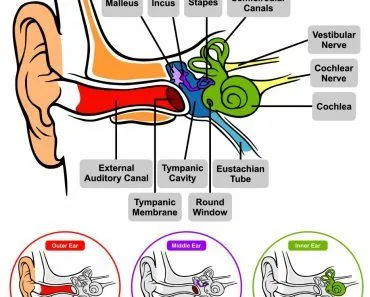
As you can see in the illustration above, the tensor tympani muscle arises from the superior surface of the cartilaginous part of the auditory tube and the adjacent part of the greater wing of the sphenoid and petrous part of the temporal bone (refer to the diagram below). It passes back through the canal and culminates in a slim tendon that enters the tympanic cavity.
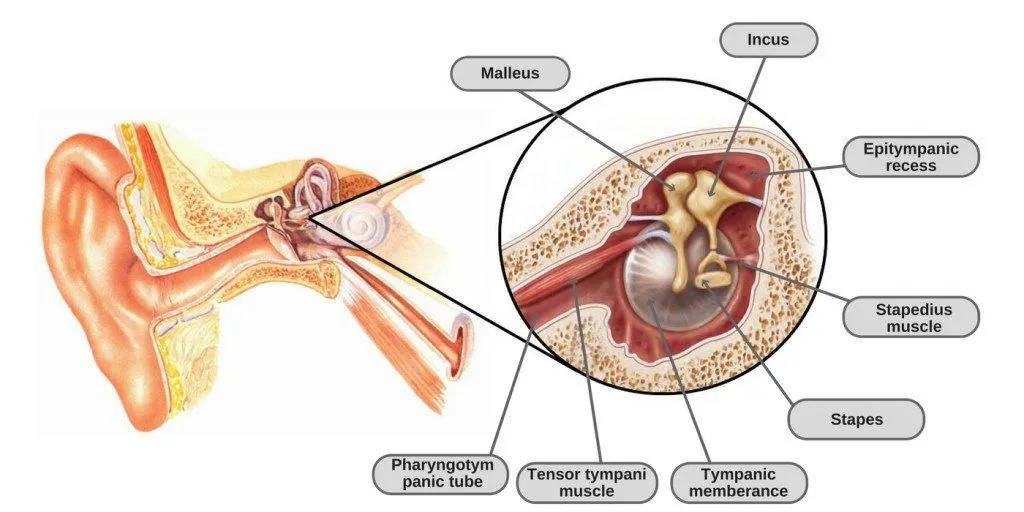
There are two muscles in the tympanic cavity, the tensor tympani, and the stapedius, the former being the larger.
Functions Of The Tensor Tympani Muscle
The tensor tympani muscle dampens certain sounds, such as those produced when chewing. The two muscles present in the tympanic cavity reflexively dampen ossicle movement to suppress forceful low-frequency sounds.
Imagine how irritating it would be to constantly hear the sounds produced inside your mouth while chewing.

Although you still hear those sounds, they’re greatly dampened by the tensor tympani muscle present inside your ears.
What Happens When You Shut Your Eyes Too Tightly?
Suppose you squint or shut your eyes too tightly, the tensor tympani muscle contracts and pulls the malleus inward through a tendon, tightening the eardrum. This reduces the vibrations transmitted through the ossicular chain to the inner ear, protecting it from loud sounds.
It is interesting to note that when muscles contract, vibrations, and low-frequency noises are produced. This is just like when you flex your arm, as you can actually see the muscles in motion/vibration.

Similarly, when you shut your eyes too tightly, the same thing happens inside your ear. Sustained muscle contractions produce low-frequency sounds, typically around 25 Hz. Slow-twitch muscles tend to produce sounds around 10 Hz, while fast-twitch muscles produce sounds around 20-30 Hz (Source). Note that the generally accepted audible range for humans is 20 to 20,000 Hertz, although this audible range may vary depending upon individuals and various environmental factors.
The sound of muscle contractions can be heard directly by flexing a muscle, such as a clenched fist pressed against the ear. Similarly, the sound of a contraction of the tensor tympani muscle can be heard by shutting one’s eyes tightly or enjoying a deep yawn (as jaw muscles are highly tensed when one yawns deeply).

However, not everyone can produce this rumbling sound on demand. For most people it's purely reflexive, triggered only by squinting hard, chewing, or a deep yawn. A smaller group can flip it on at will, the same way some people can wiggle their ears. We'll look at both groups next, along with the other clicks, pops, and flutters that show up inside the ear.
Can You Make Your Ears Rumble On Purpose?
Picture this: you're a kid, lying in bed, and you discover that if you tense something just behind your jaw, a deep rolling thunder fills your head. You sit up. Nobody else hears it. You try to explain it to a sibling and they look at you like you've lost it.
That's a club. It has members.
Some people can voluntarily contract the tensor tympani at will. They don't have to squint or yawn until their jaw cracks. They just do it, the way you might wiggle your ears or curl your tongue. Clinicians call this voluntary tensor tympani contraction, and it is well documented in the medical literature.
How real is the sensation? A 2016 study published in Auris Nasus Larynx put five voluntary "rumblers" in a soundproof booth, asked them to contract on cue, and measured their hearing with pure-tone audiometry. During each contraction, their hearing dropped sharply at low frequencies. At 250 Hz, the air-conduction threshold rose by 22 dB and the bone-conduction threshold by 10 dB. Smaller bumps showed up at 500 Hz, 1000 Hz, and 2000 Hz. The instant the subjects relaxed, their hearing snapped back to baseline (Source). So the rumble isn't imagined. The ear is genuinely behaving differently while it happens.
How common is the ability? Honestly, nobody has a good population number. The largest survey to date is a 2021 study from a team at the University of Bath, which framed the trick as a possible hands-free input method for wearables. Of 198 people who answered their online questionnaire, 43% reported being able to do it on command (Source). That sounds high, but a self-selected online survey about a quirky party trick is going to attract exactly the people who can do the party trick, so real-world prevalence is almost certainly lower.
Is there a technique to learn it? Not really. Voluntary "rumblers" describe it as just "thinking about" the muscle, the same way you can wiggle your ears if you happen to be one of the people who can wiggle your ears. There is no reliable training routine in the literature. The kindest description is that some people happen to have voluntary motor access to a muscle that, for most of us, is purely reflexive. Most rumblers report figuring it out by accident in childhood.
Is It Harmful To Make Your Ears Rumble On Purpose?
If you are one of the people who can summon the rumble at will, the obvious next question is whether you should be doing it. The short answer from the literature is reassuring: voluntary tensor tympani contraction is a benign quirk, not a sign that something is wrong with your ears.
The clearest illustration is a 2013 case report in the Journal of Laryngology & Otology. A 27-year-old man went to an ENT clinic worried about a cracking, tinnitus-like noise he could trigger in both ears at will. On examination, doctors could actually watch the handle of the malleus and the eardrum twitch inward each time he “made the sound,” confirming it was his tensor tympani contracting. He had no ear disease and needed no treatment; the noise was simply the audible signature of a muscle he happened to have conscious access to (Source). So flexing it for fun is not damaging your hearing. Each contraction briefly raises your low-frequency hearing threshold, but the moment you relax, hearing returns to baseline.
The version of tensor tympani activity that is worth taking seriously is the opposite of voluntary. In tensor tympani syndrome, the muscle sits in a state of chronic, low-level, involuntary activation, and the NCBI StatPearls entry notes this is often set off by loud-noise exposure or an underlying anxiety disorder that lowers the muscle's trigger threshold (Source). That can bring on ear fullness, muffled hearing, tinnitus, and tension headaches. The dividing line is control: a rumble you switch on and off is healthy machinery; a flutter that runs on its own and won't stop is the cue to see an ENT. There is no evidence that the occasional party-trick contraction nudges anyone toward the chronic condition.
Why Do You Hear Thunder When You Plug Your Ears With Your Fingers?
Here is a related trick that feels like the same thing but isn't: push your fingers firmly into your ears, then clench your jaw, hum, or even just walk, and a deep, hollow, thunder-like roar fills your head. Plenty of people assume this is the tensor tympani again. Mostly, it isn't. This one is the occlusion effect.

Your body is constantly generating faint low-frequency sounds, including your own voice, your heartbeat, your chewing, and the thud of your footsteps. These travel to the cochlea partly through the bones of your skull rather than through the air. Normally, the low-frequency portion of that bone-conducted energy leaks back out through your open ear canal and dissipates. Block the canal with a fingertip (or an earplug, or an earbud) and that energy has nowhere to go, so it builds up against the eardrum and gets re-routed inward to the inner ear.
The result is a dramatic boost to exactly the low pitches that make a sound feel like “thunder.” Researchers who measured this found the occlusion effect grows steadily as frequency drops, reaching roughly 40 dB for tones below 40 Hz, and as high as 50 dB in some people below 20 Hz (Source). A 40 dB jump is a hundredfold increase in sound pressure, which is why plugging your ears makes your own voice boom and turns a clenched jaw into rolling thunder. It is the same effect that makes your voice sound strange and heady through closed-back headphones, and the reason hearing-aid wearers complain that their own voice sounds like they are talking inside a barrel (Source). It is harmless, and it is a different mechanism from the tensor tympani rumble, even though both end in a low roar only you can hear.
Clicks, Pops, and Whooshes: Other Sounds From Inside Your Ear
The tensor tympani rumble is not the only odd noise your ear makes. If you scrunch your face, squeeze your eyes, yawn deeply, or blink hard, you might hear a click, a pop, a whoosh, or a flutter, and each of those usually comes from a different mechanism.
The yawn pop. The "pop" you feel when you yawn or swallow isn't your tensor tympani at all. It's the Eustachian tube briefly opening to equalize the air pressure between your middle ear and the back of your nose. The muscle doing the opening is the tensor veli palatini, which sits in the soft palate. When it contracts during swallowing or yawning, it pulls the Eustachian tube open and air rushes in or out (Source). Different muscle, different mechanism, but the names are easy to confuse because the two muscles are neighbors.
The stapedius reflex. The tensor tympani has a smaller cousin called the stapedius, attached to the stapes (the third tiny ossicle, right next to the inner ear). When the brain detects a loud sound, the stapedius contracts reflexively in about a tenth of a second, stiffening the ossicular chain and reducing how much sound energy reaches the cochlea. This is the acoustic reflex. You don't usually hear it directly. It's why a sudden very loud bang often feels muffled a moment after.
Middle ear myoclonus. If the clicking, fluttering, thumping, or buzzing in your ear is constant, rhythmic, and not under your control, that's a different story. Middle ear myoclonus (MEM) is an involuntary spasm of the tensor tympani, the stapedius, or both. Cleveland Clinic lists the typical descriptions patients give as "buzzing, clicking, crackling, fluttering, rumbling, or thumping," and notes that the sound is rhythmic but not synchronized with the heartbeat (which is what distinguishes it from pulsatile tinnitus) (Source). MEM is rare. If it is persistent enough to disrupt sleep, it is worth seeing an ENT.
Tensor tympani syndrome. Closely related is tensor tympani syndrome (TTS), where the tensor tympani is in a state of low-level chronic activation, often triggered by exposure to loud sounds or anxiety. The NCBI StatPearls entry on TTS lists ear fullness, muffled hearing, tinnitus, dysacusis (sounds feeling oddly loud or distorted), tension headaches, and Meniere-like vertigo as common presentations (Source). The clinical sign clinicians often describe is a clicking noise, while stapedius myoclonus tends to produce a buzzing.
The rule of thumb: if your ear sounds happen only when you squeeze your eyes or yawn hard, and stop the moment you relax, you are almost certainly hearing a healthy tensor tympani at work. If they are happening on their own, all day, that is the cue to get checked out.
References (click to expand)
- The Ear's Protective Mechanisms - Hyperphysics. Georgia State University
- Cochlea and Auditory Pathways. vanat.cvm.umn.edu
- Oster, G., & Jaffe, J. S. (1980, April). Low frequency sounds from sustained contraction of human skeletal muscle. Biophysical Journal. Elsevier BV.
- Audiometric findings with voluntary tensor tympani contraction. Auris Nasus Larynx (via PMC, National Library of Medicine).
- Smith, A., Ahuja, K., Goel, M., & Harrison, C. (2021). EarRumble: Discreet Hands- and Eyes-Free Input by Voluntary Tensor Tympani Muscle Contraction. ACM CHI 2021.
- Anatomy, Head and Neck, Tensor Veli Palatini Muscle. StatPearls. NCBI Bookshelf.
- Middle Ear Myoclonus: Symptoms, Causes & Treatment. Cleveland Clinic.
- Tensor Tympani Syndrome. StatPearls. NCBI Bookshelf.
- Angeli, R. D., Lise, M., Tabajara, C. C., & Maffacioli, T. B. (2013). Voluntary contraction of the tensor tympani muscle and its audiometric effects. The Journal of Laryngology & Otology.
- Stone, M. A., et al. (2014). A Technique for Estimating the Occlusion Effect for Frequencies Below 125 Hz. Ear & Hearing.
- Stenfelt, S., & Reinfeldt, S. (2007). A model of the occlusion effect with bone-conducted stimulation. International Journal of Audiology.