Table of Contents (click to expand)
- What Causes Thunder?
- Anatomy Of Thunder
- What Is A Thunderclap?
- How Does A Lightning Bolt Get That Hot, And How Do We Know?
- Why Does Thunder Rumble?
- How Lightning Affects The Sound Of Thunder
- How Loud Is Thunder?
- Does Lightning Itself Make A Sound?
- Can Thunder Be Used To Measure The Distance Of Lightning?
- Conclusion
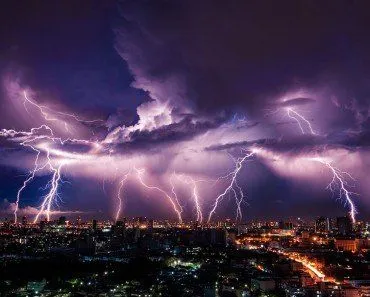
Thunder is the shock wave produced when a lightning bolt instantly superheats the air in its channel to about 30,000 °C (~54,000 °F), causing it to expand explosively. As that pressure wave travels outward, it weakens (attenuation), bounces off terrain, and overlaps with sound from different points along the zig-zag lightning channel — which is why a single bolt sounds like a sharp crack up close and a long, low rumble from far away.
Lightning and the rumbling sound of thunder have intrigued and enticed humans for centuries. Ancient Greeks believed that thunder was the weapon of Zeus, the Greek god of lightning. According to Scandinavian mythology, Thor was considered to be the god of thunder. In Hindu mythology, Indra is considered the god of heaven and thunder. From ancient times, clearly, thunder has been considered sacred and magical.
Today, with the advancement of science, we’ve figured out exactly what causes thunder and its distinctive layers of sounds.
Now, let’s go ahead and explore the science behind the frightening yet fascinating sound of thunder!

What Causes Thunder?
In simple words, thunder is the sound produced by lightning.
It all begins with a cloud made of water droplets and ice crystals. During a thunderstorm, these ice crystals move around and collide against each other. In the process, they transfer their electrons between one another, resulting in the formation of positively and negatively charged particles.
The storm and wind cause the lighter positive ions to move up and the heavier negative ions to settle down. Thus, the charge in the cloud becomes separated. As these charges build up, the clouds wait for a chance to somehow discharge and neutralize themselves.
Subsequently, when the clouds soar over positively charged ground, the negative charges of the cloud and the positive charges of the ground try to make a connection. When that happens, a sudden drift of electrons occurs through a tiny air channel and BOOM—we witness a flash of lightning!
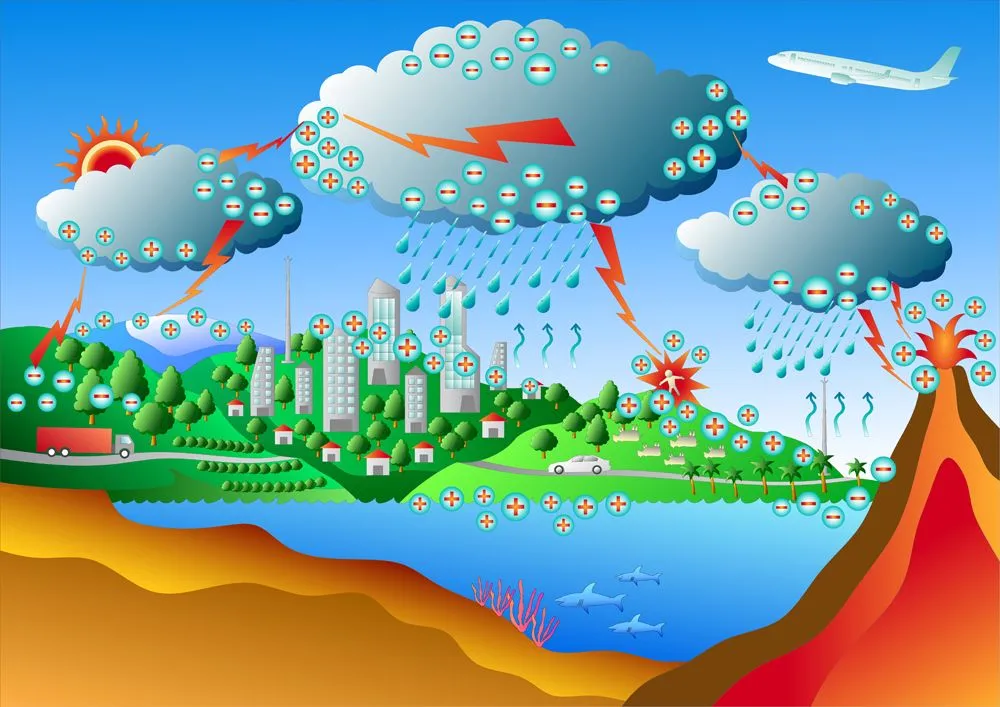
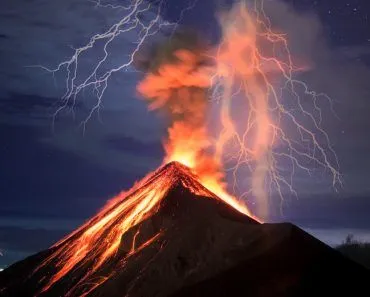
Lightning can happen within a cloud, between two clouds, or between a cloud and the ground. A lightning strike produces an enormous amount of energy in the form of heat and light. This heat is what causes the shocking sound of thunder.
Anatomy Of Thunder
The immense heat released by the lightning superheats the air around it. As a result, the air molecules vibrate vigorously and expand suddenly, sending a shock wave through the air. This abrupt movement of air is perceived by our ear as the crackling sound of thunder.
But that’s not all… if you’ve ever heard thunder, you know that we can’t define it as a distinct sound with a beginning and an end. The resonating sound of thunder is a mixture of different frequencies, making it an unpredictable yet distinguishable melody of nature.
It commences with a loud crack of sound called a thunderclap, which is followed by dampened crackles called thunder booms. These finally die out as a low rumble or a feeble roll.
What Is A Thunderclap?
As discussed earlier, lightning produces an immense amount of heat. In fact, a lightning strike can heat the surrounding air channel to a temperature of about 20,000-30,000 °C (36,000-54,000 °F) — roughly five times hotter than the surface of the Sun. As we all know, when air heats up, it expands.
However, when air heats up to nearly 30,000 °C within a fraction of a second, the expansion is essentially an explosion. In fact, it is called explosive expansion and it creates shock waves similar to sonic booms in the atmosphere.
Similarly, when the lightning ceases, the hot air cools down at a rapid rate. This causes a sudden compression of the expanded air, resulting in an implosion. These shock waves created by the abrupt expansion and compression of air is what you hear as the deafening bang called a thunderclap.
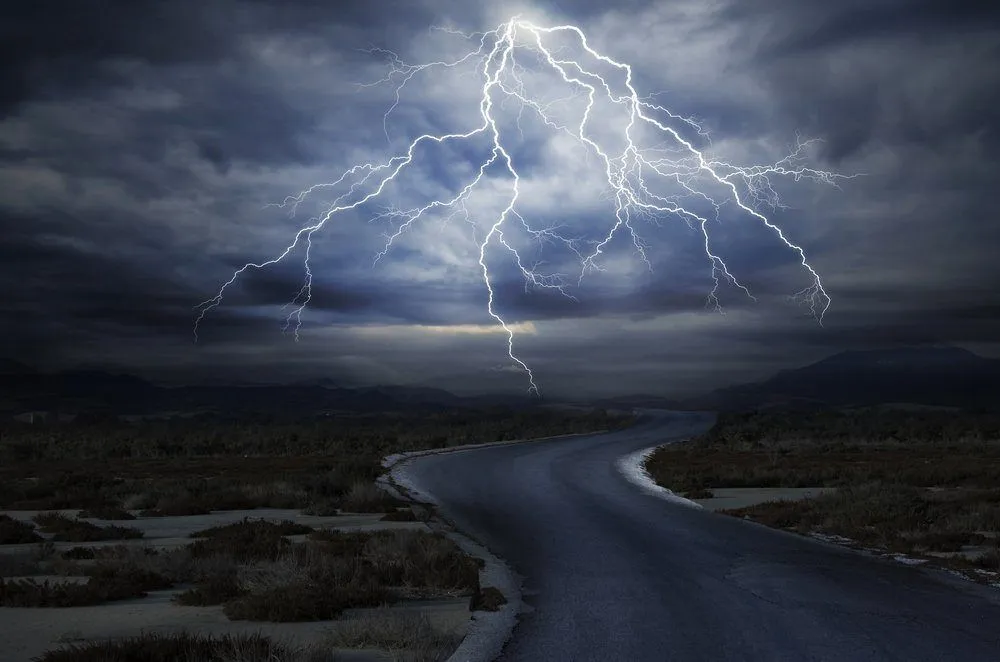
On average, a peal of thunder can be heard up to about 16 km (10 miles) from the source of lightning. The closer you are to the lightning, the better your chances are of hearing a thunderclap (and the better your chances of being struck by lightning!)
However, as the distance increases, the clap becomes more muffled, so instead of a sharp crack, you may hear a resonating boom. This sound is called a thunder boom.
How Does A Lightning Bolt Get That Hot, And How Do We Know?
It is worth pausing on that number, because "hotter than the surface of the Sun" sounds like it should belong to something the size of a star, not to a flicker of light thinner than your thumb. So where does all that heat actually come from?
The answer is the same reason the coils inside a toaster glow orange. Air is normally a stubborn insulator, but the instant lightning tears a path through it, that narrow channel briefly carries a staggering electric current, often in the neighborhood of 30,000 amperes, squeezed through a tube only a few centimeters wide. Force that much electricity through something so thin and so unwilling to conduct, and the energy has nowhere to go but into heat. Physicists call this resistive (or "ohmic") heating, and most of the time it warms things politely, the way it does in that toaster. Dump it into a pencil-thin channel all at once, in a few millionths of a second, and "politely" becomes a bolt of plasma hotter than the face of the Sun. The heat is genuinely that fierce; there is just astonishingly little of it, crammed into a sliver of air that cools back down almost as fast as it flared.
Which raises a fair question. If a lightning channel lasts only a few millionths of a second and would instantly vaporize any thermometer brave enough to face it, how could anyone possibly know it reaches 30,000 °C? The trick is that we never measure the heat at all. We read the light.
When a gas gets hot enough, its atoms glow at very specific colors, a fingerprint unique to each element (the same trick that lets astronomers identify the atoms inside a distant star). In 1968, physicist Richard Orville split the light of real lightning bolts through a spectrograph and studied the glow of its electrically charged nitrogen. By comparing the brightness of two particular nitrogen lines, he could read the temperature straight off the flash, the way a blacksmith judges hot iron by its color, only far more precisely. His bolts came out between roughly 18,000 and 36,000 K, peaking close to 30,000 K, which is where that famous figure comes from.
There is one honest wrinkle worth adding. A lightning channel is not all one temperature. A 2021 study by Boggs and colleagues found that the bottom of the channel runs markedly hotter than the top, with the temperature falling by as much as 12,000 K over a single kilometer of its length. So "30,000 °C" is really the peak of the hottest slice at the hottest instant, not a fixed property that lightning carries around with it. For a few millionths of a second, in one thin ribbon of air, the sky briefly out-blazes the surface of the very star that lights our days. If you are curious how that stacks up against everything else, from molten lava to exploding stars, take our tour of the hottest and coldest things in the universe.
Why Does Thunder Rumble?
When you hear the word thunder, the first thing that may come to your mind is a soothing and rumbling sound in the sky.
As the thunderclap propagates through the atmosphere, it can get absorbed, reflected, overlapped, weakened, or muffled depending on the distance and the environment. All these factors transform the thunderclap into a low rumble.
How Lightning Affects The Sound Of Thunder
The zig-zag shape of lightning is one of the reasons behind the rumble. Since sound from different parts of the lightning reach our ears at different times, instead of a sharp crack, we hear more of a continuous sound.
Moreover, a lightning strike is composed of multiple thunderclaps. One study found that, on average, a lightning flash is composed of 3-7 claps occurring within 1-3 seconds. In such cases, the sound from multiple claps can overlap and produce a burst of cracks and rumbles.
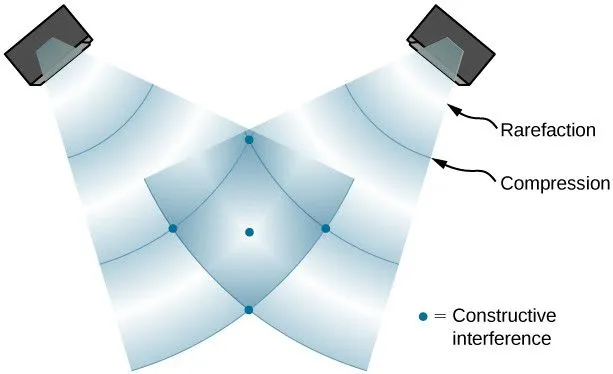
In addition to these factors, the sound of thunder also depends on the power and strength of the lightning and the channel of air through which it flows.
Attenuation Of Thunder
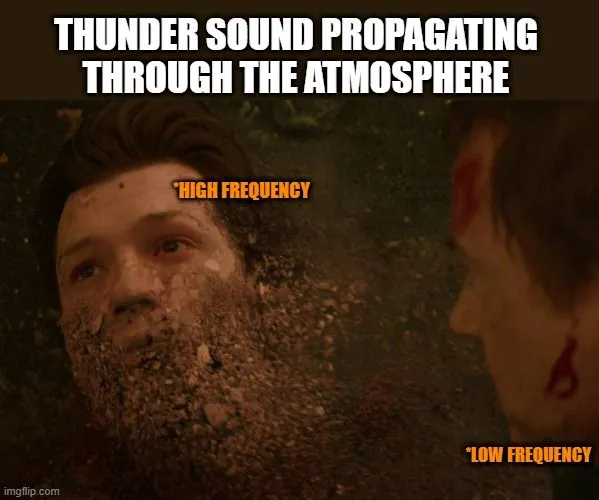
Attenuation is another factor resulting in the low-pitched rumble. A thunderclap consists of a mixture of frequencies from high to low. However, factors like absorption by air and distance propagated will weaken these waves.
Higher frequencies are affected the most by this attenuation. As they propagate, the higher frequencies get stretched out and dissipated. Conversely, the lower frequencies are relatively unaffected. Below a frequency of 100Hz, the attenuation is almost insignificant. Thus, as the sound travels over a large distance, all that falls on our ears are the lower range of frequencies, which is why the rumbles are so low in pitch.
Several factors including temperature, wind strength, turbulence, local topography, and molecular interactions also affect the sound of thunder. For instance, if there are many trees or mountains in the terrain, the sound bounces off and echoes, leading to a more resonant rumble. This is why thunder is so unpredictable. It depends greatly on the state of the environment.
Gradually, even the thunder rumble gets fainter until all you hear is a distant feeble rolling sound. This is called the thunder roll. Due to the effect of attenuation, beyond a distance of about 25 km (15 miles) from the source, the sound of thunder is rarely heard.
Thus, thunder starts out as a majestic bang and dies out as a faint shuffling murmur.
How Loud Is Thunder?
If a nearby thunderclap has ever made you jump out of your skin, that reaction is completely justified. Thunder is genuinely one of the loudest sounds in all of nature. Right next to the lightning channel, the sound pressure level of thunder is usually around 165 to 180 decibels, and in rare cases it can climb past 200 decibels. Because the decibel scale is logarithmic, every extra 10 decibels means ten times more sound intensity, so those figures place thunder among the most powerful sounds produced anywhere on Earth.
The reason thunder can sound like a bomb going off is that it essentially is a small explosion. As we saw earlier, the air around a lightning bolt is heated so violently that it expands faster than the speed of sound, launching a shock wave (much like a sonic boom) in every direction. That shock wave is what slams into your eardrums as a sharp, percussive bang rather than a gentle musical tone.
All of that raw energy makes thunder more than just startling. If you are standing very close to a strike, the sound alone can be intense enough to cause ear pain, temporary deafness, or even rupture an eardrum. Thankfully, thunder loses energy quickly as it spreads outward, so by the time the sound reaches you a few kilometres away, it has softened into the familiar boom and rumble instead of a damaging blast.
And if you have ever wondered what kind of energy thunder actually is, here is the full chain: lightning converts electrical energy into heat, and that sudden heating is unleashed as sound. So the rumble you hear is acoustic energy, a form of mechanical energy that travels to you as waves of pressure rippling through the air.
Does Lightning Itself Make A Sound?
This is one of the most common questions about storms, and the answer is beautifully simple: yes it does, and the sound of lightning is thunder. There is no separate, silent lightning that later produces a noise somewhere else. The flash and the bang are two halves of the very same event, one reaching your eyes as light and the other reaching your ears as sound. Every single lightning flash generates thunder, whether or not you happen to hear it.

So why do we sometimes see lightning without hearing a thing? If a flash is far enough away, its thunder simply fades out before it can travel all the way to you. Lightning more than about 16 km (10 miles) away is often seen as a distant flicker with no accompanying sound, which is exactly what people mean when they talk about “heat lightning.” Despite the name, it has nothing to do with heat; it is ordinary lightning whose thunder never reaches your ears.
Up close, lightning reveals that it has more than one voice. When a strike is very near, the sound is often described first as a faint click or tearing-cloth noise, followed almost instantly by a cannon-like crack or snap, and only then by the long, low rumble. That sharp crack or click is a telltale sign that the lightning channel passed close by. It happens because the sound from the nearest part of the bolt reaches you first, while the sound from more distant sections of the same jagged channel arrives a little later, smeared out into a rolling rumble.
Can Thunder Be Used To Measure The Distance Of Lightning?
We all know that light travels faster than sound. This is why you hear the sound of thunder a short while after you see lightning. Light travels at around 299,792,458 meters per second, which means that you see the lightning (almost) instantly as it occurs. Sound, however, travels about 343 m/s in air, taking roughly 3 seconds to cover 1 km (or 5 seconds per mile), which is why you hear the thunder much later. Let’s see how this helps us calculate the distance of lightning.
The moment you see a flash of lightning, start counting the seconds until you hear the thunder. Since sound takes roughly 3 seconds to cover one kilometer (or 5 seconds per mile), dividing the total seconds by 3 gives you the distance in kilometers (or by 5 for miles).
3 seconds → 1 km, 6 seconds → 2 km, 9 seconds → 3 km and so on.
For example, if you hear the thunder 6 seconds after you see the lightning, the total distance traveled by the sound is 6/3 = 2, which means the lightning struck about 2 km (1.2 miles) away from you. It also means that it’s time for you to take shelter and stay safe. As the saying goes, “When the Thunder Roars, Go Indoors!”
Conclusion
So far, we have discussed the patterns of thunder created by a single lightning strike, but in the event of a massive thunderstorm, these phenomena happen on a much larger scale.
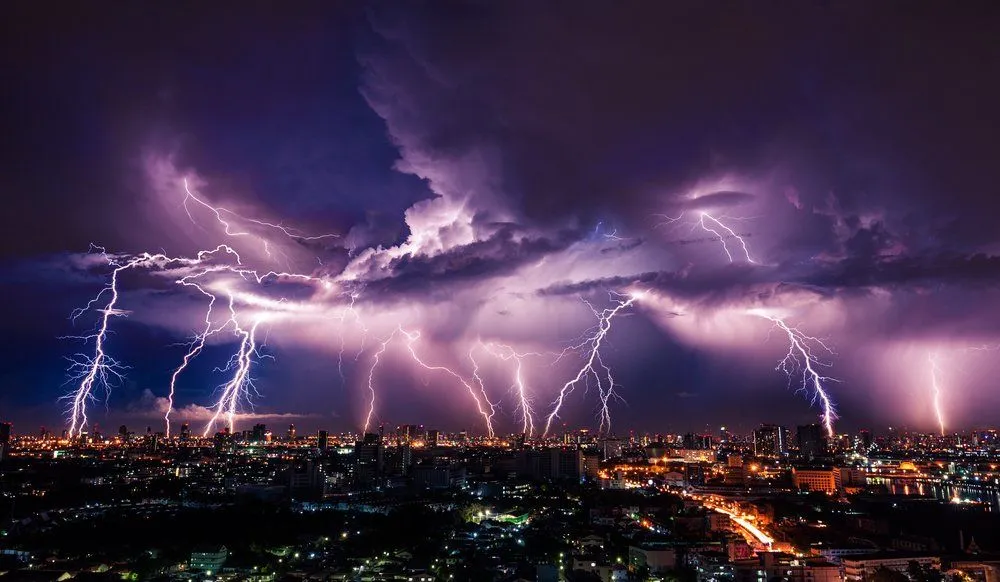
During a thunderstorm, a large number of clouds get discharged, which produces a large number of lightning bolts, sending out numerous bursts of thunder. All of these waves interact with each other, creating a captivating symphony of claps, cracks, booms, and rolls for your aural entertainment!
References (click to expand)
- (2022) Audible thunder characteristic and the relation between peak .... The Indian Academy of Sciences, Bangalore
- Ndihokubwayo, K., & Nkundabakura, P. (2019, April 16). Lightning Myths versus Science Facts: Traditional Beliefs on Thunderstorm among Rwandans. AFRREV IJAH: An International Journal of Arts and Humanities. African Journals Online (AJOL).
- characteristics of thunder and relationships to lightning .... The New Mexico Institute of Mining and Technology
- NWS JetStream - The Sound of Thunder. The National Weather Service
- Severe Weather 101: Thunderstorm Basics (NOAA National Severe Storms Laboratory)
- Thunder (Encyclopaedia Britannica)
- Understanding Lightning: Thunder. National Weather Service (NOAA)
- Heat Lightning. National Weather Service (NOAA)
- Thunder. Wikipedia
- Orville, R. E. (1968). A High-Speed Time-Resolved Spectroscopic Study of the Lightning Return Stroke: Part II. Journal of the Atmospheric Sciences.
- Boggs, L. D., et al. (2021). Vertical Temperature Profile of Natural Lightning Return Strokes Derived From Optical Spectra. Journal of Geophysical Research: Atmospheres.