Humans sleep less than any other primate, around 7 hours a night versus 9.5 for chimpanzees and up to 17 for night monkeys. Researchers explain this with two ideas: the social sleep hypothesis (we sleep safely on the ground in groups) and the sleep intensity hypothesis (we sleep more deeply and spend more time in REM sleep than our primate cousins).
As a general recommendation for optimal health, adults need about 8 hours of sleep every night. Add that up over the course of your life and it amounts to one-third of your life that you spend asleep.
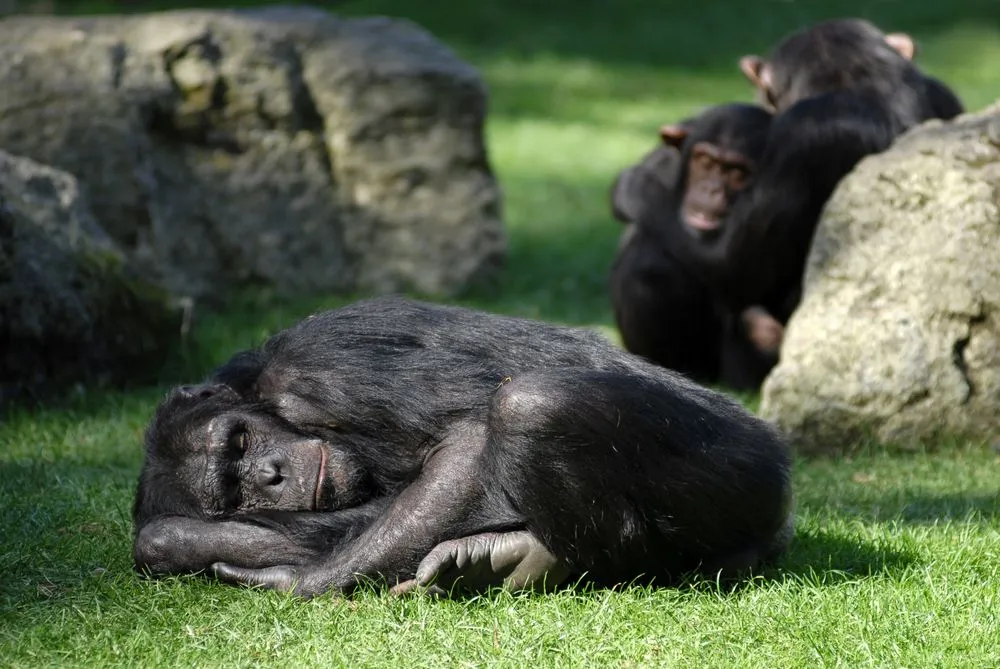
If spending one-third of your life sleeping sounds like a bit too much, consider that many of our primate relatives sleep for around 9 (our closest relative, the chimpanzee) to 17 (three-striped night monkey) hours each day. In fact, we sleep the least among our primate cousins.
There’s an irony here, of course. We work and toil and slog away at our tiresome jobs, and then spend the night binging on Netflix, while our primate cousins with none of these industrial burdens snooze peacefully for 2 to 10 more hours than we do every day!
Keeping in mind that we depend on sleep for vital physiological and neurological functions, isn’t it ironic that humans sleep the least of any primates?
Why Do We Sleep Less Than Primates?
Researchers think that human sleep patterns changed when we moved from sleeping in trees to sleeping on the ground. Our ancestral primates were likely arboreal, and would sleep in tree holes to avoid predators. Over time, primates got larger and reached a point where sleeping in a hole in a tree was no longer a viable option.
The transition from tree to ground was a risky move for early primates. Sleeping on the ground is dangerous. Humans are the only primates that are ground sleepers (with the exception of male chimpanzees and gorillas, where the threat of predation is low).
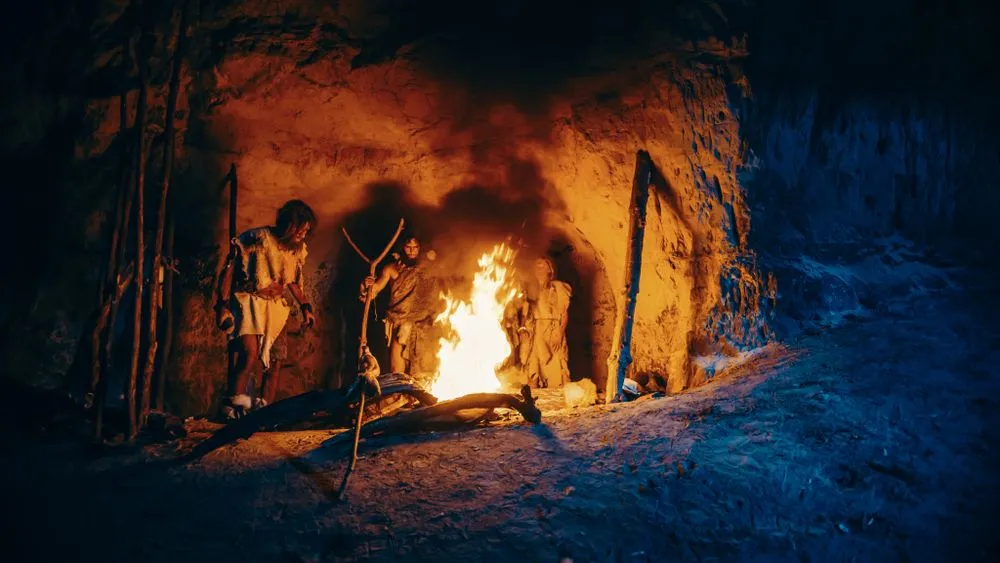
To explain how humans overcame these risks, researchers proposed a “social sleep hypothesis“. This idea suggests that early humans formed a socio-technological group that enabled them to have both short and high-quality sleep. The use of fire and sheltered dwellings further secured the sleeping conditions for more restful slumber!
Another reason why humans sleep less than other primates has to do with the type of sleep we get. We spend more time in REM sleep than other primates. Humans spend around 20-25% of their sleep time in REM sleep, while primates like mouse lemurs and African green monkeys barely spend 5% of their sleep time in the REM cycle. The more time an animal spends in REM sleep, the more quickly they complete their needed sleep quota.
In 2015, Samson and Nunn came up with the “sleep intensity hypothesis”. It states that the evolutionary shifts in the human sleep environment (i.e., from tree to ground) have allowed sleep quality to improve by allowing for deeper sleep. They credit this change in sleep behavior to the overall pattern of efficient sleep in humans. The high sleep quality and increased net activity time could be why we have such a cognitive and behavioral advantage.
As we socialized in our groups, often late into the night, we sacrificed sleep. These social activities became so important for our reproductive success that natural selection favored the expansion of these activities into the night, in lieu of extra hours of slumber.
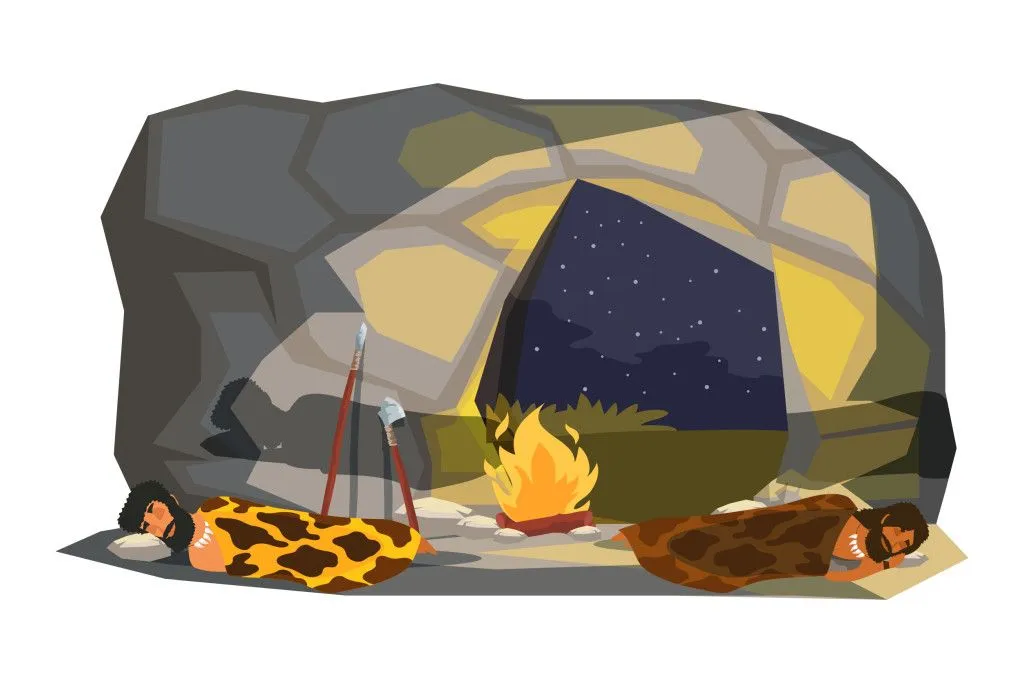
On the basis of the social sleep hypothesis, the researchers predict that the temperature, the size of the group, and the elements of protection were the original drivers of short but high-quality and flexible sleep in humans.
Do We Sleep Less Because Of Industrialization And Electricity?
Others argue that before the discovery of electricity, humans slept longer, as their sleep cycle was synchronized with the sunlight. The setting sun was indicative of an approaching bedtime. As industrialization struck humanity and light bulbs made it possible to stay active even during the darkness of night, humans started spending less time asleep. However, recent studies argue otherwise.
A team of researchers studied the sleeping patterns of three pre-industrialized societies from Tanzania, Namibia and Bolivia. To their surprise, they found that these groups slept for an average of 6.4 hours, which is nearly identical to the sleep duration of the industrialized population. Another study conducted on the Haitian community reveals that they also sleep for an average of 7 hours.
This shows that the discovery of electricity and the technological inventions that followed had very little effect on our general sleep duration. Instead, nature found less sleep to be more favorable for the human race!
How Do Chimpanzees And Other Apes Sleep?
If we sleep on the ground, where do our relatives sleep? Almost every night of their lives, great apes do something we never bother with: they build a brand-new bed. Chimpanzees, bonobos, gorillas and orangutans all weave themselves a fresh sleeping platform, usually called a nest, and then abandon it by morning. A sleeping ape is not just slumped on a bare branch. It is lying in a structure it engineered at dusk.

Chimpanzees are surprisingly picky about their mattress. At the Toro-Semliki Wildlife Reserve in Uganda, a team led by anthropologist David Samson examined 1,844 chimp nests and found that 73.6% were built in the Ugandan ironwood tree, even though that species made up less than 10% of the available trees. Ironwood was the stiffest and strongest wood they tested, with a branching pattern that locks together into a stable, firm but slightly springy bed. The chimps were, in effect, choosing the best memory-foam tree in the forest. They spend roughly eight to nine hours a night up on these platforms.
Orangutans take the engineering even further. Working between about 11 and 20 meters (36 to 66 feet) up, a Bornean orangutan first bends thick, rigid branches halfway through, a "greenstick" fracture that leaves them attached but folded, to make a load-bearing rim. It then layers thinner, weaker branches on top as a soft mattress, and may add a leafy "pillow", a "blanket" of foliage, or even a roof. Gorillas, by contrast, build their nests either on the ground or in trees, raking branches, leaves and other plant material into a simple bed of foliage. In every case the bed is single-use: with the exception of young infants, each gorilla builds its own fresh nest and rarely sleeps in the same one twice. Compared with all this nightly carpentry, our own habit of falling asleep on a couch mid-Netflix starts to look almost lazy.
How Long Do Different Primates Sleep?
So humans sleep about 7 hours, and chimps about 9.5, but the full primate range is much wider than that. When anthropologists David Samson and Charlie Nunn, then at Duke University, compiled sleep data across 21 primate species for a 2015 study in Evolutionary Anthropology, the numbers stretched from our short nights all the way up to species that are barely awake at all.

Here is roughly how the day's sleep stacks up across primates, from least to most:
- Humans: about 7 hours, the shortest of any ape, monkey or lemur studied.
- Chimpanzees: around 9.5 hours, our closest living relatives.
- Cotton-top tamarins: roughly 13 hours.
- Gray mouse lemurs and pig-tailed macaques: as much as 14 to 17 hours.
- Three-striped night monkeys: around 17 hours, the sleepiest primate on the list.
Here is the part that really makes us the odd ones out. Based on body size, diet, and other traits, Samson and Nunn's model predicted that a primate like us should sleep roughly 9.5 hours a night, not 7. We are sleeping about two and a half hours less than our biology "orders". We make up the deficit with quality: humans spend nearly 25% of the night in REM sleep (the deep, dream-rich stage), whereas mouse lemurs, mongoose lemurs and African green monkeys barely climb above 5%. In other words, we do not just sleep less than our cousins. We sleep less than we arguably should, and get away with it because each hour we do sleep is unusually concentrated and restorative.
References (click to expand)
- Nunn, C. L., & Samson, D. R. (2018). Sleep in a comparative context: investigating how human sleep differs from sleep in other primates. American Journal of Physical Anthropology, 166(3), 601-612.
- Why Humans Sleep Less Than Their Primate Relatives. Smithsonian
- Samson, D. R. (2021, October 21). The Human Sleep Paradox: The Unexpected Sleeping Habits of Homo sapiens. Annual Review of Anthropology. Annual Reviews.
- Capellini, I., Barton, R. A., McNamara, P., Preston, B. T., & Nunn, C. L. (2008, July). Phylogenetic Analysis Of The Ecology And Evolution Of Mammalian Sleep. Evolution. Wiley.
- Samson, D. R., & Hunt, K. D. (2014). Chimpanzees Preferentially Select Sleeping Platform Construction Tree Species with Biomechanical Properties that Yield Stable, Firm, but Compliant Nests. PLOS ONE.
- van Casteren, A., et al. (2012). Nest-building orangutans demonstrate engineering know-how to produce safe, comfortable beds. PNAS. NCBI PMC.
- Humans Evolved for Better Sleep In Less Time. Duke Today.
- #GorillaStory: Nest Building. Smithsonian's National Zoo and Conservation Biology Institute.