Table of Contents (click to expand)
The Feynman Technique is a four-step method for learning anything new, named after physicist Richard Feynman. First, pick a topic and study it thoroughly. Second, explain it as if teaching a beginner, in the simplest terms. Third, review your notes to find and fill the gaps. Fourth, refine and simplify using plain language and analogies.
Richard Feynman is one of the most influential and celebrated physicists not only of the past century, but of all time. A late talker, Feynman subsequently exhibited an animated and mischievous behavior. A website dedicated to Feynman introduces him as “scientist, teacher, raconteur and drummer.” His antics brought him the status of a celebrity.
This is something that people might not associate with someone who reportedly aced the math and physics sections of Princeton University’s graduate entrance exam, a near-unheard-of feat (though he fared far less brilliantly on the history and English sections). Feynman was also dubbed “The Smartest Man In The World” by Omni Magazine in 1979 (although this came as a surprise to his mother, who in dismay, comically responded: “Our Ritchie? The world’s smartest man? God help us!“).
However, despite being an indisputable genius and accomplishing innumerable academic accolades, Feynman’s passion for learning new concepts never dwindled.

Furthermore, these concepts did not necessarily lie in the field of physics; his curiosity led him to explore other apparently unrelated fields, such as charcoal art and playing the bongo. His incentive to satiate his insatiable curiosity and expand his repertoire of knowledge and skills was driven by, as he would exuberantly exclaim, “the pleasure of finding things out.”
He cheerfully fostered the Scientific Method and desired to disperse his admiration for science to his students. A revered scientific communicator, much like Carl Sagan, Feynman loved to and, it is fair to say, was obligated to make complex concepts, such as his work on quantum electrodynamics (the field for which he shared the 1965 Nobel Prize in Physics with Julian Schwinger and Shin’ichirō Tomonaga), as simple as possible for the general public, something that we aspire to do at ScienceABC. His metaphorical approach to simplifying and explaining dense concepts awarded him the title of “The Great Explainer.”
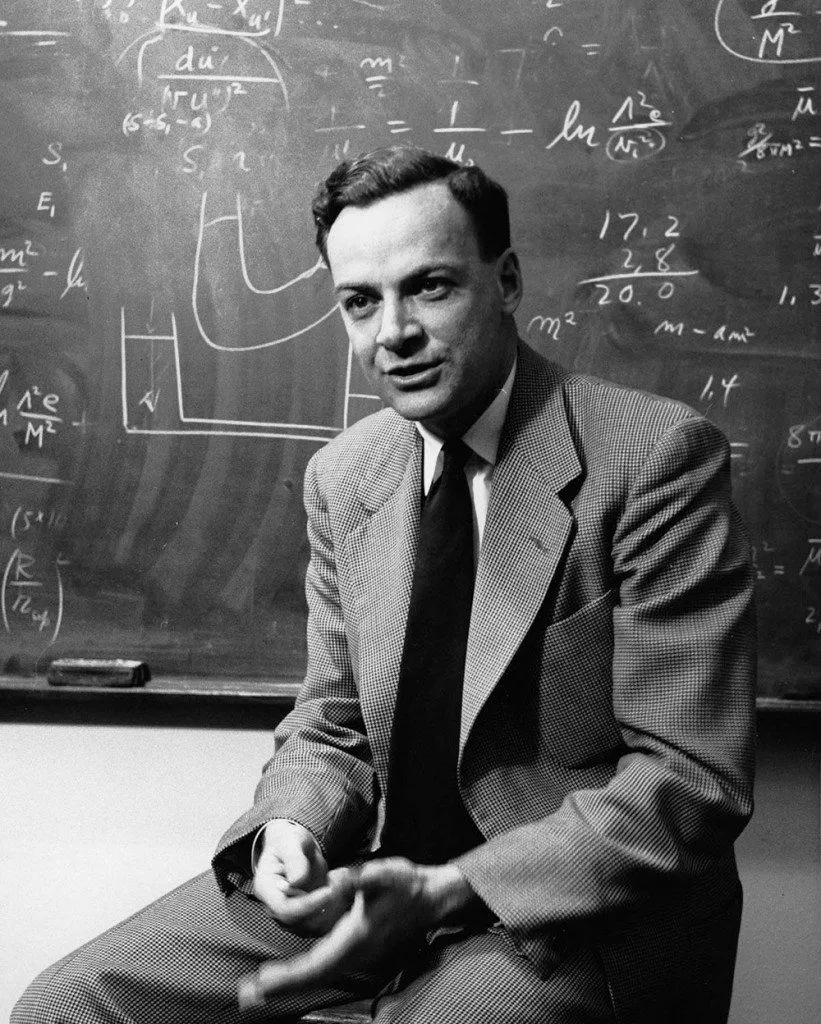
Feynman’s approach to learning anything is often summarized by four succinct steps, collectively called the Feynman Technique. To be clear, Feynman never wrote down these steps himself; the four-step formulation was distilled from his habits and popularized decades later by writers such as Scott H. Young, who named it in his honor. The technique, essentially a mental model, doesn’t just help with learning but also aids in retaining what you have already learned.
Step One: Pick A Topic And Study It Thoroughly
Pick the concept you wish to learn and write down everything you know about it on a piece of paper. This will require you to study it thoroughly, which is, of course, a prerequisite for learning.

Try to jot down every speck of information you can recall or you have learned. Continue adding more information as you progressively learn more and more about it.
Step Two: Pretend To Teach
The next step is to pretend to teach what you have learned to a hypothetical student. This is a challenging test as being a teacher, you are obligated to teach effectively, in the simplest terms.
Feynman strode to de-escalate the complexity of a concept in terms of academic levels. Therefore, a concept could be reduced from the level of a doctorate degree holder to that of a freshman, and the lower the grade, the easier it would be to comprehend. Not only did this make learning physics less mentally taxing, but it also illustrated the explainer’s acute grasp of the subject.
For Feynman, this was a matter of pride. This is why failure to simplify or explain a concept led Feynman to doubt his own abilities and made him glum. When physicist David Goodstein asked him to explain why spin-½ particles obey Fermi-Dirac statistics, Feynman promised him that he’d prepare a freshman lecture on it. However, a few days later, Feynman returned, upset, for he couldn’t reduce it to freshman level. Dejected, he went on to conclude, “that means we don’t really understand it.”
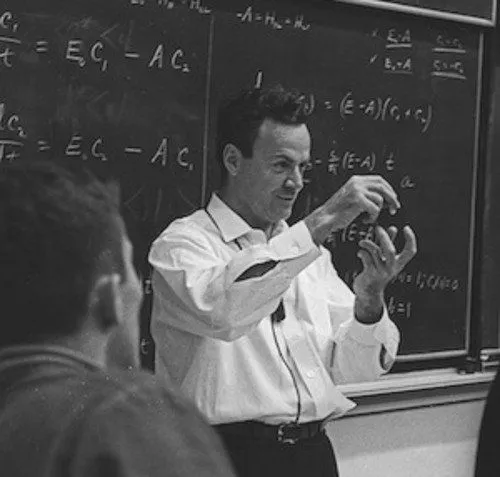
This line of thought is captured by a saying so often pinned on Einstein that it has become folklore: “If you can’t explain it simply, you don’t understand it well enough.” (For the record, there’s no firm evidence Einstein ever said it, but the sentiment is pure Feynman.) A parallel can be drawn to the last-minute college favorite: Explain-it-to-me-like-a-five-year-old.
Step Three: Review And Revise
There is nothing to worry about if you get stuck, especially when you have just started to learn. Rectification is part of the process. In the case of a mental roadblock, refer to your notes again. Identify your weaknesses, revise and review the concepts periodically to fill these holes in your knowledge and strengthen your understanding. Following the revision, repeat step two. Again, don’t forget to simplify.
Step Four: Use Analogies
Make sure that your language is not esoteric. Excessive scientific jargon does sound cool, but it demotivates and confuses beginners. Instead, use the gift of language to simplify dense concepts. Analogies are a great way to explain ideas; Plato often used them to relay his thoughts to his disciples.

This is because our mental faculty is predisposed to comprehend abstractions with symbolism; this is why languages are so successful. This sort of creativity, a propensity to discover hidden connections between polar ideas, has been shown to be immensely beneficial for learning and is often witnessed to be a hallmark of geniuses.
For instance, the equations of Einstein’s Theory of General Relativity essentially illustrate that mass deforms the fabric of space and time, forcing, say, the moon to be “pulled” towards the earth because the space beneath it is curved itself. This is also true for the revolution of Jupiter around the sun.
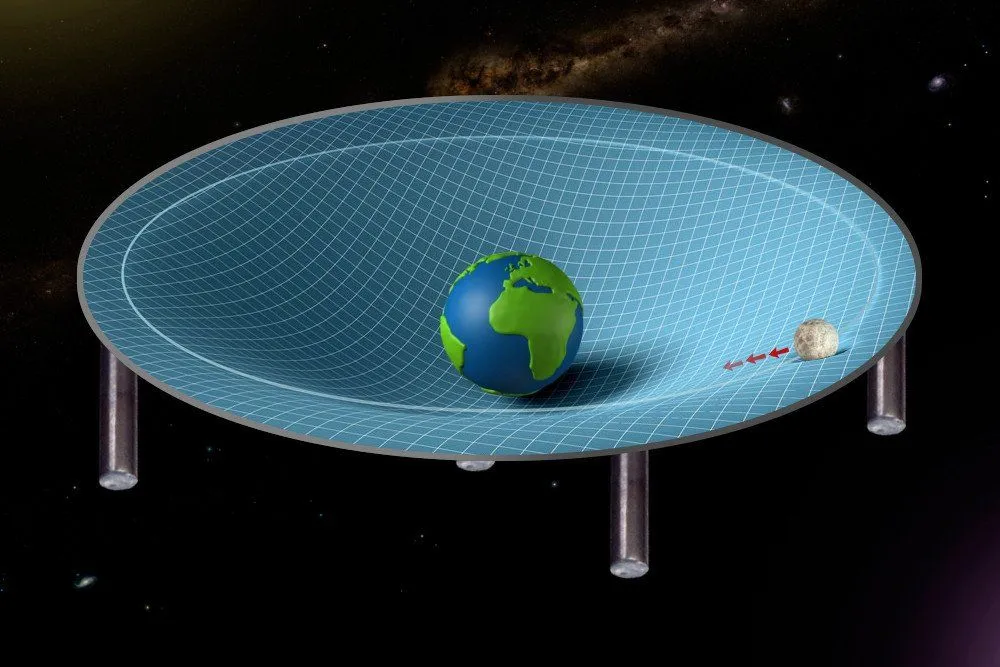
How do we explain this incomprehensible movement of gargantuan objects, and moreover, the preposterous claim of the deformation of space itself in the simplest terms? One analogy is that of a trampoline. When you place a bowling ball at its center, the trampoline bends, such that now a marble rolled onto the trampoline will be attracted towards the bowling ball.
And that’s it! Together, these four steps represent a powerful and effective technique to swiftly learn any novel concept or encourage your retention of previously learned concepts.