Table of Contents (click to expand)
The four fours puzzle is a math challenge to write every whole number, ideally from 0 toward infinity, using exactly four 4s and standard operations such as addition, multiplication, factorials, square roots, decimal points and concatenation (as in 44). With logarithms added, a single general formula can express any whole number.
Do you like challenges? Do you often pride yourself on your mathematical brilliance? Do you always act indignant or chagrined, but secretly love the accusations of being a nerd? If yes, then this challenge is for you.
The four fours problem appeared in the 6th edition (1914) of Mathematical Recreations and Essays, written by W.W. Rouse Ball, who nonchalantly described it as a “traditional recreation”. The whimsical puzzle is older than that, though: its first known appearance in print was in Knowledge: An Illustrated Magazine of Science back in 1881, and it was a popular intellectual diversion through the 1880s and 1890s. It gradually grew less well known, until Rouse Ball folded it into his essays and revived interest in it.
The puzzle slowly grew into an intellectual pastime. Even Paul Dirac, the Nobel Prize-winning physicist who predicted the existence of antimatter and is widely lauded for his mathematical genius, is said to have given it a try and, as one would expect, solved it. Or, rather, as we’ll eventually find out, he hacked it.

The Rules
The rules are simple: create every whole number from 0 to possibly infinity using mathematical expressions that only consist of four fours manipulated by any number of mathematical operations. For instance, 0 can be expressed as 4 + 4 − 4 − 4, while 1 can be expressed as 4 ÷ 4 + 4 − 4 and 2 as 4 ÷ 4 + 4 ÷ 4 (remember that under the order of operations, the division happens before the subtraction) and so on to the largest number you can create. Also, like a snippet of code, more space and time-efficient expressions are favored. For instance, 1 can be expressed even more succinctly as 44 ÷ 44.
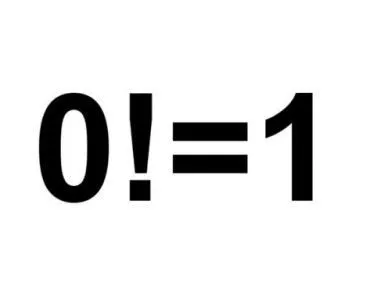
However, the four basic operations can only create a handful of numbers. Therefore, we must turn to other operations. This would include concatenation or the combination of two numbers to form a larger number such as 44, factorials such as 4! = 4 × 3 × 2 × 1, decimal points .4, square roots √4, exponential and consequently logarithms. These operations allow us to express numbers to infinity!44 − 44 = 044 ÷ 44 = 14 ÷ 4 + 4 ÷ 4 = 2(4 + 4 + 4) ÷ 4 = 34 × (4 − 4) + 4 = 4(4 × 4 + 4) ÷ 4 = 5(4 + 4) ÷ 4 + 4 = 644 ÷ 4 − 4 = 74 + 4 + 4 − 4 = 84 + 4 + 4 ÷ 4 = 9For instance, 47 can be expressed as 4! + 4! − 4 ÷ 4 (again, the order of operations says the division must happen first). Or, and this is brilliant, 49 can be expressed as 4! × √4 + 4 ÷ 4. Try it out, it really is 49! Also, because we cannot use any other number, even the decimalized .4 is written as .4 and not 0.4.
Some even resort to summoning absurd or atypical operations, such as the percentage or even permutation and combination (4P4 and 4C4). For instance, 99 can be expressed as 4 ÷ 4% − 4 ÷ 4, which is 100 – 1 or 99. However, traditionalists might call the introduction of atypical operations cheating or sophistic. A sophist is someone who reasons with clever (but false) arguments.
The methods are clever, but not entirely false. What perturbs some people is that these novel methods simplify the puzzle, which takes the fun out of it, like playing basketball on a knee-high hoop. Also, if these tricks weren’t enough, mathematicians devised a formula that enabled them to express numbers to infinity. Dirac is rumored to have arrived at the same generalization when he confronted the puzzle, and was thus accused of hacking it.
How To Make Every Number From 0 To 20 With Four Fours
Reading the rules is one thing, but the puzzle only really grips you once you sit down and start building numbers yourself. To give you a running start (and to settle the arguments that inevitably break out on long car journeys), here is one tidy solution for every whole number from 0 to 20, each using exactly four 4s. There is rarely a single “correct” answer here, so if you found a different route to the same number, yours is just as valid.
| Number | Four fours |
|---|---|
| 0 | 44 − 44 |
| 1 | 44 ÷ 44 |
| 2 | 4 − (4 + 4) ÷ 4 |
| 3 | (4 + 4 + 4) ÷ 4 |
| 4 | 4 + 4 × (4 − 4) |
| 5 | (4 × 4 + 4) ÷ 4 |
| 6 | (4 + 4) ÷ 4 + 4 |
| 7 | 44 ÷ 4 − 4 |
| 8 | 4 + 4 + 4 − 4 |
| 9 | 4 + 4 + 4 ÷ 4 |
| 10 | (44 − 4) ÷ 4 |
| 11 | (4! × √4 − 4) ÷ 4 |
| 12 | (44 + 4) ÷ 4 |
| 13 | (4! × √4 + 4) ÷ 4 |
| 14 | 4 × 4 − 4 ÷ √4 |
| 15 | 4 × 4 − 4 ÷ 4 |
| 16 | 4 × 4 + 4 − 4 |
| 17 | 4 × 4 + 4 ÷ 4 |
| 18 | 4 × 4 + 4 − √4 |
| 19 | 4! − 4 − 4 ÷ 4 |
| 20 | 4 × (4 ÷ 4 + 4) |
You will notice that the four basic operations quietly run out of steam somewhere around 10 or 11. To reach numbers like 11 and 13, we have to invite the factorial (4! = 24) and the square root (√4 = 2) to the party, exactly as the rules allow. And this is only the gentle end of the scale. A few numbers are notoriously stubborn: mathematicians single out 113, 157 and 347 as especially hard to build under the usual rules, with 113 typically demanding the heavier machinery of the gamma function.
The Hack
The hack relies on one of the most common but least understood operations, the logarithm. Let me first remind you how logarithms work. If a = bc, then logb a = c. For instance, 10 = 101, therefore, log10 10 = 1.
Now, the rules demand that we only use the number 4, so the base of logarithms we employ must be limited to 4. For instance, if 16 = 42, then log4 16 = 2. Or, if 256 = 44, then log4 256 = 4. One can discern the emergence of a pattern here: log4 4n = n. Let’s denote this expression by X. Even if you don’t understand the working principle of logarithms, just remember this formula to get through the rest of the article.X → log4 4n = nThe value of n in X doesn’t even have to be a whole number. This characteristic is crucial for the hack. Now, the article gets slightly more complicated from here, so a moderate degree of grit is expected from the reader. Let’s plug in ½ in place of n, in X, which translates to 41/2 or √4. We see that X becomes ½. Similarly, the value of X for n = ¼ or 41/4 is ¼ and then 1/8 when n is 1/8 and so on.
Now, let’s perform the same logarithmic operation X, but replace 4 with ½. For instance, log1/2 (1/2) = 1 and log1/2 (1/2)2 = 2 or log1/2 (1/4) = 2 and log1/2 (1/2)3 = 3 or log1/2 (1/8) = 3 and so on. You can practically smell the hack from here.
The numbers on the right side of the equal sign increment each time we increment the number ½ is raised to. This incrementation could reach infinity if we were to increment the power on ½ ad infinitum.
If we express the operation on the left with four fours, we would solve or “hack” the puzzle.
Refer to X again and you will realize that the powers of 1/2 namely, 1/2, 1/4, 1/8, 1/16 can be expressed with X itself! Now, X uses two fours, so we need the remaining two to solve the puzzle. These two fours arise from our need to express the base of the logarithm, which is 1/2, in terms of four, as the use of 1/2 is against the rules. Let’s find a way to express 1/2 in terms of fours. Now, 1/2 can be written as 2/4, which is nothing but √4 ÷ 4. And there, we have solved it.log√4÷4 (√4÷4)n = n
.
.
.
If exponentials weren’t enough, adroit mathematicians used logarithms to solve it. This generalization or formula to produce any natural number essentially vanquishes the puzzle once and for all. To produce any number, one must plug in the formula, the square root of 4 taken for the same number of times. Given a page long enough, one billion or even infinity can be produced by taking the square root of 4 a billion or an infinite number of times. For this reason, logarithms have been banned as a viable solution to solve the puzzle. However, some mathematicians also despise this hack because it looks ugly.
The puzzle has been used for years by puzzle lovers to pass the time during long journeys on trains or flights. Now, even newer versions of the puzzle have been developed, versions that might require superior mathematical acuity, the five fives or six sixes puzzles! But do you have what it takes?
Can You Make Pi With Four Fours?
Once you have made every whole number in sight, the natural next question is whether the four fours can escape the integers altogether and land on a famous irrational number like π (roughly 3.14159). Astonishingly, they can, and the trick has the same mischievous flavor as Dirac’s logarithm hack.
The move hinges on the factorial. We normally treat the factorial as something you apply only to whole numbers, but the gamma function extends it smoothly to fractions too. One of its prettiest results is that (½)! equals √π ÷ 2. Now watch what happens when we feed the puzzle a half. Since √4 ÷ 4 is just 2 ÷ 4, which is ½, we can write:
(√4 ÷ 4)!√4 × 4 = πCount them: four 4s, no other digits. Working from the inside out, (½)! becomes √π ÷ 2, squaring it (that is what the √4 exponent does) gives π ÷ 4, and the final × 4 recovers π exactly. This elegant sleight of hand is credited to Colin Harkins in David Wheeler’s definitive answer key. Like the logarithm hack, purists usually wave it away, because leaning on non-integer factorials feels a little like smuggling π in through the back door. Still, the fact that four humble 4s can pin down π at all is a small marvel.