Table of Contents (click to expand)
Many classic magic tricks have simple scientific explanations. Vanishing water uses sodium polyacrylate, a superabsorbent polymer that turns liquid into gel. The burning money trick relies on water absorbing heat as it evaporates, keeping the bill below paper's ignition point. The traveling flame ignites vaporized wax in candle smoke. The levitating disc uses flux pinning in a cooled superconductor. Thunder in a bottle is triboluminescence in europium tetrakis crystals.
Imagine that you’re suddenly standing in the middle of the street in Victorian England. Wondering where you are, you decide to whip out your phone and try to get a signal, when a passing child spots your phone.
Nowadays, it’s quite common for us to use cell phones on a daily basis, but for people who haven’t ever seen a light-bulb, the moving images in your hand would be considered magic. While you’re left there cursing your network provider, the villagers would have lined up with pitchforks and torches!
Similarly, magicians have been amazing audiences for centuries with new ‘tricks’ employing scientific ideas in a non-conventional manner. Every magic trick can likely be explained if the right ideas are identified. Although a magician never reveals his secrets, the whole point of being a scientist is explaining ideas.
This is a great way to spoil magic tricks without facing any criticism from fellow magicians. This article will teach you how to perform some mind-boggling ‘magic’ tricks and learn about the science that makes them possible.
Vanishing Water
The Trick:
A magician takes an ordinary looking cup, pours some water into it after a series of gestures and appears to make the water disappear. The viewer is left speechless when the cup is flipped over and no water drips out, as if it has vanished into thin air. Watch the video demonstration here.
The Science:
The method isn’t that much of a revelation, since it make use of an easily available compound called sodium polyacrylate. This is a superabsorbent polymer (SAP) that swells into a gel as it locks water into its molecular network, capable of soaking up hundreds of times its dry weight in seconds. Baby diapers contain this compound to absorb moisture more easily. When the cup is lined with this substance, any water that comes in contact with it forms a mixture that is a solid gel. Unassuming audiences think that the water has suddenly disappeared, when in fact the mixture is simply stuck to the base of the cup.
Burning Money
The Trick:
The magician takes a small currency note and tells the audience that he is going to light it on fire. Then he takes a lighter or a candle in one hand and lights the bill aflame. The fire then goes out, leaving the bill unharmed and the audience spellbound.

The Science:
The bill used in this trick is not an ordinary currency note. Prior to the trick, it has already been doused in an alcohol-water mixture. When the bill is lit, the alcohol is what actually burns, while the note remains unharmed. Water has a very high specific heat and absorbs a large amount of energy as it evaporates. As long as water is still evaporating from the bill, the paper stays below its ignition point (about 233 °C, or 451 °F), so the alcohol burns off without ever setting the note alight. Don’t attempt this trick at home, not only because it’s highly dangerous, but also because money comes in handy when you’re off buying magic wands.
Traveling Flame Trick
The Trick:
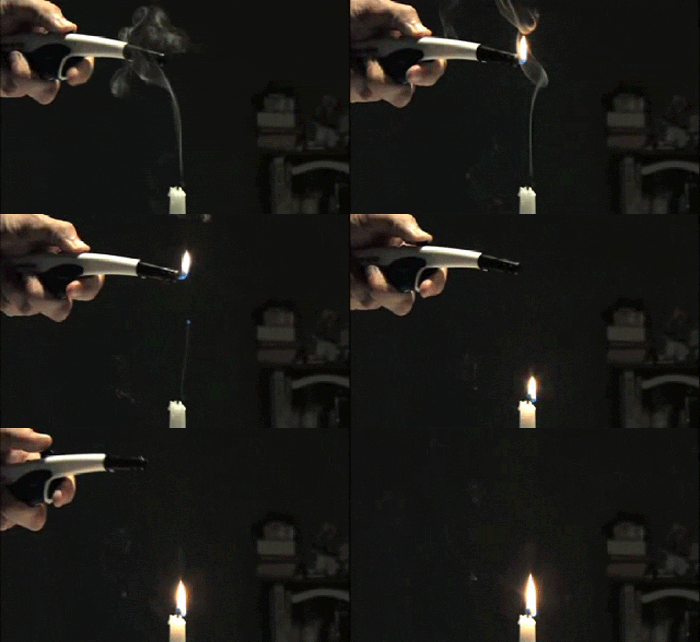
The magician lights a candle with a lighter or a match in front of the audience. He then blows out the flame and immediately places the flame from a matchstick or a lighter into the smoke. To the amazement of the onlookers, the flame travels down the smoke and relights the blown-out candle. You can watch the actual trick in the gif below.
The Science:
The candle and matchsticks involved are ordinary in all respects. The only thing extraordinary is the way candles work. As we all know, the heat from the flame of a burning candle melts the wax around it. However, not only does the wax melt, but some part of it also vaporizes and remains inside the smoke for a while after you blow out the flame. If a heat source like a matchstick is applied quickly enough to this vapor, it can ignite the wax and travel down the vapor to the actual candle wick.
Levitating Disc
The Trick:
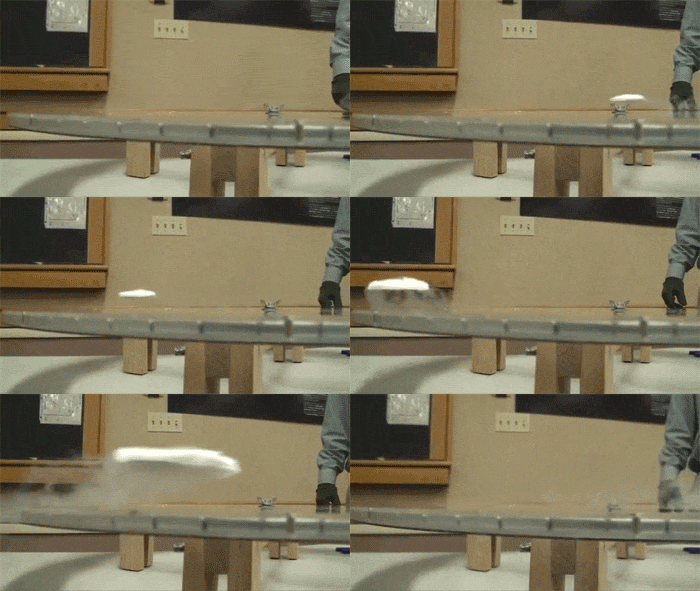
A magician pulls out a disc from a container and puts it onto a track he has laid out on a table. The disc begins levitating, even though it’s completely composed of non-magnetic substances.
The Science:
Everyone knows that you can levitate objects using a magnet, but there’s only a certain degree of freedom with magnetic levitation. Since magnets can only attract or repel each other and not fix them in place, levitating objects for long periods is difficult. In this trick, magicians employ the help of superconductors that interact with magnets in a weird manner called ‘Quantum Levitation’.
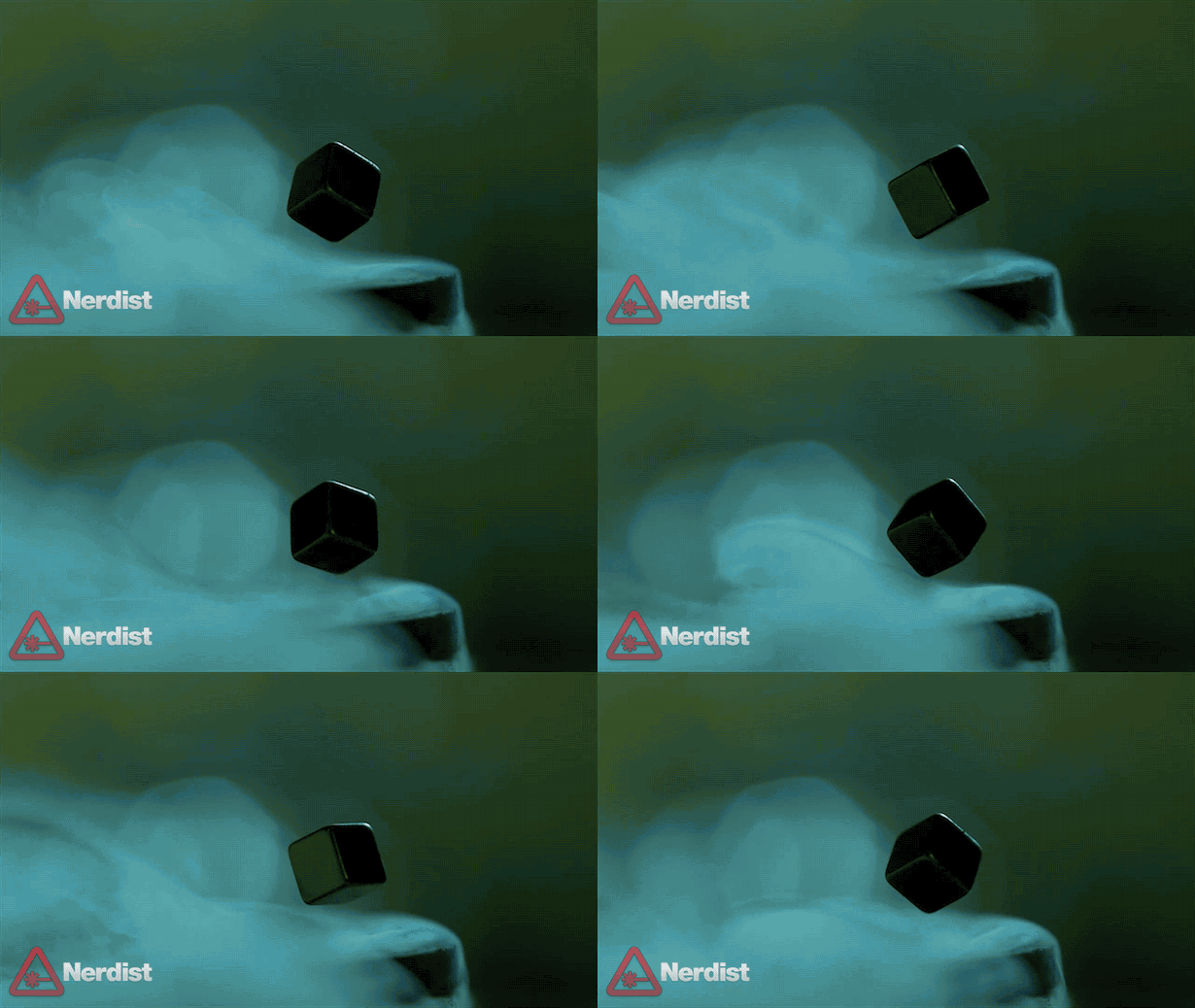
The disc itself is a thin Type II superconductor (typically yttrium-barium-copper-oxide, YBCO) that has been cooled with liquid nitrogen to about −196 °C. At that temperature, magnetic field lines from the track get trapped inside microscopic defects in the superconductor in a phenomenon called flux pinning (sometimes nicknamed “quantum locking”). Those pinned field lines lock the disc into place above the magnetic track, so it can hang in mid-air or even ride upside-down along the rails, levitating like a UFO.
Thunder In A Bottle
The Trick:
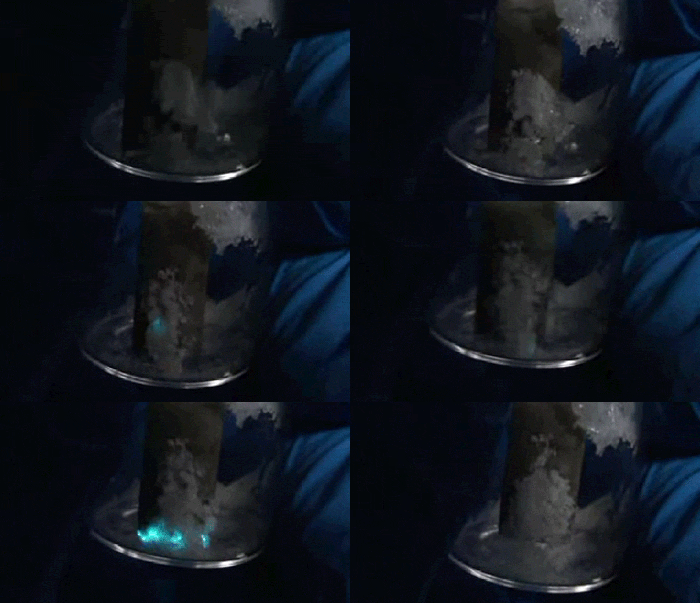
A magician takes some sugar-like crystals and puts them in a transparent jar. He then asks an audience member to turn off the lights, barely allowing them to see. He then takes a hammer and starts crushing the crystals with the butt of the hammer. The jar lights up like a thunderstorm as soon as the force of the hammer disintegrates the crystals inside!
The Science:
The sugar-like crystals are actually europium tetrakis dibenzoylmethide triethylammonium (EuD4TEA), a compound first described in Nature in 1966. As the crystals fracture, they emit bright red flashes of light, a phenomenon called triboluminescence. Cracking the lattice separates electric charges across the fresh fracture surface, and the resulting tiny electrical discharges excite the europium ions, which then release that energy as visible light. Other substances usually convert this kind of mechanical energy into heat instead, which is why they don’t glow. Plain sugar is mildly triboluminescent too, which is why crunching a Wint-O-Green Life Saver in the dark gives off a tiny blue spark. You could certainly give a whole different meaning to a “sparkly smile” in this way. Just chew on some sugar in the dark and you’re golden!
Next time you watch Harry Potter, keep an encyclopedia of science handy. Your friends will probably never invite you to a movie marathon again, but hey… at least you’ll know that the reason behind the failure of the trick is not an incorrect pronunciation of ‘Wingardium Leviosa‘.