Middle child syndrome is the popular idea that a middle child, sandwiched between an older and younger sibling, gets less parental attention and grows up feeling overlooked, often cast as the family “black sheep.” It is not a clinical diagnosis, and large modern studies find birth order has little to no real effect on personality.
If you have both an older and younger sibling, middle child syndrome probably isn’t a new concept. Whether or not you feel that being a middle child has affected your life in a particular way, the subject has probably been raised at one time or another. There are a number of personality traits and woes commonly attributed to being a middle child, in relation to parental attention, social skills, relationship with siblings, academic success and dozens of other characteristics.
The question, of course, is whether being a middle child truly has any effect or not. The stereotype of a middle child may be a rebel, a loner, someone more likely to take risks, be more separated from parental authority… the black sheep of the family, per se. It’s worth saying upfront that “middle child syndrome” isn’t a real medical or psychological diagnosis. It’s a popular idea, one that traces back to the Austrian psychiatrist Alfred Adler (1870-1937), who argued that the order in which we’re born shapes who we become. A good deal of research has since tested that claim, and the conclusions are more sobering than the stereotype suggests. Before we get into whether middle child syndrome is real or not, let’s take a closer look at why and how this “syndrome” became popular in cultures around the world.
Middle Child Syndrome
When parents are graced with their first child, it is a life-changing experience, and one that deservedly dominates the majority of their time and attention. Hard lessons are learned and herculean tasks of parenting sacrifice are made to protect their precious firstborn. When a second child is born, parents often feel more relaxed and less overbearing; after all, they successfully raised one child, so the second feels easier. This can result in slightly less attention, comparatively, being given to the second child, particularly because the beloved firstborn still receives a good deal of energy and focus.
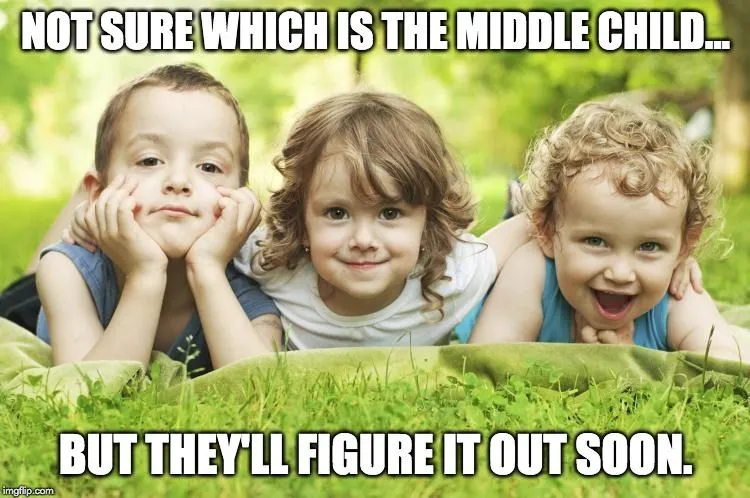
Thus, when a third child is born (the baby of the family), attention is once again shifted away from the second child. This sets up an interesting paradigm, where the firstborn and last-born enjoy the brunt of parental affection, while the middle child must ostensibly “fend for itself”. Essentially, the firstborn child will receive responsibilities, privileges and higher expectations from the parents, while the youngest child will have its needs indulged, forever being the “baby” and receiving special treatment. This is the proposed idea behind middle child syndrome, though certainly not a biological imperative, nor a phenomenon seen in every three-child family.
Is Middle Child Syndrome Real?
When viewed through the basic lens outlined above, it would seem that middle child syndrome has a clear foundation, one that might explain feelings of being “left out”, distanced from parental love, and more likely to find their own path forward. That being said, there are pros and cons for any child, regardless of their birth order, and given the infinite range of personalities, being a middle child isn’t inherently a bad thing. In fact, one’s place as a middle child may be a huge advantage in some cases.
Before we go further, a reality check is in order. When researchers stopped relying on small samples and started using huge, representative ones, the “syndrome” mostly evaporated. The landmark study here is a 2015 analysis in the journal PNAS by Julia Rohrer and colleagues, who examined more than 20,000 people across the United States, the United Kingdom and Germany. They found that birth order has no meaningful effect on personality traits such as extraversion, emotional stability, agreeableness, conscientiousness or imagination. The only consistent difference was a tiny edge in measured intelligence and self-reported intellect for firstborns, and even that was small. In other words, the science gives middle child syndrome very little to stand on.
So why does the stereotype refuse to die? Below, we’ll explore the common tropes or claims about middle children, treating each as folk wisdom to be weighed rather than settled fact, and dig into both the supposed positives and negatives. Keep that 2015 finding in mind as a yardstick: many of these claims come from older, smaller studies or from popular books, and they rarely hold up when the numbers get big.
Parental Connection
While middle children may not receive as much attention and over-parenting as a family’s first precious bundle of joy, being a middle child certainly doesn’t suggest immediate neglect. Being raised from a slightly greater distance can also have its advantages when it comes to problem-solving and dependency issues that may be seen in both older and younger siblings.
Social Skills
Due to the potential sensation of feeling “left out”, the popular claim is that middle children develop stronger social skills and learn to engage more effectively with different groups of people. The reasoning goes that by escaping the “firstborn” or “baby” labels, a middle child becomes a natural negotiator, finding ways to fit in with diverse groups smoothly. It’s a tidy story, but the hard evidence for a social edge is thin. There is one intriguing modern twist, though: a huge 2024 study in PNAS by Michael Ashton and Kibeom Lee, drawing on personality data from more than 700,000 people, found that middleborns scored slightly higher than only children, firstborns and youngest children on honesty-humility and agreeableness, traits tied to cooperation and getting along. The catch is that the effect was tiny (roughly 0.2 standard deviations) and largely explained by family size rather than birth position itself, since middle children only exist in families of three or more.
Rebellious Nature
Without the ever-present and watchful eye of parents worrying about every move they make, middle children may develop more rebellious behavior, leaning into the “black sheep” stereotype of the family. This may come from a place of wanting to draw more attention from inattentive parents, but could also be a form of boundary-pushing. When rules aren’t as firmly enforced, children are bound to stretch them, which can have any number of results, not all of which are bad.

World View
Similarly, children born in the middle are less likely to follow in their parents’ footsteps, as they may feel less pressure than their older sibling to “carry on the family business”, per se, or share an identical set of beliefs to their parents. Middle children may be able to avoid this pressure, exploring new ideas, communities, lifestyles and opportunities their older siblings were steered away from.
Sibling Relationships
One survey-based claim is that middle children lean less on their parents and more on their siblings, building close horizontal bonds in lieu of close dependence on Mom and Dad. If that happens, those sibling connections can be genuinely nourishing and beneficial as children grow up. As with the other traits here, though, the pattern is modest and inconsistent across studies, not a hard rule.

Expectation And Pressure
A popular version of the story holds that, without the pressure to perform and excel that is placed on older children, or the overly protective hovering aimed at the “baby” of the family, middle children dodge some of that parental projection and may feel calmer for being outside the spotlight. It’s a comforting idea, but it’s important not to overstate it: the large 2015 PNAS data set found no birth-order difference in emotional stability, so there is no solid evidence that middle children are systematically less anxious or depressed than their siblings.
Independence
As alluded to a few times already, being a middle child has the potential to make a person much more independent, as they have been relying on themselves for guidance, survival and validation since a young age. Later in life, this self-contained instinct can be very helpful, both in personal relationships and measures of self-esteem.

Thinking Patterns
It’s sometimes claimed that middle children are less likely to head to college, but the data here are shaky, and where firstborns do show an edge it’s in measured intelligence, and only by a sliver (think a point or two of IQ, as the 2015 study found). None of that dictates a person’s intelligence or education. If anything, a slightly different vantage point may nudge some middle children toward less traditional passions or professions. While a firstborn might feel inclined to study law or medicine, a middle child may feel freer to chase visual art or music instead, though, again, that’s a tendency at most, not a law of nature.
Is Middle Child Syndrome The Same As Second Child Syndrome?
If you have searched around this topic, you have probably run into a few different labels: middle child syndrome, middle sibling syndrome and second child syndrome. They are mostly describing the same folk idea from slightly different angles. “Second child syndrome” usually refers to a second-born who feels overshadowed by an older sibling, whereas “middle child syndrome” really kicks in once a third child arrives and that second-born becomes the one stuck in the middle. Put another way, a second child only becomes a middle child when a younger sibling shows up, which is also why middle children, by definition, only exist in families of three or more.

What these labels share matters far more than how they differ: none of them is a recognized medical or psychological diagnosis. You will not find any of them in a clinical manual, and the large personality studies discussed above (the 2015 and 2024 PNAS analyses) report the same near-zero effect of birth order whether you call someone a second child or a middle child. The name on the box changes; what is inside does not.
Are Middle Children More Prone To Low Self-Esteem Or Depression?
This is one of the most common worries pinned to the middle child label, and it deserves an honest answer rather than an alarming one. The popular story says that years of feeling overlooked leave middle children with shakier self-esteem and a greater risk of depression. The actual research is mixed, and much weaker than the stereotype implies.
A useful reference point is the 2021 A-CHILD study published in Frontiers in Psychiatry, which surveyed 3,744 children aged 9 to 10 in Tokyo, Japan. Tellingly, self-esteem scores did not differ by birth-order position at all. The study did find that middle-borns reported the lowest happiness scores, and slightly lower resilience than first-borns and last-borns, but the authors stressed that the design was cross-sectional. That means it captures a single snapshot in time and cannot show that birth order causes any of those feelings.
That fits the broader picture. The large 2015 PNAS analysis, our yardstick throughout, likewise found no birth-order gap in emotional stability, which argues against the idea that middle children are, as a group, meaningfully more anxious or depressed than their brothers and sisters. When a middle child does feel low, the cause is far more likely to lie in the particulars of their family and life than in the slot they happen to occupy.
A Final Word
Birth order feels like it should matter, and the “black sheep” middle child makes for a great story. But when researchers test it with large, careful samples, the effect on personality is somewhere between tiny and nonexistent. There isn’t a strong case for the oldest, middle or youngest child having a real, built-in advantage, beyond a barely perceptible bump in measured intelligence for firstborns. Middle child syndrome, then, is best understood as a cultural stereotype rather than a diagnosis: real in the sense that people feel it, but not something stamped into you by your slot in the family. Personality is shaped by countless factors, from genes to friendships to plain luck. Birth order may look like an obvious variable, but it simply isn’t a decisive one!
References (click to expand)
- Rohrer, J. M., et al. (2015). Examining the effects of birth order on personality. PNAS - PMC, NIH.
- Ashton, M. C., & Lee, K. (2024). Personality differences between birth order categories and across sibship sizes. PNAS - PubMed, NIH.
- Birth Order and Personality (Murphy, 2012). Adler Graduate School.
- A study of self-esteem in middle children - Rowan Digital Works.
- Fukuya, Y., et al. (2021). Birth Order and Mental Health, Self-Esteem, Resilience and Happiness (A-CHILD Study). Frontiers in Psychiatry.
- Resilience among middle–born children - repository.nwu.ac.za
- Ph.D. C. S.,& Schumann K. (2012). The Secret Power of Middle Children: How Middleborns Can Harness Their Unexpected and Remarkable Abilities. Penguin