Table of Contents (click to expand)
MSG (monosodium glutamate) is the sodium salt of glutamic acid, a non-essential amino acid that occurs naturally in tomatoes, cheese, mushrooms, and human breast milk. In food, it triggers umami, the savory "fifth taste", which is why a small pinch makes broths, sauces, and processed snacks taste richer. After decades of review, the FDA, the WHO/FAO JECFA, and the European Food Safety Authority all consider MSG safe at the levels found in food; the once-feared "Chinese Restaurant Syndrome" has not held up under controlled blind trials.
Try to think back to the last time you ordered Chinese food. You picked out your items, eagerly waited for them to be delivered and then promptly devoured all of it once the bag arrived at your door. However, despite gorging on every delicious dish, a few hours later, your stomach seems mysteriously empty. Or, at the very least, you are already turning one eye to your pantry for a snack.
Many people are familiar with this sensation, and commonly say, “Well, it’s just the MSG”, but they rarely explain it any further. The question is, what is MSG? Why is it found in Chinese food? And most importantly, does it actually make you hungry?
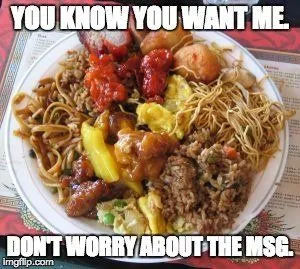
Short answer: MSG is a salt form of a non-essential amino acid that is found in many different foods and is used as a flavor enhancer and additive, allowing for lower-quality food that still tastes good, and even causing addiction to the substance!
What Is MSG (Monosodium Glutamate)?
While people commonly associate MSG (monosodium glutamate) with Chinese food, it is actually present in a huge variety of foods, being one of the most popular flavor enhancers in what we eat. It can be found in processed foods, salad dressings, soups and sauces, potato chips, frozen dinners, and dozens of other common items.
Why Is MSG Used In So Many Food Items?
The reason MSG is so popular is straightforward. Glutamate is the molecule responsible for the umami taste, the savory "fifth taste" sensed by specific receptors (mGluR1, mGluR4, T1R1/T1R3) on the tongue. When food contains free glutamate, those receptors fire, the brain reads "high in protein, nutritious", and the dish tastes deeper and more satisfying. Adding a pinch of MSG is essentially a concentrated, cheap shortcut to the same umami punch you'd get from slow-cooked broth, aged parmesan, ripe tomatoes, or seaweed.
The Effects Of MSG On The Brain And The Body
Popular articles often describe MSG as an "addictive excitotoxin" that causes overeating, but the human evidence for this is weak. A 2019 systematic review in Annals of Pharmacotherapy ("A review of the alleged health hazards of monosodium glutamate") concluded that controlled trials do not show MSG triggering uncontrolled hunger, weight gain, or behavioural addiction at normal dietary doses. The "excitotoxin" framing originated from very high pharmacological doses injected into rodents, not from food.
It is true that ingested MSG, like all amino acids, can modestly influence insulin and satiety signals. But pooled human-subject data show that, calorie for calorie, MSG-seasoned food does not reliably lead people to eat more than the same food seasoned with salt. In fact, because umami is satisfying, some studies find slightly better appetite regulation when meals contain umami flavour.
And yes, MSG is a non-essential amino acid, meaning the body can synthesise glutamate on its own. About 90% of dietary glutamate, whether from MSG or from a tomato, is metabolised by the cells of the gut wall before it ever reaches the bloodstream, so circulating glutamate stays roughly constant whether you eat MSG-rich food or not. Inside the brain, glutamate is the most abundant excitatory neurotransmitter; the blood-brain barrier tightly regulates its levels regardless of diet.
Dangers Of Consuming Too Much MSG
For most people, the genuine risk profile of MSG is modest, and quite different from the headline-grabbing claims you may have seen online. The U.S. Food and Drug Administration, the joint WHO/FAO Expert Committee on Food Additives, and the European Food Safety Authority have all reviewed the evidence and conclude that MSG is "generally recognized as safe" (GRAS) at typical food levels. A 1995 FASEB report commissioned by the FDA found no causal evidence linking MSG to chronic disease.
What the literature does support is that a small subset of sensitive people may experience mild, transient symptoms (a headache, flushing, tingling, drowsiness) after consuming roughly 3 grams or more of MSG without food. A typical serving of an MSG-seasoned dish contains less than 0.5 grams, so this threshold is rarely crossed in normal eating. The studies once cited to link MSG with kidney damage, liver damage, obesity, Alzheimer's, lupus, multiple sclerosis, or Parkinson's used very high doses injected into animals; controlled trials in humans at dietary levels have not reproduced these effects.

One real consideration: MSG is a sodium salt (about a third the sodium of table salt by weight), so people on tight low-sodium diets should still count it as part of their daily sodium intake. Beyond that, if you know you personally feel off after big doses of MSG-rich food, it is reasonable to moderate your intake. But for the average eater, the available scientific evidence simply does not support the idea that adding a pinch of MSG to a stir-fry is meaningfully more dangerous than adding salt or soy sauce.
So you can almost certainly enjoy that delectable General Tso's chicken with a little less guilt than the internet might lead you to think.
References (click to expand)
- What Exactly is MSG? - www.msgtruth.org
- (1994) Excitotoxins in foods - PubMed. The United States National Library of Medicine
- Freeman, M. (2006, October). Reconsidering the effects of monosodium glutamate: A literature review. Journal of the American Academy of Nurse Practitioners. Wiley.
- (2005) Fact or Fiction? The MSG Controversy - Harvard DASH. Harvard University
- Questions and Answers on Monosodium glutamate (MSG). U.S. Food and Drug Administration.
- Zanfirescu A. et al. (2019). A review of the alleged health hazards of monosodium glutamate. PMC.