Table of Contents (click to expand)
Yes, lips are skin—but a heavily modified, transitional form of it. The lip vermilion (the red part) is only 3–5 cell layers thick versus around 16 layers on the rest of your face. It also has far fewer melanocytes, no hair follicles, and no sebaceous or sweat glands, so the dense network of blood vessels just below shows through as red. The thinness and the high density of nerve endings are also what make lips so sensitive and so prone to chapping.
Lips are one of the most striking facial features that we humans possess. They are also incredibly helpful in our lives. What would we do without them? You stretch them to smile when you want to show your inner glee. You smack them to display your immense satisfaction after a great meal. You pucker them to bring out your petulant side. You bite them to show reluctance. Perhaps most importantly, lips give you the ability to display your affection for anyone and anything!

But why are lips so different from all the other skin areas? Why are they red? Why are they so soft? Why are they so flexible and useful for kissing? Let’s try to briefly answer each of these questions.
Why Are They Red?
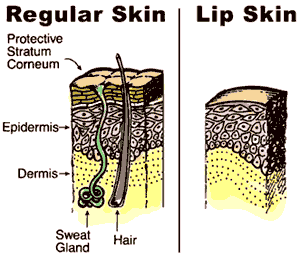
The skin on our lips looks clearly different from the rest of our body. That is because it is much thinner in comparison. Most skin on the body has two main layers—the epidermis on top and the dermis below (a fatty hypodermis sits beneath that). The epidermis itself is built up from several sublayers, and its outermost sheet of dead, flattened cells is called the stratum corneum. The stratum corneum is what we touch when we touch our own skin—it is the body’s barrier against the outside world. The deeper part of the epidermis is busy making new cells, and it is also where the melanocytes live—the cells that make melanin, the pigment that gives skin its colour once it has been exposed to the sun.
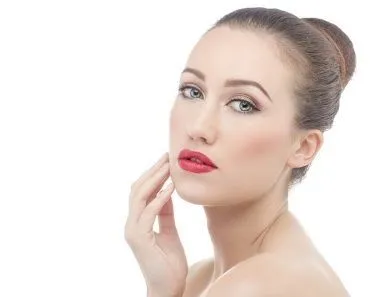
The lip vermilion, however, has very few melanocytes (roughly one melanocyte per 10–15 keratinocytes, compared to about one per 4 in regular facial skin), so there is hardly any melanin to mask the red colour of the dense blood vessels that crowd the dermis just underneath. Combined with a stratum corneum that is barely there—only a few cells thick—the result is that the bright colour of blood is directly transposed into the soft pinkish-red colour of your lips.
Why Are They So Soft?
The stratum corneum, by virtue of its protective nature, is harder than the other layers of skin. Lips, however, have a very thin stratum corneum. Therefore, they are obviously softer than the other skin areas.

In addition to this, the skin on your lips doesn’t have hair follicles. Hair follicles cover every external part of your body, excluding the palms of your hands and the soles of your feet. They also play a role in preserving the body’s integrity and add to the skin’s characteristic hardness. That being said, the skin on your lips doesn’t have this luxury, and is invariably softer and more vulnerable.
Another factor that adds to the vulnerability of lips is the lack of sebaceous glands. These are the glands responsible for providing moisture to the skin, but lips are left on their own, with their only source of moisture being saliva. This is why lips are much more likely to be chapped if not moisturized adequately.
Lips (as well as the tips of your fingers) have more nerve endings than any other part of your body. Coupled with the aforementioned thinness of the skin, your lips become extremely useful for kissing!
As you can see, lips have evolved differently for us humans. The thing is, no one really knows why! The outline that divides the reddish-pinkness of the lips from the rest of the skin is called the vermilion border. But why is it found only in humans and not other animals? That is a mystery yet to be solved!
What Are Lips Actually Made Of?
If you slice a lip from the outside in, you pass through three different surfaces, not one. The outer part nearest your nose and chin is ordinary, hair-bearing facial skin. The inner part that touches your teeth is the wet, pink oral mucosa that lines the whole mouth. Sandwiched between them is the famous red strip, the vermilion (the zone the rest of this article has been calling "lips"). The vermilion is not really skin at all but a modified mucous membrane: hairless, packed with blood vessels, and built from layers of flat cells that lack the usual skin appendages.

Underneath all three surfaces sits the real engine of the lip: a sheet of muscle called the orbicularis oris. It loops around the mouth and, unusually for a muscle, has no bony anchor at all. Instead it is woven into the soft tissue of the lips themselves, which is exactly why your lips can move in so many directions. Anatomists once described it as a simple ring-shaped sphincter, but its fibers actually run in several directions, so it is better thought of as a complex of muscle that both seals the mouth shut and shapes it for speech. So when you ask "what are lips made of," the honest answer is skin on the outside, mucosa on the inside, a vivid vermilion in between, and a clever little muscle holding the whole thing together.
Why Do We Have Lips At All?
It is easy to take lips for granted, but they do a surprising amount of work. The most basic job is feeding. The orbicularis oris lets you close your mouth into an airtight seal, so you can hold food and drink in, keep unwanted things out, and (when you were a baby) generate the suction needed to breastfeed. A newborn forms a tight funnel with its lips, and that seal is what makes nursing possible at all.

Lips are also part of your speech apparatus. Many sounds simply cannot be made without them: press both lips together and you get the bilabial sounds in "bat," "pat," and "mat," while tucking the lower lip against your upper teeth gives you the labiodental "f" and "v." Intriguingly, our talking lips may have a deep ancestry. When Princeton researchers led by Asif Ghazanfar X-rayed monkeys, they found that adult macaque "lip-smacking" runs at about 5 cycles per second, the very same rhythm as the lip movements in human speech, hinting that the facial machinery of talking evolved from an older social gesture rather than from the voice alone.
Finally, lips are expressive and exquisitely sensitive. They are among the most densely nerve-rich parts of the body, which is why their map in the brain's sensory cortex is far larger than their size would suggest. That dense wiring is what lets you read a smile, a pout, or a pressed-lip frown across a room, and it is a big part of why lips matter so much to how we eat, speak, and connect with one another.