Table of Contents (click to expand)
We get goosebumps when we’re cold because the cold triggers the sympathetic nervous system, releasing adrenaline that contracts the tiny arrector pili muscles at the base of each hair. This pilomotor reflex pulls the hairs upright and dimples the skin into bumps. In our furry ancestors it trapped warm air for insulation; in nearly hairless humans it survives mostly as a harmless leftover.
Imagine walking down an empty street after dark, the cold wind whistling above your head, when a clatter of garbage cans from the alley behind you startles you. In that instant, not only do you walk a bit faster and take out your cell phone, but your body also reacts by releasing a truly mysterious defense… it causes the hair on the back of your neck and arms to stand up. Commonly known as goosebumps, this is one of the strangest physical reactions in the body, and one that many people don’t quite understand. So…. why do we get goosebumps when we’re cold?

Short Answer: Goosebumps are caused by the body’s fight-or-flight response to a perceived threat. When the body perceives danger, either physically or physiologically, it will tense up the muscles and cause the hair on our arms to rise, along with those legendary goosebumps.
Goosebumps Are A Good Thing
While it may not seem like goosebumps provide much protection against physical danger or the environment, the fact that goosebumps have appeared on your body is a good thing. It means that your reflexes are working normally. More specifically, it means that your pilomotor reflex is functional, which is the scientific name for the phenomenon of goosebumps. Essentially, the pilomotor reflex is a part of the fight-or-flight response, which is what animals undergo when they feel threatened in any way. It causes a flood of adrenaline in the body, which can help animals and people prepare to fight (defend themselves, etc.) or flee (run away).
Now, goosebumps don’t only occur when you feel that your life is in danger or when you’re about to run away from something. They can also be set off by strong emotions of love, surprise or nostalgia, or by a swelling piece of music. That musical version even has its own name, frisson, and it comes with a measurable hit of dopamine in the brain’s reward circuits, which is part of why a goosebump-inducing song feels so good. Even thinking back to old moments filled with powerful memories can do the trick. In many ways, the body doesn’t differentiate between strong emotions, and merely flicks a switch for fight-or-flight preparation.
When this adrenaline surge hits in a human, it triggers an unconscious tensing of the tiny muscles attached to each hair. These minuscule muscles, called the arrector pili, sit at the base of every hair follicle and answer to the sympathetic nervous system. When they contract, they tug the skin a bit tighter and pull each hair upright, raising those tiny bumps at its base. The most common places to feel the pilomotor reflex are the back of your neck, your legs and your arms, as these are the most frequently exposed patches of skin (that still have hair) and the sensation of those rising hairs can be quite strong.
In humans, getting goosebumps is typically seen as a warning for an individual. If you feel goosebumps on your arms, you should probably put on a sweater, because your body is detecting a dangerous drop in temperature. If you feel goosebumps on the back of your neck, it may be a reaction to an anxiety-inducing situation, or a potential danger that your “sixth sense” has picked up on. However, the way that we use and think about goosebumps is not actually their intended purpose…
The Origins Of Goosebumps
If you think humans are special because they occasionally get goosebumps, think again. The pilomotor reflex is something that has been handed down to humans over the course of evolutionary history. Many other animals experience this reflex of the skin when they feel threatened or endangered in some way. For hundreds of millions of years, animals have been relying on goosebumps to keep them safe and help them defend against predators.
The fundamental purpose of the pilomotor reflex is to change the orientation of hair on an animal’s body. When the goosebumps appear, animals with a thick mane of hair suddenly increase the amount of air between their skin and their hair. This air acts as insulation, which keeps animals warm during the cold winter months. Therefore, when an animal begins to feel cold, its body reacts with adrenaline, making the hair stand on end and boosting insulation so the animal doesn’t freeze.
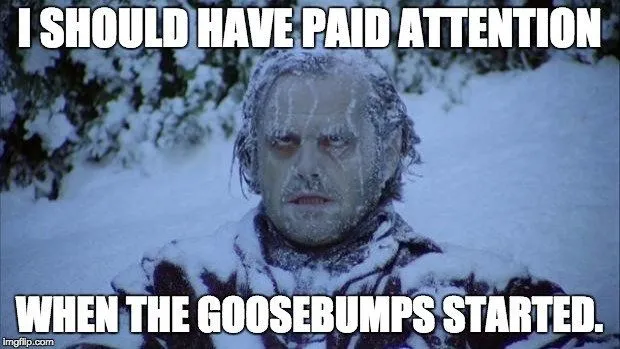
The other vital function of the pilomotor reflex is for defense. When an animal feels threatened or afraid, or forced to fight a predator or rival, the burst of adrenaline causes their hair to stand on end, which makes them look larger to their opponent. In some cases, this can be enough to avoid a fight or scare their opponent enough to give them time to make an escape. If you’ve ever surprised your cat while it was napping, you’ll notice how puffy its tail immediately gets: the pilomotor reflex in action!
Researchers are still finding fresh reasons not to dismiss goosebumps as a useless relic. In 2020, a Harvard and National Taiwan University team reported in Cell that the very same nerves and arrector pili muscles behind goosebumps also wrap around the stem cells that grow new hair. In their experiments on mice, prolonged cold ramped up the nerve signals that raise goosebumps and, in turn, nudged those stem cells to start regenerating the coat, hinting that the reflex may help animals grow a thicker layer of insulation when they need it most.
While these basic functions of goosebumps don’t help human beings much (minimal hair coverage and low levels of naked fighting), at least the next time you feel that tingle on the back of your neck, you’ll understand exactly where it comes from!
References (click to expand)
- Goose bumps - Wikipedia. Wikipedia
- pilomotor reflex - Wiktionary. Wiktionary
- Spinney, L. (2008, May). Remnants of evolution. New Scientist. Elsevier BV.
- Anatomy, Hair Follicle. StatPearls. NCBI Bookshelf.
- Shwartz, Y., et al. (2020). Cell Types Promoting Goosebumps Form a Niche to Regulate Hair Follicle Stem Cells. Cell.