Reflex actions are roughly 4–10× faster than normal voluntary responses, completing in about 20–50 milliseconds versus around 200 ms for a conscious reaction. The speed comes from a shorter neural pathway: in a spinal reflex arc, the signal jumps from a sensory neuron straight to a motor neuron through the spinal cord, bypassing the brain entirely.
Every one of us has burned our hand from touching a hot object, or has been zapped when touching an open electrical socket. We pull our limbs away from these objects of danger with remarkable speed. Even the clumsiest of us are able to execute these actions with extreme quickness.
But how?
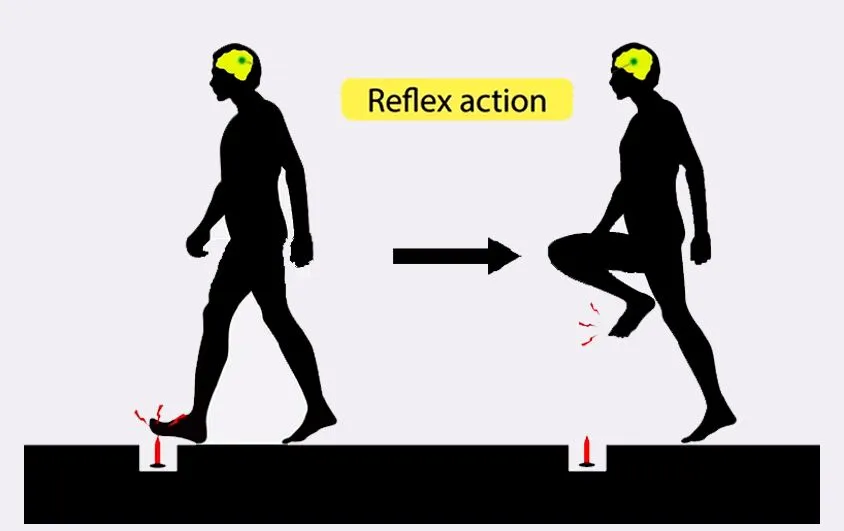
Mechanism Of A Reflex Action
A reflex action is simply a fast response of our body to any dangerous situation, such as burning your hand from a hot object. Reflexes keep us safe and distanced from harmful things, so how does our body execute these reflexes?
Reflex actions are carried out by the nervous system. Our body has built-in nerve circuits that carry out each reflex action. Let’s look at how these nerve circuits work.
Structure Of A Reflex Arc
A typical reflex arc, in its simplest form, consists of: (1) a sensory neuron that senses the potentially dangerous stimulus, and (2) a motor neuron connected to a muscle in the limbs that moves to avoid potential danger.
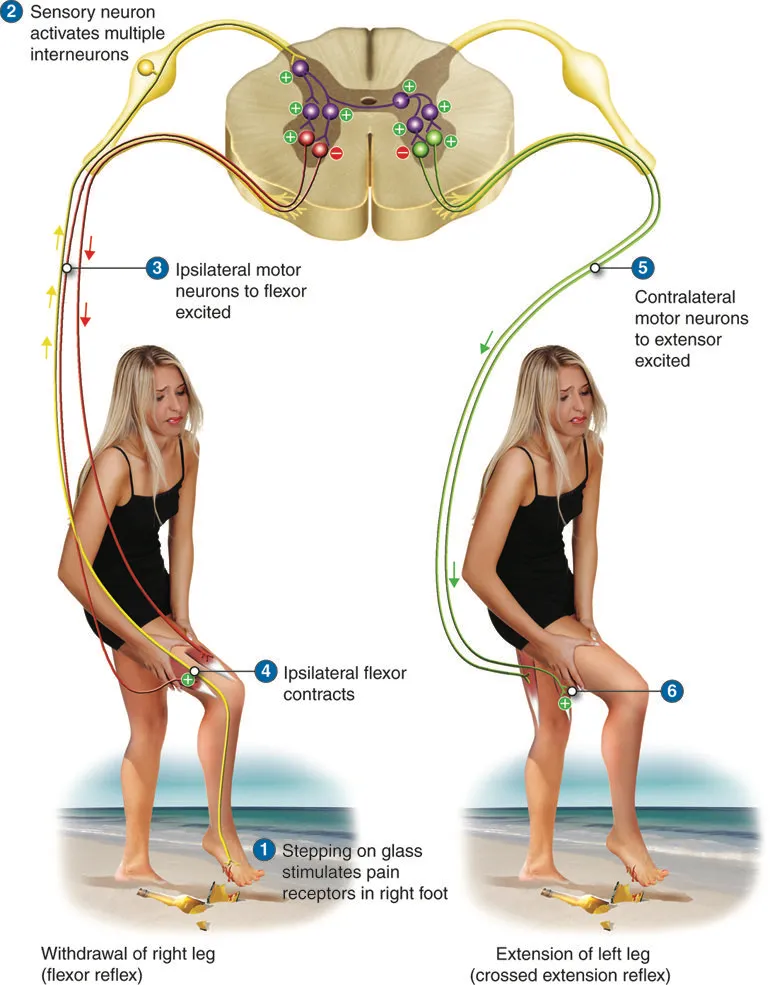
Imagine that you’ve accidentally touched the flame of a candle. The sensory neurons on your fingers sense the heat and the consequent signal travels up to the spinal cord. This is then passed on to the motor neuron connected to the muscle on your arm, which then contracts, moving your hand away from the flame.
The reflex arc neurons reside in the spinal cord of our body. The signals of danger travel up to our spinal cord. Commands from the spinal cord then travel down to our limbs through the motor neurons. However, you may have noticed that such a reflex arc completely bypasses the brain.
If we had no reflexes, the heat signal would be carried from your hand all the way to the brain’s sensory regions, and then to the motor regions. From here, the signal would have traveled to the arm, helping you move the arm consciously away from the hot object.
This type of circuit is much longer than a reflex arc, so it would take you a long time to consciously move your hand away from a hot object. Such a delay would result in you burning your hand. When faced with danger, every millisecond counts!
In contrast to normal movement, the reflex arc carries out the rapid removal of your hand from the hot object in an automatic way with a much shorter circuit, one that doesn’t require the signal to reach your brain.
Thus, reflexes are much faster due to their use of shorter circuits. Also, since these only involve the spinal cord, they are involuntary or automatic, rather than conscious movements. Any conscious movement requires the involvement of the brain.
Just how much faster are we talking? A spinal reflex like the knee-jerk can complete in roughly 20–50 milliseconds, while a typical voluntary reaction time (say, hitting a button when you see a flash of light) clocks in at around 200 milliseconds. That’s a four- to tenfold difference, and in a situation involving a flame or a falling object, that gap is often the difference between getting hurt and walking away unscathed.
Types Of Reflexes
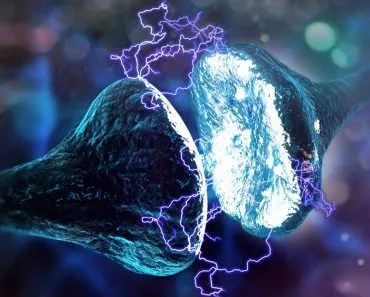
The simplest reflex arcs usually contain only two nerve cells that meet at a junction called a synapse. Typically, there is one sensory neuron and one motor neuron that meet at one synapse or junction. These are therefore called monosynaptic. However, the human body contains more sophisticated reflex arcs that contain additional neurons. These are often called interneurons, which simply pass on information from sensory to motor neurons. Such reflex arcs are called polysynaptic.
There are two broad types of reflexes based on what action it takes in the body in response to danger. Some reflexes activate our internal organs – called autonomic reflexes, but the more popular and well-known reflexes are somatic reflexes, which cause specific muscles to move in our limbs.
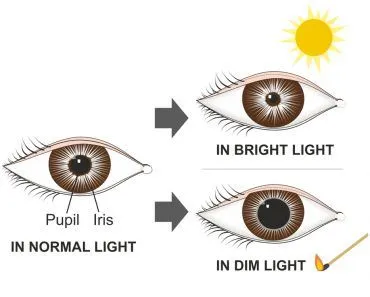
A good example of the autonomic reflex is the contraction and dilation of our pupils in response to light.
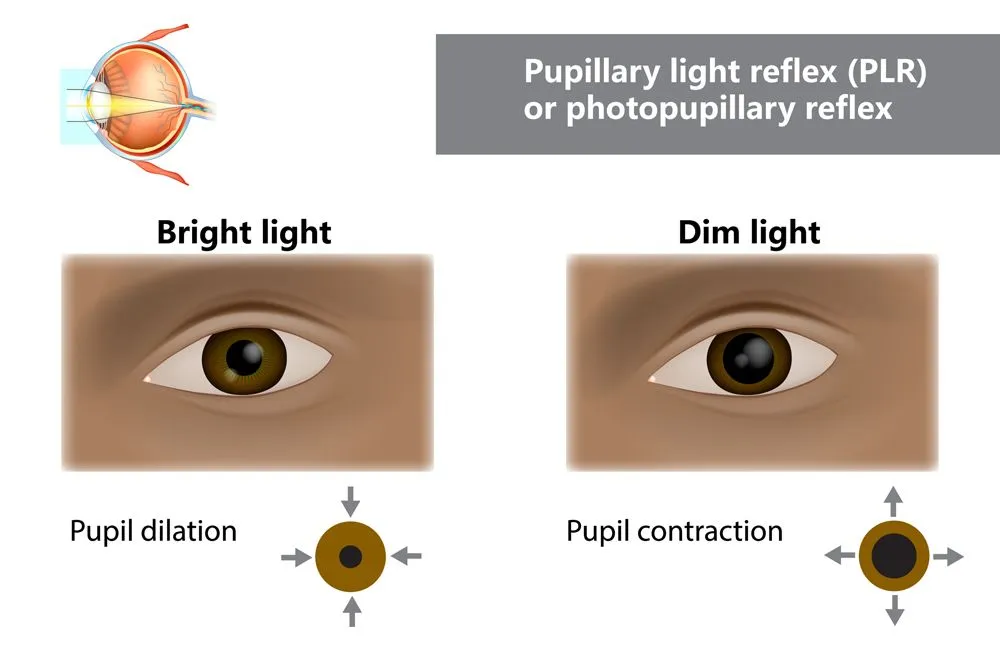
When there is a sudden bright light in front of us, the sensory cells in the retina signal the reflex arc. This causes the muscles in the iris of our eye to contract, thus reducing the pupil size. This protects our eyes from any sudden exposure to bright light, which could potentially blind us. Several such reflexes take part in modulating our heart rate, breathing, and other similar functions without our conscious control, helping us to survive day in and day out.
How Are Involuntary Actions And Reflex Actions Different?
Here's a question that trips a lot of people up: if a reflex is involuntary, isn't every involuntary action just a reflex? Not quite. All reflexes are involuntary, but not all involuntary actions are reflexes.

Think about your heartbeat, your breathing, and the slow churn of digestion. These are involuntary actions in the broad sense: they happen without you deciding to do them, they run continuously in the background, and they are governed by the autonomic nervous system. Crucially, many of these ongoing functions are coordinated with help from the brainstem rather than a quick spinal loop. They are about keeping the internal machinery ticking over (maintaining a steady internal state, what physiologists call homeostasis), not about reacting to a sudden threat.
A reflex action, by contrast, is a specific, triggered event. Something happens (a tendon is tapped, a finger touches a flame, a bright light hits the retina), a sensory neuron fires, and a fixed, stereotyped response follows within a fraction of a second. A reflex needs a trigger and produces a predictable, repeatable answer to that trigger. Your resting heartbeat needs no such trigger; it simply continues.
The two categories do overlap. The autonomic reflexes we met earlier, such as your pupils shrinking in bright light, are both involuntary and genuine reflexes, because they are triggered, fast and stereotyped. So the cleanest way to think about it is this: "involuntary action" is the wide umbrella for anything your body does without conscious command, while a "reflex action" is the narrower, trigger-and-response subset of those actions that runs on a dedicated reflex arc. Steady processes like your background heartbeat sit under the umbrella but are not reflexes in the strict sense.
Reflex Vs. Reaction: What's The Difference?
People often use "reflex" and "reaction" as if they mean the same thing, but in neuroscience they are quite distinct, and the difference comes back to whether the brain gets a vote.

A reaction is a voluntary, considered response. When you see a traffic light turn green and press the accelerator, your brain has to detect the signal, recognize what it means, decide on a response and then send the command to your muscles. That perception-and-choice loop runs through the higher centers of the brain, which is exactly why it is flexible: you can choose not to go if a pedestrian steps out. The cost of that flexibility is time. A typical voluntary reaction takes around 200 milliseconds, and a chunk of that is your brain processing the information before any muscle moves.
A reflex skips the deliberation entirely. The classic example is the patellar reflex, the knee-jerk your doctor tests with a small rubber hammer. The tap stretches the tendon, a sensory neuron carries that signal to the spinal cord, and a motor neuron fires straight back to the thigh muscle, all without the brain choosing anything. Because the loop is short and there is no decision step, a spinal reflex like this can complete in roughly 20–50 milliseconds, several times faster than a voluntary reaction.
This is also why walking is not a reflex. Walking is a complex, voluntary movement you can start, stop, speed up or redirect at will, all under conscious control. A reflex offers none of that freedom; it is fixed and automatic by design. The trade-off is the whole point: reactions buy you choice, reflexes buy you speed, and your nervous system uses each where it matters most. You still feel a reflex after the fact, because the sensory signal also travels up to the brain, but by then your hand or leg has already moved.
A Final Word
Reflexes are automatic responses to harmful stimuli around us. These are executed by special pathways involving a sensory and a motor neuron. These reflex arcs bypass the brain and occur mostly in the spinal cord. Due to this, these actions are faster than typical movements and don’t require conscious control. This is particularly useful because we require extremely fast responses to avoid danger.
Although reflex actions are automatic, we do sense these events as they happen. This is because the sensory information is eventually passed to the brain. However, we would have completed the reflex action in that short interval of time. Therefore, it’s possible to “feel” the reflexes.
It is even possible to train yourself to actively stop a reflex action. The brain can send signals to “override” a reflex and consciously help us not respond to a stimulus, but only with a lot of training. Reflex actions, although typically fast, can get slowed down at times, such as in the case of consumption of alcohol. This is the reason why drunk driving is so dangerous. When drunk, our body will not be able to execute fast reflexes, such as suddenly hitting the brake to avoid a head-on collision, for example.
Reflexes not only help us move our body away from dangerous stimuli, but also help regulate the actions of our organs in response to changes in our environment. They play a crucial role in our survival, and are in some ways the “silent warriors” of our body!
References (click to expand)
- (1845) On the Reflex Function of the Brain - PMC - NCBI. National Center for Biotechnology Information
- McIntosh, C. (2004, September 1). Alcohol and the nervous system. Journal of Neurology, Neurosurgery & Psychiatry. BMJ.
- Physiology, Withdrawal Response. StatPearls. NCBI Bookshelf.
- Reflexes: What They Are, How They Work & Types. Cleveland Clinic.
- Reflexes. Anatomy & Physiology. Lumen Learning / SUNY.
- Reflexes. Health Encyclopedia. University of Rochester Medical Center.