We raise our eyebrows when surprised for two reasons. Charles Darwin argued it lets us see better, and raising the brows really does widen the eyes and expand our field of vision. It also works as a signal, telling others around us that something unexpected has happened. Curiously, most people don’t actually make the full “surprised” face.
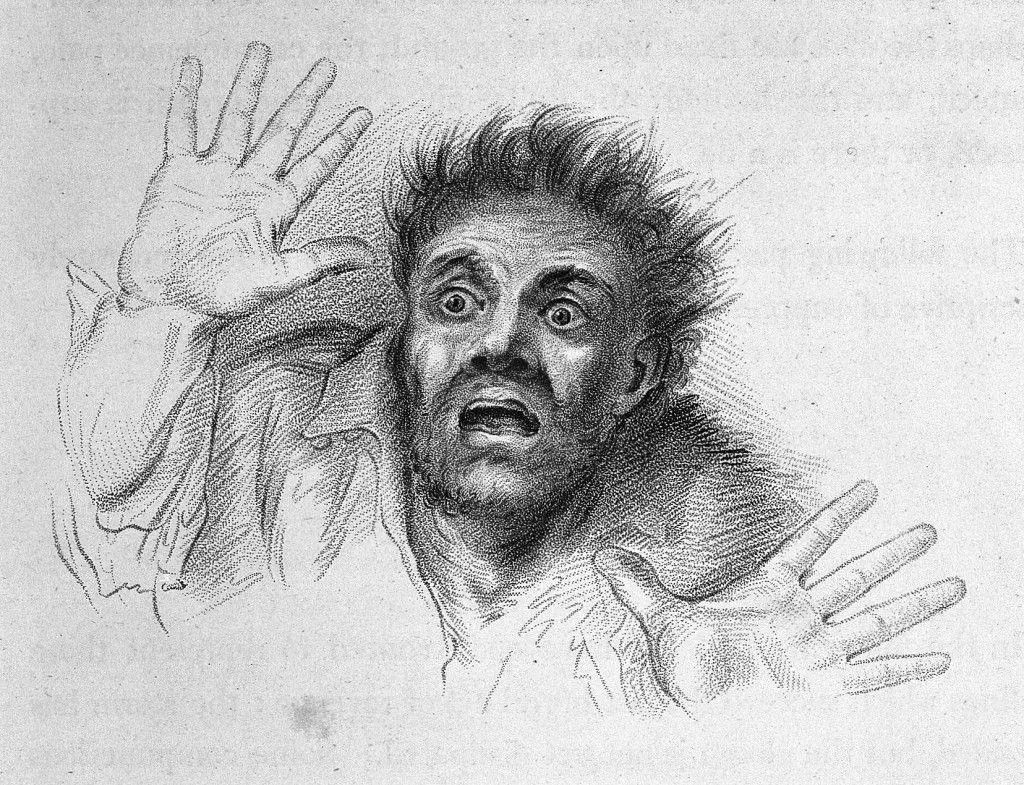
One day, as I sat daydreaming, my brain surprised me with a sudden question: “Why do we raise our eyebrows when we’re surprised?” The many depictions of surprise always seem to show three characteristics (raised eyebrows, widened eyes, and a dropped jaw). I react with similar expressions when surprised, either by a fact that changed my perspective of the world, or when my friends surprised me on my birthday!
When I dug around for answers, I realized that raised eyebrows, or any other change in your expression, isn’t a universal response to surprise. Even so, across countless depictions, we’ve clearly come to associate raised eyebrows with surprise.
So, why do we raise our eyebrows when surprised?
How We Get Surprised
The element of surprise sits squarely between the element of wonder and the element of curiosity. From our earliest ages, we respond to novel and unexpected things. A sense of surprise is nothing but a reaction to the unexpected, and/or novel. Why and how the unexpected brings about the emotion of surprise is, unsurprisingly, a vast landscape of research.
Our experiences shape our belief systems about the world and our place within it, what psychologists call schema. We form our schemas from past and present experiences, and based on them, we predict (not wholly consciously) what might or might not happen in the next instant or a year from now.
If you’ve never received a surprise birthday party, or any indication that surprise birthday parties might even be a possibility, your brain eliminates that possibility.
So, when a surprise birthday party does happen, and you see your friends and family standing there with a cake and streamers, it will come as a surprise. Your schema couldn’t predict this.
The amount of your surprise is going to depend on how unexpected the event is. The more unexpected, the more surprise you feel.
The Surprise Mechanism And Evolution
The “surprise” awakens a jolt of curiosity within us, the brain itching to analyze the unexpected. With curiosity, we learn. We divert all our attention toward the event, hijacking other mental processes, such as worrying about work or daydreaming, to do so.

Our focus on an unexpected thing makes evolutionary sense. The unexpected event could be a danger we’ve never encountered, or we encounter an opportunity that might help us with survival. The surprise helps us build upon our world experience. Once someone has thrown a birthday party for you, your brain integrates that into your schema. Now, if someone throws another surprise party for you, you’re likely to be less surprised than you were the first time.
Your head turns toward the surprise and all your senses go into high alert. We focus so wholly on the surprise (a loud bang in the corner of the room) that our brain momentarily becomes blind to other stimuli.
Coupled with our mental exploration are our facial expressions, which bring us to the eyebrow raise…
Facial Expression Of Surprise
According to the most famous evolutionary biologist of all time, Charles Darwin, we raise our eyebrows and widen our eyes in order to see better. The single muscle that lifts the brows, the frontalis (the frontal belly of the occipitofrontalis), drags the forehead skin upward and pulls the eyelids wide open. That, Darwin and many after him have postulated, widens our field of vision, helping our ancestors take in a sudden danger and improving their chances of survival.
Later researchers have actually tested this. When people pose a wide-eyed, fearful “surprise” face, their visual field expands, their eyes dart between targets faster, and they pull in more air with each breath, exactly what you would want when something unexpected demands your attention. Posing the opposite expression, disgust, does the reverse. So the surprised face does seem to be built to gather more information, just as Darwin suspected.
There is a twist, though. Surprisingly (or unsurprisingly for some), most people don’t actually make that face when surprised. The full eyebrow raise, widened eyes and open mouth show up in only a minority of surprised people, roughly 10 to 30% across various studies. The same low hit rate holds for other emotions, such as happiness, sadness, and disgust. The expression may be useful, but we don’t reliably produce it.
This is not to say that the body ignores surprises. Studies have noted a brief change in skin sweat response and a momentary slowing of the heart as we freeze and orient toward the unexpected.
So if the surprised face isn’t a guaranteed readout of surprise, what else is it for?
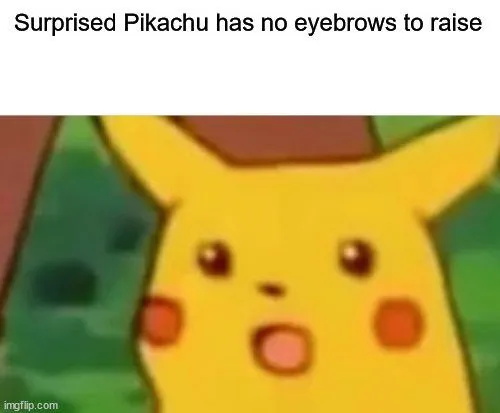
The other big answer is social communication. Our faces help broadcast our state to others around us. An angry face signals disapproval, while a fearful face warns of danger. Surprise works the same way. We often react to a surprise by raising our brows and blurting out an “Oh!”, as if to show the other person that we have been caught off guard.
Eyebrows are remarkably good at this. The ethologist Irenäus Eibl-Eibesfeldt filmed people greeting one another across cultures (in Samoa, Papua New Guinea, among the San of southern Africa, in Bali, and in Europe) and found the same quick up-and-down flick of the brows, lasting only a fraction of a second. This “eyebrow flash” is a near-universal signal of recognition, a wordless “I see you” that works across languages. So even when surprise itself doesn’t reliably move our brows, raised eyebrows remain one of our most powerful social signals.
It is worth stressing that these are still working hypotheses, and researchers are very much still untangling how and why we express surprise the way we do. Darwin wasn’t entirely wrong, then. The surprised face really can help us see more. It just isn’t the automatic giveaway he imagined.
What Raised Eyebrows Say When We Talk
Surprise is only one reason our brows go up. Watch anyone tell a good story and you will see their eyebrows bobbing away, and that turns out to be a big part of why we raise them in the first place. Our eyebrows work as a kind of visual punctuation for speech, run by the same forehead muscle (the frontalis) that lifts them when we are startled.

When the linguist Marisa Flecha-García recorded pairs of people working through a map task together, she found that brow raises clustered tightly around the emphasised words in a sentence. More than 80% of eyebrow movements began within about a third of a second (330 milliseconds) of the nearest stressed, high-pitch syllable, and on average the brow started to lift roughly 60 milliseconds before that syllable was spoken. The raise seemed to add an extra layer of prominence, marking out the words that mattered most.
Later work has echoed this. Analysing 887 clips from late-night talk-show interviews, one study found brow raises closely tied to the peaks of the speaker's pitch, with eyebrows and voice produced as a single coordinated package rather than one simply trailing the other. Another study, looking at YouTube monologues, found that the higher a speaker's pitch climbed, the stronger the brow raise tended to be, and that the link between pitch and brow-raising was stronger for North American speakers than for British ones.
So when someone lifts their brows mid-sentence, they are usually underlining a word, flagging a question, or signalling “pay attention, this bit is important”, the facial equivalent of italics. It is the same channel Darwin's surprised face borrows, and a reminder that our facial expressions do real work in everyday conversation.
Why Do Some People Raise Their Eyebrows So Much?
Ever caught yourself, or a chatty friend, lifting your brows almost constantly? There are a few harmless explanations, and one worth a passing mention.
The commonest is the one above. Expressive talkers recruit their eyebrows as emphasis markers, and some of us are simply more animated than others (recall that the YouTube study found the tie between pitch and brow-raising was stronger in North American speakers than in British ones). A frequent brow-lift can also settle into a plain habit. None of this means anything is wrong.
Occasionally, though, a repeated brow-raise that you cannot easily suppress is a facial tic, a brief involuntary contraction of the muscles. According to the NHS, tics are fairly common, usually first appearing in childhood, and, importantly, they are not usually serious and do not damage the brain. In most cases they ease over time or stop completely on their own. When a tic is persistent or bothersome, a behavioural approach called habit reversal training can help: you learn to notice the urge building and swap in a competing movement that makes the tic hard to carry out. If involuntary movements are frequent, distressing, or newly appearing in adulthood, it is worth checking in with a doctor.
A Final Word
Whether a surprise makes you raise your eyebrows or not, it does increase curiosity, as well as the urge to share that surprise. A surprising fact can make you curious about the topic, and by extension, the world around you. Not to mention, surprises are pleasant (for most people) and there is evidence that we seek out surprises because they give us joy.
Alice Walker’s words, “Expect nothing. Live frugally on surprise.” seem like good advice to live by!
References (click to expand)
- Jack, R. E., & Schyns, P. G. (2015, July). The Human Face as a Dynamic Tool for Social Communication. Current Biology. Elsevier BV.
- Reisenzein, R., Horstmann, G., & Schützwohl, A. (2017, September 23). The Cognitive-Evolutionary Model of Surprise: A Review of the Evidence. Topics in Cognitive Science. Wiley.
- Noordewier, M. K., & van Dijk, E. (2018, September 6). Surprise: unfolding of facial expressions. Cognition and Emotion. Informa UK Limited.
- Susskind, J. M., et al. (2008). Expressing fear enhances sensory acquisition. Nature Neuroscience.
- Anatomy, Head and Neck: Frontalis Muscle. StatPearls. NCBI Bookshelf.
- Grammer, K., et al. (1988). Patterns on the Face: The Eyebrow Flash in Crosscultural Comparison. Ethology.
- Flecha-García, M. L. (2010). Eyebrow raises in dialogue and their relation to discourse structure, utterance function and pitch accents in English. Speech Communication.
- Gast, V. (2023). The Temporal Alignment of Speech-Accompanying Eyebrow Movement and Voice Pitch. Behavioral Sciences.
- Berger, S., & Zellers, M. (2022). Multimodal Prominence Marking in Semi-Spontaneous YouTube Monologs. Frontiers in Communication.
- Tics. NHS.
- Habit Reversal Training. Cleveland Clinic.