Table of Contents (click to expand)
Optical illusions happen when the brain misreads visual cues. Yes, animal optical illusions are real: pigeons, fish, monkeys, and cats fall for many of the same tricks we do. A 2024 review of 26 species found illusions are widespread in animals, though some, such as dogs, see certain illusions in reverse.
We often think that we see with just our eyes. Sure, our eyes help us perceive things in front of us, but it is our brain that helps us make sense of what our eyes observe.
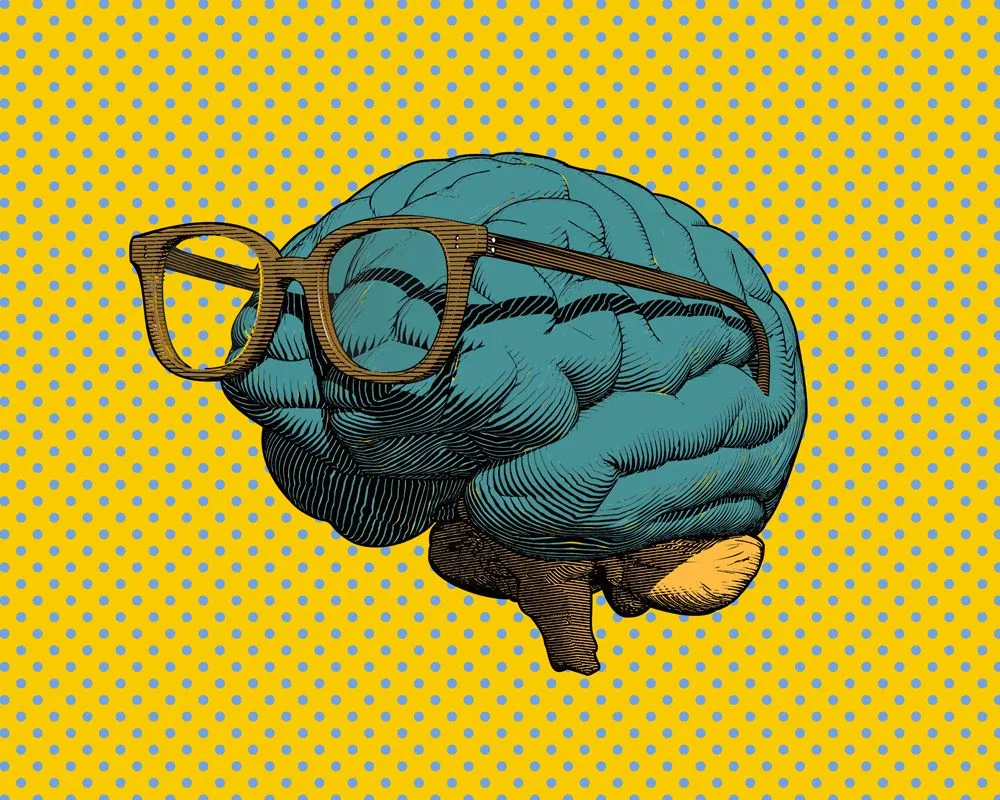
The brain helps us understand information about an object’s size, depth, distance, and many other factors. In other words, it helps us “interpret” what the eyes perceive.
From the day a baby first opens its eyes and starts seeing the world, its visual system takes in information about its surroundings. It starts learning several rules, which help in understanding visual information. For example, we know that things look smaller when far away and larger when near us. We may not think about these rules consciously, but we use them to understand what we are seeing in the world around us.
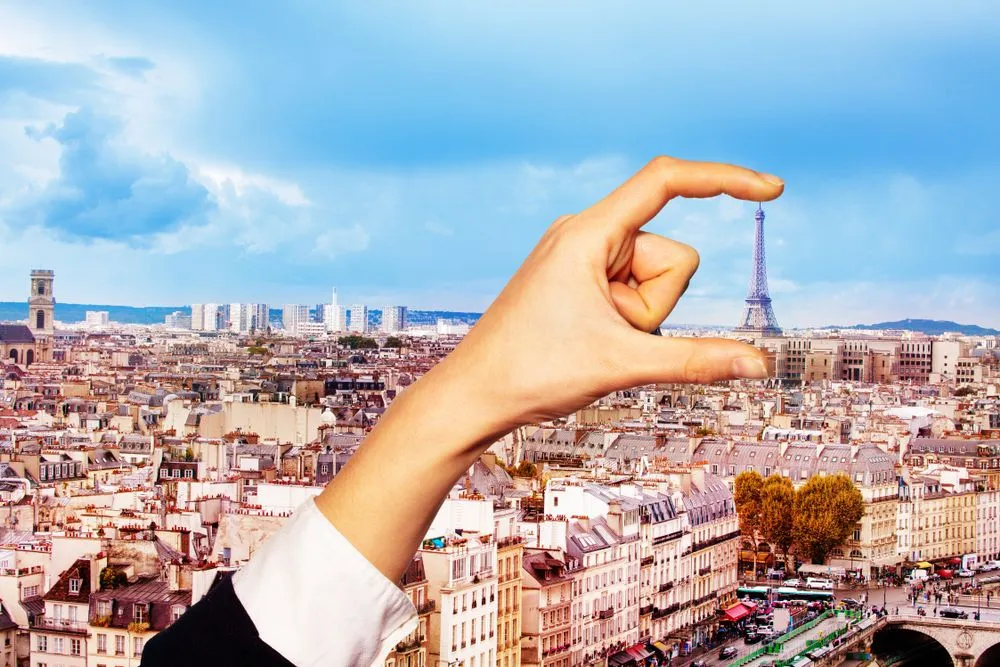
There is a cost to using such rules or blanket assumptions about the world as we see it. Optical illusions are a testament to this!
What Is An Optical Illusion And Why Does It Happen?
Optical illusions are simply “misreadings” by the brain about what our eyes perceive, i.e., the brain applies its usual assumptions learned from experience about the world, and in some cases, it may lead to us making errors in how we perceive something visually. An object can appear bigger, smaller, longer, shorter, darker, or lighter than it is due to misperception by our brains.
Müller-Lyer Illusion
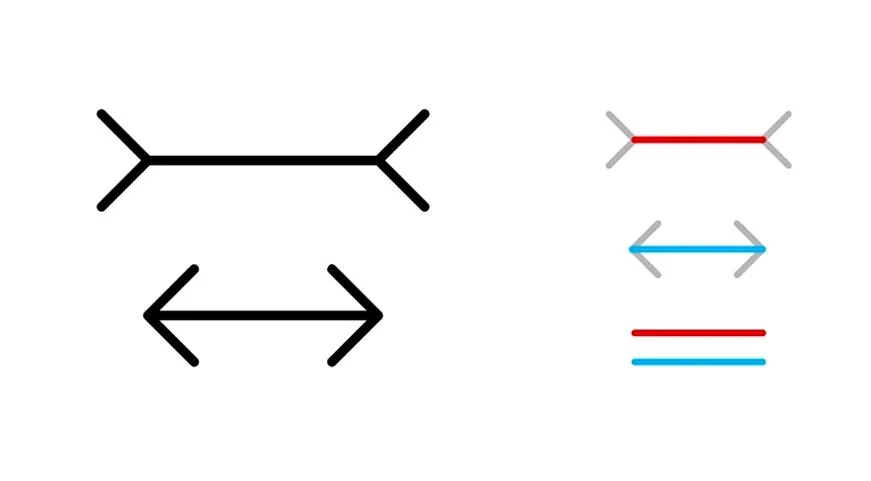
For example, consider the famous Müller-Lyer illusion of two horizontal lines shown side by side – one with inward-pointing arrows, and one with outward arrows.
Ponzo Illusion And The Kanizsa Triangle
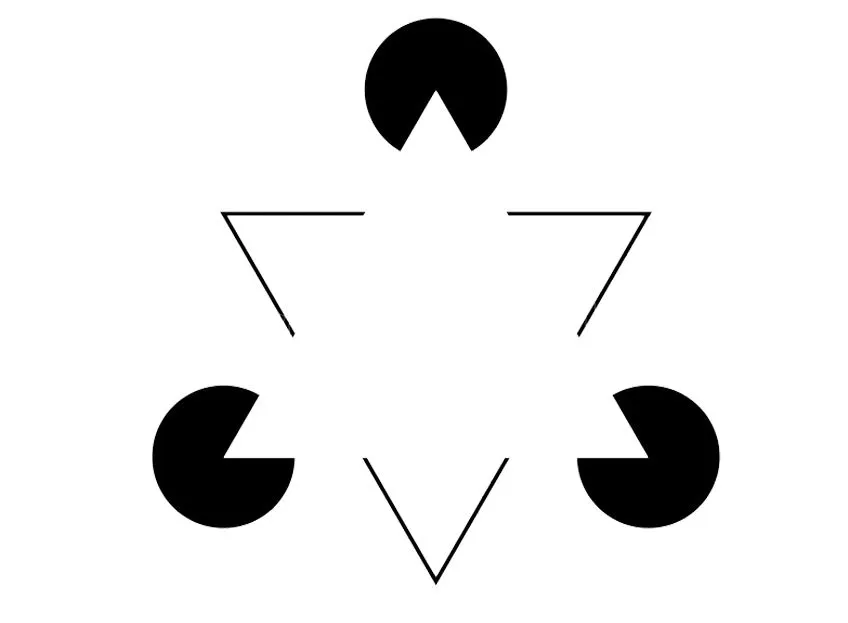
Although both lines are of the same length, we perceive the lines to be unequal in length. There are several well-studied geometric illusions, such as the Ponzo illusion and the Kanizsa triangle, each of which deal with a different kind of error being made by the brain.
Similar to the Müller-Lyer illusion, the Ponzo illusion causes an error in the perception of the length of lines. Kanizsa triangle is an example of illusion caused by “filling in” by the brain, where the brain fills in non-existent information. A triangle that does not exist in the image is perceived in the background!
Optical illusions occur because the brain uses context to understand visual information coming from the eyes, but the contextual cues can sometimes be misleading. Interestingly, studies have proven that knowing the reality of an optical illusion will not stop you from seeing it, telling us that these brain mechanisms are automatic and cannot be regulated by conscious awareness.
A natural question that would arise in anyone’s mind is whether such errors are unique to human brains or do all organisms make similar errors in judgment of objects they see?
Perceptions Of Illusions In Animals
If animals also use rules similar to us to interpret the world around them, then they would also be able to perceive optical illusions. A review of studies on animals perceiving visual illusions found that many species do indeed fall for the same optical illusions as we do. A more recent 2024 meta-analysis in Proceedings of the Royal Society B pulled together 45 studies covering 534 individual animals across 26 species, and concluded that susceptibility to geometric illusions is a general phenomenon among animals. That said, the picture is not as tidy as a single headline would suggest: roughly as many experiments showed no effect, or an effect in the opposite direction, as showed the human-like response. Birds turned out to be the most reliably fooled, and animals with eyes on the sides of their heads tended to be more susceptible than forward-facing species like us.
In these studies, they train animals on well-known optical illusions, such as the Müller-Lyer illusion. The animals were trained to respond if the lines are of the same or different lengths or classify lines as long or short by different actions in distinct studies.
While birds, such as pigeons, were trained to respond through a keypress, parrots were trained to respond through vocal responses. In experiments with monkeys, they were taught to respond using touchscreens. Fish were trained to move towards a specific compartment to record their choice. In all these studies animals were seen to perceive lines with inward arrows as shorter, just like humans!
In short, many geometric illusions seem to carry across different types of birds, fish, dolphins, and macaques. This suggests that these animals and humans often process visual information in similar ways using their brains.
You do not always need a lab to catch an animal in the act, either. Take the internet's favorite party trick: cats sitting inside squares taped on the floor. In a charming 2021 citizen-science study (cheekily titled "If I Fits I Sits"), owners around the world taped out three shapes for their cats. One was a real square outline, one was a "Kanizsa square" made only from four Pac-Man-like corners (the same illusory-contour trick described above), and one was a scrambled control. The cats plonked themselves down in the illusory Kanizsa square about as readily as in the real square, and far more than in the control. In other words, your cat's brain "fills in" the missing edges of that fake box just like yours does.
Do Insects Fall For Optical Illusions Too?
So far, every animal we have met (birds, fish, monkeys, cats, and dogs) has a backbone. That raises an obvious question: are illusions a quirk of large vertebrate brains, or does the trick reach further down the family tree? To find out, researchers turned to insects, whose brains are minuscule next to ours.

Honeybees turned out to be surprisingly easy to fool. In a classic experiment, van Hateren, Srinivasan, and Wait (1990) trained bees to tell apart patterns of tilted lines, then presented them with Kanizsa figures, the same illusory shapes described earlier, in which the brain fills in edges that are not actually there. The bees responded to the illusory rectangles just as they did to real ones, as though the missing borders were solid. Later research found that honeybees also fall for contextual size illusions much as we do, at least when they are free to view the pattern from a natural distance rather than up close (Gatto et al., 2022).
The praying mantis produced an even stranger result. A team at Newcastle University fitted mantises with tiny 3D glasses, gluing a colored filter over each eye with a dab of harmless beeswax, and sat them in front of an "insect cinema." When a virtual bug appeared to hover in the air just in front of them, the mantises lunged at empty space, proof that they see real three-dimensional depth (Nityananda et al., 2018). Their depth sense, though, does not work like ours. Mantis 3D vision locks onto where an image is changing from one moment to the next rather than matching up static detail, so the insects could spot moving targets buried in flickering dot patterns that the human volunteers watching the same films simply could not see.
That a creature with a brain smaller than a grain of rice can both be tricked by our illusions and see depth in ways we cannot hints that these visual shortcuts are ancient, arising again and again wherever eyes and brains must turn flat images into a three-dimensional world.
A Final Note
Optical illusions reveal how an organism uses its brain to interpret visual information using contextual cues. Humans and many animals have been shown to perceive several optical illusions in a similar fashion. However, some striking exceptions have also turned up. The exceptions show that evolution may have wired some animals to see the world differently than we do.
Dogs are a great example. When tested on the Ebbinghaus illusion (a circle ringed by larger circles looks smaller to us, and a circle ringed by smaller circles looks bigger), dogs got it backwards. They judged the sizes in the reverse direction from humans, suggesting their visual system weighs the surrounding context in a different way than ours does. So no, optical illusions do not work on every animal the same way, and a few do not seem to work at all.
And some animals do more than just see illusions, they build them. Male great bowerbirds in northern Australia arrange the bones, shells, and pebbles on their courtship "avenues" from small at the front to large at the back. From the spot where a watching female stands, this size gradient creates a forced-perspective illusion that makes the display look evenly proportioned, and the males that pull off the strongest illusion tend to win the most mates. Researchers found that when they jumbled the carefully sorted objects, the males rebuilt the gradient within a few days, which tells us the illusion is no accident.
These findings of optical illusions in animals prove that these mechanisms are probably far more innate and based on evolutionary roles played by our environment.
The beauty of our brain’s visual processing system lies in how the same contextual cues that help you read difficult letters and numbers in “cache” on websites is also responsible for you making errors and perceiving illusions, making us distinctly “human” and so very unlike a computer or machine!
References (click to expand)
- Feng, L. C., Chouinard, P. A., Howell, T. J., & Bennett, P. C. (2016, August 3). Why do animals differ in their susceptibility to geometrical illusions?. Psychonomic Bulletin & Review. Springer Science and Business Media LLC.
- Nakamura, N., Watanabe, S., & Fujita, K. (2009). Further analysis of perception of the standard Müller-Lyer figures in pigeons (Columba livia) and humans (Homo sapiens): Effects of length of brackets. Journal of Comparative Psychology. American Psychological Association (APA).
- Pepperberg, I. M., Vicinay, J., & Cavanagh, P. (2008, January 1). Processing of the Müller-Lyer Illusion by a Grey Parrot (Psittacus Erithacus). Perception. SAGE Publications.
- SUGANUMA, E., PESSOA, V., MONGEFUENTES, V., CASTRO, B., & TAVARES, M. (2007, August 22). Perception of the Müller–Lyer illusion in capuchin monkeys (Cebus apella). Behavioural Brain Research. Elsevier BV.
- Sovrano, V. A., da Pos, O., & Albertazzi, L. (2015, September 11). The Müller-Lyer illusion in the teleost fish Xenotoca eiseni. Animal Cognition. Springer Science and Business Media LLC.
- Bánszegi, O., Rosetti, M., Olivares, U. J., & Szenczi, P. (2024). Response to geometrical visual illusions in non-human animals: a meta-analysis. Proceedings of the Royal Society B: Biological Sciences.
- Smith, G. E., Chouinard, P. A., & Byosiere, S.-E. (2021). If I fits I sits: A citizen science investigation into illusory contour susceptibility in domestic cats (Felis silvestris catus). Applied Animal Behaviour Science. Elsevier BV.
- Byosiere, S.-E., Feng, L. C., Woodhead, J. K., Rutter, N. J., Chouinard, P. A., Howell, T. J., & Bennett, P. C. (2017). Visual perception in domestic dogs: susceptibility to the Ebbinghaus-Titchener and Delboeuf illusions. Animal Cognition. Springer Science and Business Media LLC.
- Kelley, L. A., & Endler, J. A. (2012). Male great bowerbirds create forced perspective illusions with consistently different individual quality. Proceedings of the National Academy of Sciences.
- van Hateren, J. H., Srinivasan, M. V., & Wait, P. B. (1990). Pattern recognition in bees: orientation discrimination. Journal of Comparative Physiology A, 167(5), 649-654.
- Gatto, E., Loukola, O. J., Miletto Petrazzini, M. E., Agrillo, C., & Cutini, S. (2022). Illusional Perspective across Humans and Bees. Vision, 6(2), 28.
- Nityananda, V., Tarawneh, G., Henriksen, S., Umeton, D., Simmons, A., & Read, J. C. A. (2018). A Novel Form of Stereo Vision in the Praying Mantis. Current Biology, 28(4), 588-593.