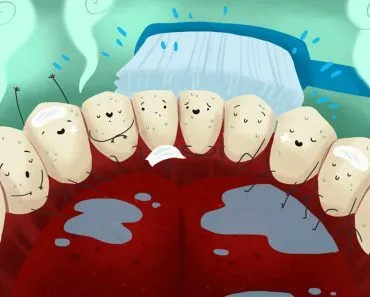
Your teeth chatter when you’re cold because your brain’s thermostat triggers shivering to generate heat. The jaw muscles are skeletal muscles too, so they contract and relax rapidly along with the rest, knocking your upper and lower teeth together. It’s an involuntary reflex that stops once you warm back up.
Imagine the last time you stepped out into a brisk autumn morning without a sweater on, just to let that cold air wake you up. The first few seconds might be refreshing, but after that, a peculiar thing happens. The tip of your nose will start getting cold, and then a bit of a shiver will run down your spine. Within a few minutes, your teeth begin to bang against one another – chattering – and there’s almost nothing you can do to stop it!
This happens to everyone – except those who live in climates that never get chilly – but what is the real cause of this peculiar physical phenomenon? Why do our teeth chatter when we’re cold?
Short answer: This occurs because the muscles around your jaw shiver in an attempt to generate warmth, causing your teeth to bang into one another and “chatter”.
Is Your Blood Cold Or Warm?
Cold-blooded animals – insects, amphibians, reptiles and fish, among others – don’t have to worry about their surroundings as much, because their body temperature simply tracks the world around them. When it’s hot outside, the animal warms up; when it’s cold, its body cools down to match. They are specially adapted to stay alive and functional, despite these sometimes extreme sweeps in exterior temperature.
However, as warm-blooded animals – like the vast majority of other mammals and birds – human beings have a rather narrow temperature range where they are truly “comfortable”. Our bodies also do their best to maintain a steady temperature, despite the surrounding conditions. This is the same reason we wear coats and scarves in the winter, but shed those layers once summertime comes out to play. Warm-blooded animals don’t do well in extreme temperatures, so they tend to stay in their preferred environments, hibernate if necessary, and regulate their body temperature as best they can.

Human beings, however, globe-trotting explorers that we are, often put ourselves into environments that alter our preferred internal body temperature away from roughly 37 °C (98.6 °F). (That long-quoted 98.6 °F figure is actually a bit high; modern studies put the average closer to 36.6 °C, or about 97.9 °F, and it varies from person to person.) To counteract this, we have created clothing, elaborate shelters, heating and cooling systems, and various other tools to help us regulate. However, when we step outside, or when our regulatory tools don’t work properly, the body must take on the task and find a way to get that temperature back to normal…
Sweating And Shivering
The two most common temperature regulation tools used by humans are sweating and shivering. As you hopefully know, sweating occurs when the body’s temperature goes above the preferred range. By releasing sweat, the body cools itself down in two ways. First, by releasing moisture onto the skin, it “feels” cooler. Just pour some water on your hand and stand next to an open window; doesn’t your wet hand feel slightly cooler? Secondly, when the sweat on your skin eventually evaporates (provided you are in a relatively humidity-free environment), it will take some of your body heat with it.
On the other end of the spectrum, when your body’s internal temperature begins to fall below the preferred range, the body needs to create extra warmth. This is steered by the hypothalamus, a small region of the brain that acts as your internal thermostat. When it senses that your core is dipping below the set point, it fires off signals that make your skeletal muscles – from your shins and thighs to your shoulders, hands and cheeks – begin to gently (or violently) shake and shiver, which expends energy and thereby releases heat. Despite the fact that shivering is normally a sign that you’re cold, the process itself is intended to keep you warm!
Shivering + Facial Muscles = Chattering Teeth
As you’ve probably already figured out, the combination of shivering skeletal muscles, including those in your face and jaw, with two rows of perfectly clack-able teeth, results in the strange chattering noise that seems to involuntarily occur when we are standing out in the cold. Very subtle chattering might happen as a result of a small chill, but when your body’s internal temperature falls significantly, shivering and chattering can both become quite powerful, causing muscle pain or even chipped teeth!
Granted, there are many other types of “self-inflicted” injuries to the teeth that are far more common – such as grinding of the teeth (bruxism) or constant flexing and contracting of the jaw muscles (oromandibular dystonia). However, as satisfying as a good teeth chatter can be from time to time, especially if it warms up your face, you don’t want to run the risk of chipping those pearly whites!

Basically, whether you’re walking through a blizzard in a t-shirt or simply sitting next to a drafty window on a cool spring night, don’t freak out when your teeth start to involuntarily bang into one another. They don’t have a mind of their own; it’s just your body’s way of telling you that it’s working hard to keep your temperature regulated – and possibly suggesting that you put on a sweater!
What If Your Teeth Chatter When You’re Not Cold?
Here’s the twist: you don’t actually have to be cold for your teeth to chatter. The clearest example is a fever. When you’re fighting an infection, the hypothalamus pushes your temperature set point higher, so your body suddenly treats its normal temperature as too low. That’s why you get chills and chattering teeth in the early stage of a fever even while you feel hot to the touch – your brain is shivering you up toward the new, elevated target.
Strong emotions can do it too. A jolt of fear or anxiety floods the body with adrenaline as part of the fight-or-flight response, and that surge can set off the same kind of involuntary jaw trembling and teeth chattering you’d expect from the cold. Less commonly, chattering that has nothing to do with temperature can stem from low blood sugar (hypoglycemia), certain medications, alcohol or drug withdrawal, or neurological conditions. If your teeth chatter often without an obvious chill, fever, or rush of nerves, it’s worth mentioning to a doctor rather than writing it off.
References (click to expand)
- Why do your teeth chatter when you are cold? - UCSB Science Line. The University of California, Santa Barbara
- Warm and Cold Blooded Animals - coolcosmos.ipac.caltech.edu
- Frank, S. M., Raja, S. N., Bulcao, C., & Goldstein, D. S. (2000, July 1). Age-related thermoregulatory differences during core cooling in humans. American Journal of Physiology-Regulatory, Integrative and Comparative Physiology. American Physiological Society.
- In brief: How is body temperature regulated and what is fever? InformedHealth.org. NCBI Bookshelf.
- Teeth Chattering: Causes, Treatment, and When to See a Doctor. Healthline.