Sounds like nails on a blackboard make our skin crawl because they sit in the same 2,000-5,000 Hz range that our ears are most sensitive to, and they share the rough, scream-like texture that triggers the amygdala’s fight-or-flight alarm. Our brain hears a distress call even though nothing dangerous is around, and the mismatch feels deeply unpleasant.
Nails clawing on a blackboard.
A fork scraping on glass.
The shrill sound of a shriek.
I bet just reading those words made some of you cringe; the very thought of them makes you grimace and sends shivers down your spine. These sounds are universally despised, but why do we have such an extremely unpleasant reaction to these sounds? Is it just because they’re annoying to listen to, or is there a deeper biological explanation behind it?

How Do We Hear Sound?
You might remember the iconic “water cup sound wave” scene from Jurassic Park.
In the dead of night, a young boy notices the water in a cup beginning to ripple as the ground around him vibrates, revealing the arrival of the giant T. rex as it stomps through the park. The vibration created by the footsteps of the giant predatory dinosaur causes the water in the glass to ripple.
A sound wave functions in a similar way. When we speak or make a sound, we create pressure from our vocal cords that pushes the air particles and creates a ripple in the air.

Human Ear Anatomy
The air particles vibrate in tune with the pressure produced and make their way to our ears. The outer part of our ears, known as the auricle or pinna, collects these sound waves in the form of vibrations of the air particles. The vibration travels through a small space between the outer opening of the ear and the eardrum known as the ear canal.
The eardrum, accurately named, is a stretched membrane that functions exactly like the surface of a drum. Just like how the surface of a drum vibrates when we beat it with a mallet, the vibrating air particles cause the eardrum to vibrate!
Just behind the eardrum, in a small air-filled space called the middle ear, sit the three smallest bones in the human body, collectively called the ear ossicles (the malleus, incus, and stapes). The eardrum sets them vibrating, and the chain of three bones acts like a tiny mechanical amplifier, pressing the vibrations onto the membrane of the cochlea.
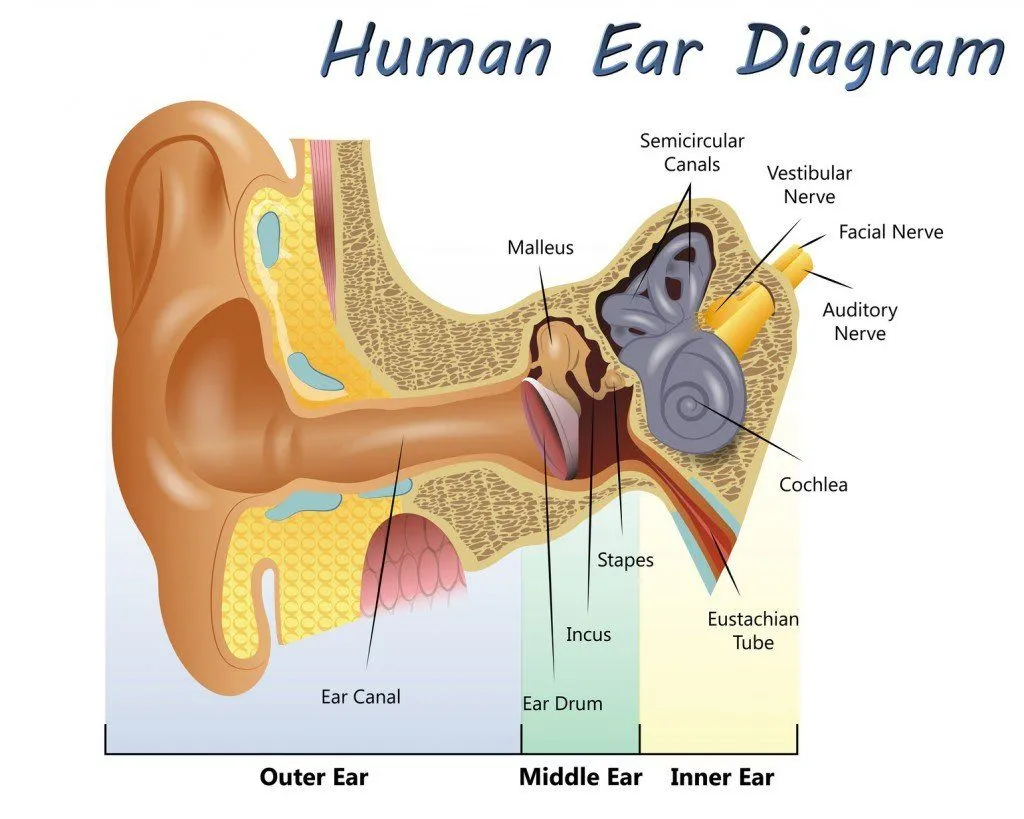
The cochlea is a small, snail-shaped structure tucked into the inner ear. It is filled with fluid and lined with tiny hair cells along a strip called the organ of Corti.
Now, recall how the T. rex made the glass of water vibrate with its mighty stomps. In a similar way, the smallest of the three ossicles (the stapes) pushes on the cochlea’s oval window and sets the fluid inside the cochlea sloshing back and forth. The rippling fluid bends the hair cells, which fire electrical signals down the auditory nerve to the part of the brain responsible for making sense of sound, known as the auditory cortex.
The two defining features of a sound wave are its amplitude and frequency. Amplitude tells us how loud a sound is, while frequency lets us know how high or low a sound is, known as the pitch.
Why Can’t We Bear The Sound Of Nails Dragging On A Blackboard?
In 2012, scientists conducted a study where they asked people to rank a list of sounds according to how annoying they were. The sounds that made it to the top included knife on glass, nails on a blackboard, fork on glass, and shrill screams.
All of these sounds had one underlying similarity… their high pitch! Pitch, as mentioned earlier, is determined by frequency. The number of times a thing occurs is said to be its frequency. Similarly, the number of vibrations caused by a sound wave is its frequency. More vibrations correspond to a high-pitched sound. The unit of measurement for frequency is Hertz (Hz).
Human beings can hear sounds in the frequency range between 20 Hz and 20,000 Hz. The frequencies of the sounds listed above are between 2000 Hz and 5000 Hz. Our ears appear to be the most sensitive to this range of sound frequency.
While the people participating in the study listened to these sounds, scientists measured the real-time activity in their brains through functional magnetic resonance imaging (fMRI). fMRI shows activity in the brain by measuring the changes in blood flow in the brain. An active part of the brain uses more oxygen, which causes more blood flow to that specific area.
Scientists observed that sounds like nails clawing on a blackboard and a knife scraping on glass cause high activity in two brain regions: the auditory cortex and the amygdala. As we learned earlier, the auditory cortex is the part of the brain that helps us make sense of the sounds we hear each day.
The amygdala is a small pouch-like structure known as the “emotional center” of the brain. When we see an unsuspecting spider in our room and run out of the room at top speed, it is our amygdala at work. It triggers our fight-or-flight response, which is essential for our survival.
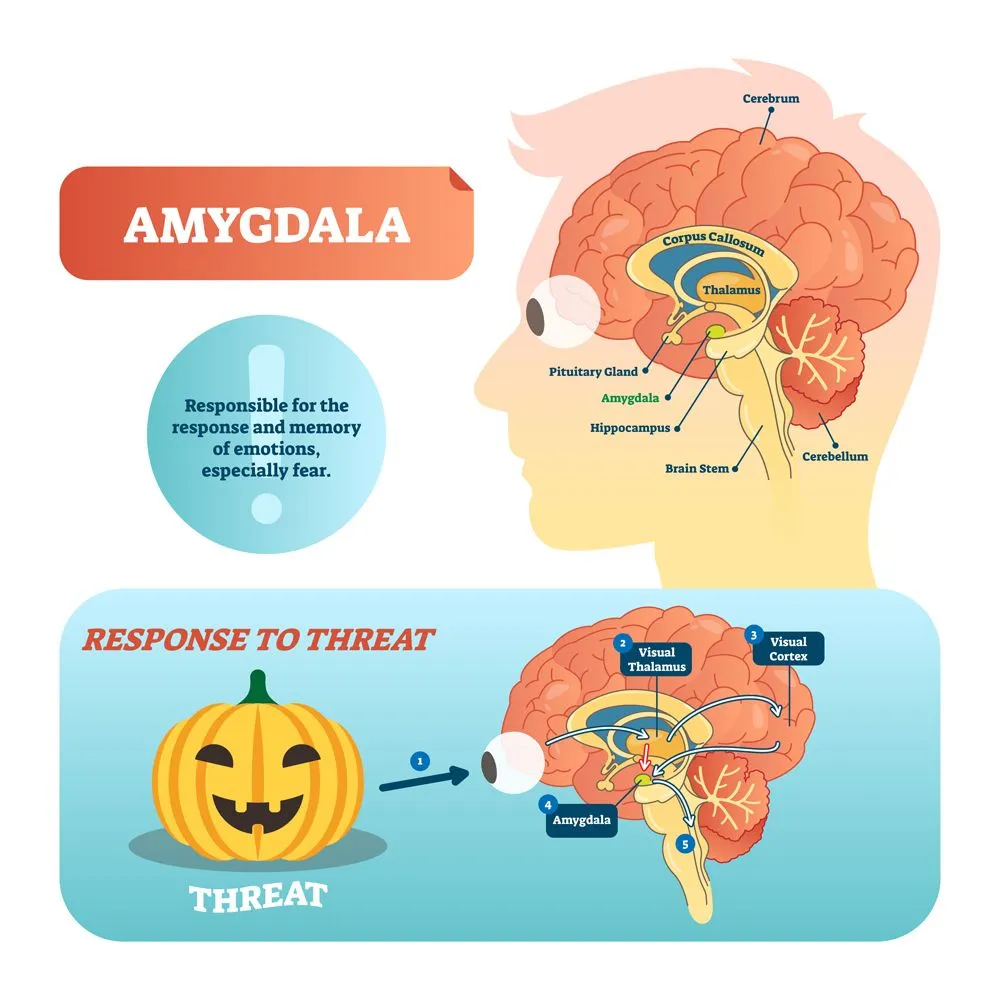
Why Do Such Sounds Trigger Our Survival Instincts?
Of all the sounds mentioned, screaming is the only one produced as a “normal” reaction to a situation. Human beings are evolutionarily programmed to respond to a scream as if it were a matter of life or death, because in the past, it often was! The distress calls or calls for help emitted by our primitive ancestors were similar to the sound of screams.

Any behavior that assists in the survival of a species is encouraged by evolution. A theory is that our ears evolved to amplify shrill noises like that of a scream to increase our chances of survival.
A scream, like any other sound, consists of multiple frequencies. In another study, scientists isolated the different frequencies of a shrill noise (i.e., a shriek) and asked individuals to rank them according to the discomfort they caused. Surprisingly, it wasn’t the highest notes of the scream that were the most painful to listen to, but rather the middle frequency notes.
The frequency range of nails clawing on a blackboard turned out to be a close match with the middle frequencies of a scream. Later neuroscience work led by Arnal and colleagues (2015, Current Biology) sharpened the picture: human screams (and certain alarm sounds) occupy a privileged acoustic niche of fast amplitude fluctuations called roughness, roughly 30 to 150 modulations per second, which directly activates the amygdala and is judged as scarier the rougher it gets. Scratching, scraping, and shrieking noises share that rough texture. Scientists speculate that the sounds of nails clawing on a blackboard or a fork scraping on a plate set off the same alarm bells in our heads as a scream, even though our eyes are telling us nothing threatening is going on.
This conflict between what our brain tells us and what we see causes the acute discomfort brought on by these sounds.
Why Do These Sounds Give Us Goosebumps And Chills?
We keep saying these noises make our skin crawl, but what does that actually mean? That prickling, hair-raising sensation has a proper name: goosebumps, or piloerection. Tiny muscles called the arrector pili sit at the base of each hair follicle, and when they contract, they tug the hairs upright and pucker the skin into little bumps.

Here is the key part: those muscles are wired to the sympathetic nervous system, the same fight-or-flight circuitry we met with the amygdala a moment ago. Goosebumps are not only about cold. A sudden jolt of fear, shock or excitement flips the same switch, which is why a gripping film or a stirring piece of music can also raise the hairs on your arms. When a scraping, screeching sound trips your brain’s threat alarm, that alarm does not stop at the amygdala. It reaches down through the same nerves, the hairs stand up, and a shiver runs down your spine, even though nothing in the room is actually dangerous.
In our furry ancestors (and in a startled cat today), puffing up all that hair made the animal look bigger and more menacing to a predator. We have kept the reflex long after we lost the thick coat that made it useful, so instead of an impressive bristle, an unpleasant sound just leaves us with a rash of goosebumps and the eerie feeling that our skin is crawling. The pleasant version of the very same response, the tingle some people get from soft ASMR whispers or a favorite song, is called frisson. Same machinery, opposite mood.
Why Does Squeaky Styrofoam Set Our Teeth On Edge?
Nails on a blackboard get all the attention, but for a lot of people the real nightmare is the squeal of two pieces of Styrofoam rubbing together, or a fork dragged across a plate. So where does that ghastly squeak actually come from?

The short answer is friction that cannot make up its mind. When one surface slides over another, it does not glide smoothly; it grips, releases, grips again, over and over, in a pattern engineers call stick-slip. Each tiny release sends out a pulse of sound, and the rhythm of those pulses sets the pitch we hear. In 2026, researchers led by Adel Djellouli and Katia Bertoldi at Harvard’s School of Engineering and Applied Sciences took a close look at squeaks from soft, springy materials sliding on hard surfaces and, writing in Nature, traced the culprit to fast, wrinkle-like “slip pulses” racing along the contact between the two surfaces. The rate at which those pulses repeat is what fixes the squeal’s frequency.
Foam and cutlery squeaks tend to come out thin and high-pitched, which puts them right in the 2,000 to 5,000 Hz band our ears are most sensitive to. They are also rough and irregular rather than a clean musical note, so they carry the same jagged texture that our brains read as a warning. In other words, squeaky Styrofoam ticks all the same boxes as a scream or a scrape, which is exactly why it can make you wince and reach for the nearest exit.
Conclusion
The exact reason why we can’t stand the shrill noise caused by nails clawing on a blackboard or a knife scraping on glass remains a mystery to scientists, but they have a good theory.
It might very well be due to how our ears and brains have tuned themselves over the course of thousands of years to be more alert to calls of distress, which are typically higher in pitch.
When we experience the same sound frequency produced by other non-threatening sources, it puts our mind on edge, as our primitive fight-or-flight response is triggered.
References (click to expand)
- Kumar, S., von Kriegstein, K., Friston, K., & Griffiths, T. D. (2012, October 10). Features versus Feelings: Dissociable Representations of the Acoustic Features and Valence of Aversive Sounds. Journal of Neuroscience. Society for Neuroscience.
- Halpern, D. L., Blake, R., & Hillenbrand, J. (1986, March). Psychoacoustics of a chilling sound. Perception & Psychophysics. Springer Science and Business Media LLC.
- Arnal, L. H., Flinker, A., Kleinschmidt, A., Giraud, A.-L., & Poeppel, D. (2015, August). Human Screams Occupy a Privileged Niche in the Communication Soundscape. Current Biology. Elsevier BV.
- Theunissen, F. E., & Elie, J. E. (2014, May 20). Neural processing of natural sounds. Nature Reviews Neuroscience. Springer Science and Business Media LLC.
- Sound - Neuroscience - NCBI Bookshelf. The National Center for Biotechnology Information
- Wondering about goosebumps? Of course you are. (2020, August 3). Harvard Health Publishing, Harvard Medical School.
- Why Do You Get Goosebumps? Cleveland Clinic.
- The Physics of a Squeak. Harvard John A. Paulson School of Engineering and Applied Sciences.