Table of Contents (click to expand)
Bitter food tastes bad because, over millions of years, bitterness became a built-in warning that something might be toxic. Many natural poisons taste bitter, so an aversion to them helped our ancestors survive. How strongly you sense that bitterness depends on your TAS2R genes, which is why some people can’t stand bitter food while others don’t mind it.
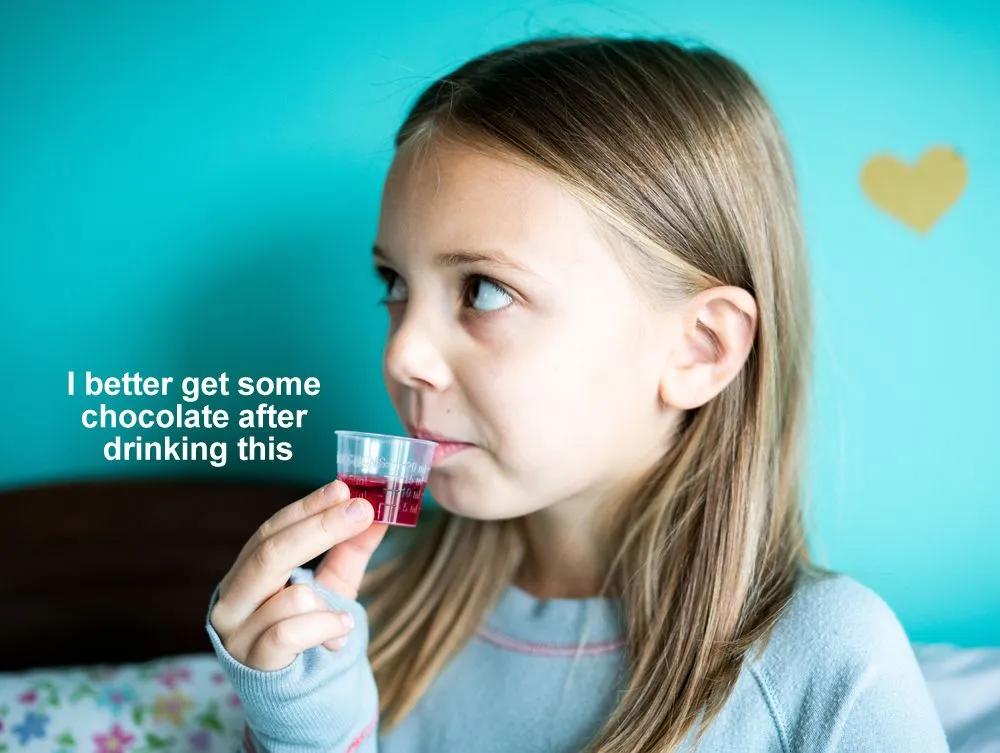
Everyone has the memory of drinking disgusting cough syrup. As children, we would do anything to escape that bitter syrup: scream, yell, run away or negotiate for candy afterwards. As adults, however, we submit to our bitter fate and scoff it down.
Now, most of us can’t begin our day without a drink of coffee or tea, both of which are bitter. Sure, they give our day a caffeinated kick, but many beverage enthusiasts simply enjoy the taste of a well-brewed cuppa, relishing the perfect amount of bitterness.
So why do we find bitter food disgusting and why do we enjoy it?
But first…
What Is Bitterness?
When a food particle enters the mouth, it interacts with the surface of the tongue. The tongue has tiny pores with taste receptors inside.
These receptors are formed by special cells called taste receptor cells. These cells are like your nerve cells. They sense a change, send signals to your brain, and interact with other nerve cells. Each onion-shaped taste bud is packed with about 50 to 150 of these taste receptor cells.
A taste cell has many proteins that can recognize different tastes. The ones that recognize bitter taste are a family of receptor proteins called TAS2Rs. These proteins are built by following a set of instructions in our DNA, namely the genes. Humans have about 25 genes that code for these bitter-sensing proteins. The actual number of copies of these genes in an individual and the amount of TAS2Rs they produce might explain why some people don’t perceive bitter substances, while others do.
What Causes The Bitter Taste?
Think of a bitter taste as a chemical warning of danger.
Do you remember the food pyramid from school? Plants are the foundation of the food chain that provides food for countless herbivores, but no one wants to be eaten. Thus, plants produce toxins to protect themselves from greedy herbivores.
These toxins have a very strong bitter taste that makes the plant unpalatable and protects it from predators.
The same is true of rancid oil or butter. Rancid fats, a product of microbial fermentation, are bitter. These stale fats are not good to eat.
Humans, apes and monkeys have evolved the ability to detect a bitter taste to avoid being poisoned by these substances. However, a study found that different species of primates have different degrees of taste perception, suggesting that the degree of bitter taste perception has evolved according to the presence of toxic compounds in a given animal’s diet.
Why Do Some People Hate Bitter Food?
Like most other discoveries in science, differences in bitter taste detection was found by accident. In 1931, Dr. Arthur Fox, a chemist at the DuPont Chemical Company laboratory, investigated a compound called phenylthiocarbamide (PTC). While funneling the PTC crystals into a bottle, their dust flew through the air. His colleague Dr. C. R. Noller complained about the extremely bitter taste of the dust. Dr. Fox, who was much closer to the bottle, tasted nothing. When Dr. Noller insisted, they both tasted some crystals. While the crystals were extremely bitter for Dr. Noller, they were completely tasteless for Dr. Fox.
These two different observations were a starting point for further studies.
After examining a larger group of people, they determined that this difference was not related to age, race, sex or pH of the mouth, and referred to those who could taste PTC as “tasters” and those who couldn’t as “non-tasters”.
A study carried out on 103 families found that parents who were both non-tasters had children who were also non-tasters. However, even if both parents were tasters, a significant percentage of their children were not tasters. Moreover, more females in both parents and children were tasters. In other words, to be a taster, one parent must be a taster, and you must have a certain amount of luck!
Another study found that the makeup of these genes varies between populations, with African groups carrying distinctive TAS2R38 variants. This suggests that some versions of the gene evolved to detect bitter compounds found uniquely on the African continent.
Why Did We Evolve To Hate Bitter Food?
Scientists have found bitter taste receptors in various organs of the body. Members of the TAS2R family are present in your nasal passages, digestive system, heart, brain and testes. TAS2Rs do not “taste” bitter in the other organs, but scientists believe they may be present to kill certain bacteria.
A class of microbes called gram-negative bacteria release signaling molecules that bind to these bitter taste receptors in the airway lining. That binding acts like a tripwire, triggering defenses (including a burst of nitric oxide) that help kill the invading bacteria and clear them out. In this way, the same receptors that warn you off bitter food also help guard the immunity of the upper respiratory tract.
When scientists conducted studies in malaria-prone areas, they found that these areas had more non-taster populations. Many plant-derived compounds are recognized as therapeutic treatments for malaria. Hence, being predisposed to eat bitter foods may have improved one’s chances of surviving a malaria epidemic.
Animals that can eat bitter food do not have to compete with animals that cannot eat bitter food. For example, the golden bamboo lemur of Madagascar happily eats bamboo shoots laced with about 12 times the dose of cyanide that would be deadly for an animal its size. Thus, it creates a niche without competition. It would be interesting to know whether the ability to ingest cyanide is associated with a loss of taste and bitter perception.
Our bitter taste perception decreases with age, so as you get older, you will develop a tolerance to bitter foods, such as alcohol or coffee… and hopefully the horrors of cough syrup!
References (click to expand)
- Smail, H. O. (2019, December). The roles of genes in the bitter taste. AIMS Genetics. Georg Thieme Verlag KG.
- Menashe, I., Man, O., Lancet, D., & Gilad, Y. (2003, May 5). Different noses for different people. Nature Genetics. Springer Science and Business Media LLC.
- Behrens, M., & Meyerhof, W. (2006, May 29). Signaling in the Chemosensory Systems. Cellular and Molecular Life Sciences. Springer Science and Business Media LLC.
- Delwiche, J. F., Buletic, Z., & Breslin, P. A. S. (2001, July). Covariation in individuals’ sensitivities to bitter compounds: Evidence supporting multiple receptor/transduction mechanisms. Perception & Psychophysics. Springer Science and Business Media LLC.