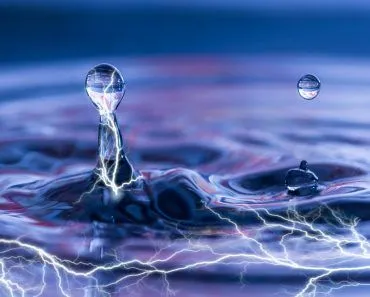
Chlorine is added to swimming pools to disinfect the water. Dissolved in water, it forms hypochlorous acid (HOCl), which kills bacteria and other germs by oxidizing their cell walls, proteins, and enzymes. The CDC recommends keeping free chlorine at a minimum of 1 ppm and pH between 7.2 and 7.8 so the water stays safe to swim in.
In the past, there were many times when humans’ knowledge of chemical reactions was not nearly as profound as it is now. Those were also the times when we drank water wherever we found it (lakes, streams etc), experimented dangerously with what we ate, and wore clothes that nature ‘provided’. All of these basic activities were done without significant fear of serious consequences. One simply never thought of questions like, ‘What if the water I’m drinking is contaminated?’ or ‘What if the food I’m eating is full of germs and bacteria?’
Granted, cavemen didn’t have a deep understanding of “contamination”, germs, or bacteria, but now that we have the wealth of scientific knowledge behind us, we do ask these questions, which is a very good thing. Continuing with the same trend, have you ever thought about whether the pool that you swim in is pure water or plagued with impurities?
Water Purity In Swimming Pools
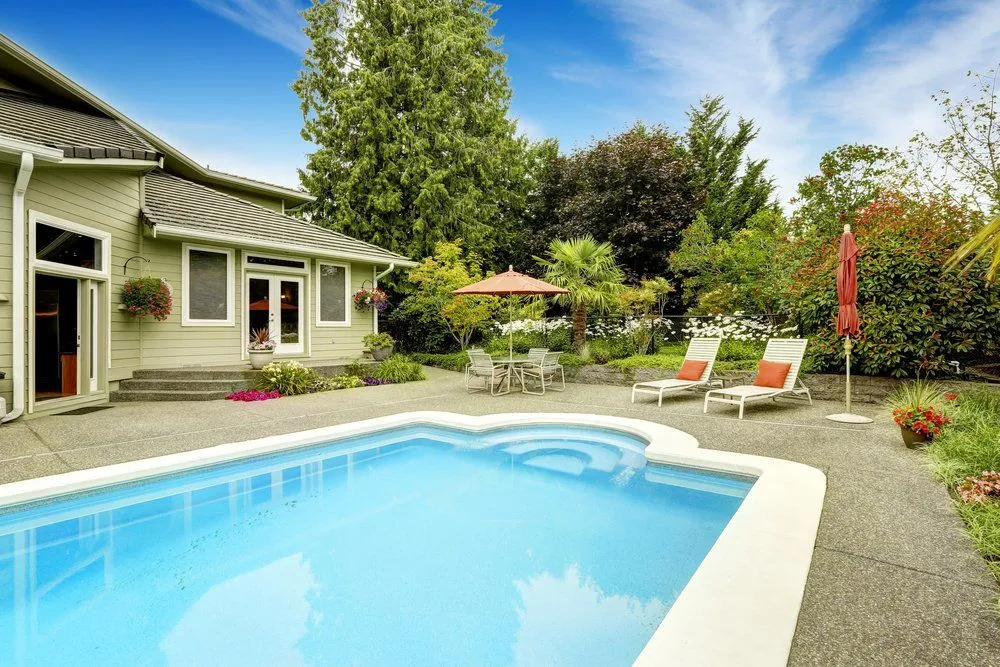
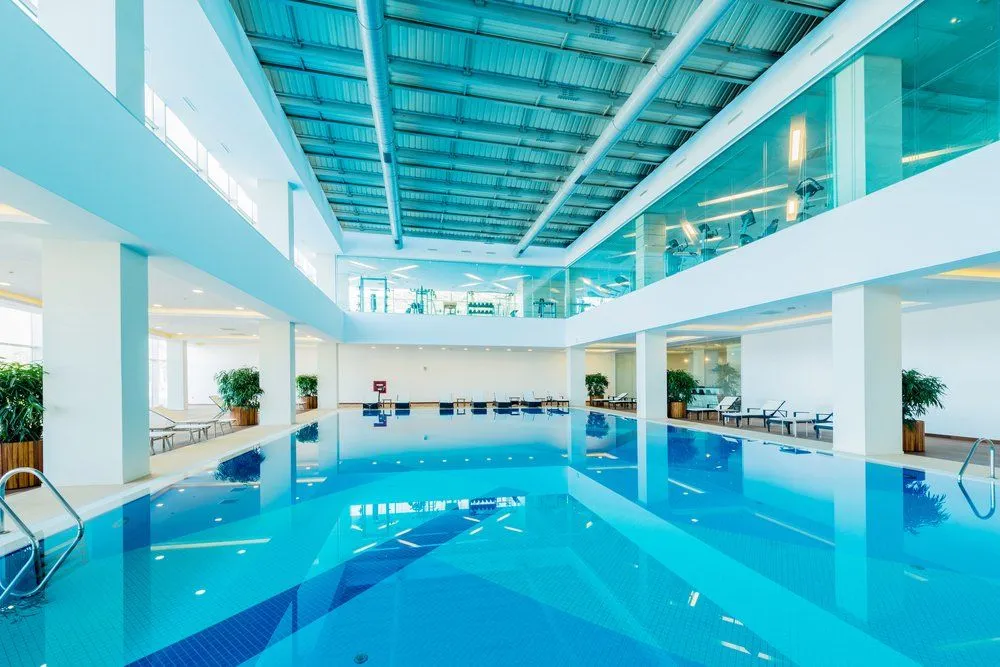
There are a number of ways in which the water in your swimming pool can become contaminated. The contaminants are primarily environmental or caused by humans; environmental contaminants include windblown dust and debris, rain containing microscopic algae spores, and incoming water from unsanitary sources. If it’s an indoor swimming pool, then the chances of environmental contamination are obviously lower. Water can also be contaminated by humans through sweating, cosmetic substances, saliva, urine and other undesirable materials.
Chlorine To The Rescue
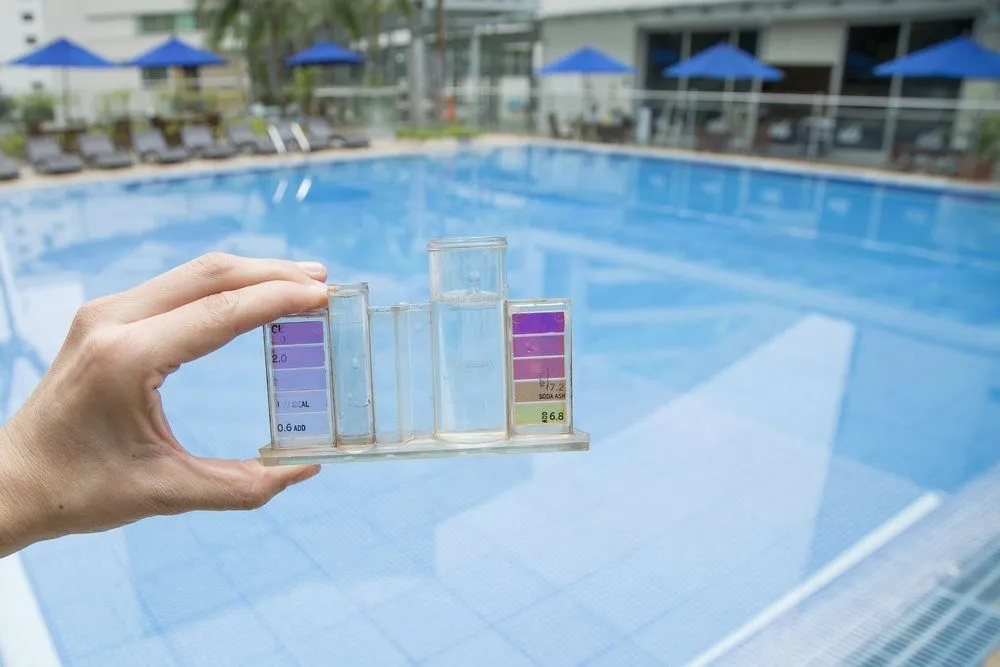
It’s crucial that the water in your swimming pool is regularly treated, and high levels of hygiene must be maintained. To do that, a process called ‘water chlorination’ is used. When chlorine (whether added as chlorine gas, liquid bleach, or solid tablets) dissolves in water, it reacts to form hypochlorous acid (HOCl): Cl2 + H2O → HOCl + HCl. That hypochlorous acid then partly splits apart into a hydrogen ion and a hypochlorite ion (OCl−): HOCl ⇌ H+ + OCl−. Both species disinfect, but neutral HOCl is the far stronger germ-killer, roughly 80 times more effective than the charged OCl−.
How much of each you get depends almost entirely on pH. The lower the pH, the more of the chlorine stays as potent hypochlorous acid; as pH climbs past about 7.5, more of it shifts to the weaker hypochlorite ion. That’s why pool chemistry matters. The CDC recommends keeping pool pH between 7.2 and 7.8, with the free chlorine level at a minimum of 1 ppm (parts per million). Within that window, the water disinfects efficiently while staying gentle enough not to sting your eyes or corrode the plumbing.
What’s So Special About Chlorine As A Decontaminating Agent?
Chlorine’s importance comes down to one talent: it’s a powerful oxidizer. The hypochlorous acid it forms is a small, electrically neutral molecule, so it slips through the negatively charged outer walls of bacteria and other microorganisms with ease (the charged hypochlorite ion is repelled, which is partly why it’s the weaker disinfectant). Once inside, it oxidizes the cell’s proteins, enzymes, and genetic material, scrambling the chemistry the microbe needs to survive and reproduce. The germ is left utterly harmless, usually within a few minutes. Since bacteria, viruses, and other pathogens pose a real threat in pool water, chlorine does an exceptional job of wiping them out and making the water safe for human use.
Is Chlorine An Irritating Agent?
While chlorine undeniably keeps the water clean, treating a pool with it does come with a few drawbacks. Here’s a surprise, though: that sharp ‘swimming pool smell’ and the stinging red eyes you blame on chlorine usually aren’t caused by the chlorine itself. They’re caused by chloramines, irritating compounds that form when free chlorine reacts with the nitrogen in sweat, body oils, and (yes) urine that swimmers bring into the water. A pool that reeks strongly of ‘chlorine’ is therefore often a pool that needs more fresh chlorine, not less, because too much of its chlorine has already been used up forming these smelly byproducts. Chlorine can also gradually fade swimsuits, but not by ‘sticking’ to the fabric. Acting as a mild bleach, it oxidizes the dyes and breaks down the fibers, which is why bright colors turn dull after a season of swimming. And at unusually high concentrations, chlorine and its byproducts can irritate the airways and be genuinely hazardous to health.

It’s important that a regulated amount of chlorine is added to pool water to ensure that its cleansing potential is maximized without compromising human health. However, you should make a point to thank chlorine next time you enjoy that backstroke, because that special little substance is working its heart out while you splash around in the summer sun!
What’s The Difference Between Free, Combined, And Total Chlorine?
If you’ve ever watched someone test a pool with a little kit that turns the water pink or yellow, you may have heard them rattle off three different ‘chlorine’ numbers. They aren’t measuring three different chemicals you poured in; they’re measuring the same chlorine at different stages of its job. Free chlorine is the fresh, unused disinfectant, the hypochlorous acid and hypochlorite still on patrol, ready to attack the next germ that drifts in. This is the number that actually keeps the water safe, which is why the CDC wants it kept at a minimum of 1 ppm.
Combined chlorine is chlorine that has already reacted with the nitrogen in sweat, body oils, and urine to form those irritating chloramines we met earlier. It still shows up on a test, but it has been mostly ‘spent’ and is a feeble disinfectant. Total chlorine is simply the two added together, so a quick bit of subtraction (total minus free) tells you how much combined chlorine has built up. That single number is a neat gauge of how hard your chlorine is working versus how much has already been used up.
Most health departments cap combined chlorine at 0.4 ppm, because anything higher means the water is loading up with chloramines and starting to smell. The fix is counter-intuitive: you add a big slug of chlorine rather than backing off. This deliberate overdose, called shocking or breakpoint chlorination, pushes free chlorine to roughly ten times the combined-chlorine level, which is enough to blast the chloramines apart and convert them to harmless nitrogen gas that bubbles off into the air. After the pool is shocked, the free-chlorine reading climbs back up and that ‘too much chlorine’ smell finally clears, which is the clearest sign that the chlorine was never really the villain in the first place.
Does Pool Chlorine Create Chloroform?
Here’s a fact that surprises most swimmers: the very chlorine that keeps a pool safe also brews up trace amounts of chloroform, the same sweet-smelling compound (trichloromethane, CHCl3) once used as a surgical anesthetic in the 1800s. It isn’t added on purpose; it forms all by itself. It forms on its own whenever free chlorine, a strong oxidizer, meets the organic matter that swimmers bring in: sweat, skin oils, hair, urine, and the residue of lotions and cosmetics. The chlorine chews through these carbon-rich compounds and, as a side reaction, stitches chlorine atoms onto them. The result is a family of compounds called disinfection byproducts, or DBPs.

The most abundant DBPs are the trihalomethanes (THMs), and in a typical chlorinated indoor pool chloroform is overwhelmingly the dominant one. In one long-term monitoring study of two indoor pools, chloroform made up 96 to 99 percent of all the trihalomethanes present, with the rest a mix of brominated cousins. The amounts are small, usually measured in micrograms per liter (millionths of a gram), and the more swimmers and the warmer and dirtier the water, the more DBPs form. That is yet another reason a quick pre-swim shower matters: the less sweat, lotion, and urine you bring into the pool, the fewer carbon-rich precursors there are for chlorine to turn into chloroform in the first place.
Are these byproducts dangerous? At the trace levels found in well-maintained pools, the disinfection benefit far outweighs the risk, and chlorinating the water is vastly safer than swimming in a soup of live bacteria and viruses. Even so, scientists take DBPs seriously: reviews of pool chemistry link long-term exposure to the irritation of eyes and airways, and epidemiological studies have associated high lifetime exposure to trihalomethanes with a raised risk of bladder cancer, mostly in people who swim or work poolside for years. The practical takeaway isn’t to fear chlorine, but to appreciate why pool operators ventilate indoor pools, dilute with fresh water, and nag everyone to shower first.
References (click to expand)
- Water chlorination - Wikipedia. Wikipedia
- Swimming pool sanitation - Wikipedia. Wikipedia
- How does chlorine work to clean swimming pools?. HowStuffWorks
- Home Pool and Hot Tub Water Treatment and Testing. Healthy Swimming. CDC
- Preventing Eye Irritation from Pool Chemicals. Healthy Swimming. CDC
- Chloramines: Understanding “Pool Smell”. American Chemistry Council
- Chloramines and Pool Operation. Healthy Swimming. CDC
- Occurrence, origin, and toxicity of disinfection byproducts in chlorinated swimming pools: An overview. International Journal of Hygiene and Environmental Health (2017). PubMed
- Halogenated By-Products in Chlorinated Indoor Swimming Pools. ACS Omega (2023). NCBI PMC