Table of Contents (click to expand)
RO is short for reverse osmosis. A pump forces water at high pressure through a semipermeable membrane whose pores are roughly 0.0001 micron (0.1 nm) wide. The membrane lets water molecules through but holds back dissolved salts, heavy metals, fluoride, and microbes, producing purified water on one side and a concentrated brine that drains away.
The water on our planet is in a closed cycle, which means that there is a fixed amount, and more water cannot be created. The existing amount of water on the planet is constantly being recycled by nature. However, what serves human needs, out of the vast amount of planetary water, is the tiny fraction of salt-free and unpolluted freshwater.
Municipal utilities treat the water that reaches most homes, and in the US, UK, Australia, and Canada that tap water is usually safe to drink straight from the faucet. Even so, it isn’t always perfect. More than 23 million US households draw their water from private wells that no public utility tests or treats, and well water can carry nitrate, arsenic, or other dissolved contaminants.
Another issue is that if you live in an older building with aging plumbing, your pipes could shed rust, lead, or bacteria into the water after it leaves the treatment plant.
With that in mind, it is increasingly common for households, especially those on well water, to install an under-sink RO water filter to get the cleanest water possible.
What Is RO And Why Is It Used?
RO stands for Reverse Osmosis. To understand the "reverse" part, start with ordinary osmosis: when a semipermeable membrane separates fresh water from salty water, water molecules naturally drift from the fresh side into the salty side, trying to even out the salt concentration. Reverse osmosis flips that around. By applying enough pressure to the salty side to overcome its osmotic pressure, you push water molecules the other way, through the membrane and away from the dissolved salts, leaving the impurities behind.
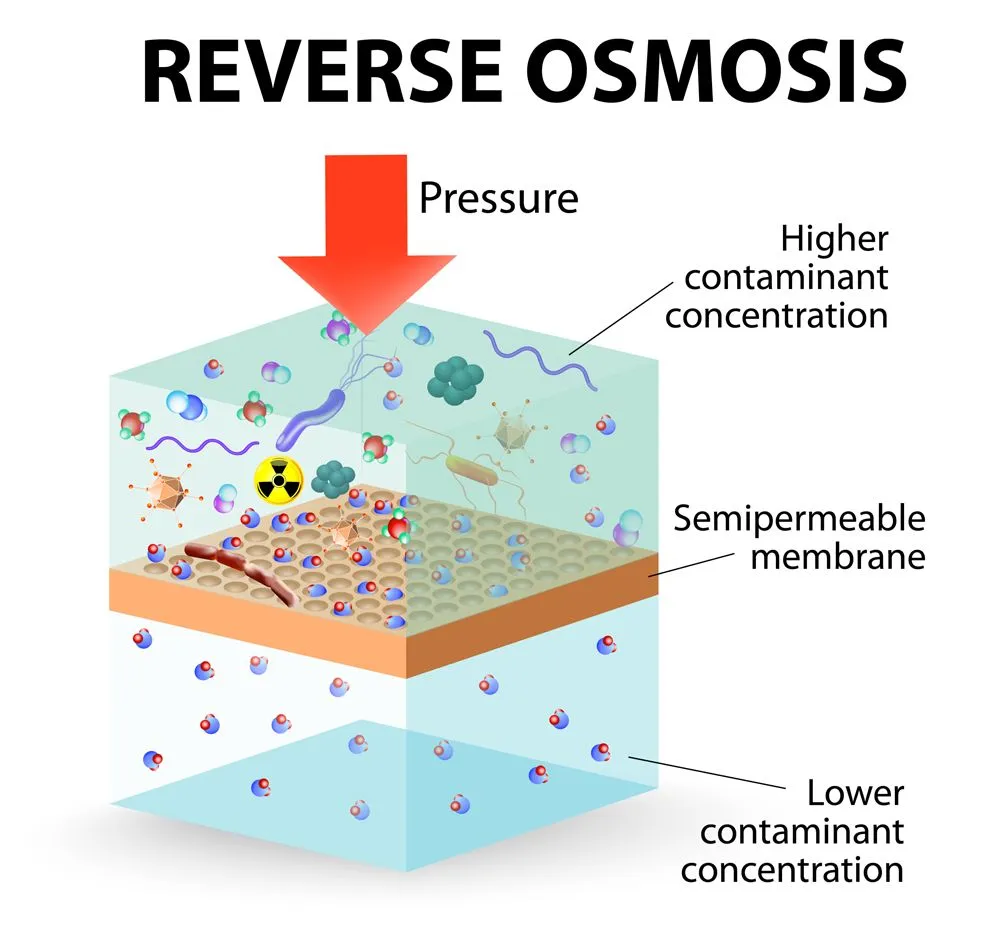
The main purpose of a reverse osmosis filter is to remove the micro-organisms and total dissolved solids (TDS) present in water. Total dissolved solids include minerals, as well as organic molecules present in the water. Of all these small molecules, some may be beneficial trace minerals, but others can be toxic pollutants.
Reverse osmosis isn’t just applied in simple household water filters, but also on a much larger scale in wastewater treatment plants. Desalination plants (the facilities that remove salt from water) also use this method to make seawater drinkable. This technology makes it possible for ships at sea to filter seawater in order to obtain fresh drinking water.
Mechanism Of An RO Filter
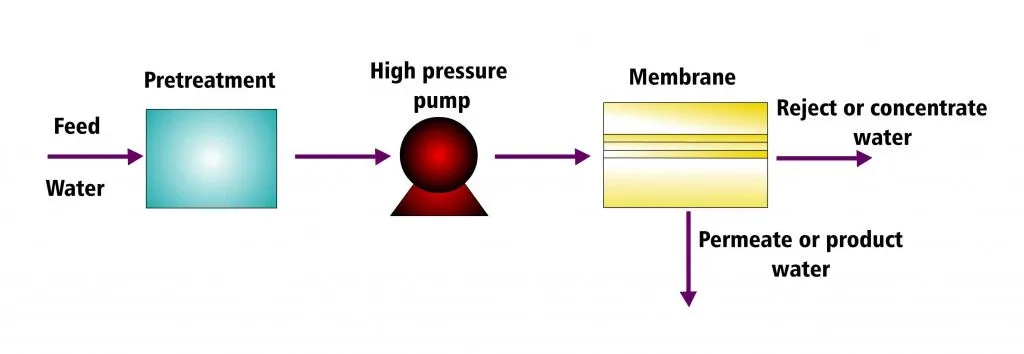
The setup of a filter like this is very simple. Water from the building pipes (or any other source) enters the RO machine and passes through a pre-filter, which is a filter placed before the semi-permeable membrane. The job of this pre-filter is to filter out all large particles, such as sediment, dirt and even rust that may come through the pipes with the water. This filter is relatively cheap and increases the overall lifespan of the RO filter.
After crossing this pre-filter, the water reaches the semipermeable membrane, also known as the reverse osmosis membrane. This is a carefully designed, multi-layered membrane made of polymers such as polyamides, and cellulose.
Polyamides can be artificially created or taken from natural sources, such as wool and silk. Cellulose membranes are the oldest and have been in use since 1955, but polyamide polymers are much more efficient.
A high-pressure pump is used to push the water through the RO membrane. The reverse osmosis membrane has a pore size of about 0.0001 micron (0.1 nm), which is roughly 750,000 times narrower than the width of a human hair! That pressure is doing real work, since it has to overcome the water's osmotic pressure to drive it through such tiny pores. A home system runs on ordinary household line pressure of about 40 to 60 psi (2.8 to 4.1 bar), while a seawater desalination plant has far more salt to fight and needs pressures of around 55 to 82 bar (800 to 1,200 psi). At that scale, the membrane strains out dissolved salts, heavy metals, fluoride, and the microbes in the water, along with other minute chemical compounds.
Some RO filters may also include post-treatment filters that improve the flavor of the water.
One side effect of reverse osmosis is that the water usually tastes worse than when it goes in.
This is mainly because the trace minerals and other elements have been removed from the water. Natural freshwater usually contains some amount of mineral and organic water, so humans have evolved to like the taste of that mixture. To counter this side effect, the post-filter may contain mineral balls that selectively replenish good minerals that were lost in the process of RO.
The final product that leaves the filter is clean potable water that is safe to drink. Along with that, the waste products and dirt leave the filter through another pipeline connection that goes to the drain.
Advantages Of RO Filters
RO filters are currently the best water filters available and are preferred over other conventional options.
RO systems filter out many bacteria, parasites and viruses, several of which are responsible for common gut-related diseases and other health disorders. These filters are also very efficient at removing toxic chemical components, such as heavy metals and various hard salts. A well-maintained RO membrane typically rejects 90 to 99% of the dissolved solids in the water, including lead, copper, chromium, sodium, and a large share of the fluoride, arsenic, and nitrate. That makes RO more thorough than standard filters that rely on heat, chemicals, or ultraviolet light alone.
RO is not a cure-all, though. Because it sorts molecules largely by size and charge, very small uncharged molecules can slip past it. Dissolved gases like hydrogen sulfide (the rotten-egg smell), along with some pesticides and volatile organic compounds, are not reliably removed, and chlorine actually passes straight through and can damage the membrane over time. That is why most home units pair the RO membrane with an activated carbon stage to mop up chlorine, taste, and odor.
This technology is also quite environmentally friendly. It doesn’t generate much pollution and there is no need for the use of chemicals in the process.
It is very common for RO filters to incorporate additional cleansing strategies, such as more efficient or multiple filters. Alternatively, they may include an additional cleansing system in the form of an ultraviolet (UV) light installed in them. The installed UV lights release UV rays, which inactivate the microorganisms that make it through by scrambling their DNA so they can no longer reproduce.

Disadvantages Of RO Filters
Alas, anything that good must have a catch. The main disadvantage of RO filters is that they are somewhat tedious to maintain.
For example, imagine that one day there is some error in the pump and the water pressure reduces, meaning that the flow of water through the RO membrane will be very slow. This will increase the time taken for the RO filter to purify water. If the filters aren’t regularly cleaned, the RO system may get clogged and bacterial biofilms can form inside the device, further contaminating the water coming in from the pipes.
RO is also thirsty. To keep the rejected salts from caking onto the membrane, the system constantly sweeps them away in a stream of concentrated brine that goes down the drain. A typical under-sink home unit sends roughly 3 to 4 liters of water to waste for every liter it purifies, a recovery rate of only about 20 to 30%. Newer permeate-pump and high-efficiency designs cut that waste considerably, but RO will always discard more water than it delivers.
A related drawback is that RO strips out the helpful minerals along with the harmful ones. Because RO-filtered water is almost completely free of dissolved minerals, the World Health Organization has flagged low-mineral water as a possible health concern, since elements like magnesium and calcium are necessary for many of the body's metabolic functions. The clearest documented effect is in the kitchen: cooking vegetables, meat, or grains in demineralized water leaches a good chunk of their minerals into the cooking water, which usually gets poured away.
For most people on a normal diet this is a minor issue, since food supplies far more than the daily requirement of minerals, and many RO units add a remineralization stage that puts calcium and magnesium back into the water. Even so, the long-term effects of drinking demineralized water are still being studied, which is why remineralization is becoming a standard feature rather than an afterthought.
Conclusion
Advancements in technology are leading to better ways for us to obtain clean water, which is incredibly essential to life. Every single human being should have access to clean drinking water, and the hope is that RO filters will be one way to ensure that… once the price comes down!
RO technology is currently used all over the world to filter wastewater, tap water and seawater. Research in this area is primarily focused on improving the sustainability of RO filters by reducing the energy requirements and improving the durability of the RO membranes!
References (click to expand)
- Yang, Zhou, Feng, Rui, Zhang, & Zhang. (2019, July 29). A Review on Reverse Osmosis and Nanofiltration Membranes for Water Purification. Polymers. MDPI AG.
- About Home Water Treatment Systems. Drinking Water. U.S. Centers for Disease Control and Prevention (CDC).
- Private Drinking Water Wells. U.S. Environmental Protection Agency (EPA).
- Nutrients in Drinking Water (2005). World Health Organization. (Includes Kozisek, F. Health Risks from Drinking Demineralised Water.)
- (2018) Application of reverse osmosis in purifying drinking water. E3S Web of Conferences.
- Verma, K. C., & Kushwaha, A. S. (2014, October). Demineralization of drinking water: Is it prudent?. Medical Journal Armed Forces India. Elsevier BV.