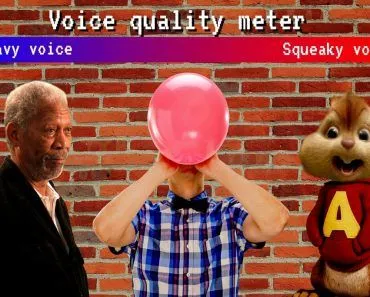
The element that causes some people to sing well and others to sing badly are problems with pitch accuracy, also known as intonation. Pitch can be understood as the ‘sharpness’ of a voice; the higher the pitch, the sharper and shriller the voice sounds.
Some people can sing. And other people belt Whitney Huston’s ‘And I will always love you!’ like a heartbroken banshee.
For the poor singers of the world, being able to hold the right note at the right time would be an achievement; a simple aspiration. What would it take for the poor singers of the world to get better at the skill? Can you learn the music or are some of us just doomed to wail like a banshee?

What Does It Take To Sing Well?
Of course, good singers are born with an amazing “instrument” that includes lungs with excellent vital capacity, exceptional breathing control, and a larynx that allows them to stretch and squeeze their vocal cords to achieve the desired vocal range. The shape and size of the pharynx and nasal cavities also correlate with its ability to sing. They have won the genetic lottery and can go on to become the Beyonces of the world. Most of us though have serviceable enough vocal cords for song singing.
Then, if you are a poor singer, you probably lack at least one of the following: timing and pitch.
These two metrics determine good music, singing included.
Timing is also called a beat. As the word suggests, it is like the clock of the music.
Broadly pitch is how we perceive the frequency of sound. Frequency is how long a song wave takes to complete one cycle. We perceive low frequencies as a low pitch. A low pitch sounds deep and bassier. A high frequency correlates to a high pitch which we call sharp and shrill sounds. We’ve given specific pitch names and arranged them in an order. The names of the pitches are called notes. For musicians who read sheet music, a note also indicates the duration to hold a pitch.
For non-offensive singing, it is enough to get the beat and pitch right. The brain is good at detecting these almost naturally. Most of us can detect something off with a song, just like sniffing spoilt food. When someone is off by a semitone (a measure between the interval of pitches), then that person is said to have poor pitch.
Professional and prodigious musicians are exceptional at discriminating between different pitches. Their brains, one might say, are wired to understand pitch. A small fraction of the population has perfect pitch. These people can identify the pitches exactly in any sound, from the clink of a glass to the grating of nails on a chalkboard. Jacob Collier and Charlie Puth frequently demonstrate their perfect pitch.
Poor Pitch Recognition And Imitation
The most egregious of errors is getting the pitch wrong.
Around 1.5% of people are amusics and they tend to be pitch deaf. They cannot discriminate between different pitches and struggle to reproduce the song. This is a minority, and studying amusics and the average singer shows us that most of us can identify pitch.
For the average singer, the problem can lie in one of two places.
First, you can’t recognize the pitch. A study has shown that, as humans, we can recognize different pitches and replicate them on an instrument, although it may be difficult for some of us to hear a pitch and recreate the sound with our voices, showing that we have the innate ability to “recognize” pitches. The average singer does not have a developed enough ear.
But, we tend to recognize pitch in songs since they have musical structure. This brings us to our second problem: imitating the pitch. In other words, the “input” component is fine; the problem occurs at the “output.”
After you hear the sound, the brain sets up an output sound corresponding to what you hear, but unfortunately, it is not in tune. Singing is moving the vocal folds to produce the pitch you want. It is a combination of muscle movement and airflow. The brain has a neural pathway that maps pitch into vocal movements. For those of us singing out of tune, our brains might just not know how to move muscles to create the right pitch.
Even when you do realize that you are singing off-key, there is not much you can do about it. Your ears do register that you’re not quite producing the tone that you intended to, so the vocal cords ask for instructions from the brain.
However, the brain still sends the same instructions, and you simply can’t get the tone right. It’s almost as though the vocal cords have locked themselves in a particular position to produce the same erroneous tone every time, even after knowing better!
Is Singing Ability Genetic, Or Can Anyone Learn?
So is a great voice something you are born with, or something you build? The honest answer is “a bit of both,” but the balance is more hopeful than most shower-singers assume.
Your ear leans heavily on genetics. In a well-known twin study, researchers played hundreds of identical and fraternal twins a run of familiar tunes with some notes knocked deliberately out of tune, then asked them to spot the duds. Identical twins, who share all their genes, matched each other far more closely than fraternal twins did. The heritability of pitch perception worked out to roughly 70-80%, one of the highest figures recorded for any complex human trait. How sharply you can hear that a note is wrong is largely baked in.

Your voice is a different story. Recall the input-versus-output split from earlier: most bad singers hear pitch perfectly well and simply have not trained their vocal muscles to land on the note. That output side is a motor skill, and motor skills are learned. Genuine, hardwired tone-deafness (congenital amusia) affects only about 1.5% of people, far fewer than the 4% once believed. So unless you are in that small minority, “I just can’t sing” almost always means “I never learned how.” The ear is the part you inherit; the voice is the part you build.
Can You Train Yourself To Sing Better?
Here is the good news for anyone who has ever been told to “just mouth the words”: singing responds to practice like any other skill. In one experiment, adult poor-pitch singers improved their accuracy by around 20% after a single short training session, as long as they got visual feedback showing how close each note actually landed. You are essentially rewiring that brain-to-vocal-muscle pathway, one note at a time.

A few things that genuinely help:
- Record yourself and listen back. You hear your own voice differently from the inside, so a recording is the fastest way to catch exactly where you drift flat or sharp.
- Get instant feedback. A piano, a tuning app, or a pitch-monitor shows the target note right next to the one you sang, and that visual comparison is what made the lab subjects improve so quickly.
- Work on breath and posture. Steady breath support gives your vocal folds a reliable stream of air, so the muscles are not fighting just to hold a note.
- Sing with other people. Choirs and singing groups push you to match pitch in real time, which is practice and feedback rolled into one.
Genetics still sets a few outer limits. If your vocal cords are built a certain way, you may never comfortably reach Mariah Carey’s whistle notes or a bass singer’s lowest rumble, and that is fine. Staying in tune within your own range is the part that is overwhelmingly trainable.
Lastly, confidence is key. So shed that nervousness and have fun. You might not hit every note, but with a bit of practice you definitely won’t make everyone’s ears bleed.
References (click to expand)
- 5. The Voice.
- INTONATION.
- Probing Question: Can anyone be taught how to sing?.
- Dalla Bella, S., Giguère, J.-F., & Peretz, I. (2007, February 1). Singing proficiency in the general population. The Journal of the Acoustical Society of America. Acoustical Society of America (ASA).
- Hutchins, S., Larrouy-Maestri, P., & Peretz, I. (2014, July 25). Singing ability is rooted in vocal-motor control of pitch. Attention, Perception, & Psychophysics. Springer Science and Business Media LLC.
- Bennett, G. (2017). The science of singing: A voice lesson from anatomy and physiology.
- Drayna, D., Manichaikul, A., de Lange, M., Snieder, H., & Spector, T. (2001). Genetic correlates of musical pitch recognition in humans. Science.
- Peretz, I., & Vuvan, D. T. (2017). Prevalence of congenital amusia. European Journal of Human Genetics.
- Berglin, J., Pfordresher, P. Q., & Demorest, S. M. (2022). The effect of visual and auditory feedback on adult poor-pitch remediation. Psychology of Music.