Speeding up audio packs the same sound wave cycles into less time, so more cycles pass every second. That higher frequency is heard as a higher pitch, which is why sped-up voices sound squeaky. The speed of sound itself does not change; only the frequency and wavelength do.
Have you ever sped up an audio or video playback? If yes, then you know that when you speed up an audio file, it sounds squeaky, right? In other words, it sounds as if its pitch has been elevated.
Here’s an example of the popular song ‘Let it go’ (from the movie Frozen) after being sped up. First, listen to the original and ‘normal’ audio:
Now, listen to the sped-up version of the same audio:
Notice the difference? When you speed up the audio, it sounds squeaky. Why does that happen?
Before we can understand that, let’s take a quick crash course in sound waves in general.
What Are Sound Waves?
You have surely heard countless times that sound is actually a wave… but what’s a wave?
Simply put, a wave is a disturbance that transfers energy from one place to another without requiring any net flow of mass. Waves are broadly classified into two types: pulses and periodic waves. Note that waves can also be classified into longitudinal and transverse waves.
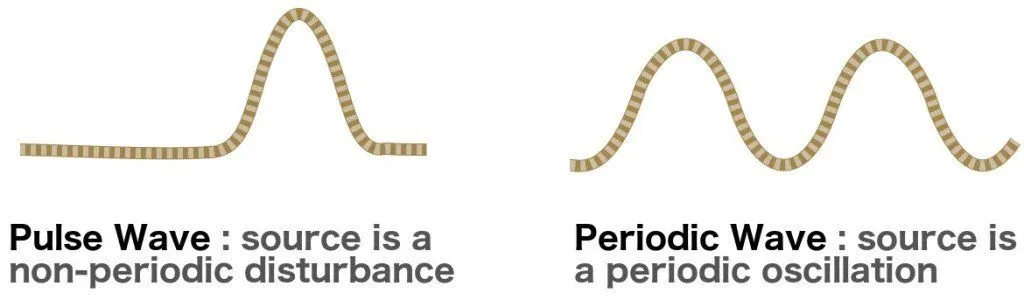
While a pulse is a single disturbance, a periodic wave is a continually oscillating motion. Picture dropping a single pebble into a still pond: that one lonely ripple spreading outward is a pulse. Now imagine dipping your finger in and out of the water at a steady rhythm so the ripples keep coming, one after another, in a repeating pattern. That stream of repeating cycles is a periodic wave. As you can imagine, sound waves are periodic waves. Also, they fall under the category of longitudinal waves, because the particles of the medium (through which sound travels) oscillate in the direction of the motion of the sound wave.
Sound, therefore, is actually a wave (or a combination of waves) made of vibrations in the air. Think of it this way: when a source, like a microphone, produces a sound, what it actually does is vibrate the air molecules. Those vibrated air molecules, in turn, vibrate the air molecules next to them. This goes on until the vibrations reach your ear, allowing you to hear the sound produced by the microphone.
Frequency Of A Sound Wave
Since a sound wave is a periodic wave, it has certain attributes or properties (characteristic of all periodic waves). The two main attributes of sound waves are amplitude and frequency. The amplitude of a sound wave determines the loudness of the sound, while the frequency determines its pitch. For the scope of this article, we are only interested in the latter.
Simply put, the frequency of a sound wave will tell you how many of its waves pass by in a single second. In other words, you could say that frequency is the measure of the number of wave cycles that occur in one second.
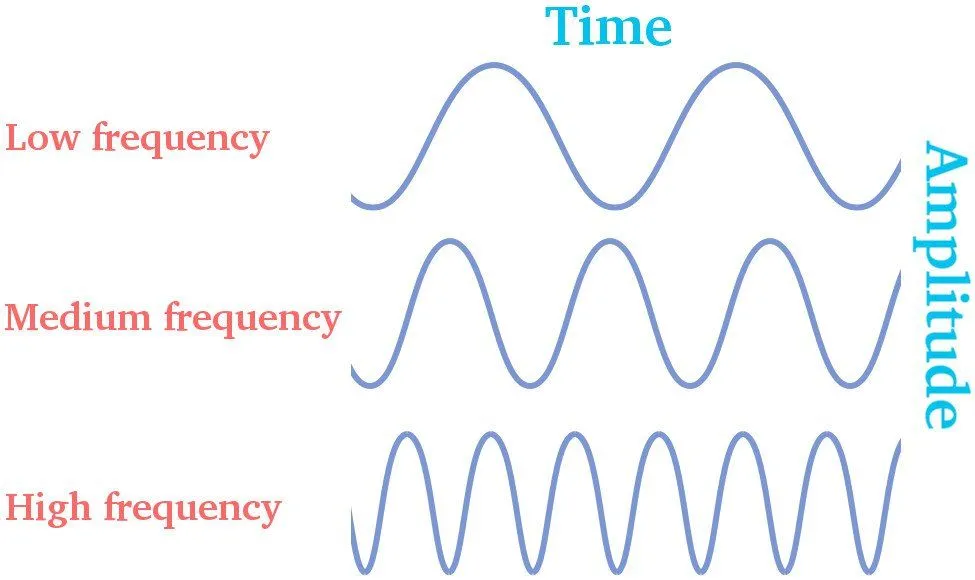
Frequency is measured in Hertz. Thus, if a sound wave has a frequency of 1 Hz, it means that there is only 1 cycle per second. Similarly, for a sound wave with a frequency of 10 Hz, there will be 10 wave cycles.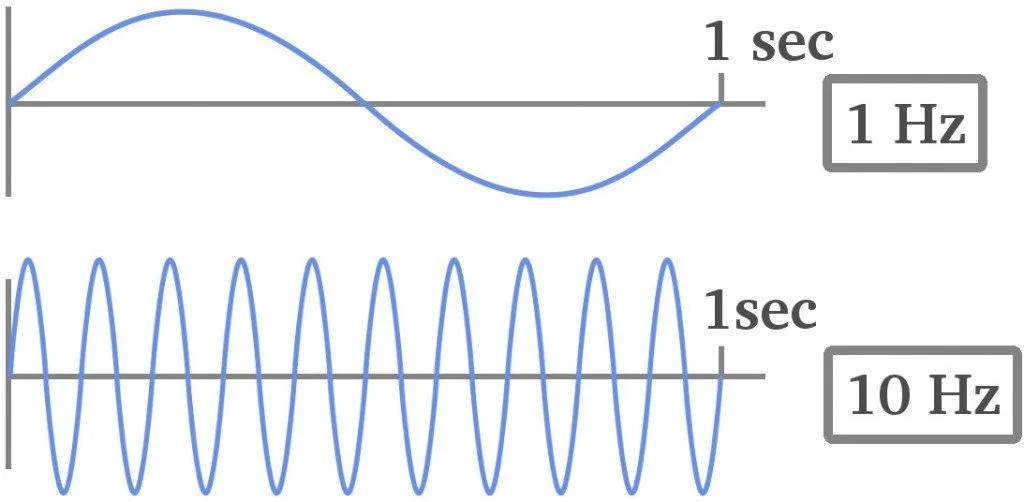
Frequency And Pitch
Frequency is a crucial property of sound, which is why it’s very closely monitored or controlled to produce meaningful sounds. You see, the frequency of a sound wave determines its ‘pitch’.
Pitch, as you might already know, is a perceptual property of sound. It’s a measure of how shrill or squeaky a sound is. For instance, we commonly say that girls’ voices are higher in pitch than boys’ voices. This simply means that girls’ voices sound more sharp or higher-pitched than boys’ voices. The higher the pitch of a sound wave, the more squeaky it sounds.
Now, let’s go back to the original question of why a sped-up audio sounds squeaky. When you play a sound faster, or in other words, you ‘speed it up’, you’re cramming the same wave cycles into less time. Each cycle now passes by more quickly, so more of them go by every second. That, by definition, is a higher frequency, and a higher frequency means a higher pitch.
A quick word on a common misconception here: speeding up the playback does not make sound travel faster through the air. The speed of sound in air is essentially fixed (roughly 343 m/s, or about 767 mph, at room temperature) no matter the pitch. What actually changes is the wavelength. Since the speed of a wave equals its frequency multiplied by its wavelength, squeezing the cycles closer together raises the frequency while shortening the wavelength, and the speed stays put.
This is why sped-up audio sounds squeaky!
What’s The Difference Between A Pulse And A Wave?
We slipped past this earlier, but it trips up a lot of people, so let’s nail it down. A pulse and a periodic wave are not the same thing, even though both are disturbances travelling through a medium.
A pulse is a single, one-off disturbance. Flick one end of a stretched-out slinky just once and you’ll send a single bump racing down its length. That lonely bump is a pulse. It has a beginning and an end, it does not repeat, and on its own it has no frequency, no period, and no wavelength, because there’s nothing for it to repeat against. The OpenStax physics text describes a pulse as “a sudden disturbance in which only one wave or a few waves are generated.”
A periodic wave, by contrast, is a disturbance that keeps repeating. Instead of flicking the slinky once, you shake it up and down at a steady rhythm so a continuous train of identical bumps travels along it. Because the pattern repeats, you can now measure a frequency (how many cycles pass per second), a period (the time for one cycle), and a wavelength (the distance between two matching points). A periodic wave repeats the same oscillation for cycle after cycle, and it’s tied to simple harmonic motion.
So why does this matter for squeaky voices? Because sound is a periodic wave, not a pulse. It has a genuine, measurable frequency, and that frequency is exactly the knob that gets turned when you speed up the audio. A single pulse couldn’t sound squeaky or deep at all, since it has no pitch to raise in the first place.
Why Can Podcast And Video Apps Speed Up Without The Squeak?
Here’s a puzzle. If speeding up audio always cranks the pitch, how does your podcast app or video player let you listen at 1.5x or 2x speed without everyone sounding like a chipmunk? You finish the episode faster, yet the host’s voice stays perfectly normal.
The squeaky version is what you get from the simplest possible method: resampling, or just running the same recording through faster. As we’ve seen, that crams the wave cycles into less time, so every frequency in the clip scales up together. Speed and pitch are welded to each other. Slow it down and voices droop low; speed it up and they squeak. This linked behavior is the famous “chipmunk effect.”
Modern apps dodge it with a smarter trick called time-stretching, which decouples speed from pitch. The classic approach, the phase vocoder, breaks the sound into short overlapping slices, analyzes the frequencies inside each one, and then reassembles those slices closer together (to speed up) or farther apart (to slow down) while carefully keeping each frequency where it was. The result plays faster but at the original pitch. As one Carnegie Mellon reference puts it, “the phasevocoder is used for time stretching a signal without changing the pitch.”
You don’t need special software to hear it, either. Pitch-corrected playback is baked into web browsers: every HTML media element has a preservesPitch property that defaults to true, so the browser quietly keeps the pitch steady whenever you change the playback speed. Flip it to false and you get the chipmunk back. So the squeak was never inevitable, it’s simply the cheapest way to change speed.
References (click to expand)
- Waves and Sound - Physics. Boston University
- 1 What is Sound? Simple Harmonic Motion -- a Pendulum. The University of Washington
- Sound Waves - mysite.du.edu
- Aspects of Sound - hep.physics.indiana.edu:80
- Pitch, Frequency, Period, Loudness, Timbre. The University of Connecticut
- Speed of Sound, Frequency, and Wavelength. Physics. OpenStax
- 13.1 Types of Waves. Physics. OpenStax
- HTMLMediaElement: preservesPitch property. MDN Web Docs
- Phase Vocoder Tutorial. Carnegie Mellon University