Table of Contents (click to expand)
No, more megapixels do not always mean better image quality. A megapixel is just one million pixels, so it only sets how large you can print or how far you can crop. Sharpness, low-light performance and dynamic range depend far more on sensor size, pixel size and the lens than on the megapixel count alone.
Social media and pop culture have redefined our ideas of photography in many ways. Just a few decades ago, photography was reserved for the privileged and talented among us; its use was largely restricted to special occasions and truly interesting moments in life.
Today, however, with the advent of digital photography, taking pictures has become an incessant obsession for many people. More importantly, our ancient habit of printing photographs seems to have waned. People now prefer to fuel their narcissism through social media outlets instead. Of course, cell phone companies have played a large role in encouraging this process. As the smartphone market grows increasingly competitive, they continue coming up with newer models with even higher megapixel cameras included. However, do more megapixels equal better image quality?

Credit: Javiindy
What Is A Megapixel?
Simply put, a megapixel is one million pixels. Therefore, if you know the resolution of an image, you can calculate the megapixels within it. For a computer screen, the best available resolution is usually 1920 x 1080. Therefore, a crisp picture that size would have 1920 x 1080 = 2,073,600 pixels. Basically, if you want to click a photo for your computer screen without it looking grainy, don’t worry! A 2-megapixel camera is enough to snap that picture and have it look clear.

Given that information, do you really need a camera that offers a higher number of megapixels?
As the example above proves, large megapixels make no difference if your intention is to simply put it up on your Instagram account. The number of megapixels taken in isolation is not a guarantee of photographic quality. In fact, megapixels only come into play in two ways:
1. If You Have To Print An Image
As discussed earlier, printing photographs is no longer a popular trend. Most people are quite content just uploading the pictures online and saving their digital copies, rather than making the effort of printing them. In case you’re interested in printing the photograph, you must be mindful of the number of megapixels. Obviously, more pixels would translate into a sharper image, which would keep the picture looking clear even when you blow the image up to accommodate much larger prints. Here is a chart that denotes different types of prints and how many megapixels they require to look “good”.
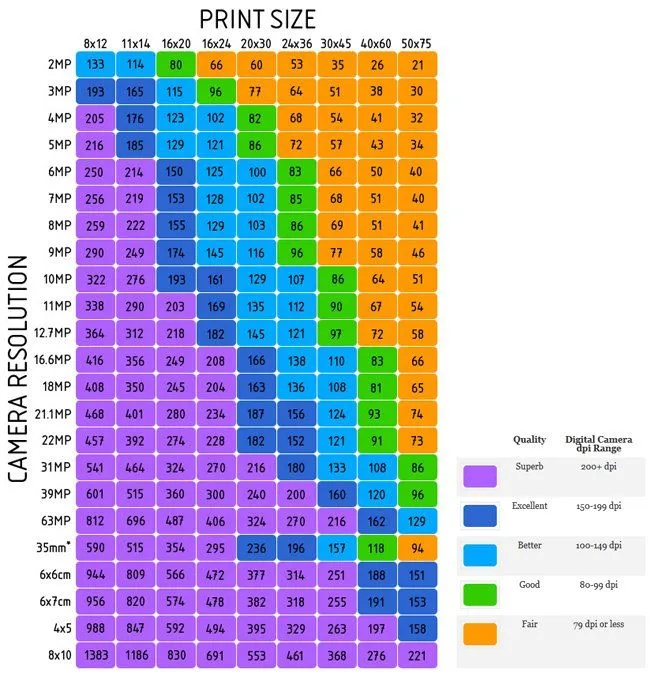
However, there is another factor that you need to consider – the viewing distance from the print. Let’s take billboards, for example. A billboard with an image that looks acceptably crisp is usually very pixelated if you take a closer look. However, from afar, that graininess is completely disguised. Believe it or not, a good 16-megapixel camera is all you need for prints the size of billboards!
When it comes down to more everyday needs, most posters usually don’t require more than 7 megapixels! Even if the size of the print is 30 x 40 inches, due to the large viewing distance that would almost certainly be needed, a 7-megapixel camera would be good enough.

2. If You Have To Crop Or Zoom In On An Image
We all know the adverse effects of too much zooming. Your beautiful and colorful image will be shredded down to its ugly grainy self, leaving you annoyed by the entire ordeal of uploading a photo that you’re unhappy with.

Fortunately, cameras today have too many pixels crammed into their sensors for this to be a problem anymore! Another way megapixels help you as a photographer is by giving you more room to play around with the pictures you take. You can zoom more effectively and crop photos without any worries about quality loss. However, even in these cases, you still don’t need as many megapixels as most phone and camera companies offer. Even with a meager 4-megapixel camera, you can double the entire image on your monitor screen and still not worry about pixelation!

Knowing what we do about pixels, why are we constantly battered with advertisements for products that offer more and more megapixels? In reality, it’s just a marketing strategy to make you want to buy a newer and “better” phone or camera. The truth is that a photo taken with a 5-megapixel camera can be just as good as one snapped with a 12-megapixel camera. In fact, it can even be better!
Allow me to explain…. in many settings, image quality is more dependent on the image sensor than the megapixel count.
Why Sensor Size And Pixel Size Matter More
Here’s the part the spec sheet never tells you: a pixel doesn’t actually capture “a pixel of detail.” It’s a tiny bucket that collects light. The bigger that bucket, the more light it can gather before the reading gets swamped by electronic noise. So when you cram more megapixels onto a sensor of the same size, each individual pixel has to shrink, and smaller pixels collect less light. That’s exactly why two cameras with the same megapixel count can produce wildly different photos.
What really drives image quality, then, is the size of the whole sensor and the size of its pixels, not the raw megapixel number. A larger sensor simply has more surface area to soak up light, which is why it gives you cleaner images in dim rooms (less of that ugly speckly noise) and a wider dynamic range, meaning it can hold detail in both the bright sky and the dark shadows of the same shot. This is the real reason a chunky camera can crush a phone packing twice the megapixels: the phone’s fingernail-sized sensor just can’t catch as much light.
There’s also a hard wall set by physics called diffraction. As pixels get tiny, light bending around the edges of the lens aperture starts to smear fine detail across them, so past a certain point extra megapixels stop buying you any real sharpness. Denser pixels aren’t useless (they give you room to crop and to shoot at wider apertures), but you can’t just keep adding them to a small sensor and expect the pictures to keep getting better.
So why do phones now advertise eye-watering numbers like 48, 108, or even 200 megapixels? The trick is pixel binning. Samsung’s 200-megapixel ISOCELL HP2 sensor, for example, packs 200 million pixels just 0.6 micrometers wide onto a sensor roughly 1/1.3 inch across. In good light it can use all of them for a hugely detailed shot, but in low light it merges groups of neighboring pixels (up to 16 at once) into one big virtual pixel, behaving like a 12.5-megapixel sensor with much larger 2.4-micrometer pixels that gather far more light. In other words, even the headline 200-megapixel cameras quietly admit that bigger pixels, not more of them, are what you want when the lights go down.
If the image sensor and lens can’t make good use of the megapixels on offer, the quality of the pictures will obviously suffer. So the next time you want to buy a phone with a good camera, remember that having fewer megapixels is not exactly the end of the world! Your amateur photography career can continue!
References (click to expand)
- Camera megapixels: Why more isn't always better. CNET.
- Do More Pixels Mean Better Photos? Forbes.
- Digital Camera Sensor Sizes: How It Influences Your Photography. Cambridge in Colour.
- Diffraction Limited Photography: Pixel Size, Aperture and Airy Disks. Cambridge in Colour.
- Samsung Introduces the 200-Megapixel Image Sensor (ISOCELL HP2). Samsung Global Newsroom.
- ISOCELL HP2 Mobile Image Sensor. Samsung Semiconductor.