Table of Contents (click to expand)
Fiber-optic cables beat copper wires for signal transmission because they carry far more bandwidth, suffer almost no signal loss over long distances, are immune to electromagnetic interference, and are lighter, thinner, and more durable. The signal in both travels at about two-thirds the speed of light, so fiber wins on data capacity, not raw speed.
What is worse than not having an Internet connection? Having a slow Internet connection! Most of us can agree with that. Those of us who are part of the generation known as millennials are well aware of the frustrations caused by having slow Internet speed.
Before the age of wireless Internet, we had wired, dial-up Internet. This type of connection used the phone line to connect to the Internet. Countless hours were spent praying for the connection to be successful. Back then, fast Internet was definitely a luxury.
Then, broadband connections entered the picture, which completely changed the Internet scene. Speeds of 2-10 Mbps became common. However, this still used good old copper wires as the transmission medium.

A little over 10 years ago, Internet providers began using fiber as a medium to transmit the signal. The reason for this was that the transmission occurred with minimal losses, thereby providing much faster Internet speeds. In 2014, a research group at the Technical University of Denmark (DTU) managed to squeeze 43 terabits per second over a single (multi-core) optical fiber using just one laser transmitter, a world record at the time. Research fibers have since pushed well past 1 petabit per second.
So, what makes fiber-optic technology so much more efficient than copper wires? To answer that question, we need to understand how the two mediums of transmission work.
Copper Wires
Copper communication works by sending electrical pulses through a copper wire. The strength of the signal determines how much of it will be retained by the time it reaches its destination. At the destination (e.g. the router), the wire’s electromagnetic field is constantly monitored for changes. As the field gets stronger, the destination registers a ‘1’ (logic high). If it dips below a certain measurement, a ‘0’ (logic low) is registered.
Fiber Optic
Fiber-optic cable is made from fine hair-like glass fibers that carry light impulses transmitted by an LED or laser. Data in optic fiber is transmitted in the form of light.
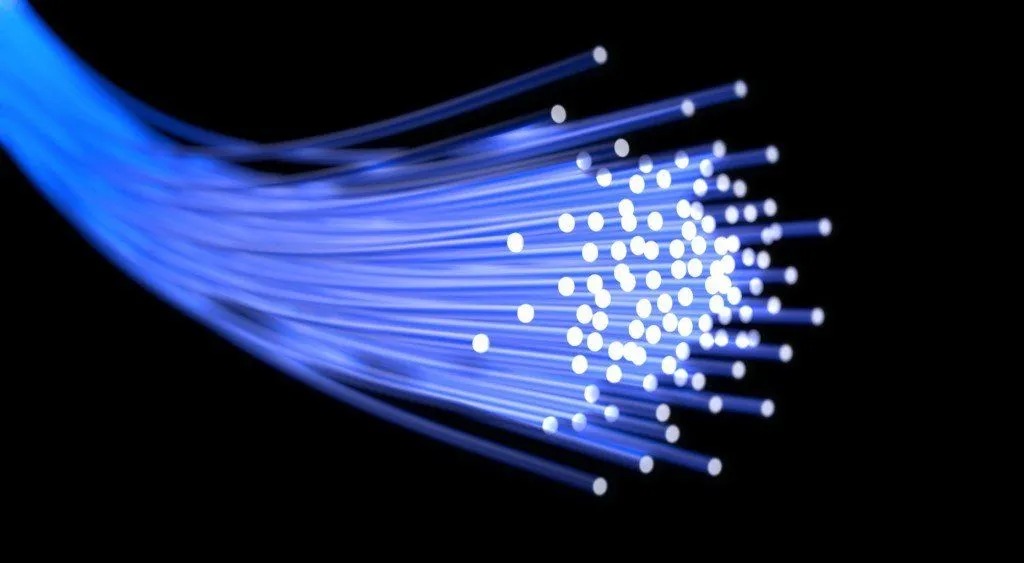
Imagine a long, flexible pipe, with its insides perfectly coated with mirrors. Look through one end, and ask a friend to flash a source of light (a torch or laser) through the other end. The light will reach your end, regardless of whether the pipe is straight, curved or twisted. This is because light will reflect off the sides of the pipe with almost negligible losses. While making a tube out of mirrors would work, it would be bulky and difficult to make. Therefore, optic fibers use glass instead of mirrors.
Glass is incredibly pure, so that even if it is several miles long, light can still make it through. The glass is drawn into a very thin strand, with a thickness comparable to that of a human hair. This light-carrying glass strand (the core) is surrounded by a second layer of glass (the cladding) that has a slightly lower refractive index, and the two together are wrapped in protective plastic. For transmitting light over long distances, it employs the principle of total internal reflection.
Total internal reflection in fibers.
Light rays traveling from a denser medium to a less dense medium (here, from the higher-index core glass toward the lower-index cladding glass) speed up at the boundary. This causes the rays to bend, or refract, when they strike the boundary at an angle. The slight difference in refractive index between the core and the cladding is what makes the light reflect rather than escape.
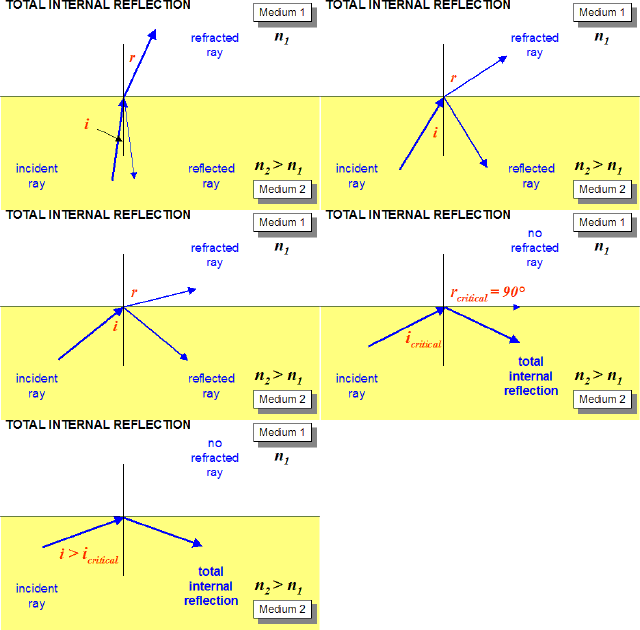
Beyond a certain angle, called the critical angle, all the waves reflect back into the glass. We say that they are totally internally reflected. The light rays stay inside the optic fiber and are transmitted over long distances with negligible loss.
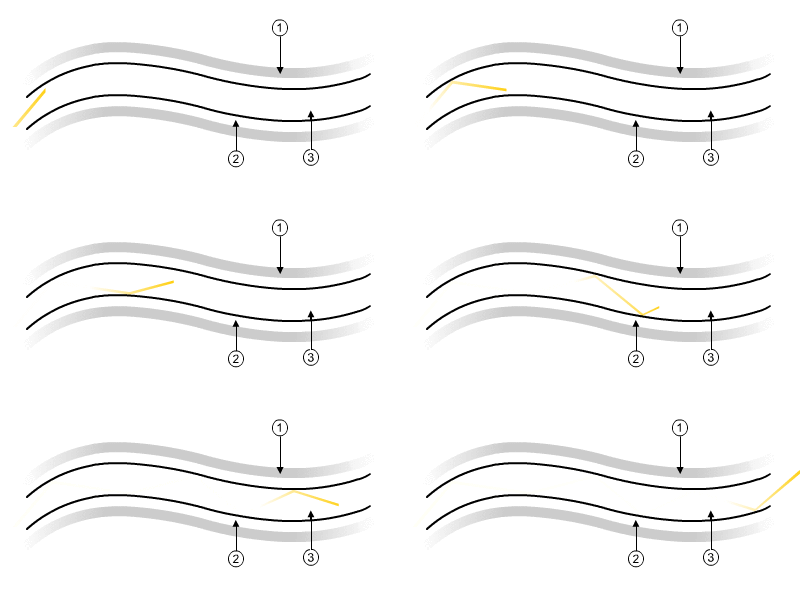
This is the essence of a fiber optic cable.
One common misconception is worth clearing up here: light does not travel faster than electricity, so that is not why fiber wins. Light in glass actually slows to roughly two-thirds of its vacuum speed (around 200,000 km/s, or 124,000 mi/s), because the glass has a refractive index of about 1.5. An electrical pulse racing down a copper cable also moves at roughly two-thirds the speed of light. In other words, the two signals travel at a broadly similar pace. Fiber's advantage is not raw signal speed but how much data it can pack into that signal, and how little of it is lost along the way.
Benefits Of Fiber Optics
The following properties make fiber optic cable superior to conventional copper cables.
1) Bandwidth
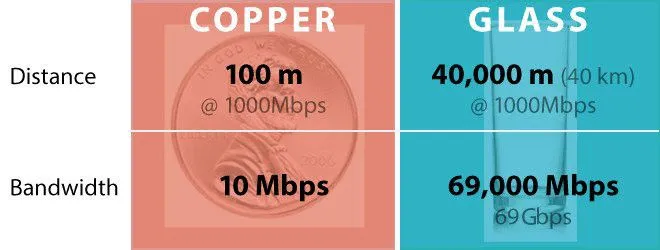
Fiber provides far more bandwidth than copper. A single fiber now routinely carries 10, 100, or even 400 Gbps in commercial networks, and it does so over distances that copper cannot match. More bandwidth means that fiber can carry more information with far greater efficiency than copper wire.
2) Range of transmission
Since data travels in the form of light (in total internal reflections, the loss of quality is negligible) in fiber-optic cables, very little signal loss occurs during transmission and data can move at higher speeds and greater distances.
3) Not susceptible to interference
Fiber-optic cable is also far less susceptible to noise and electromagnetic interference than copper wire. Because copper carries an electrical signal, it acts like an antenna, picking up nearby electromagnetic noise and leaking signal to neighboring wires (crosstalk); fiber carries light, so it is immune to both. The difference shows up in attenuation: over the first 100 meters, a copper cable can lose the vast majority of its signal strength, while a fiber loses only a few percent. That is why fiber can run for tens of kilometers between repeaters where copper would need boosting every few hundred meters.
4) Size, weight & strength
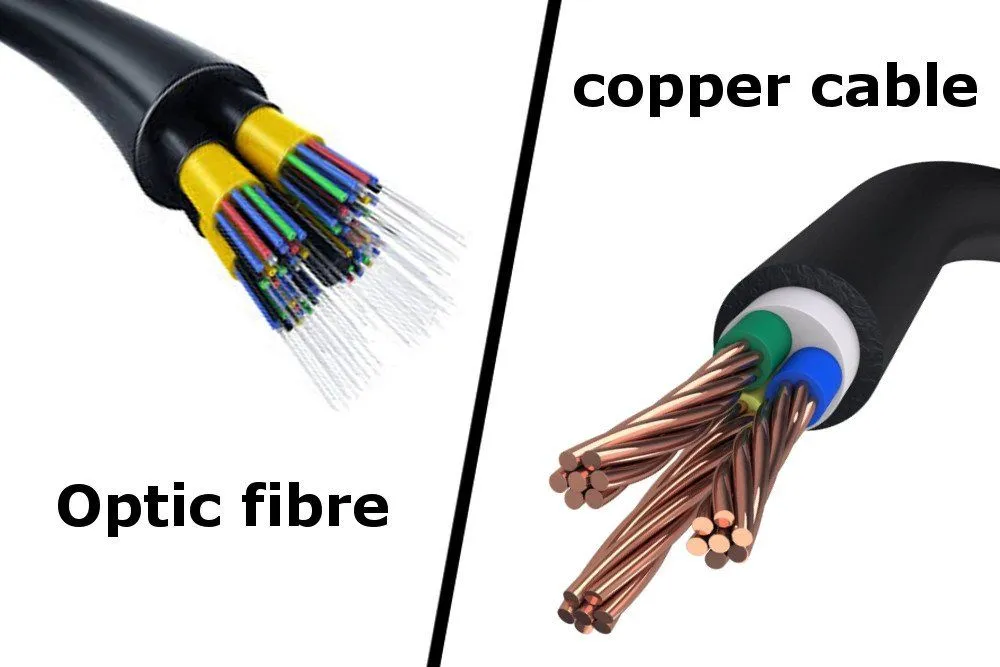
Fiber optic cable is much thinner and lighter than copper cable. It can be used more efficiently in confined underground pipes, and is also much stronger, with eight times the pulling tension of copper wire. Furthermore, it has strength members and stiffeners that make it much harder to damage or kink.
5) Cost
Although the material for fiber is much more expensive than its copper counterpart, in the long run, the working cost is much less. Typically, it has less of a maintenance cost and requires less networking hardware.
6) Durability
Fiber-optic cable is completely immune to many environmental factors that affect copper cable. The core is made of glass, which is an insulator, so no electric current can flow through. You can run fiber cable next to industrial equipment without any worries. Fiber is also less susceptible to temperature fluctuations than copper and can be submerged in water.
While the difference between copper and fiber-optic cables is similar to the difference between the telegraph and the telephone, the future will see fiber-optic technology improve exponentially. Fiber-optic systems are already being used in the backbone applications of most major companies due to their reliability and speed.

With ever-increasing Internet speeds, perhaps there will be a time when people once again long for slow Internet speeds. Actually, on second thought…. maybe that’s stretching things a bit too far!