LiFi (Light Fidelity) is a wireless networking technology that transmits data by flickering an LED on and off billions of times per second, far faster than the human eye can see. A photodetector on the receiver decodes that flicker back into bits. The term was coined by Professor Harald Haas at the University of Edinburgh in 2011, lab prototypes have reached 224 gigabits per second (not gigabytes), and the technology was formally standardised as IEEE 802.11bb in 2023, putting it on the same family of standards as WiFi.
Recently, there have been countless discussions and debates around a fancy new technology referred to as ‘LiFi’. However, the part of the whole affair that raised eyebrows around the world was the claim that LiFi can provide 100 times faster internet connectivity than existing WiFi offerings!
For those who haven’t followed the announcements regarding the arrival of LiFi, let’s take a closer look at what LiFi actually is and how it’s going to transform the world of internet connectivity.
What Is LiFi?
LiFi is a high-speed wireless communication technology that uses visible light (presently using LEDs) to transmit information. WiFi and LiFi are similar because both technologies are wireless, but also very different, because unlike WiFi, which relies on radio waves, LiFi uses visible light communication (VLC) or infrared and near-UV spectrum waves. In other words, LiFi works by using visible light, like the light that is emitted by any regular lamp or bulb! The term was coined by Professor Harald Haas of the University of Edinburgh in a 2011 TED talk, and in June 2023 LiFi was formally standardised by the IEEE as 802.11bb, sitting alongside WiFi’s 802.11 family of standards.
How Does It Work?
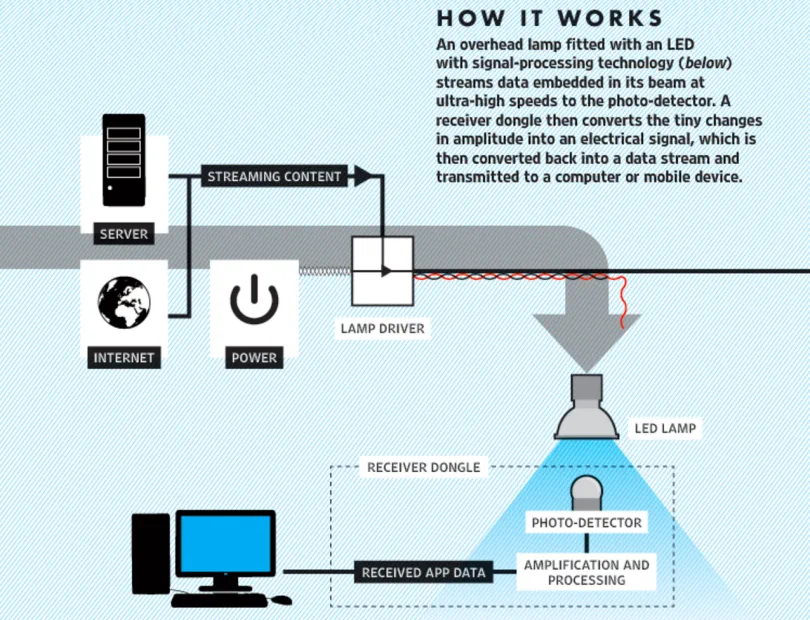
When a constant current is applied to an LED (LED lamps are commonly found in households and offices nowadays), tiny packets of energy (called photons) are released, which we perceive as visible light. If the input current to the LED is varied slightly, the intensity of the light output also varies. The good thing is that such tiny variations in the intensity of the light are imperceptible to human eyes. Since LEDs are semiconductor devices, the current and the optical output (the light produced by LEDs) can be modulated at very high speeds, which is then detected by a photodetector device that converts it back to electric current.
In this way, LiFi technology uses light from LED lights to transmit data and provide much faster Internet connectivity.
Benefits Of LiFi
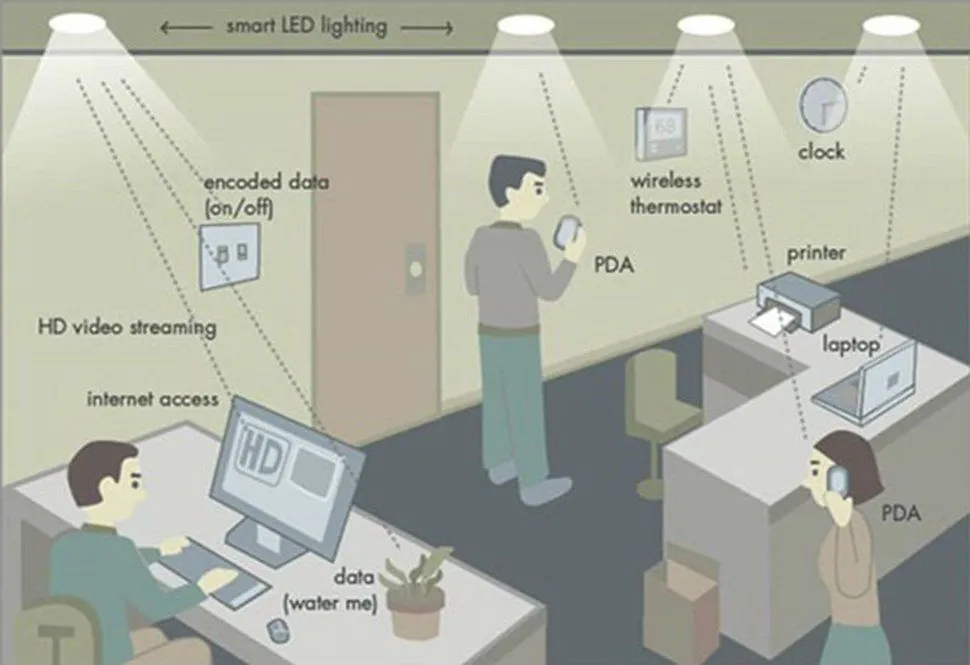
Since we are already largely dependent on visible light from lamps and bulbs, LiFi presents many unprecedented advantages for its uptake and use, as far as wireless Internet connectivity is concerned.
Lights are almost everywhere you go – in your room, in halls and auditoriums, in cafes…. it’s impossible to make a complete list of places where you can easily find a source of light. If this new trend catches on, then where there’s light, there will be Internet connectivity through LiFi. As mentioned above, LiFi relies on visible light to communicate, which is a good thing in more ways than one. These waves are able to carry far more information than the traditional radio waves used in WiFi technology.
The visible-light spectrum is roughly 1,000 to 10,000 times wider than the radio-frequency spectrum used by today’s WiFi, depending on how you count. In laboratory conditions, LiFi has demonstrated data rates of up to 224 gigabits per second (Gbps, that’s bits, not bytes), and Edinburgh-spinout pureLiFi has commercial modules in the 1 Gbps range. Marketing copy often summarises this as “100x faster than WiFi,” but the honest answer is that the gap depends on which WiFi standard you’re comparing against.
LiFi is also more suitable in electromagnetic-sensitive areas like hospitals, airplane cabins, and nuclear power plants (where electromagnetic disturbance can be disastrous).
The Downside Of LiFi
Along with all these benefits, there are also some disadvantages of a LiFi connection. Since it uses visible light to transmit data, LiFi would be rather useless in conditions where there is no light. That means no Internet while lying in your bed at night. If you have a WiFI router installed in one room of your house, you can connect your devices sitting anywhere in the house, but this is not the case with LiFi. Since visible rays cannot pass through walls, you have to be in the immediate vicinity of the source of light to access the Internet on your device, which may not sound particularly convenient to many people.
This technology is also said to be less reliable (again, due to it being dependent on visible light) and has high installation charges.
How Is LiFi Different From WiFi?
The two technologies do the same job (carry your data through thin air), but they ride on completely different parts of the electromagnetic spectrum. WiFi rides on radio waves; LiFi rides on light. That single choice drives almost every other difference between them.

Sit visible light next to radio on that chart and you can see why engineers got excited: the slice of spectrum that LEDs can use is far wider than the crowded radio band today’s WiFi shares. The University of Edinburgh’s LiFi Research Centre puts it at roughly 1,000 times the bandwidth of the entire 300 GHz radio, microwave and millimetre-wave range. More spectrum means more room for data.
The headline-speed contest is closer than the “100x” marketing suggests. When the IEEE finalised the LiFi standard, IEEE 802.11bb, in 2023, it specified a top throughput of 9.6 Gbps, which is exactly the same ceiling as WiFi 6. Where LiFi pulls ahead is aggregate capacity: because each light bulb is its own little cell and the beams do not bleed through walls into one another, the Edinburgh team estimates a LiFi network’s area data rate can be around 1,000 times that of a WiFi network packed into the same room.
The flip side is reach. WiFi happily passes through walls and floors, so one router covers a flat; LiFi needs a line of sight to the lamp. That sounds like a weakness, but it doubles as a security feature: since the signal stops at the wall, someone in the next room (or the car park) cannot quietly grab your traffic. LiFi also causes no radio interference, which is exactly why a radio technology like Bluetooth or WiFi is a poor fit for the places we will look at next.
Is LiFi Just a Glorified Light Bulb?
It is easy to picture LiFi as a one-way trick: a bulb blinks, your laptop reads the blinks, done. That describes plain visible light communication (VLC), which is essentially a point-to-point optical link. LiFi is the full networking version of that idea. The review literature defines LiFi as a complete, bidirectional, multi-user wireless network built from many tiny optical cells, with seamless handover as you move from one light to the next, much like your phone hops between mobile masts.
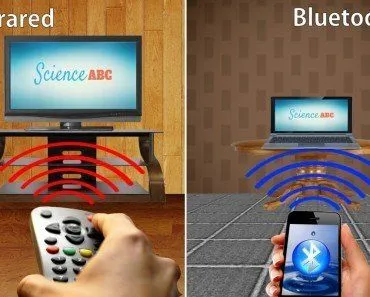
Two-way traffic raises an obvious question: if the ceiling lamp sends data down to your device, how does your device send data back up? Beaming visible light back up from your laptop would be distracting and would clash with the downlink, so most LiFi designs hand the uplink to infrared. Infrared sits just beyond the red end of the visible spectrum, behaves much like visible light, and is invisible to us, so the return channel stays out of sight. (It is the same band your TV remote uses; we cover it in how infrared transmission works.)
The downlink itself is pure speed of switching. A LiFi-enabled LED is driven by a small controller that flicks it on and off tens of thousands to millions of times per second, encoding ones and zeros into the changing brightness. The changes are far too fast and too slight for your eye to notice, so the lamp still looks like an ordinary, steady light. A semiconductor LED can be modulated this quickly precisely because it has no slow-warming filament, which is why the whole approach only became practical once LED lighting was everywhere.
Where Is LiFi Actually Used?
LiFi’s quirks (no signal through walls, no radio interference) turn into genuine advantages in places where ordinary WiFi is awkward or even unwelcome.

Hospitals and aircraft cabins. Operating theatres are packed with sensitive monitors, and an aircraft cabin is wrapped around radio-sensitive avionics. Because LiFi adds no radio noise, it can deliver fast connectivity in these settings without the electromagnetic-interference worries that come with radio kit, which is why healthcare and aviation are repeatedly singled out as natural homes for the technology.
Underwater. Radio waves die out within metres of seawater, but light travels far better, so LiFi-style optical links are being explored to let divers and autonomous underwater vehicles talk to each other where WiFi simply cannot reach.
Indoor positioning and vehicles. Because each lamp covers a small, well-defined patch, a phone can work out which light it is sitting under, giving room-level indoor positioning where GPS struggles. On the road, the same principle lets headlights, tail-lights and street lamps double as data links for vehicle-to-vehicle communication. In 2025, US firm Terra Ferma announced LiFi product lines aimed at military and government use, a sign the technology is edging out of the lab.
There’s no doubt that LiFi is going to transform the world of Internet connectivity, but it seems unlikely that its rise would necessarily mean the death of WiFi, since the latter is deeply embedded in the lifestyles of billions of people. A more likely scenario, though, is that we’ll eventually have a wide range of technologies available at our disposal and will be free to choose the most appropriate one. Having that flexibility certainly seems like the most desirable scenario to me!
References (click to expand)
- Li-Fi - Wikipedia. Wikipedia
- (PDF) Li-Fi (Light Fidelity)-The future technology In Wireless .... Academia.edu
- pureLiFi (Edinburgh spinout commercialising LiFi technology).
- IEEE 802.11bb-2023: Light Communications Amendment (LiFi standard).
- LiFi networking spec IEEE 802.11bb approved (800–1000 nm band, 10 Mb/s to 9.6 Gb/s). The Register.
- Li-Fi: 100 Times Faster Than Wi-Fi. IEEE Spectrum.
- How Fast Can LiFi Be? LiFi Research Centre, University of Edinburgh.
- Jurczak, C. Review of LiFi Visible Light Communications: Research and Use Cases (2018). arXiv.