WiFi signals are a type of electromagnetic radiation, much like visible light. The electromagnetic waves that have a wavelength in the range of WiFi signals pass through walls just as easily as light passes through glass windows.
One of the most common problems of the modern world is the lack of WiFi availability, especially when you need it most!
However, there are some things about Wi-Fi technologies that, if you’d mentioned them a few decades ago, would have made people think you’d lost your marbles. For instance, the very existence of a technology that enables you to stream videos and connect to the rest of the world, wirelessly, would have boggled everyone’s mind.
Also, WiFi signals reach your device even when the WiFi router is far away from you. For example, you’re able to browse the internet using WiFi even if the WiFi router is in a different room with one or more walls/doors between your phone and the router.
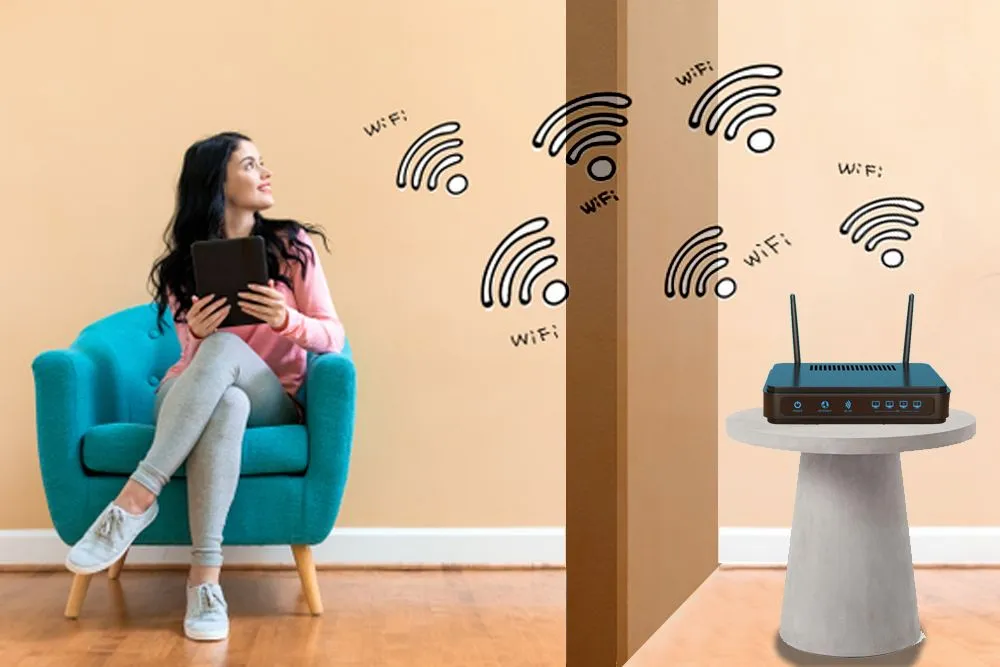
Isn’t it strange that light can’t travel through walls, but WiFi signals can? How does that happen?
Electromagnetic Radiation And WiFi
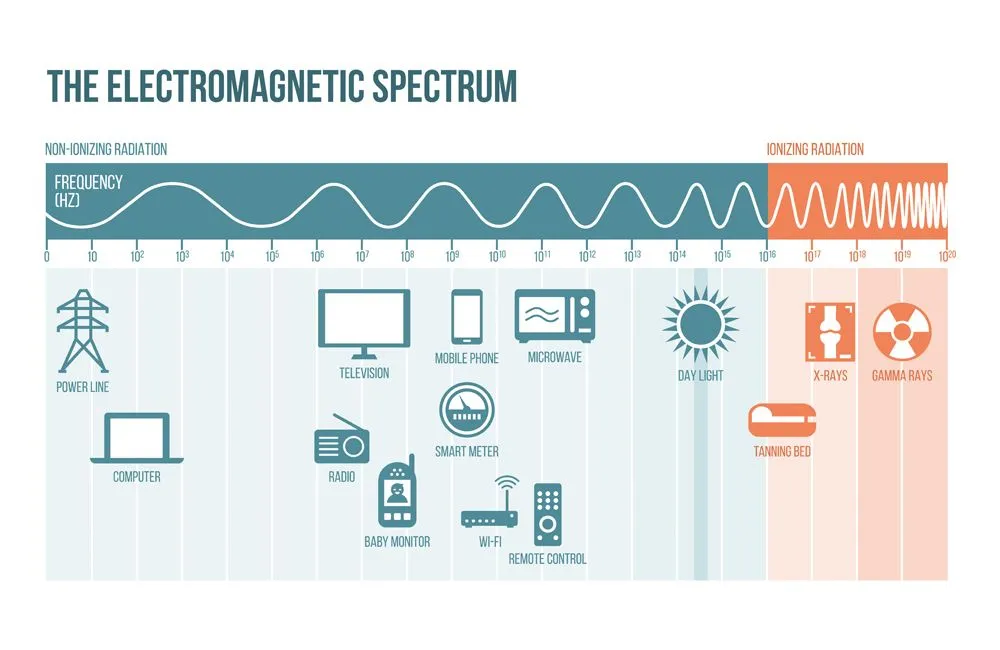
You’ve probably come across electromagnetic radiation at some point recently. After all, we’re constantly surrounded by it. Visible light, Bluetooth, WiFi signals, infrared, it’s everywhere. From a technical standpoint, it is a form of energy that travels at the speed of light and is categorized into radio waves, microwaves, UV rays and so on, depending on its frequency (or wavelength).
Take a look at the following picture:
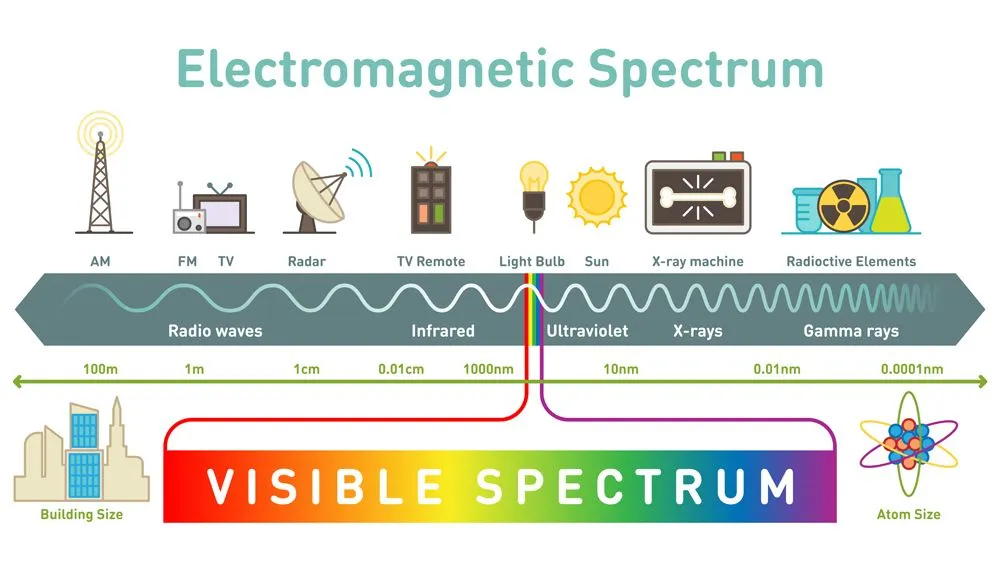
As you can see in the image above, there are 6 main types of electromagnetic radiation (7, if you count visible light separately).
Radio waves are one of the types, and WiFi works on these radio waves.
WiFi uses radio waves to establish wireless communication between two or more devices. Strictly speaking, the 2.4 GHz, 5 GHz, and 6 GHz bands that WiFi uses sit at the boundary between radio waves and microwaves on the electromagnetic spectrum, but they are conventionally called radio frequencies. Modern routers operate on more than one of these bands depending on the amount of data being transmitted, and the higher the frequency, the greater the amount of data that can be sent per second.
The 2.4 GHz band travels farthest and penetrates walls best, but is more crowded (microwaves, cordless phones, Bluetooth, baby monitors). The 5 GHz band carries more data with less interference, but its shorter wavelength is absorbed more by walls. The newer 6 GHz band, opened up by Wi-Fi 6E and used by Wi-Fi 7 (IEEE 802.11be, certified in January 2024), offers even more bandwidth and lower latency, though its range and wall penetration are the most limited of the three.
What Is The Wavelength Of A WiFi Signal?
We keep talking about WiFi having a "frequency" of 2.4, 5 or 6 GHz, but how long is a single WiFi wave, exactly? Working it out is surprisingly easy. The wavelength, frequency and speed of any electromagnetic wave are tied together by one simple relationship: wavelength = speed of light ÷ frequency (λ = c/f). Light travels at almost exactly 300,000 km/s (about 3 × 10⁸ m/s), and we know the frequency, so the wavelength falls right out.
For the 2.4 GHz band, that gives roughly (3 × 10⁸ m/s) ÷ (2.4 × 10⁹ Hz) ≈ 0.125 m, or about 12.5 cm (5 inches) from one wave crest to the next. Run the same sum for the higher bands and the waves get shorter: the 5 GHz band works out to about 6 cm (2.4 inches), and the newest 6 GHz band to roughly 5 cm (2 inches). A handy shortcut, if you ever want to do this in your head, is that the wavelength in millimeters is close to 300 divided by the frequency in GHz.
Those are big, chunky waves. Visible light, for comparison, has a wavelength of less than a thousandth of a millimeter, hundreds of thousands of times shorter than a WiFi wave. That size difference is exactly why the two behave so differently around a wall: a 12.5 cm wave is far too large to "notice" the fine atomic structure that soaks up visible light, so it sails through. It also explains the trade-off in your own home. The longer 2.4 GHz waves bend around obstacles and slip through walls more easily, which is why that band reaches the far corners of the house, while the shorter, more easily absorbed 5 GHz and 6 GHz waves carry more data but fade faster through brick and concrete.
How WiFi Signals Travel Through Walls
When an electromagnetic wave (in this case, a WiFi signal) strikes a surface, it can do one of three things:
1 – pass through (transmission)
2 – get reflected (reflection)
3 – get absorbed (absorption)
(In practice, all three usually happen at once: some of the wave is reflected at the surface, some is absorbed inside the material, and the rest is transmitted out the other side. Refraction (the bending of the wave as it crosses the boundary) is also involved, but it is what bends the transmitted portion, not the act of passing through itself.)
When an object reflects a particular wavelength of visible light, the color associated with that wavelength becomes the color of the object. An apple is red because, when light falls on its surface, the wavelength of light that it reflects the most is the one associated with the color red.

Now, the next logical question: what makes an object absorb, reflect or refract only a particular wavelength of electromagnetic radiation?
That depends entirely on the composition of the object in question. You see, everything in this universe is made of tiny building blocks called atoms. It is the size of these atoms and the distance between them (how closely or loosely they’re packed together inside an object) that determines whether the object will absorb a particular wavelength of electromagnetic radiation or let it pass through.
Take visible light, for example. When you close your bedroom door, the light from outside doesn’t enter your bedroom, right? Why not?
Well, because visible light cannot pass through solid objects, such as walls or your bedroom door. However, it can easily pass through certain other solid objects, such as glass windows. This is exactly why WiFi signals are able to pass through walls and doors.
Just like how glass windows are transparent to visible light, walls are transparent to WiFi signals (another kind of electromagnetic radiation) because the frequency (or wavelength) of radiation associated with WiFi signals is able to penetrate solid objects, but only up to a certain point.
If the walls in question are too thick, the WiFi signals won’t be able to pass through them. Also, as WiFi signals travel through air, they get attenuated, meaning they lose some of their energy.
This is why, if you operate a WiFi router within a room surrounded by thick concrete walls, you won’t get any WiFi reception outside the room. Similarly, you won’t get good WiFi reception on your device if the router is a considerable distance away from you (150-300 feet).
How much a WiFi signal is weakened depends almost entirely on what the wall is made of. Drywall and plain wood are nearly transparent to WiFi, costing only a few decibels of signal. Plain glass windows let WiFi through with very little loss, which is why your WiFi often works better through a window than through an interior wall. Modern energy-efficient windows are a different story: low-emissivity (low-E) and tinted glass have a thin metallic coating that, while great for blocking heat, also reflects radio frequencies, so they can attenuate WiFi by 20 dB or more compared to ordinary glass. Brick, plaster, and tinted glass cause moderate attenuation, while thick concrete (especially steel-reinforced concrete), stone, and any large sheet of metal (including foil-backed insulation, metal studs, mirrors, refrigerators, and metal filing cabinets) strongly block WiFi. Water also absorbs the 2.4 GHz band heavily, which is why a fish tank, a wet wall, or a roomful of people can noticeably weaken the signal.
Put simply, walls are just as transparent to WiFi signals as glass windows are to visible light, which is why WiFi signals can easily pass through most walls and ensure you stay connected!
Can X-Rays And Gamma Rays Pass Through Walls Too?
Here's a puzzle that trips up almost everyone. WiFi and radio waves sit at the low-energy end of the electromagnetic spectrum and pass through walls. Visible light sits in the middle and gets stopped cold. So you'd expect that as you climb to higher and higher energies, walls would block radiation even more thoroughly. They don't. X-rays and gamma rays, which sit at the very high-energy end, punch straight through walls too, which is precisely why a dentist can image your teeth through your cheek and why hospitals line their X-ray rooms with lead and thick concrete.
So penetration is not a simple slope from "blocked" to "not blocked" as frequency rises. Both ends of the spectrum get through, while the middle does not. The reason comes back to how a wave's energy lines up with the atoms in the material. Visible light happens to carry just the right amount of energy to be absorbed by the electrons in a brick or a wooden door, so the wall mops it up. WiFi-band radio waves carry far too little energy to be absorbed that way, and their long wavelength dwarfs the gaps between atoms, so they slip past. X-rays and gamma rays go to the other extreme: they are so energetic that they barely interact with the loosely held outer electrons at all and mostly sail through the mostly empty space inside atoms, stopped only by very dense, heavy materials such as lead.
What about microwaves? WiFi already lives right at the radio/microwave boundary, so true microwaves behave much like it, passing through drywall and wood while being absorbed by water. There is one crucial difference at the top end, though. X-rays and gamma rays carry enough energy to knock electrons clean off atoms, which makes them ionizing radiation that can damage living cells. WiFi's radio waves cannot do this at all, a distinction that matters a great deal for the next question.
Is WiFi Radiation Harmful To Living Things?
Once people learn that WiFi is "radiation," the natural worry is whether all those signals streaming through your walls (and through you) are doing any harm. The reassuring part is the one we just met: WiFi uses non-ionizing radiation. Unlike X-rays, gamma rays or even the ultraviolet in sunlight, WiFi's radio waves simply don't carry enough energy per photon to knock electrons off atoms or break the chemical bonds in DNA.

The only well-established biological effect of radio-frequency energy at high enough intensity is gentle heating, the same basic idea a microwave oven uses, just vastly weaker. At the power levels a home router puts out, and at the distances you actually sit from it, that heating is negligible. This is why the US Environmental Protection Agency notes that everyday exposure from WiFi and phones sits far below the levels that cause harm, and why every wireless device sold in the US must stay within the radio-frequency exposure limits set by the Federal Communications Commission.
It would be dishonest to pretend the science is completely settled. In 2011 the World Health Organization's International Agency for Research on Cancer placed radio-frequency electromagnetic fields, the broad category that includes WiFi and mobile phones, in Group 2B, meaning "possibly carcinogenic to humans." It is worth being clear about what that label means. Group 2B is the agency's weakest cancer category, it was driven mainly by studies of heavy mobile-phone users holding a handset against the head rather than by WiFi, and it reflects limited, inconclusive evidence rather than proven harm. For the faint, whole-room exposure from a WiFi router, health agencies have found no established risk, so the "EMF blocker" gadgets marketed to shield you from it are solving a problem that, on current evidence, isn't there.
References (click to expand)
- Using Wireless Technology Securely - webarchive.library.unt.edu
- Physics of WiFi. The University of Alaska Fairbanks
- HomeRF. The University of Mississippi
- Long Range Low Power (LRLP) Wireless Network. Washington University in St. Louis
- Anatomy of an Electromagnetic Wave. NASA Science
- Radio Waves. NASA Science
- The Electromagnetic Spectrum: An Overview. CDC
- Non-Ionizing Radiation From Wireless Technology. US EPA
- IARC Classifies Radiofrequency Electromagnetic Fields as Possibly Carcinogenic to Humans. IARC / WHO