A galvanic (voltaic) cell converts chemical energy to electricity using redox reactions between two electrodes like zinc and copper connected by a salt bridge. To understand this operation in detail, we must first understand what a redox reaction is.
What Is A Redox Reaction?
The word “redox” is short for “reduction-oxidation”. The combinative phrase represents two chemical reactions that occur simultaneously to exchange electrons. The reactant that loses its electrons is said to be oxidized, whereas the reactant that gains these very same electrons is said to be reduced. Note that one causes the other, and it is this causal nature of the reaction that gives the “red-ox” reaction its name.
Here is a simple experiment that illustrates a redox reaction.
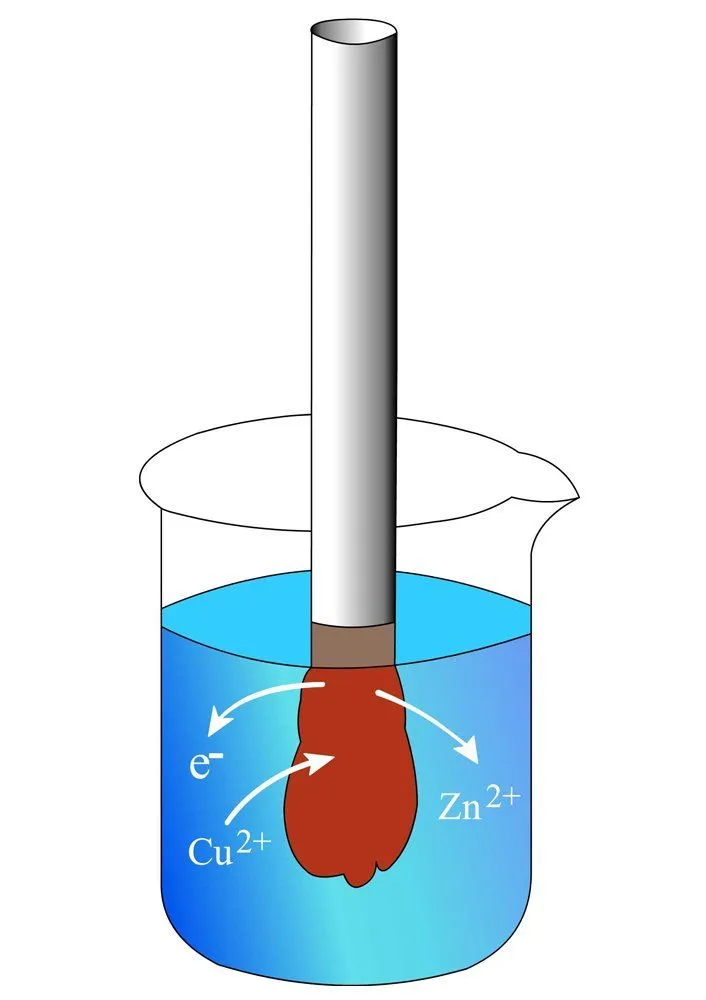 The beaker contains a solution of copper sulfate (CuSO4), in which a strip of zinc is dipped. Copper is more electronegative than zinc, meaning that it exhibits a greater tendency to attract electrons and become reduced to copper atoms. As soon as the strip is dipped into the solution, the copper ions (Cu2+) seize the zinc’s electrons to form copper atoms (Cu), which deposit as a brownish layer on the strip, while the zinc atoms (Zn), now deprived of electrons, become zinc ions (Zn2+), which dissolve into the solution. At the end of the reaction, the strip has become heavier and the solution is replete with zinc.
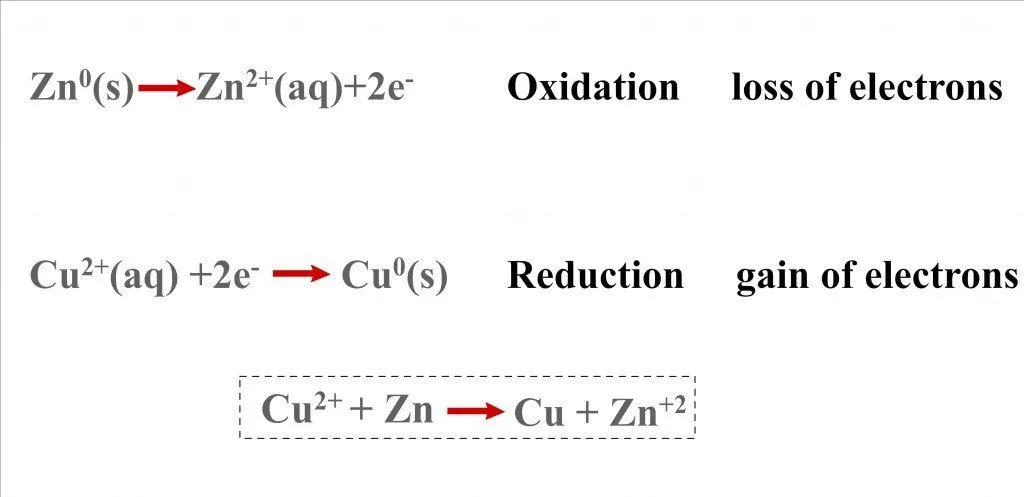
In the quick reaction between the metals, copper is reduced as it gains electrons, while zinc is oxidized as it loses electrons (remember OIL RIG: Oxidation Is Loss, Reduction Is Gain). Electricity is just the flow of electrons, and the electrons exchanged in the reaction can be used to, say, power a bulb, but this cannot be achieved in our beaker, for the electrons in it are carelessly dispersed. To harness them, we must somehow, before they are seized by copper, route every electron in the bulb. This can be achieved with not one, but two beakers.
Galvanic Cell Diagram
At its core, a galvanic cell converts chemical energy into electrical energy through a spontaneous redox reaction. Now, consider this apparatus, which represents a galvanic cell.
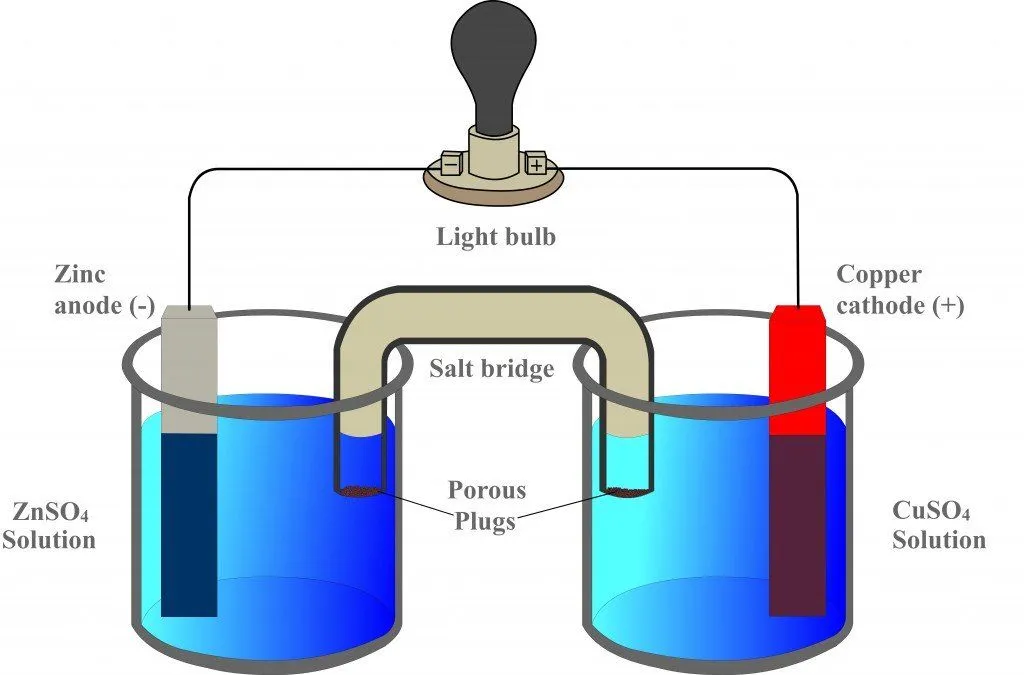
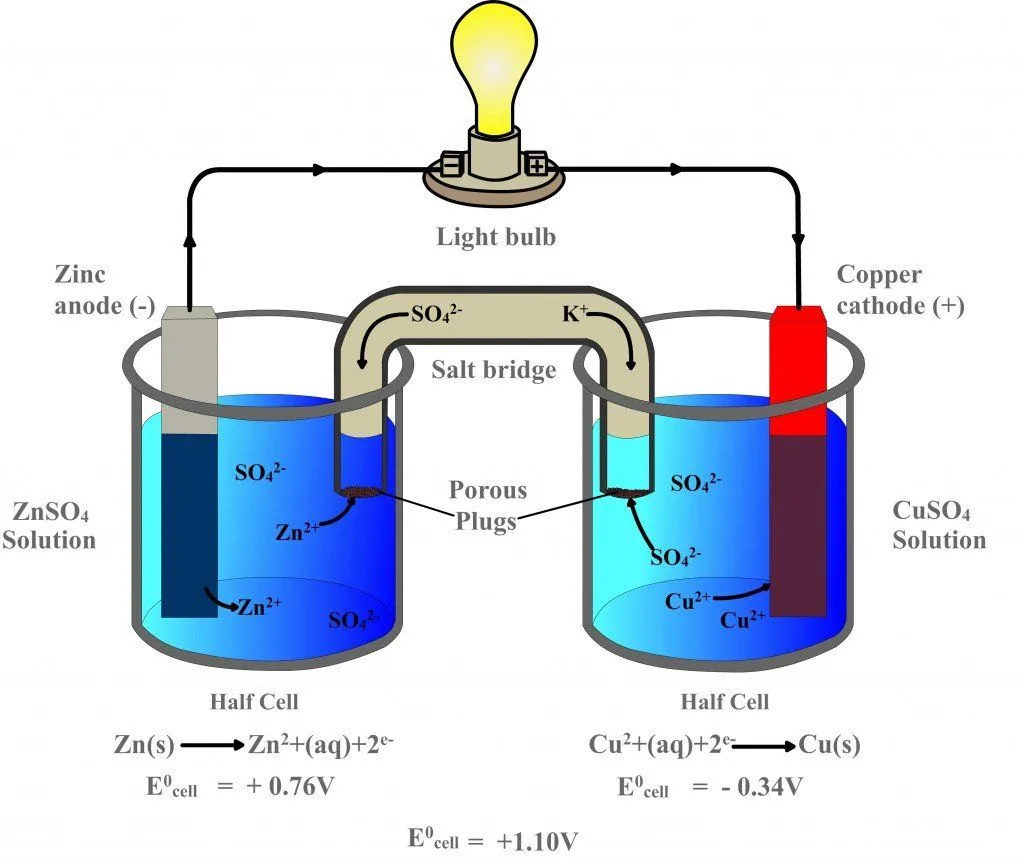
The first beaker contains zinc sulfate (ZnSO4) into which a strip of zinc is dipped, while the adjacent beaker contains copper sulfate (CuSO4) into which a strip of copper is dipped. However, the two strips are connected by an external circuit, a conductor, which is connected to a bulb.
The cell is named “galvanic” after its inventor, the physicist Luigi Galvani. In the 1780s, Galvani demonstrated that when two different metals are connected to each other at one end, while the other ends touch the legs of a dissected frog, the legs contract, indicating the flow of electricity. He attributed the twitch to what he called “animal electricity”, a vital force he believed was stored in the tissue itself. To challenge that interpretation, Alessandro Volta built the same cell without a single biological component, eventually leading to his voltaic pile of 1800. For this reason, “galvanic” and “voltaic” are used synonymously.
Even though their circuits worked, the inventors were incorrect about why they worked. Galvani believed that the frog was responsible, while Volta believed it was the properties of the isolated metals. It was Faraday who was finally correct in realizing that the electric energy was derived from chemical reactions, that the source of voltage was purely chemical. It was Faraday who coined the terms that now form electrical and electronic jargon: the metals he called electrodes (cathode and anode), the solution in which they were dipped he called electrolyte, and the charged entities involved he called ions (cations and anions).
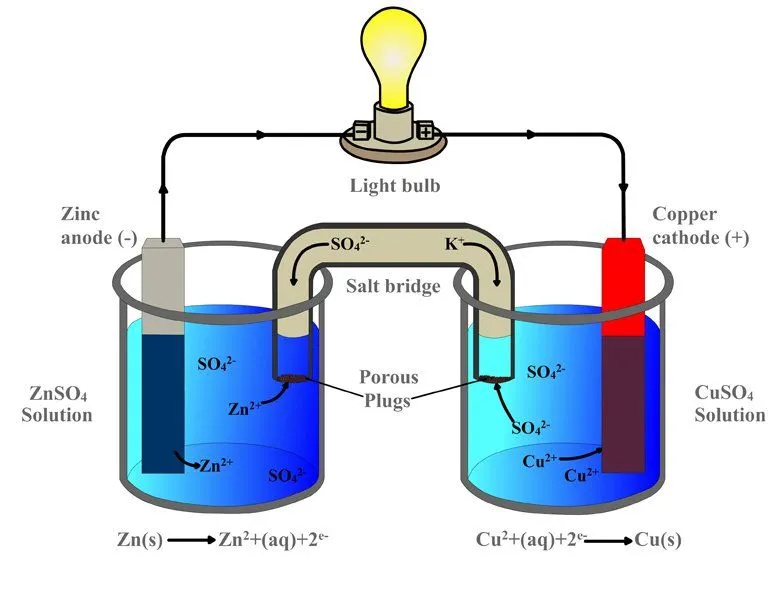
As soon as the zinc and copper electrodes are dipped into their respective sulfate electrolytes, the redox reaction begins: copper begins to lure zinc’s electrons. Just as it occurred in the single beaker experiment, the zinc atoms in the first beaker are oxidized and therefore lose their electrons and become zinc ions, which dissolve into the zinc sulfate solution. The copper ions in the adjacent beaker are reduced as they gain these electrons and become copper atoms, which deposit on the strip.
However, while the two beakers are physically separated, the electrodes are connected by an external conductor. The electrons, rather than dispersing, are routed to the copper electrode via this conductor. However, because perched on this conductor is a bulb, before reaching the copper strip, the electrons have no option but to go through the bulb. The zinc electrode, since it supplies the electrons, is the battery’s anode or the negative terminal, while the copper electrode, which attracts or receives the electrons, is the battery’s cathode or the positive terminal. Because one metal is bound to steal electrons from the other metal (or non-metal), the electronegativity determines the direction of the circuit’s current.
It’s easy to get the polarities tangled here, so let’s be precise. As zinc atoms dissolve into solution as Zn2+ ions, they leave their electrons behind on the zinc strip. The strip therefore builds up an excess of negative charge, which is why the anode is the negative terminal of the battery. On the other side, Cu2+ ions are pulling electrons off the copper strip as they plate out as neutral copper, so the cathode strip is left short of electrons and becomes the positive terminal. In short: in a galvanic cell, the anode (zinc) is negative and the cathode (copper) is positive, which is the same direction you’d see marked on a standard battery.
What Is The Salt Bridge?
Even though the electrons are successfully made to flow through the conductor and therefore the bulb, the bulb will not glow, because the circuit is still incomplete. What completes the circuit is the tube in the diagram, whose legs are dipped in both the beakers. This is called a salt bridge. The salt bridge is a porous substance composed of a salt on which electrons cannot travel, but cations and anions can. By forbidding the flow of electrons, it automatically excludes itself from participating or interfering in the process. Its sole purpose is to exchange ions and complete the circuit.
To picture what the bridge does, follow the charges. In the zinc beaker, every Zn2+ ion that dissolves leaves behind a build-up of positive charge in the electrolyte. In the copper beaker, every Cu2+ ion that plates out as copper metal leaves the electrolyte with a build-up of negative charge (the SO42− anions that were paired with it are now stranded). If we did nothing about this, the two electrolytes would rapidly accumulate opposite charges and the reaction would stall within seconds. The salt bridge (typically a U-tube filled with a neutral electrolyte such as KNO3) fixes this by letting its anions migrate into the zinc beaker (to balance the excess Zn2+) and its cations migrate into the copper beaker (to replace the consumed Cu2+). This continual internal ion flow keeps both half-cells electrically neutral and is what physically closes the circuit. The representation of a galvanic cell or the two beakers connected by a porous salt bridge can be further reduced to this:
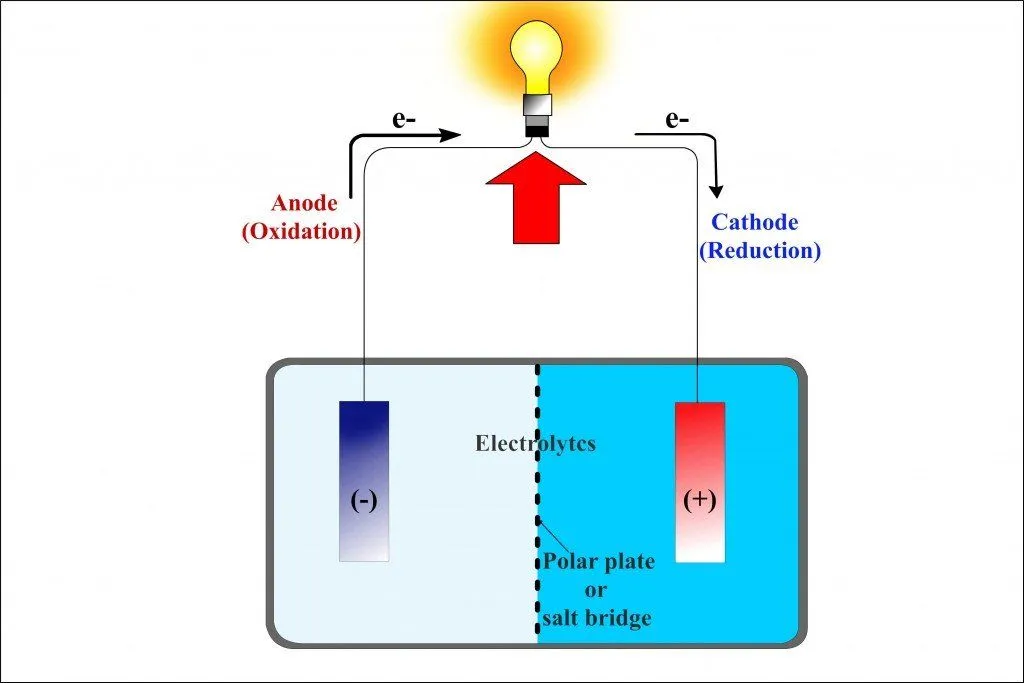
As the reduction and oxidation reactions occur physically separated in two different beakers, each beaker or unit is called a half cell. The nature of the voltage, in virtue of the singular direction of the flow of electrons, is DC. The magnitude of this DC voltage is the arithmetic difference of the voltages in the two half cells. The difference gives a relative measure of the ease of dissolution of the two electrodes into the electrolyte. The voltage is therefore a function of the properties of both the electrodes and the electrolyte. Remember (and it’s worth mentioning again) that the voltage is purely chemical.
Batteries today don’t house a single galvanic cell, but a pair, or two of them in series. A 12V battery ordinarily consists of 6 galvanic cells. The battery “dies” when the anode metal is fully consumed, or one of the cell’s key reactants (such as the cathode material or the electrolyte itself) runs out, and the redox reaction can no longer sustain a useful voltage. Bear in mind that not all batteries use zinc, copper and their sulfates as the electrodes and the electrolyte. What is necessary is the difference in the electronegativity of the electrodes.
Many common batteries, such as car batteries, are based on lead and lead oxide as anode and cathode, respectively. Even the salt bridge doesn’t necessarily have to be composed of the same salt the metals form. It merely needs to provide the necessary number of cations and anions to balance the reaction. In our example, if it were to be composed of potassium, it would donate two cations of potassium for a single cation of zinc.
How Does A Galvanic Cell Work?
We’ve now met every part of the cell on its own, so let’s assemble them and follow a single electron from start to finish. A galvanic cell works by splitting a spontaneous redox reaction into two halves and housing them in separate beakers, so that the electrons being handed from one metal to the other are forced to detour through an external wire. That detour is the electricity. Here is the whole sequence, step by step:
- Oxidation at the anode. Each zinc atom on the negative electrode surrenders two electrons and dissolves into the zinc sulfate solution as a Zn2+ ion, leaving its electrons stranded on the strip.
- Electrons take the long way around. Since the beakers are joined only by the external conductor, those electrons can’t reach the copper directly. They stream out of the zinc, through the wire, and through whatever load sits on it (in our case, the bulb), which is where their energy is spent.
- Reduction at the cathode. Reaching the copper electrode, the electrons are seized by the Cu2+ ions waiting in the copper sulfate solution. Each ion collects two electrons and plates onto the strip as solid copper.
- The salt bridge balances the charge. Oxidation leaves the zinc beaker with a surplus of positive charge and the copper beaker with a surplus of negative charge. The salt bridge feeds its anions into the zinc side and its cations into the copper side, neutralizing both half-cells so the reaction doesn’t stall.
- A steady current flows. As long as there is zinc left to dissolve and Cu2+ left to deposit, electrons keep traveling in one direction, and the cell delivers a direct (DC) current.
Written as half-reactions, the two halves and their sum are:
Anode (oxidation): Zn(s) → Zn2+(aq) + 2e−
Cathode (reduction): Cu2+(aq) + 2e− → Cu(s)
Overall reaction: Zn(s) + Cu2+(aq) → Zn2+(aq) + Cu(s)
The cell’s voltage is just the gap between the two electrodes’ standard reduction potentials: E°cell = E°cathode − E°anode = (+0.34 V) − (−0.76 V) = +1.10 V. That is exactly the ~1.1 V you would measure across the zinc-copper Daniell cell described below.
Examples Of Galvanic Cells
The zinc-and-copper apparatus described above isn’t just a textbook abstraction. It’s a real device known as the Daniell cell, built by the British chemist John Frederic Daniell in 1836 as an improvement over Volta’s pile. Its standard voltage is about 1.1 V, and for much of the 19th century, Daniell cells powered early telegraph networks. Beyond the Daniell cell, the same galvanic principle (two materials with different appetites for electrons sharing them through an external wire) sits inside almost every battery you’ve ever used:
- Voltaic pile (1800): Volta’s original, made of alternating zinc and silver (or copper and pewter) discs separated by cardboard soaked in brine or sodium hydroxide. Each pair contributes a fraction of a volt, and stacking dozens of them in series gave the world its first source of continuous electric current.
- Lead-acid car battery: A lead (Pb) anode and a lead-dioxide (PbO2) cathode sit in dilute sulfuric acid. Each cell produces roughly 2.1 V, so a standard 12 V automotive battery is six cells wired in series. Unlike the Daniell cell, it’s rechargeable (we’ll see why in the next section).
- Zinc-carbon dry cell: The classic 1.5 V AA before alkalines took over. The outer zinc can is the anode, a central carbon rod collects current from a manganese-dioxide (MnO2) cathode, and a moist paste of ammonium chloride and zinc chloride plays the role of the electrolyte.
- Alkaline cell: The modern 1.5 V AA, AAA, C, and D cells. Same zinc-and-manganese-dioxide chemistry as a dry cell, but with potassium hydroxide (KOH) as the electrolyte. It typically lasts several times longer than a zinc-carbon cell at the same load.
- Lemon battery: The classroom demo where a zinc nail and a copper coin pushed into a lemon light up an LED. The citric acid in the lemon is the electrolyte, and the cell delivers around 0.9 V, just enough to drive a small load.
What ties all of these together is the same principle a Daniell cell makes obvious: pick two materials with different electronegativities, give the electrons an external wire to travel through, and you have a battery.
Galvanic Cell Vs Electrolytic Cell
Lastly, once dead, galvanic cells cannot be revived or recharged. This is why one must change the batteries in an alarm clock or remote control from time to time. The kind of electrochemical cell that can be recharged is an electrolytic cell. An electrolytic cell also consists of two beakers filled with electrolytes into which electrodes are dipped, but it achieves the complete inverse of what a galvanic cell does: it converts electrical energy into chemical energy.
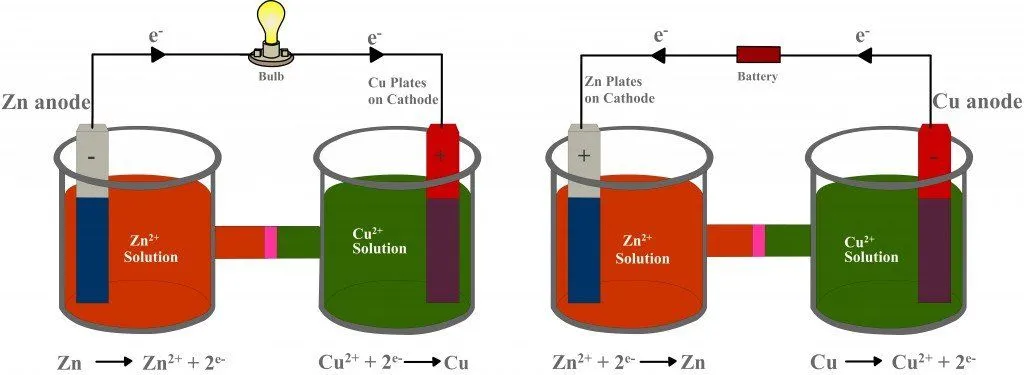
The electrodes are connected to an electrical source via an external circuit. However, the potential generated by this source is greater than the potential created by the redox reaction. What’s more, the source is installed in the opposite direction. Therefore, as a result of its greater potential, it overcomes the force of the incoming electrons and forces them to reverse their direction. The electrons then flow from the copper strip to the zinc strip, such that copper is now oxidized, and zinc is reduced. In this way, unlike a galvanic cell, which produces current from a redox reaction, an electrolytic cell uses electric current to drive a redox reaction. Later, the battery can be replaced with a bulb, making the cell galvanic, only fully charged.
References (click to expand)
- Voltaic Cells. The University of Wisconsin–Madison
- 2.1: Galvanic Cells. Chemistry LibreTexts (UC Davis).
- Daniell cell. Encyclopaedia Britannica.
- Luigi Galvani. Encyclopaedia Britannica.
- Alessandro Volta. Encyclopaedia Britannica.
- Battery: Galvanic cells. Encyclopaedia Britannica.
- Galvanic cell. Wikipedia.