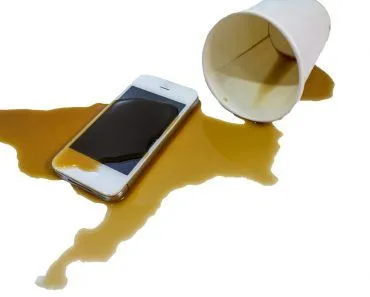
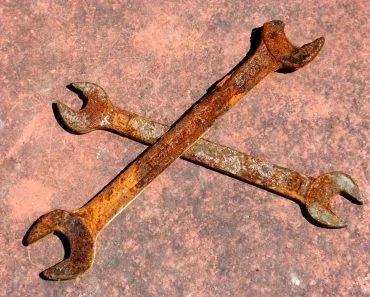
Rust is a poor conductor of electricity because it is an ionic compound (mostly hydrated iron(III) oxide, Fe2O3·nH2O) whose Fe3+ and O2− ions are locked into a solid crystal lattice and cannot move. Metallic iron conducts well thanks to its free electrons; rust has none, which is why a rusted battery terminal or wire effectively breaks the circuit.
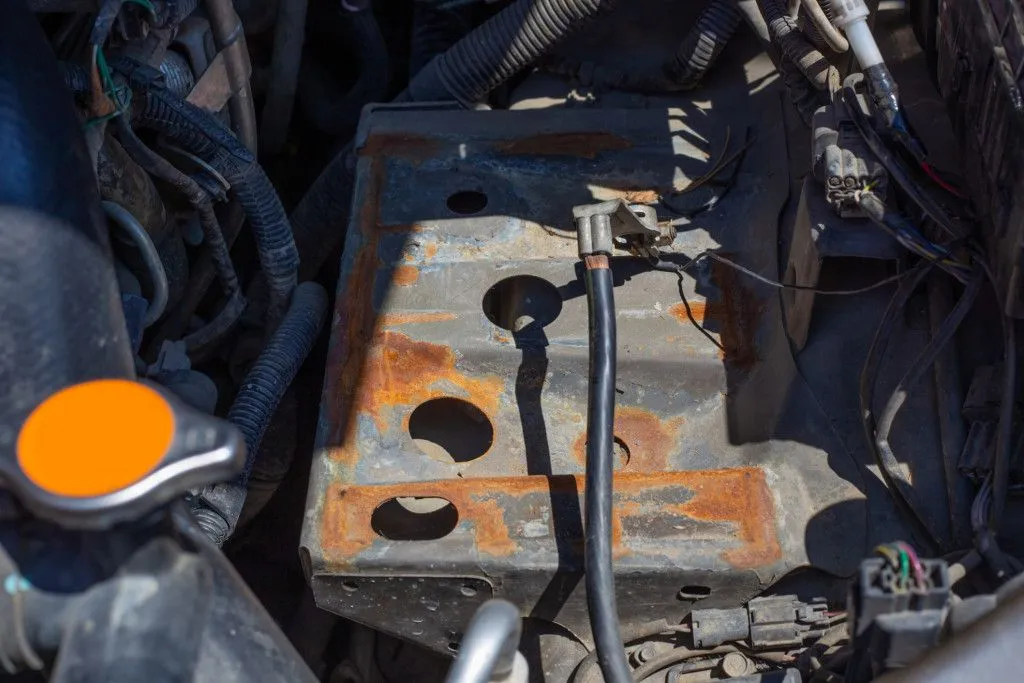
If you’ve ever used old batteries to power a device, you might have noticed that they don’t always sufficiently power the item. On closer inspection, you may even find orange-red flakes covering the terminals. After removing these flakes, the device should work just fine.
However, why did those flakes develop on the cell and why did the battery not supply sufficient power before removing the flakes?
The branch of science that answers these questions is electrochemistry.
A Word About Conduction
The property of matter that allows a directional flow of electric charge carriers due to the application of a potential difference is called electrical conduction. This directional flow of charge carriers with time is called electric current. Conductivity is an intrinsic property (depending only on its internal structure) and is quantified as follows:
Conductivity of a material, κ, is the current that flows through a 1 m long sample that is 1 m2 by cross section when a unit voltage (1 volt) is applied. Mathematically, the relation is expressed as follows:
κ = IV × lA
where,
I = Current (measured as output)
V = Applied voltage (input)
l = length of sample
A = area of cross section
Since conduction is a measure of the flow of charges, only those materials that contain free charge carriers (ions, electrons, protons) can conduct electricity.
Chemistry Of Rust
Rust is the chemical product of a redox reaction between metallic iron and oxygen in the presence of water, which acts as a catalyst (speeding the reaction up). Iron gets oxidized to various iron oxides and oxide-hydroxides, which range from orange-brown to red in color. Rust is the general name referring to all these iron oxides and iron hydroxides, with the dominant component being hydrated iron(III) oxide, Fe2O3·nH2O.
Rust Chemical Reaction
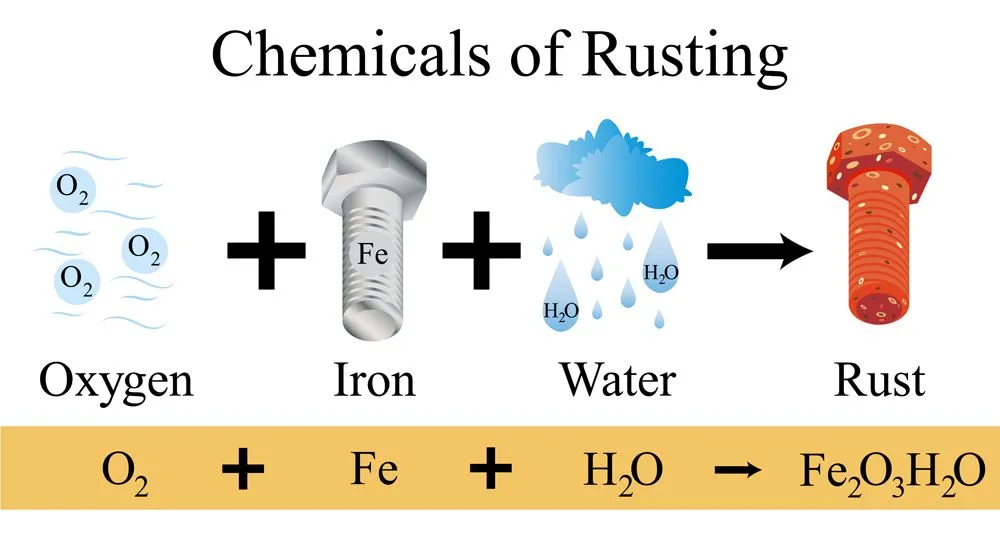
The reaction for rust formation consists of various sub-reactions that dictate the speed of reaction and the formation of rust. This is a redox reaction where iron gets oxidized and oxygen gets reduced. The reactants involved are metallic iron (Fe), oxygen gas from the atmosphere (O2) and water vapor/moisture (H2O).
- Fe(s) → Fe2+(aq) + 2e– : In this step, solid iron loses two electrons (oxidizes) in the presence of moisture
- 4Fe2+(aq) + O2 → 4Fe3+ + 2O2- : Further oxidation of Fe2+ occurs due to presence of atmospheric oxygen
- O2 + 4 e− + 2H2O → 4 OH− : The electrons released from the oxidation of Fe reduce oxygen to OH–
- Fe2+ + 2H2O ⇌ Fe(OH)2 + 2H+ : Fe2+ ions in water get hydrated to Fe(OH)2
- Fe3+ + 3H2O ⇌ Fe(OH)3 + 3 H+ : Fe3+ ions in water get hydrated to Fe(OH)3
- Fe(OH)2 → FeO + H2O : When water is removed (dehydration), FeO and Fe2O3 are formed
- 2FeO → Fe2O3 + H2O
Rust is the general term for Fe(OH)2, Fe(OH)3, FeO, Fe2O3 and higher oxides and hydroxides of iron.
Nature Of Chemical Bonds
Recall that conductivity is a property that results from the ordered movement of charge carriers due to voltage. Charge carriers can be ions, electrons or protons. If free charge carriers don’t exist, then no current will flow upon the application of voltage.
About The Ionic Bond
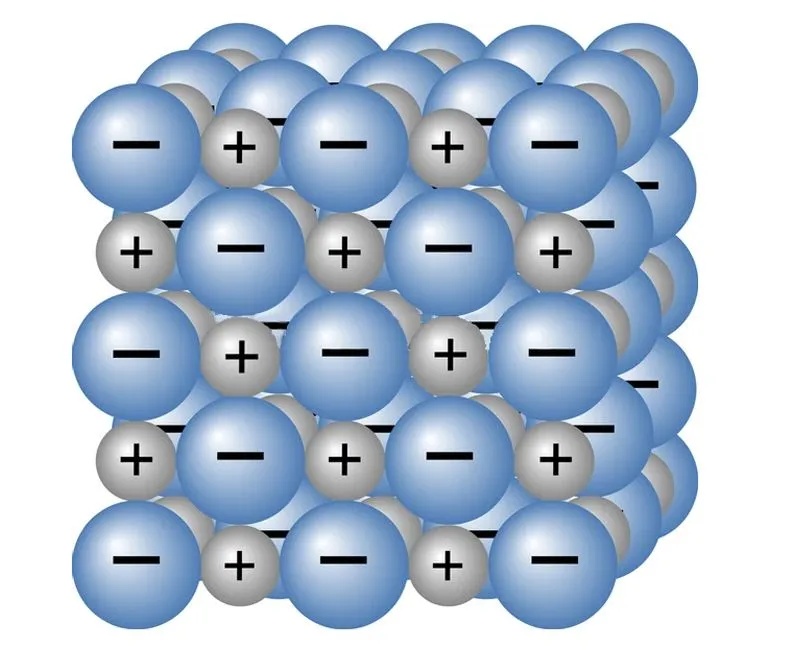
Fe(OH)2, Fe(OH)3, FeO and Fe2O3 are all ionic compounds. Ionic compounds are formed when a metal atom (Fe) donates electrons to a non-metal atom. The metal atom gains a positive charge and the non-metal atom gains a negative charge, resulting in the formation of ions. This causes electrostatic attraction between the two oppositely charged ions. This attraction keeps the ions close, and this bond is called an ionic bond. The compounds formed due to the transfer of electrons from a metal to a non-metal are called ionic compounds.
Why Is Rust An Insulator?
When in an aqueous solution, molten or gaseous form, ions are free to move, thereby conducting electricity. However, when in solid phase, ions are not free to move, and are instead bound together strongly to form crystals. The tendency of ions/charge carriers to move in the presence of voltage is called mobility.
Since conductivity arises due to the motion of charge carriers, there exists some characteristic velocity, called drift velocity, vd, with which charge carriers move. The greater the drift velocity, the greater the current. Also, a voltage produces an electric field, E. Mobility is defined in terms of vd and E as:
μ = vdE
Since ions are not free to move in solid crystals, rust barely conducts electricity. (Strictly, hematite α-Fe2O3 is a wide-bandgap semiconductor with a room-temperature conductivity of only about 10−11 S/cm (roughly 10−9 S/m) via slow “polaron hopping” between Fe2+ and Fe3+ sites. That is many orders of magnitude lower than metallic iron (about 107 S/m), which is why rust effectively acts as an insulator in everyday circuits.)
Is Iron Itself A Good Conductor Of Electricity?
A lot of people who land on this question are really asking about the metal underneath the rust, so it is worth being clear: pure metallic iron does conduct electricity, and it does so fairly well. It simply is not the best material for the job. At room temperature, iron has an electrical conductivity of roughly 1.0 × 10⁷ S/m, which corresponds to a resistivity of about 9.7 × 10⁻⁸ Ω·m. By comparison, copper sits near 5.95 × 10⁷ S/m and silver near 6.29 × 10⁷ S/m. Put simply, a copper wire carries roughly six times the current of an identical iron wire at the same voltage, which is exactly why the wiring in your walls is made of copper or aluminum rather than iron.

So why does the solid metal conduct when its rust does not? It comes down to the kind of bonding. In metallic iron, the atoms sit in a lattice of positively charged ions bathed in a shared “sea” of delocalized electrons. Recall that conduction needs free charge carriers. These outer electrons belong to no single atom, so they are free to drift through the entire structure the moment a voltage is applied, and that drift is the electric current. Iron trails copper and silver only because its electrons scatter a little more as they travel, which nudges its resistance up.
Rust turns this picture on its head. Once iron reacts with oxygen, those once-mobile electrons are handed over and locked into ionic bonds with oxygen atoms. What remains is not a pool of free electrons but a rigid arrangement of Fe3+ and O2− ions held firmly in place. The free charge carriers disappear, and the material’s ability to conduct disappears right along with them.
Does Oxygen Conduct Electricity?
The other half of rust is oxygen, and that raises a neighboring question people often ask: can oxygen itself carry a current? Under everyday conditions, the answer is no. Ordinary oxygen gas (O2) is made of electrically neutral molecules whose electrons are firmly bound, so there are no free charge carriers available to move. Air, which is about 21% oxygen, is therefore an excellent insulator. That is precisely why bare high-voltage power lines can hang out in the open with nothing but air separating them.

Notice that this is the very same rule that makes rust an insulator: no free charge carriers means no conduction. Oxygen does have electrons, but they are tied up inside its molecular bonds rather than free to roam.
Oxygen can be forced to conduct, however, if it is ionized. Push a strong enough electric field through air (roughly 3 million volts per meter) and the field rips electrons away from the molecules, converting the gas into plasma, a state of matter made of free electrons and positive ions. Because plasma is packed with mobile charges, it conducts electricity readily. The most dramatic everyday example is a bolt of lightning, a channel of ionized air that briefly carries a colossal current between cloud and ground. So oxygen is not a conductor in the usual sense, but, like most gases, it can be made to conduct once it has been torn into charged pieces.
References (click to expand)
- Electrical Conductivity and Resistivity. NDE Resource Center, Iowa State University
- Rust chemistry - Corrosion-Doctors.org. corrosion-doctors.org
- The electrical conductivity of thin film donor doped hematite: from insulator to semiconductor by defect modulation. Physical Chemistry Chemical Physics (2014). PubMed.
- Ionic bonding | School of Materials Science and Engineering. University of New South Wales
- Resistivity and Conductivity (table). HyperPhysics, Georgia State University
- Metallic Bonding. Chemistry LibreTexts
- Plasma: an electrically charged, ionized gas. NASA Science
- Electrical breakdown. Wikipedia