In a crash test, a vehicle is deliberately collided with static and moving barriers (head-on, offset, side and roof) while sensor-equipped crash dummies and high-speed cameras record the forces involved. Agencies like NHTSA, Euro NCAP and the IIHS analyze that data to rate how well the car protects its occupants and pedestrians.
Unless you live under a rock, it is unlikely for you to have not heard the term “crash test”. Crash demonstrations are often a part of marketing bulletins to help customers develop more faith in a manufacturer’s product. As much as the visuals of a car getting crushed are cringe-inducing to any motoring enthusiast, they are a necessary evil. To better understand this, let’s dive deep into the process of crash testing.
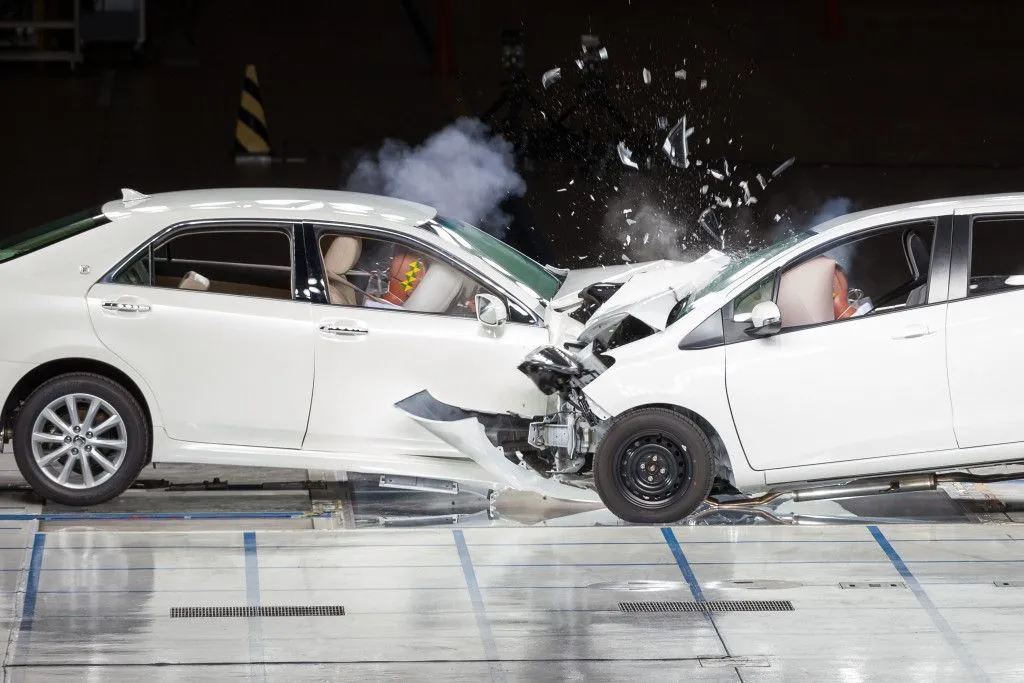
Why Do We Crash Test Cars In The First Place?
Accidents are unfortunate, and no one ever plans on having one. However, safety is paramount, and crash tests help us plan ahead for such contingencies. These tests simulate real-life accidents and their possible impacts on the human body. By doing this, it becomes possible to design safer vehicles. Such a test involves a series of destructive procedures that help analyze the post-accident dynamics. The results of crash tests are usually released as star ratings for easier understanding.
Crash Test Equipment
Apart from the car being tested, these tests involve specialized equipment to replicate real-life crashes and collect data from the event.
1. Crash Dummies
These human-like figures are made of various composites and metals and have sensors embedded in them. Crash dummies replicate the human body in terms of weight, dimensions and articulation during an accident. The long-serving Hybrid III dummy, designed back in 1978, is modeled on an average-sized adult male (about 1.75 m, or 5 feet 9 inches, and 78 kg, or 171 lb). For decades this male-centric standard left a safety gap: research has shown women are more likely than men to be injured in comparable crashes. Newer, far more sophisticated dummies are closing that gap. The THOR family of dummies carries many more sensors than the Hybrid III, and in late 2025 the US Department of Transportation finalized the THOR-05F, an advanced small-female dummy fitted with more than 150 sensors to capture how crashes affect smaller occupants.
2. Impact Trolleys
Accident media, such as oncoming vehicles and obstructions, are replicated by trolleys that are essentially frameworks of aluminum and steel. They are propelled at the test subject at various angles.
3. Imaging And Data Analysis Architecture
In order to analyze a crash and its impact, crash tests involve a lot of equipment, such as high-speed cameras, sensors and analysis software. Cameras and sensors can either be located aboard the vehicle being tested, or remotely, to accumulate crash data. Analysis of this data and the data accumulated by embedded sensors in the dummy gives a comprehensive assessment of how the vehicle’s structure fares on various safety fronts.
Various Types Of Crash Tests
There is no limit to the number of ways an accident may take place. Thus, crash tests are an ever-evolving set of procedures that try to account for the maximum number of possibilities.
1. Front Impact Tests
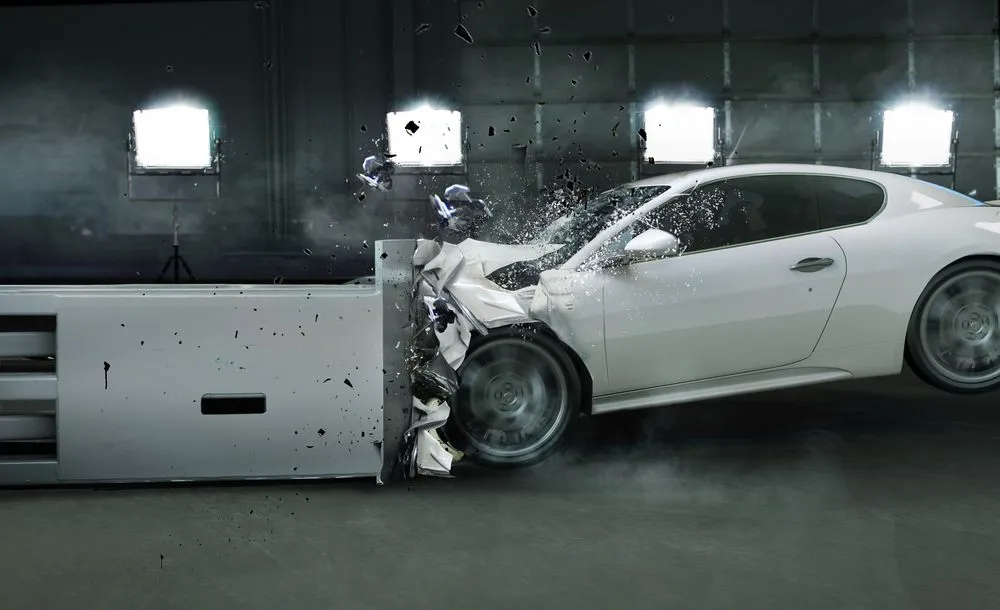
Front collisions are the most common type of accident, and consequently, extensive engineering is expended in making the front end of vehicles safer. The tests include colliding vehicles with both static and dynamic barriers; both head-on and at offset angles. Head-on collisions are usually distributed throughout the width of the car, putting more dependency on the air bags and seat belts. Offset collisions cause less distribution of forces, forcing manufacturers to design stronger structures and, in principle, safer cars. Front impact tests are usually carried out at a speed of around 56 to 64 km/h (35 to 40 mph). The US NHTSA program, for instance, slams a car into a fixed barrier at 56 km/h (35 mph), while Euro NCAP runs its offset deformable barrier test at 64 km/h (40 mph).
2. Side Impact Tests
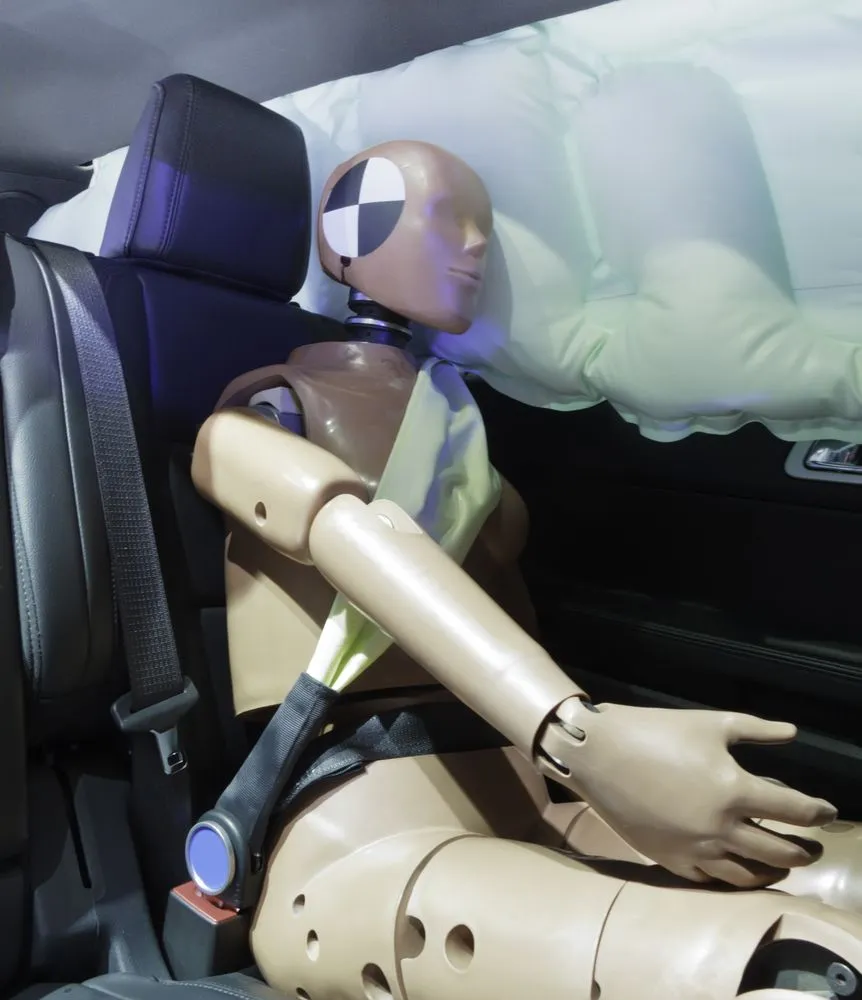
Compared to the front of the vehicle, the sides expose more of the passenger to danger, in that the length of the buffer is greatly reduced. Side impact tests involve colliding an impact trolley with a stationary vehicle at right angles, causing the doors to deform. Since there is less space for the massive amount of deceleration to play out, manufacturers must strengthen the structure of the pillars and door frames to absorb the impact better. Most new cars have side airbags fitted as standard to reinforce the side safety. Side crash safety tests are usually carried out at around 50 to 60 km/h (31 to 37 mph), with a wheeled trolley standing in for the striking vehicle.
3. Roof Impact Tests
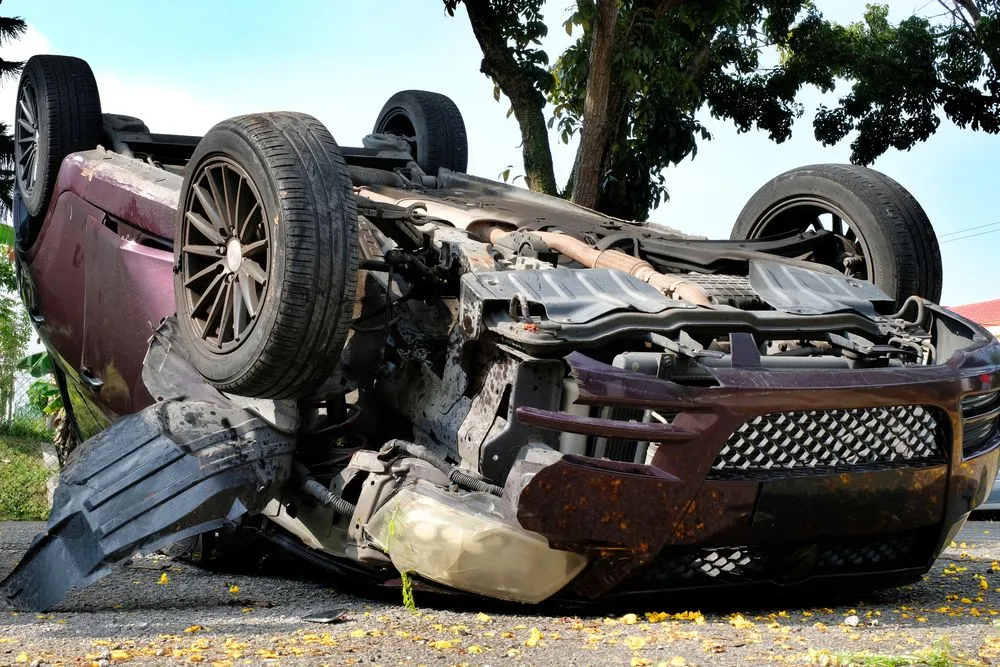
Amongst the least common, yet most significant accidents are rollover accidents, which involve a car turning over on to its roof. In the event of the roof collapsing, the occupants run the risk of being crushed under the weight of the car. These tests are carried out by pressing a metal plate against one corner of the roof at a constant speed and measuring the peak force it withstands before the roof crushes by 13 cm (5 inches).
This computation, also known as the strength-to-weight ratio, measures the peak force the roof endures relative to the weight of the vehicle, before giving way by 13 cm (5 inches). A higher strength-to-weight ratio implies better roof rigidity, and thus better rollover safety. On the IIHS scale, a ratio of 4.0 or higher earns a "Good" rating (meaning the roof holds up four times the vehicle's weight), 3.25 to 4.0 is "Acceptable", and anything below 2.5 is "Poor". Notably, the IIHS retired its standalone roof-strength test in recent years because nearly every new car was already scoring "Good", and a tougher federal standard had been phased in to match.
Crash Test Results
Crash tests, while mandated by law, are often carried out more thoroughly by third-party organizations. Some commonly known crash test authorities include the various New Car Assessment Programs (such as the US NHTSA's NCAP and Europe's Euro NCAP) and the IIHS (Insurance Institute for Highway Safety). Under the Euro NCAP scheme, crash test results have traditionally been broken into the four categories below.
1. Adult Occupant Safety
Adults are generally assumed to occupy the front seats, and thus, this safety rating is heavily dependent on frontal and side impact. It also takes into account the whiplash effect produced by the sudden jerk experienced at the neck during the course of the collision.
2. Child Occupant Safety

Crash tests assume children to be placed in adequate child seats that are fixed to the main rear seat by mounts. More emphasis is laid on the side impact, as the front and rear passengers are equally vulnerable on the sides of the car. The safety is measured by the effectiveness of the restraint system.
3. Pedestrian Safety
This is the only aspect of crash test results concerned with the safety of non-occupants. It measures the impact of the vehicle’s front end on the head, upper half and lower half of the body of a pedestrian or a cyclist who may accidentally come in contact with the car. The use of metal bumpers has therefore been banned in some countries.
4. Safety Assistance
This rating is a measurement of the effectiveness of the active and passive safety features in the car. These include lane assistance systems, seat belts and airbags. We have discussed active and passive safety in more detail here.
These categories are not set in stone. From 2026, Euro NCAP is rolling out its biggest overhaul since 2009, regrouping its assessment into four new pillars: Safe Driving, Crash Avoidance, Crash Protection and Post-Crash Safety. The shift reflects how much of modern car safety now happens before and after the impact, not just during it, with more weight given to driver monitoring, automated emergency systems and how easily rescuers can reach trapped occupants.
Is There A Downside To Safety?
While the obvious answer is no, this issue warrants a more nuanced discussion. Adding more safety features does add to a vehicle’s cost, making it less accessible to customers. Thus, motor vehicle authorities have minimum criteria that automobile manufacturers must satisfy to qualify as safe cars. Manufacturers therefore optimize their design to provide safe, yet affordable cars.
References (click to expand)
- Adult Occupant Protection - Euro NCAP. The European New Car Assessment Programme
- About our tests - IIHS. The Insurance Institute for Highway Safety and Highway Loss Data Institute
- Roof strength - IIHS. The Insurance Institute for Highway Safety and Highway Loss Data Institute
- Car Safety Ratings - NHTSA. National Highway Traffic Safety Administration
- USDOT Unveils Design for First-of-its-Kind Advanced Female Crash Test Dummy (THOR-05F). U.S. Department of Transportation
- Euro NCAP announces 2026 protocol changes to tackle modern driving risks. The European New Car Assessment Programme