Table of Contents (click to expand)
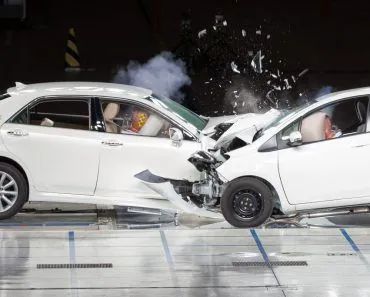
Airbags deploy in roughly 20 to 30 milliseconds, faster than you can blink. An accelerometer in the car detects the sudden deceleration of a crash and signals the Airbag Control Unit, which fires a small electrical charge into a chemical propellant (usually sodium azide or guanidine nitrate). The propellant rapidly produces nitrogen gas, inflating a nylon bag in front of the occupant to cushion the impact.
When forest-living humans first discovered that they could travel faster using a set of wheels than on their own legs, they still probably never imagined the day when they could move faster than a cheetah – the fastest animal in the wild. However, thanks to technology, traveling faster than a cheetah in today’s world is…

With the drastic shift in the speed at which a modern automobile can travel, versus an ancient one, the need for safety while driving an automobile has increased exponentially. In modern times, any discussion about the safety of passengers within a vehicle typically centers around two things: seat belts and airbags.
While we have already discussed the importance of seat belts in this article, it’s time to look at the second important safety feature of a vehicle: airbags.
What Is An Airbag?
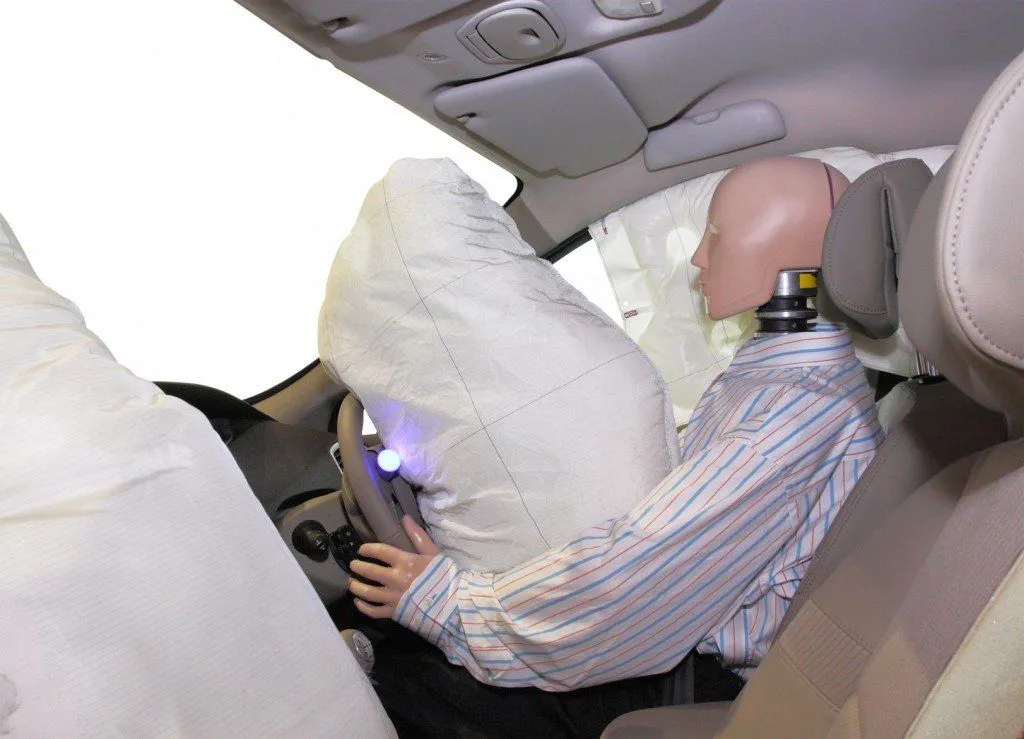
An airbag (also referred to as an ‘airbag cushion’) is a type of safety device that you can expect to find in almost every car these days. It is a flexible fabric bag that is designed to inflate in a fraction of a second in the case of any situation when the vehicle comes to an abrupt halt, such as during an accident.
The basic purpose of an airbag is to restrain the occupants’ rapid motion in the forward direction after a sudden deceleration of the car, while providing some cushion to lessen the force of the impact that the occupants are going to sustain.
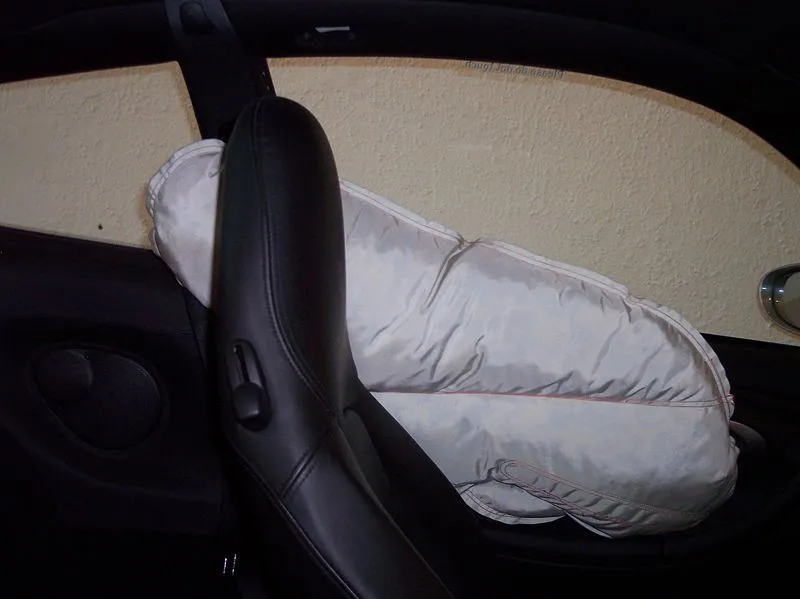
The head is the most vulnerable part of the human body; therefore, a primary airbag (the frontal airbag) is installed in the steering wheel of all modern vehicles. However, there are many other types of airbags, like side airbags, knee airbags, and rear curtain airbags, among others.
How Do Airbags Work?
We know that airbags can protect passengers and drivers from fatal injuries and render the accident marginally less harmful to everyone involved; but how do airbags determine the exact time to deploy?
Important Components
An airbag is managed by the ACU (Airbag Control Unit, which is a special type of Electronic Control Unit). The ACU also monitors a host of other sensors present in the automobile, including impact sensors, accelerometers, wheel speed sensors, gyroscopes, seat-occupancy sensors and so on, all of which contribute to the deployment of the airbag one way or another.
Deployment Of An Airbag
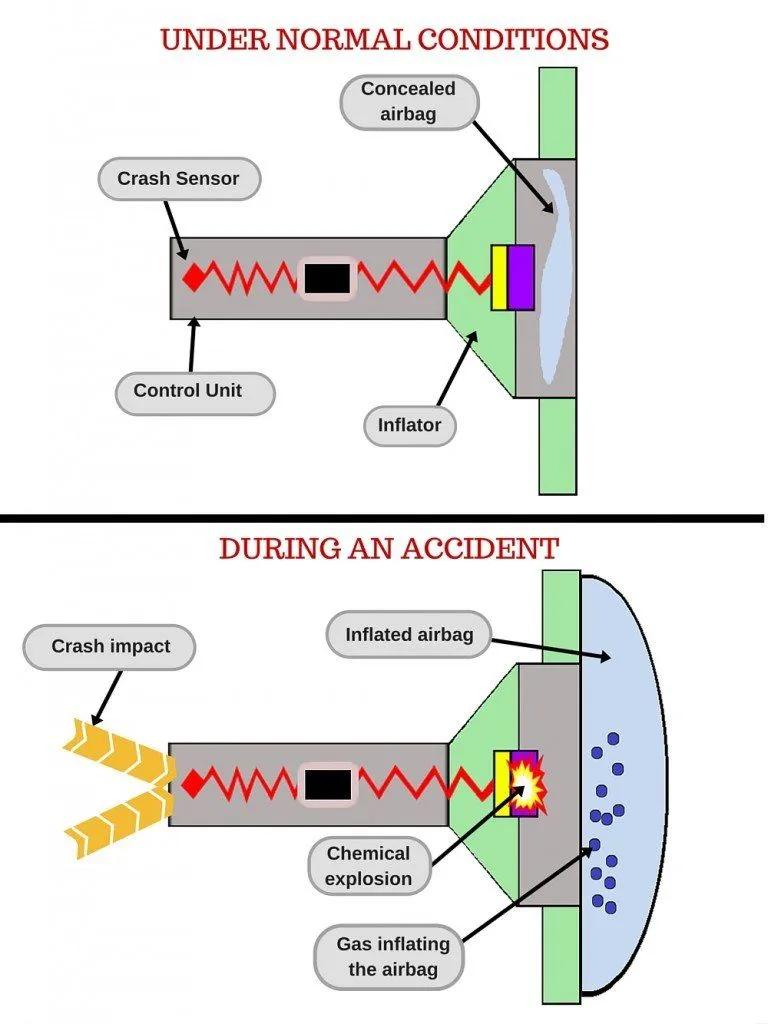
The moment a vehicle crashes into something, it slows down rapidly, or in technical terms, begins to ‘decelerate’ at a high rate. Just think of how abruptly a car stops after crashing… that means that the deceleration would be quick and highly dangerous.
Upon impact, an electronic chip, known as an accelerometer, instantly detects the sudden change in the speed of the vehicle. If this change is greater than the ‘deployment threshold’, the airbag circuit is triggered.
Current is passed through a heating element, which in turn ignites a chemical propellant. Older airbags use sodium azide (NaN3), which decomposes almost explosively into nitrogen gas; modern systems often use the safer guanidine nitrate instead. Either way, the reaction generates enough nitrogen in milliseconds to fill the nylon bag installed behind the steering wheel. The plastic cover is torn off, the bag inflates (much like a balloon), and lo and behold… a protective pillow for your face!
The airbag is deployed!
As the driver (who’s moving forward rapidly due to the sudden deceleration) pushes against the inflated airbag, it begins to deflate as the gas escapes through small holes around the edges of the bag. The airbag should already be deflated completely once the car becomes absolutely stationary.
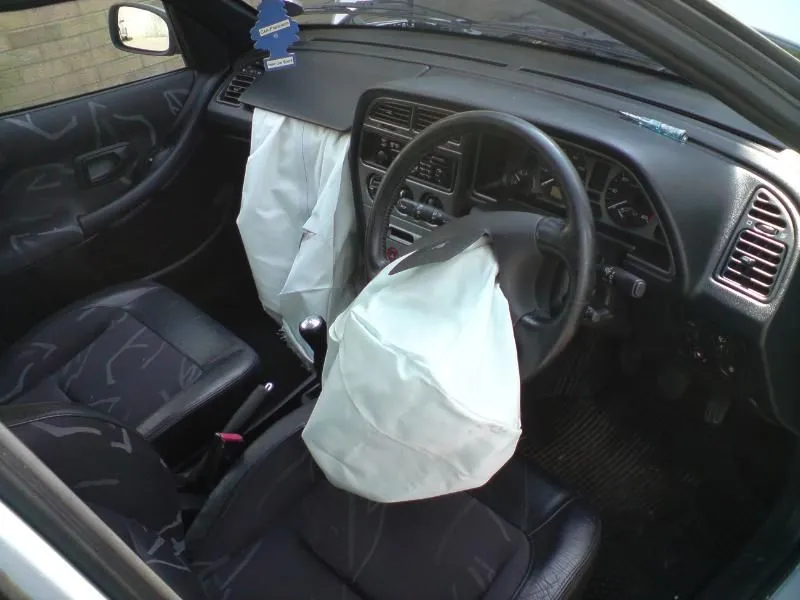
So, that’s how an airbag works!
However, after seeing that so many things have to occur before the actual deployment of the airbag occurs, doesn’t it seem to be a rather time-consuming process? How can this possibly protect you in time… a car crash happens so fast!
Well, the process all happens extremely quickly, which is the whole point! An airbag deploys in the blink of an eye, or even faster!. Take a look at the deployment of an airbag in slow-motion (filmed at 2500 frames per second):

On average, an airbag inflates fully in 20 to 30 milliseconds, and the occupant is pressed into the bag and brought to a stop within roughly 50 milliseconds of impact, depending on the vehicle and the design of the airbag.
Put Your Seat Belts On…
To avoid such a situation:
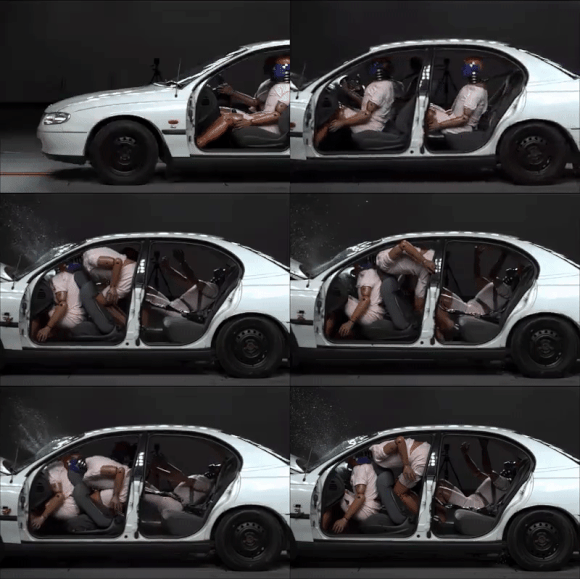
An airbag, quite appropriately is also known as a supplementary inflatable restraint (SIR). The prefix ‘supplementary’ means that airbags are meant to supplement seat belts when it comes to protecting the vehicle occupants. On the other hand, disregarding seat belts and relying entirely on the airbag could be a very risky undertaking. In fact, in some cars, an airbag won’t even be fully functional if some energy of the ‘forward-thrown’ occupant is not absorbed by the seatbelt.
Remember, an airbag only ‘supplements’ the effectiveness of your seat belt; to put it plainly, it’s really a good idea to wear your seat belt at all times!