The wheel was invented in Mesopotamia (modern-day Iraq) around 3500 BC, when a Sumerian craftsman cut a disc from a tree trunk, drilled a hole in its centre and fitted it with an axle. It started life as a potter's wheel; it took another few centuries before someone bolted two of them to an axle and made the first cart. The oldest surviving wooden wheel, found in the Ljubljana Marshes in Slovenia, has been radiocarbon-dated to roughly 3200 BC.
The invention of the wheel is often considered a hallmark of human innovation, and it has proved to be one of humanity’s greatest blessings.
According to the archaeological record, the first wheels appear in Mesopotamia (the land between the Tigris and Euphrates rivers, in modern-day Iraq) around 3500 BC. A Sumerian craftsman cut a disc from a tree trunk and made a hole in the centre, creating the wheel, arguably the greatest invention in human history. Crucially, the wheel was not originally invented to move things across the ground: it was a potter's wheel, used to spin clay into symmetrical pots. Only a few centuries later did someone realise that the same disc, mounted on an axle, could carry loads.
Dearth Of Natural Inspiration
When you carefully peruse the history of mankind, you’ll notice that most inventions were actually inspired by the natural world. For example, the idea for the pitchfork came from forked sticks in the wild. Similarly, it was gliding birds that served as the muse for the invention of the airplane.
One of the reasons it took a long time for man to invent the wheel is because there was no organic example of the wheel in nature, although the work of naturalists like Michael La-Barbera from the University of Chicago suggest that bacterial flagella, tumbleweeds and dung beetles do come close. Some biologist calls these “wheeled organisms”, but that’s a very loose term, as they roll as a form of locomotion, but are not perfectly spherical or circular.

The Invention Of The First Wheel
Wheels eased the job of carrying heavy loads across distances, but before the invention of the wheel, man himself used to carry those heavy loads. Later, he began taming animals, like oxen, horses, donkeys and camels, and used them for carrying the loads. Gradually, men started carrying loads by dragging wood planks with the help of animals.
After a long time, around 3500 BC, an idea struck one of the wise Homo sapiens residing in Mesopotamia (present-day Iraq). He cut a disc from the trunk of a tree and made a hole in its center; the end product was the wheel, arguably the greatest invention in human history! The wheel he invented was not used for transportation, however, but for pottery.
The Wheel As A Vehicle
After a brief stint of using the wheel for pottery, someone used two wheels to form a cart. He made this from the trunk of a tree, which was joined by an axle that was fastened to a platform of wood. This was the first crude cart in the world. In this cart, both the wheels and axle moved. The next improvement in the use of the wheel was fastening the axle to the vehicle and letting the wheels spin freely. The first wheeled vehicles were bullock carts, war chariots, and four-wheeled carts of the gods. Gradually, the spoke wheel was invented in around 2000 BC, which considerably reduced the weight of the wheel.
Catherine Wheel – Wheel Of Death
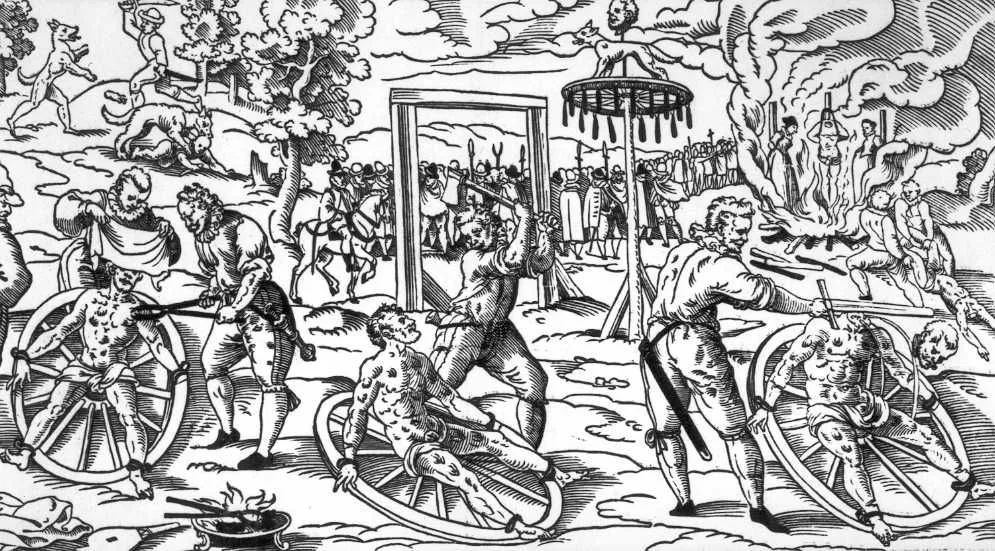
Much of the credit for progress in the modern age goes to the wheel, but the wheel has also become a source of death for many! Actually, in the Middle Ages, ‘breaking on the wheel’ was a form of capital punishment.
A culprit would be stretched across the face of a wheel and bludgeoned to death by an iron-rimmed wheel pounded over him with a hammer. In one such variation, in the early fourth century, Saint Catherine of Alexandria was wrapped around the rim of a spiked wheel and rolled across the ground. As per the legends, the wheel ‘divinely’ broke and Saint Catherine was able to escape. The breaking wheel since that time has been called a Catherine wheel.
Wheels For Perpetual Machines
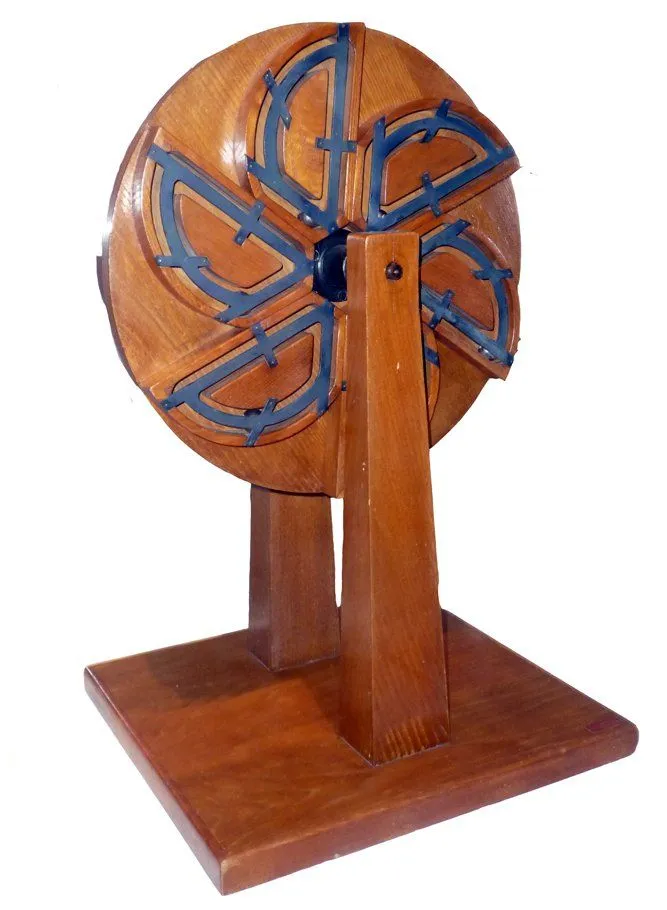
For centuries, scientists, mathematicians, tinkerers, and even philosopher have tried to master perpetual motion, a device that, once set in motion, would continue in motion perennially, producing more energy than it consumes. One of the easiest attempts to design this machine was using a wheel.
A watermill wheel is an example of such a machine that uses changes in weight to incessantly rotate. However, no matter what the design philosophy was, all such perpetual motion machines violate the first and second laws of thermodynamics, which state that energy cannot be created or destroyed, and that some portion of energy is lost in converting heat to work. Many patents for a wheel-based perpetual motion machine have been discarded by the US Patent office because inventors were unable to produce proper working models.
The First Patent Of The Wheel
Although the wheel is an ancient invention, it is interesting to learn how patents related to wheels were procured. According to the records at the US patent office, James Macomb of Princeton was the first man to secure a patent involving a wheel for the design of a horizontal hollow water wheel for hydropower. Although the patent office acknowledges that a patent was issued to him, the original record of the patent was destroyed in the unfortunate 1836 US patent office fire.
Who Invented The Wheel?
Here is the honest answer: nobody knows, and there was probably no single “inventor” to name. The wheel was devised long before anyone kept written records, so no craftsman ever signed his work. What scholars can say is where the idea first surfaced. The oldest clear evidence points to Mesopotamia and its Sumerian cities around 3500 BC, which is why the Sumerians usually receive the credit. The oldest surviving wheel itself, the Ljubljana Marshes Wheel from Slovenia, dates to roughly 3200 BC and remarkably still has its oak axle attached.

The story may stretch back even further. In 2024, engineers Kai James, Lee Alacoque and Richard Bulliet published a study in Royal Society Open Science arguing that the wheel was born around 3900 BC among Neolithic copper miners working the Carpathian Mountains of southeastern Europe. Using computer models, they showed how the heavy log rollers used to haul ore through narrow mine tunnels could have been whittled down in the middle over generations, until all that remained was a slim axle capped at each end by a round disc, the first true wheel and axle. More than 150 miniature clay wagons unearthed in the region, dated to around 3600 BC, lend the idea support.
Whichever account proves correct, the takeaway is the same: the wheel was not a single flash of genius but a slow, collective invention, refined by many hands across centuries before it ever rolled a cart.
What Are The Main Uses Of The Wheel?
When we picture the wheel, we think of cars, bicycles and trains. Yet transport was not even its first job, and it is far from its only one. The wheel’s earliest use was the potter’s wheel, a spinning turntable that let a potter shape clay into smooth, symmetrical vessels, a craft already widespread in Mesopotamia by 3500 BC.

Once people did fasten wheels to a frame, transport took off, from ox carts and war chariots to today’s cars, trucks, trains and even the landing gear of aircraft. The trick is simple but profound: a rolling wheel slashes the friction of dragging a load across the ground. Yet the wheel proved just as valuable when it stayed put. Mounted in a stream, a water wheel turns the flow of a river into useful work; the Mesopotamians used them to lift water for irrigation, and later millers used them to grind grain into flour.
From there the wheel became the heart of nearly every machine. Add teeth to its rim and a wheel becomes a gear, able to transmit motion and multiply force inside clocks, engines and watches. The spinning wheel twisted raw fiber into thread, windmills and modern turbines rotate to generate electricity, and a ship’s wheel or steering wheel lets us change direction. For an object with no model in nature, the wheel turned out to be remarkably versatile.
Our Progress Continues With Wheels
With the passage of time, numerous improvements have been made to the design of wheels. Today, the rims and spokes of the wheels are typically made of iron. Rubber tires and tubes are then put around them. Due to these improvements, the wheel has become lighter, more efficient, and long-lasting. It is not an exaggeration to say that, with the help of the wheel, the world is progressing as fast as ever!
Last Updated By: Ashish Tiwari
References (click to expand)
- When was the wheel invented?.
- The Horse, the Wheel, and Language.
- HISTORICAL DEVELOPMENT OF THE WHEEL
- The Wheel Revisited | The Engines of Our Ingenuity.
- Wheel | Invention, History & Uses. Britannica.
- Engineering the Origin of the Wheel. Georgia Institute of Technology.
- Reconstructing the invention of the wheel using computational structural analysis and design. Royal Society Open Science.
- A Salute to the Wheel. Smithsonian Magazine.