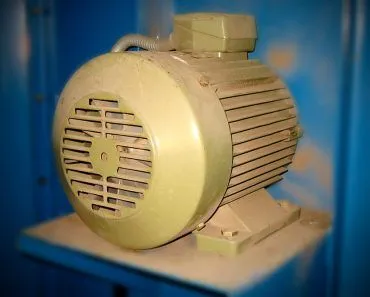
The working of an electric iron is very simple – it draws electricity from the mains and heats a coil inside. This heat is then transferred to the bottom plate, which is pressed against the clothing to remove wrinkles.
When I learned how to iron my clothes, I was quite annoyed by the whole process. Apparently, the iron switched on and off on its own for no reason. As much as I was irritated by this, I was also fascinated by the strange phenomenon. Fortunately, I soon realized that it was the “automatic power cut” function that triggered this action in the iron.
You have almost certainly observed this automatic on/off function on electric irons, but do you know how it works? How does the iron know when it turns off the power?
What Does The Thermostat Do In An Electric Iron?
It is the “thermostat” inside the iron that silently tracks the temperature and can turn the power on and off with the help of other electric components. It is probably the most important component in the iron, as it helps to regulate the temperature.
Thermostats are used not only in irons, but also in air conditioners, water coolers, automatic temperature-controlled rooms and many other devices that require strict temperature regulation. In fact, thermostatically controlled loads — mainly air conditioning and electric heating — account for a substantial share of US electricity use; HVAC alone is responsible for around 30% of commercial-building energy consumption.
The basic function of a thermostat can be derived from its name alone; the word is composed of two Greek words: “thermo” (heat) and “statis” (status quo or constant). As the name suggests, the basic function of a thermostat is to keep the heat constant in a given environment.
There is a caveat: Many people often confuse a thermostat with a thermometer or use the words interchangeably.
Well, they are not really the same thing. A thermometer is a device that measures temperature while a thermostat tries to maintain or regulate temperature.
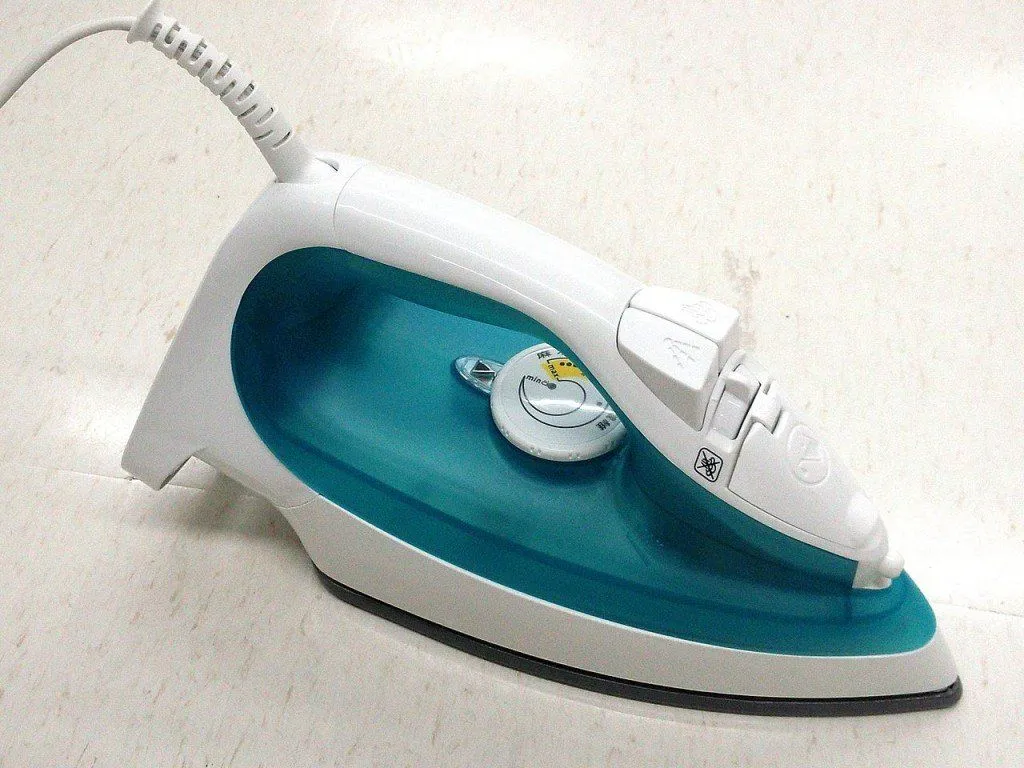
Working Of An Electric Iron
The electric irons that we use to press the folds out of our clothes contain a thermostat that keeps the iron from getting too hot when turned on and left unattended for a long time. Let’s see how the mechanism works.
An electric iron relies on a basic combination of heat and pressure to remove wrinkles from clothing.
If an electric current is passed through a coil or other heating element present in the iron, it becomes very hot. This heat is then transferred to the base plate (the smooth, flat surface that you place against clothes while ironing) through conduction, which elegantly irons your clothes.
However, if the iron continuously draws electricity from the power supply, the heating element gets hotter and hotter. This causes a lot of energy waste, as an iron consumes a lot of electricity in just a few minutes, ruining clothes and, in the worst-case scenario, causing serious and potentially dangerous accidents!
Therefore, it is essential that iron does not heat up to dangerous temperatures. Here, the thermostat comes into play.
The original thermostat conceived in the seventeenth century consisted of a float in a mercury thermometer tied to a damper cover. Whenever the ambient temperature around the thermometer surpassed a certain limit, mercury would rise, displacing the float such that it would close the damper. This basic premise led to the modern thermostats we use today.
Bimetallic Strips
The thermostat in iron generally uses a bimetallic strip. As the name implies, a bimetallic strip consists of two different types of metal – with different coefficients of expansion – that are bonded together. This means that in the presence of heat, they expand differently. This bimetallic strip is connected to a contact spring by small pins.
At moderate temperatures, the contact point remains in physical contact with the bimetallic band. However, if the temperature of the iron exceeds a certain limit, the strip begins to bend towards the metal with a lower coefficient of expansion. As a result, the strip ceases to be physically connected to the contact point, the circuit opens and the current ceases to flow.
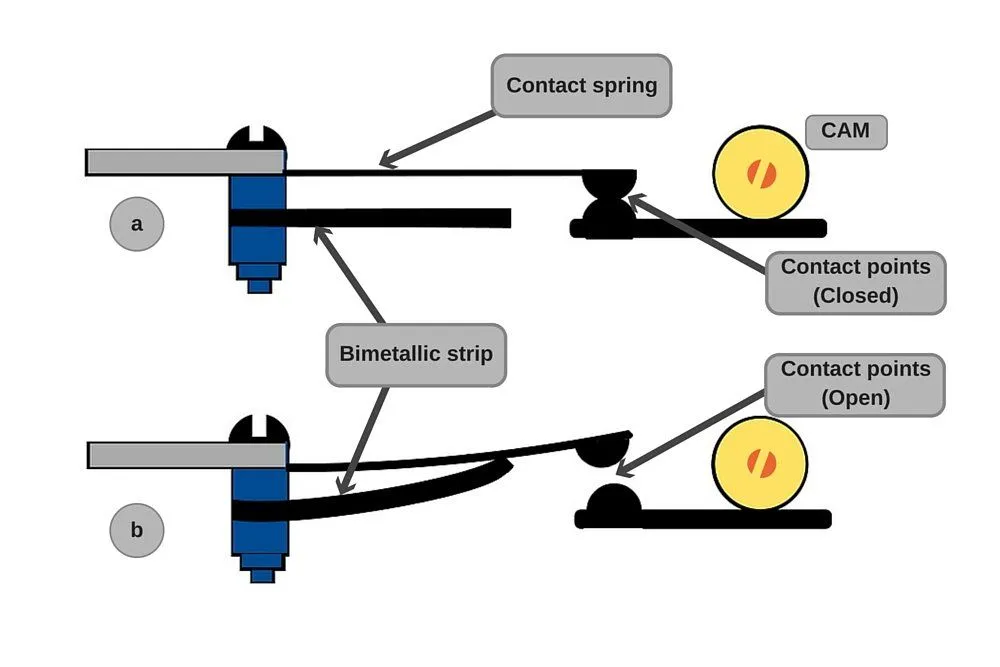
As the circuit remains open for some time, the temperature of the iron decreases, the band retains its original shape and the current flows again.
In this way, a bimetallic band functions as a kind of bridge to connect or switch off the circuit to regulate the heating.
This cyclical switching on and off of the iron is repeated until you switch off the power supply from the main power source. Therefore, the iron seems to switch on and off repeatedly during the ironing process.
Additional Capacitor
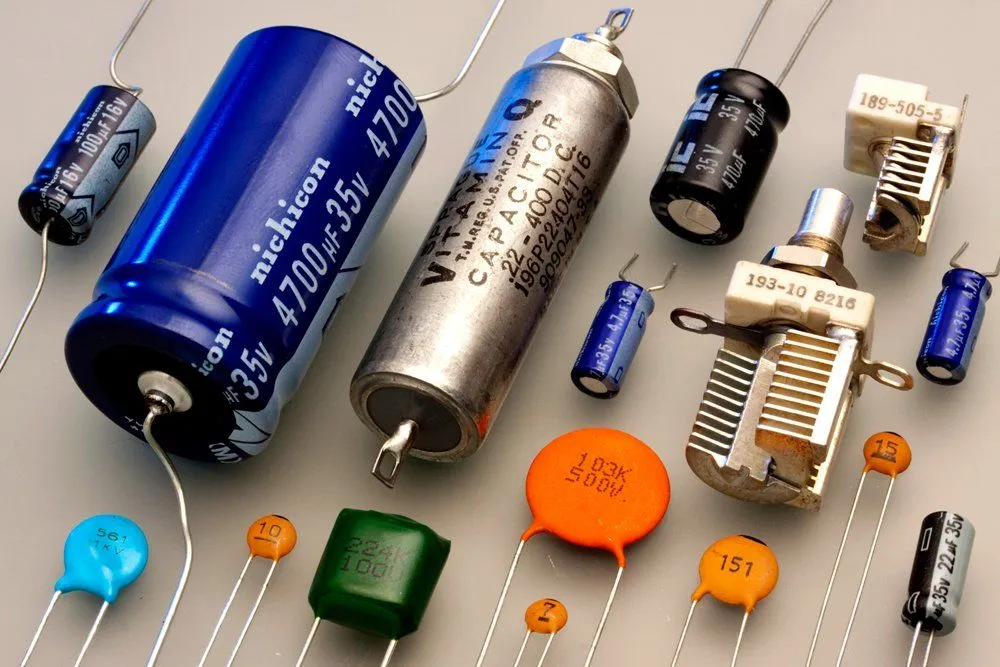
Although a thermostat helps to regulate the temperature within safe limits, frequent making and breaking of the circuit to regulate temperature leads to gradual wear and tear of the contact points. This can lead to electromagnetic interference causing problems with radio reception. To prevent this, a capacitor is connected across two contact points. The capacitor’s job is to smooth out electromagnetic interference. To learn more about capacitors, click here.
What Is The Heating Element Of An Electric Iron Made Of?
We have talked a lot about the coil that heats up, but what is that coil actually made of? The part that gets hot and gives out the heat is the heating element, and it is almost always a coil of nichrome wire. Nichrome is an alloy of roughly 80% nickel and 20% chromium, and it is the workhorse metal behind most electric heaters, toasters and ovens too.

Why nichrome and not, say, copper? Two reasons. First, it has a high electrical resistance, so when current is forced through it, the wire converts that electrical energy into heat very efficiently rather than just carrying the current along. Second, the small dose of chromium gives the alloy excellent resistance to oxidation, a high melting point and good stability when it is repeatedly heated and cooled. Adding 15 to 20% chromium to nickel is exactly what lets these alloys survive as electric-resistance heaters without crumbling away.
The nichrome coil does not touch the metal body directly. It is usually wound around a sheet of mica, a mineral that is both an excellent electrical insulator and able to withstand very high temperatures. The heat then passes by conduction into the soleplate, the smooth flat base you press against the cloth. Soleplates are typically made of aluminum (light and cheap, used in budget irons) or stainless steel (heavier, but more scratch-resistant and durable). So the iron is a tidy little chain: nichrome makes the heat, mica keeps the electricity where it belongs, and the metal soleplate delivers that heat to your shirt.
How Hot Does An Electric Iron Get?
This is the question almost everyone secretly wants answered, and the honest reply is: it depends on the setting you dial in. That is the whole point of the thermostat we discussed. The temperature dial does not change how much heat the coil produces; it changes the temperature at which the bimetallic strip snaps the circuit open, and so it sets the target the soleplate is held near.

The little dots printed inside the iron symbol on your clothing care labels are not decoration. Under the international care-labelling standard (ISO 3758, run by GINETEX), they map to maximum soleplate temperatures:
- One dot means a cool setting, roughly 110 to 120 °C (230 to 250 °F), for delicate and synthetic fibers such as nylon, acrylic, acetate and silk, which would melt or scorch if you went hotter.
- Two dots means a medium setting, around 150 to 160 °C (300 to 320 °F), for wool, polyester blends and viscose.
- Three dots means a hot setting, up to about 200 to 210 °C (390 to 410 °F), reserved for sturdy natural fibers like cotton, denim and linen.
So a hot iron on its top setting runs at roughly twice the boiling point of water, which is why a forgotten iron face-down on a cotton shirt can scorch it in seconds. It also explains why the synthetic setting is so much cooler: a polyester shirt pressed at the cotton temperature would not just wrinkle, it would partly melt onto the soleplate.
Why Does Ironing Actually Remove Wrinkles?
We now know how the iron stays at the right temperature, but why does dragging a hot metal plate across a shirt make the creases disappear in the first place? The answer is less about the iron and more about the chemistry of the cloth.

Cotton, linen and similar natural fabrics are made of cellulose, a polymer built from long chains of glucose units. Neighboring chains cling to each other through countless weak hydrogen bonds. Each bond is feeble on its own, but together they lock the fibers into whatever shape they last set in. When clothes get damp and then dry crumpled in a heap, those hydrogen bonds re-form with the fibers frozen in a creased position. That is a wrinkle: chemistry holding the fabric in the wrong shape.
Ironing breaks that lock. The combination of heat and a little moisture (from steam or a slightly damp cloth) loosens the hydrogen bonds so the cellulose chains can slide past one another again. The flat soleplate then presses the freed fibers parallel and flat, and as the fabric cools and dries under that pressure, the hydrogen bonds re-form, this time holding everything smooth. The heat does the unlocking through conduction from the soleplate into the cloth, and the pressure does the shaping. Steam helps because added water lowers the temperature at which the fibers relax, which is why a damp shirt is so much easier to iron than a bone-dry one.
Do Modern Irons Switch Off By Themselves?
The bimetallic thermostat keeps the iron from cooking itself, but it does nothing about the much scarier scenario: you leave the house with the iron sitting face-down on the board. For that, most modern irons add a separate automatic shut-off system, and it is worth knowing it is not the same component as the thermostat.
These auto-off systems usually combine a tilt or motion sensor with a timer. When you stop moving the iron, a small countdown begins. If the iron is left flat and unmoved on its soleplate, it typically cuts power after only a short interval (often under a minute), since a stationary hot plate on fabric is the dangerous case. If it is parked upright on its heel rest, it is allowed a longer grace period before shutting down, because that position is safe. A patented version of this idea uses two switches, one in the handle that senses your grip and one in the heel that senses the upright rest, to decide how long to wait before a relay cuts the current to the heating element.
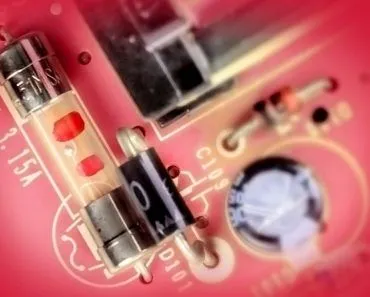
There is a second, blunter safety device too: a thermal fuse. Unlike the thermostat, which switches on and off thousands of times, a thermal fuse is a one-shot backstop. If the temperature ever climbs past a dangerous limit (say the thermostat fails), the fuse melts and permanently breaks the circuit. The iron simply stops working and never heats again until the fuse is replaced. It is the last line of defense that turns a potential house fire into a dead appliance.
References (click to expand)
- Bimetallic strip - Physics. Boston University
- CLASS NOTES. Vanderbilt University
- Thermostat. Encyclopaedia Britannica.
- Bimetal strip. Encyclopaedia Britannica.
- Nickel processing: Heat-resistant alloys. Encyclopaedia Britannica.
- Mechanical, Thermal and Microstructural Properties of Nichrome (NiCr 80/20)-Reinforced Composites. PMC, NCBI.
- Lorch, M. How chemistry can make your ironing easier. The Conversation, University of Hull.
- Care symbols (ISO 3758). GINETEX.
- US5852279A: Clothes iron with automatic shut off system controlled by multiple switches. Google Patents.