Table of Contents (click to expand)
Graphene is a single layer of carbon atoms, the thinnest material known and one of the lightest known to science, yet about 200 times stronger than steel. It conducts electricity better than copper and heat better than diamond, and it is flexible, transparent, and almost impermeable. It is peeled from graphite (pencil lead), and it already appears in real products like batteries, tennis rackets, and protective coatings.
We have all seen countless sci-fi representations of our future. Hoverboards, sleek electronics, self-tying shoes (yes, Back to the Future II, I’m looking at you)… all of them seem like impossible predictions, but there is always something coming next, right?

While these things may seem a bit far-fetched, there is one savior that can pull us from our static misery and propel us into the future. There is one near-perfect material that can make a lot of our dreams come true. It is the thinnest material we know of and one of the lightest, yet roughly 200 times stronger than steel. It conducts electricity better than copper and conducts heat better than a diamond. It is bendable, stretchable, transparent, and nearly impermeable. It resists corrosion and rusting. Finally, and perhaps most importantly, it is derived from one of the most commonly found household items.
Our hero’s name is Graphene.
Graphene 101
Scientists have suspected graphene’s existence since the 1850s, when the chemist Benjamin Brodie was already probing the layered structure of graphite. After all, graphene is nothing but a single sheet of carbon atoms. Layers and layers of these sheets stack up to create graphite. Yes, the same thing used in pencil lead.
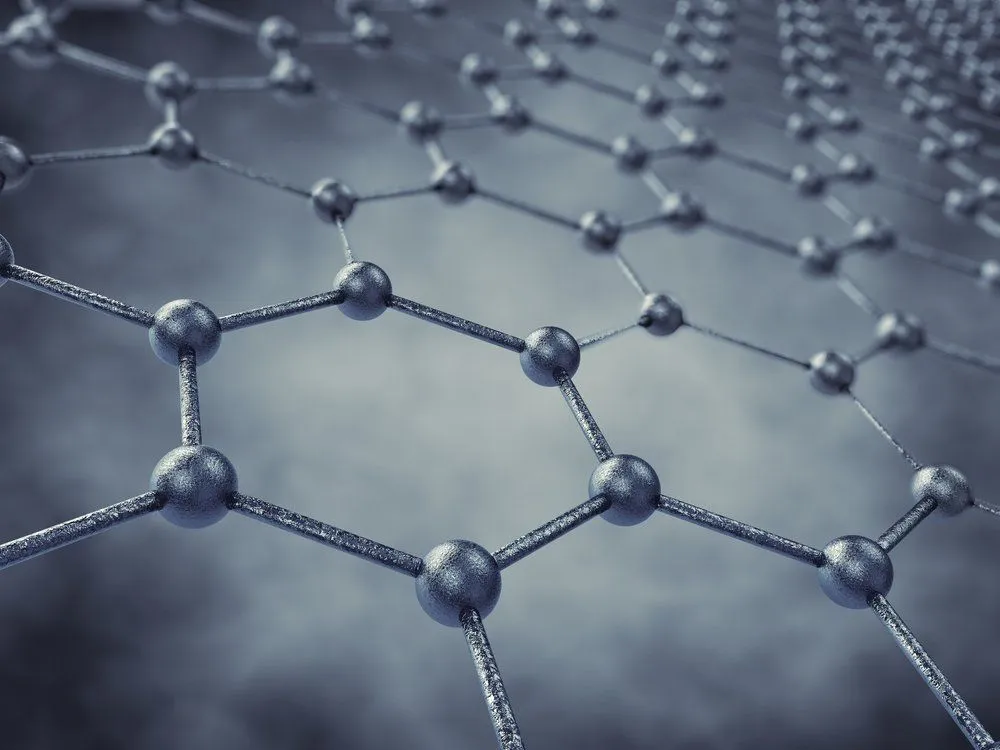
However, graphite is brittle, common, and generally unimpressive. In that case, what makes graphene so special?
The power of graphene is that it is the first stable two-dimensional material ever isolated. Just to be clear, I mean two-dimensional from an electron’s perspective, not ours. To us, graphene technically has a thickness, as it DOES measure one atom across. However, to an electron, that single layer is a flat, two-dimensional highway. In ordinary 3D conductors, electrons rattle around in all three dimensions; in graphene, they are confined to the sheet itself, gliding across the plane as if they had no mass at all. Physicists call them massless Dirac fermions, and that strange behavior is exactly why graphene conducts so spectacularly well.
Almost 150 years were spent trying to isolate graphene from graphite. This consisted of 150 years of strenuous lab experiments and absolutely no results to show for the effort. This led to the idea that two-dimensional materials must be unstable at room temperatures. The scientific world seemed to have abandoned graphene.

Then, along came two scientists with the names of Andre Geim and Konstantin Novoselov. They created graphene using (and I’m quite serious when I say this)… scotch tape. Yup, you got it. 150 years of scientific research and no one tried using scotch tape to separate graphene. Embarrassing? Quite.
That deceptively simple 2004 trick finally produced stable, isolated graphene, and in 2010 the duo won the Nobel Prize in Physics for this *ahem* remarkable experiment.
 Now, why can I so confidently claim that graphene will be the harbinger of change? Well, let me give you a few potential uses for graphene.
Energy
One thing that seems to restrain all technology is batteries. Batteries are essentially the party poopers of the technological realm. They drain away, they die off, they burst, and they are impossible to recycle. However, the time has come to say goodbye to these cumbersome batteries, because graphene is here!
As mentioned earlier, graphene is a flat sheet of atoms where electrons can zoom around quickly. Electrons race through graphene faster than through any other known material, which makes it a phenomenal conductor. Pair that with a supercapacitor and you get a device that charges in seconds rather than hours. The catch is that supercapacitors still store far less energy than a lithium-ion battery, so for now graphene is more likely to complement your phone battery than to replace it outright.

Graphene would also revolutionise solar energy! This remarkable material can be used to create stronger and better solar cells that are easier and cheaper to produce than the silicon ones we use today.
Speaking of replacing silicon, graphene can also be used to make microchips. These graphene microchips would function at frequencies 10 times that of silicon. And guess what? Those annoying heating problem your computers always seem to experience? Graphene would completely eliminate the issue.
 Another novel way to use graphene is to deliberately misplace a single atom. Why would anyone poke a hole in graphene’s two-dimensional perfection? To use it as a sieve, obviously! By removing a single atom, you leave space for a single proton to pass through the graphene membrane. Now, which element has just a single proton? Hydrogen, of course! The same hydrogen that can now easily be used to make hydrogen fuel cells. This is a dream come true for renewable energy enthusiasts.
Purifying Water
Graphene is also hydrophobic! It would cling on to other materials, but let water pass through without any problem when micro-pores are made in it. This property of graphene could be used to purify contaminated water and could also be useful in hydraulic fracking. Graphene oxide has even been known to separate radioactive material from water. Dangerous and risky tasks like cleaning up oil spills could be completed much more easily with graphene nanotechnology.
Potable water is growing scarcer by the day. One possible solution has been the desalinization of seawater. Graphene would speed up this process to be 2-3 times faster than the commercial desalinization technologies in use today. Say goodbye to water scarcity forever!

Construction
Two words. Graphene. Paint. Yes, ladies and gentlemen, graphene can also be used as paint! Not only will it keep your house corrosion-free and waterproof, but because due to its photosensitivity, it can even power the same house using solar energy! Because of the immense potential of graphene as a conductor, the entire house can be used as an interface! TV on your ceiling? Gaming on the floor? Color-changing walls? The possibilities are truly endless.

Automobiles
Automobiles would also never be the same with graphene nanotechnology. Being the strongest and the most pliable material on earth, all automobiles could be made of graphene. Imagine how light those cars and jetplanes would be! They could run on solar energy that the car surface produces, or they could be recharged with graphene supercapacitors. Imagine electric cars that could get charged anywhere in a matter of seconds! The whole process would be completely eco-friendly too!

Medicine
Graphene can also be utilized in the construction of incredible biosensors that can detect genetic diseases like Parkinson’s disease. Because of the thinness of the product, and the fact that it is essentially just carbon, graphene could also be used for tissue engineering. It would change the future of prosthetics as well. The more we think about this material, the more we realize that graphene may just be perfect?

Electronics
Graphene is a highly anticipated new advancement in the electronics industry. Touchscreens need sensitive conductors to be able to detect your touch. And as we have just learned, graphene is the best, most overachieving material in the world. So, not only can it replace silicon microchips and batteries in your electronic devices, it can also replace the external body. If that isn’t good enough, it can also make these devices transparent…and thin…and unbreakable. And flexible. And waterproof. And biodegradable. Not to mention, it can simultaneously generate solar energy to charge your phone or device. The possibilities are endless.

Graphene would also impact the speaker industry. A diaphragm made of a single sheet of graphene would be able to achieve the same sound quality produced by the most expensive of Sennheisers out there.

These applications are truly just a few of the ideas flying around the scientific, medical, technological, and commercial worlds. Scientists are discovering new uses for graphene all the time. From creating better gas sensors and improving collective health to developing actual invisibility cloaks and hover boards, graphene could do it all!
So, why isn’t graphene everywhere already? I mean, graphite is found pretty much everywhere, right? Well, yes, but although making a tiny flake of graphene is a very easy task, producing large, defect-free sheets on an industrial scale is a whole different ballgame. That is the bottleneck scientists have been chipping away at for two decades.
The good news is that graphene has quietly slipped out of the lab and into real life. You can already buy graphene-reinforced tennis rackets and bike frames, headphones with graphene-coated drivers, graphene-enhanced batteries and asphalt, and protective coatings that fight corrosion. It hasn’t rebuilt your phone from scratch just yet, but the global graphene market has grown from a few million dollars a decade ago to roughly a billion dollars a year, and analysts expect it to keep climbing through the 2030s. The future, it turns out, is already trickling in.

References (click to expand)
- Researchers design one of the strongest, lightest materials .... news.mit.edu
- The science of friction on graphene | MIT News. news.mit.edu
- (2012) Thermal properties of graphene: Fundamentals and applications. Stanford University
- The 2010 Nobel Prize in Physics (Geim and Novoselov) - Press release. NobelPrize.org
- Engineers Prove Graphene Is the Strongest Material (Columbia University). Phys.org
- Graphene - A simple introduction - Explain that Stuff. explainthatstuff.com
- Graphene - Wikipedia. Wikipedia