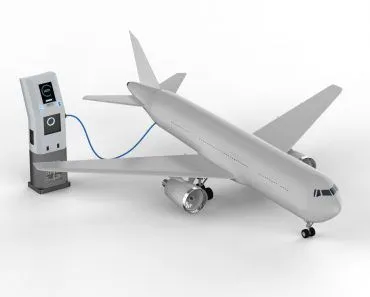
A solar-powered airplane runs on photovoltaic cells that convert sunlight into electricity, storing some in batteries to fly at night. Aircraft like Solar Impulse 2 have flown around the world on sunlight alone. But they are far too slow, light, and small to replace jet-fueled airliners, so today their real future lies in uncrewed, high-altitude surveillance and communications flights.
Aviation has come a long way since the Wright brothers took their first flight in the early 20th century. Airplane design was pretty basic back then and their glider-like plane could only carry a person or two. However, modern-day airplanes are gargantuan beasts, capable of carrying hundreds of people at super-fast speeds.
The catch is that those beasts burn kerosene-based jet fuel, and aviation accounts for roughly 2.5% of the world’s energy-related carbon dioxide emissions. That has pushed engineers to ask a tantalizing question: could an airplane fly on sunlight alone? The most famous attempt to answer it was a wispy, wide-winged aircraft called Solar Impulse, so that is where our story begins.
Solar Impulse
Solar Impulse 1
André Borschberg and Bertrand Piccard are two Swiss visionaries on a mission to bring a solar plane into reality. Solar Impulse was their first experimental solar-powered aircraft project intended for a long-range flight. They roped in the Swiss government and other corporations to finance their ambitious project. The Solar Impulse project kickstarted with the mission to complete the first circumnavigation flight around the globe in a solar-powered aircraft that solely uses clean-green solar energy as its fuel. To learn more about solar power, click here.

André Borschberg (left) and Bertrand Piccard (right). (Image Credit: Flickr)
In 2010, an aircraft that goes by the same name – Solar Impulse – took to the sky for the first time. Although this wasn’t the first attempt to make a solar-powered plane, the project managed to achieve an unprecedented feat, a 26-hour flight solely using solar power. This included 9 hours of flying in the dark without any sunlight.
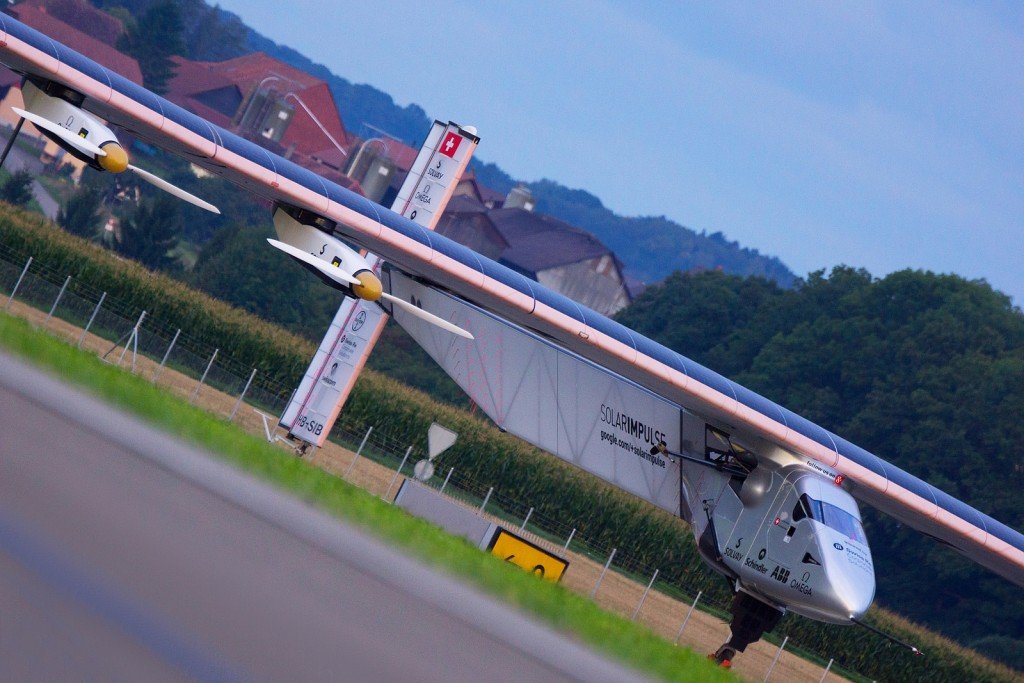
Solar Impulse aircraft. (Image Credit: Flickr)
Solar Impulse 2
The Swiss duo didn’t stop here. They toiled hard with their team of engineers and other professionals to improve the design and working of the solar aircraft. Solar Impulse 2 was the sequel to the original Solar Impulse project and was destined to reach even greater heights. The Solar Impulse 2 aircraft, which took to the skies in 2014, went on to circle the entire planet, covering a massive 42,000 kilometers (about 26,000 miles) in 17 legs at an average ground speed of just 75 km/hour (47 mph), all without using a single drop of conventional jet fuel.
In 2015, when Solar Impulse 2 soared through the air with a wingspan wider than a Boeing 747, it became the first solar airplane to complete an oceanic crossing, flying from Nagoya, Japan to Hawaii using nothing but solar power! That single leg lasted 117 hours and 52 minutes (almost five days and nights aloft), still the longest solo nonstop flight ever made, though the batteries overheated badly enough to ground the plane in Hawaii for repairs until 2016.
Now, let’s look a bit more closely at the solar-powered aircraft’s design and construction.
Construction of the Solar Impulse 2 aircraft
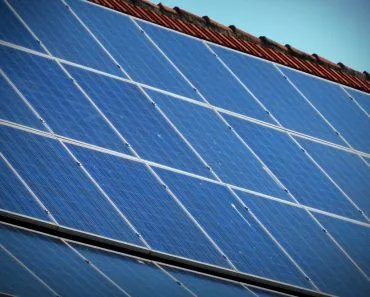
Just like domestic solar roof panels, the Solar Impulse 2 aircraft uses devices called photovoltaic cells or solar cells to generate electricity from sunlight. These cells are made of silicon and are very thin. Silicon is a semiconductor that conducts electricity in certain conditions, while acting as an insulator in certain other conditions. To learn more about those conditions, click here.
Now, when photons of sunlight hit a solar cell, it compels the electrons to move from one side of the silicon wafer to the other. This “flow of electrons” is what we popularly call ‘electricity’. Solar Impulse 2 has more than 17,000 solar cells (17,248 of them, to be exact) installed on its surface. The electricity these produce powers the aircraft’s motors, which turns the propellers and charges the onboard batteries. These batteries preserve the power required by the aircraft to fly at night. The aircraft uses 633 kg (1,396 lb) of lithium-ion batteries, which account for roughly a quarter of the aircraft’s weight.
In terms of motors, this aircraft has four electric motors, each delivering 17.4 horsepower (13 kW). The Solar Impulse 2 aircraft uses clever composites, such as carbon fiber, in the plane’s airframe to ensure that it is lightweight. Making the plane lighter means that less energy is required to keep the aircraft flying.
Who Built The First Solar-Powered Airplane?
Solar Impulse grabbed the modern headlines, but it was standing on the shoulders of pioneers who had been coaxing aircraft into the sky on sunlight since the 1970s. The very first was a spindly, uncrewed model called AstroFlight Sunrise, which lifted off from a dry lakebed at Fort Irwin, California on 4 November 1974. Designed by engineer Roland Boucher and funded by the U.S. defense research agency DARPA, Sunrise had a 9.8-meter (32-foot) wingspan, weighed barely 10 kilograms (22 pounds) empty, and carried 1,872 solar cells on its wing. It was the first machine ever to fly on solar power alone.

Getting a person into a solar cockpit took another six years. In 1980, Paul MacCready’s company AeroVironment, the same team behind the human-powered Gossamer Albatross, built the Gossamer Penguin. On 7 August 1980, pilot Janice Brown, a Bakersfield schoolteacher who weighed under 45 kilograms (100 pounds), flew it roughly 3.1 kilometers (1.95 miles) in 14 minutes and 21 seconds at NASA’s Dryden Flight Research Center. That short hop was the first sustained piloted flight powered by nothing but the Sun.
MacCready’s team then built a sturdier successor, the Solar Challenger, blanketed with 16,128 solar cells and designed to fly without a single reserve battery. On 7 July 1981, pilot Stephen Ptacek flew it 262 kilometers (163 miles) from an aerodrome north of Paris, across the English Channel, to Manston in England, staying aloft for 5 hours and 23 minutes. It was the first time a solar aircraft had crossed the Channel, and it proved that sun-powered flight could cover real distances. Every record Solar Impulse later set traces back to these gossamer machines.
How High Can A Solar-Powered Plane Fly?
While Solar Impulse chased distance, another team was chasing altitude. Through the 1990s, NASA ran a program called Environmental Research Aircraft and Sensor Technology (ERAST), and it handed the flying to AeroVironment, the very company Paul MacCready had used to build the Gossamer Penguin and the Solar Challenger. AeroVironment produced four generations of giant, uncrewed solar flying wings, each one larger than the last: Pathfinder, Pathfinder Plus, Centurion and, finally, the Helios Prototype.

The lineage began as a secret. In 1983, AeroVironment started a classified military study of a high-altitude solar drone code-named HALSOL. The aircraft was declassified and handed to NASA in 1994, which renamed it Pathfinder because it was, quite literally, scouting the way for a future fleet of solar aircraft. On 7 July 1997, flying from the Hawaiian island of Kauai, Pathfinder climbed to 21,800 meters (71,530 feet), a record for both solar-powered and propeller-driven aircraft.
That record did not last, because Pathfinder’s much larger successor was already taking shape. The Helios Prototype stretched its single wing to 75 meters (247 feet), wider than a Boeing 747 and even a C-5 military transport, and carried more than 62,000 solar cells across its upper surface. On 13 August 2001, remotely piloted by Greg Kendall, Helios climbed to 29,524 meters (96,863 feet) and stayed above 96,000 feet for more than 40 minutes. That remains the world altitude record for sustained horizontal flight by a winged aircraft, a mark that has stood for more than two decades.
The story ended abruptly. On 26 June 2003, a later Helios configuration hit turbulence shortly after takeoff, its enormous wing flexed far beyond its limits, and the aircraft broke apart and fell into the Pacific about 16 kilometers (10 miles) off Kauai. No one was aboard, but the crash underlined a hard truth about solar flight: to reach the edge of space on sunlight, you must build a wing so light and so vast that the sky itself can tear it apart.
Limitations Of Solar-powered Airplanes
Despite the breakthroughs made by solar-powered airplanes, there are still challenges that need to be overcome before they can be operated for commercial use.
Carrying Capacity
The first challenge is the ability to carry hundreds of people. Keeping the airplane’s weight to a minimum is the basic design philosophy of a solar-powered aircraft. Carrying more people means more weight, meaning that it is infeasible for solar-powered airplanes to take off with that much load, as the present solar-powered design and technology is not equipped for that.
Speed
The second issue with solar-powered planes is their appallingly slow speed. Whereas a commercial jet cruises at around 900 km/hour (560 mph), a solar aircraft struggles along at 50 to 100 km/hour (30 to 60 mph). This means that an 8-hour jet flight from London to New York would take several days to complete in a solar-powered craft.

Climate Susceptibility
The third major challenge is that solar planes are extremely sensitive to weather. The best time for them to take off is understandably during the day, to efficiently use daylight hours and keep the battery full until dusk. Although weather is an important factor across the entire aviation industry, solar planes are especially vulnerable to it. Given their light weight and slow speed, it can be nearly impossible to control the aircraft in heavy winds or during particularly harsh weather.

Skill Requirement
The fourth challenge relates to the pilot. The skillset required for flying a solar aircraft is much more extensive than the talent required to fly a normal plane. The pilot would first need to take off extremely carefully. Then, once the plane reaches a cruising altitude of around 8,000 to 9,000 meters (26,000 to 30,000 feet), the pilot would need to tactfully dodge dense cloud cover so that sunlight was not blocked.
So What Is The Future Of Solar-powered Flight?
Solar Impulse 2 finished its round-the-world trip on 26 July 2016, landing back in Abu Dhabi to become the first piloted fixed-wing aircraft to circle the globe on sunlight alone. But here is the honest takeaway: the very things that made it a record-breaker, gossamer weight and an enormous wing, are exactly what stop solar power from carrying you and 300 strangers across the Atlantic. The energy a wing can soak up from the Sun is simply too thin to haul a heavy, pressurized cabin at jet speeds. So instead of chasing passenger airliners, engineers have quietly pointed solar flight at a different job.
That job is staying up. A solar plane that never has to land can act as a “pseudo-satellite,” loitering for weeks to relay internet, watch borders, or track storms, all at a fraction of a satellite’s cost. Airbus subsidiary AALTO flies an unmanned, ultralight craft called Zephyr that does precisely this, cruising the stratosphere above 60,000 feet (about 18,000 meters). In April 2025 a Zephyr stayed aloft for a record 67 days on solar power, smashing the old endurance mark for any aircraft.
Solar Impulse 2 itself got a second life along these lines. In 2019 the airframe was bought by a company called Skydweller Aero, which stripped out the cockpit and turned it into an autonomous, optionally-piloted drone aimed at months-long surveillance and communications missions. In April 2024 it completed the first fully unmanned flight of a large solar aircraft. Sadly, the story has a melancholy postscript: on 4 May 2026 the converted Solar Impulse 2 lost power shortly after takeoff from Stennis, Mississippi and crashed into the Gulf of Mexico during an uncrewed test. No one was hurt, and the investigation is ongoing, but the original record-setting aircraft was destroyed.
The lesson of the last decade, then, is not that solar planes failed. It is that they found their lane. Sun-powered aircraft are unlikely to ever replace the jet that takes you on vacation, but as tireless eyes and antennas parked in the sky, they are only getting started.
Conclusion
Established airline companies aren’t very interested in solar-powered planes. Aviation is a capital-intensive industry and ensuring passenger safety can never be compromised, even for sensible or environmentally friendly reasons. Most aviation companies find solar-powered planes to presently be a risky proposal. Using a radically different airplane design would cost them billions of dollars, and if it goes wrong, those companies would be ruthlessly put out of business. Thus, solar planes (for now, at least) still need a lot of improvement in terms of carrying capacity, speed, and safety when navigating seasonal variations.
References (click to expand)
- Solar Powered Aviation - Stanford University. Stanford University
- Solar powered plane documentary debuts at the Hawaiʻi .... The University of Hawaiʻi System
- Solar Impulse 2 Completes Trip Around World. National Geographic
- Zephyr sets world record for longest continuous flight, flying 67 days in the stratosphere. AALTO HAPS
- Solar Impulse aircraft destroyed in Gulf of Mexico crash. SWI swissinfo.ch
- AstroFlight Sunrise. Wikipedia
- MacCready Solar Challenger. Wikipedia
- Solar-Powered Research and Development. NASA Dryden Fact Sheet
- AeroVironment Helios Prototype. Wikipedia
- NASA Pathfinder. Wikipedia