Table of Contents (click to expand)
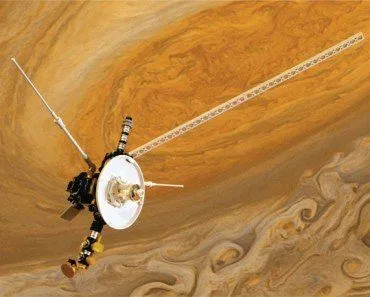
Most artificial satellites are powered by solar arrays (high-efficiency solar panels) that charge rechargeable batteries, which keep the satellite running while it passes through Earth's shadow. Probes too far from the Sun for solar power, such as the Voyagers, instead run on radioisotope thermoelectric generators (RTGs) fueled by decaying plutonium.
Anything we do or use consumes energy in some form. In our daily life, the food we eat gives us power to move and function, while devices get power from either fuel or electricity. When we are on Earth, it doesn’t strike us as to how these things affect our everyday existence. However, when you need to deploy a satellite into outer space, it becomes a lot more important. You must ensure that the satellite can sustain itself and be able to generate its power in the vast emptiness of space. As we dig further into this topic, it might surprise you how satellites get their power, but first, let’s look at the most obvious source of power.
Solar Arrays
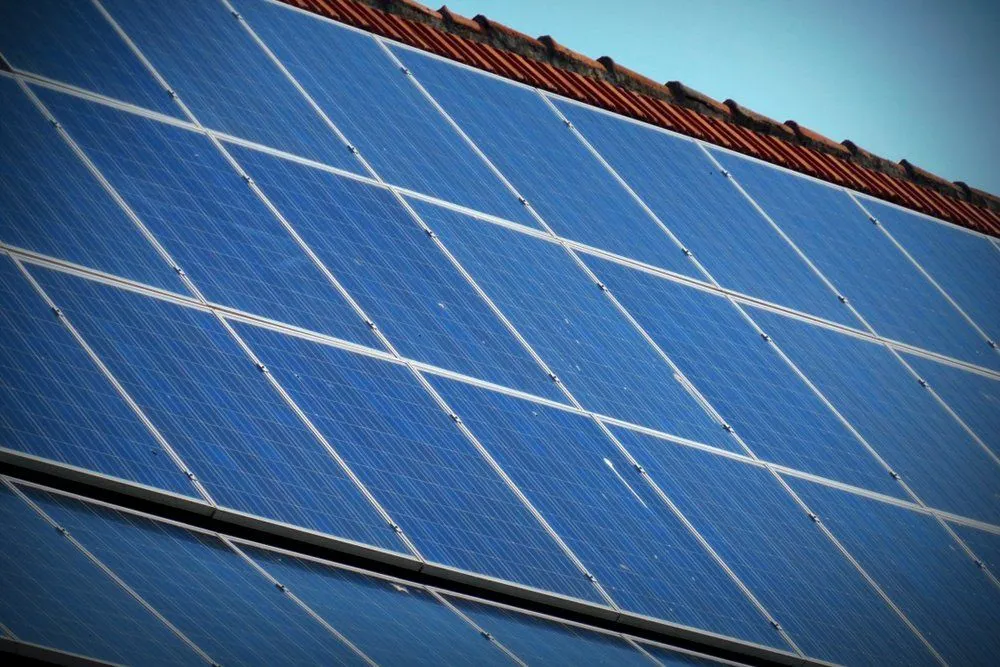
For any satellite orbiting close to home, the most abundant thing it can catch is sunlight! Although solar has not become the ruling source of energy on our planet, when it comes to artificial satellites in Earth orbit, it’s the most predominant source of power. Unlike the conventional solar panels on a rooftop, satellites carry specially built panels known as solar arrays. These arrays are unique in the fact that their efficiency in converting sunlight to electricity is much higher than the panels on your roof. Today’s spacecraft typically use multi-junction gallium arsenide cells that reach around 30% efficiency, roughly double the 15-18% you would get from a good silicon panel on Earth. In low Earth orbit, the Sun delivers about 1.4 kilowatts of power per square meter (1.4 kW/m²), so even a modest array can keep a satellite humming. Many modern arrays are also remarkably thin and flexible, folded up like an accordion for launch and then unfurled once the satellite reaches orbit, where they stay fully deployed for the rest of the mission.
Batteries
Solar arrays only work when they can see the Sun, and most satellites spend part of every orbit in Earth’s shadow. A satellite in low Earth orbit, for instance, slips into eclipse and back out roughly once every 90 minutes. To keep working through that darkness, every solar-powered satellite carries a set of rechargeable batteries. While the arrays are bathed in sunlight, they do double duty: powering the spacecraft and topping up the batteries. Then, when the satellite crosses into shadow, the batteries take over and run everything until the Sun comes back.
The chemistry has evolved a great deal over the decades. Early satellites leaned on nickel-cadmium (NiCd) batteries, which were later supplanted by sturdier nickel-hydrogen (NiH₂) cells; the Hubble Space Telescope and the International Space Station both flew nickel-hydrogen batteries for years. Today, lithium-ion batteries (the same family that powers your phone and laptop) have become the standard, thanks to their lighter weight and higher energy density. The ISS itself swapped its aging nickel-hydrogen units for lithium-ion replacements between 2017 and 2021.
RTGs: Power For Deep Space
So far, so good, but solar arrays have a hard limit: they need sunlight, and sunlight gets dramatically weaker the farther you travel from the Sun. By the time a probe reaches Jupiter, the sunlight is roughly 25 times fainter than it is near Earth; out at Saturn it is about 100 times fainter, and beyond that it is hopeless. Spread an array wide enough to power a spacecraft at the edge of the solar system and it would be impractically huge. This is why deep-space missions abandon solar power altogether.
Instead, they carry a radioisotope thermoelectric generator, or RTG, often nicknamed a “nuclear battery.” An RTG holds a small amount of plutonium-238, which steadily gives off heat as it decays. Solid-state devices called thermocouples sit between that hot fuel and the cold of space, and the temperature difference across them generates a steady electric current, with no moving parts at all. It is not a nuclear reactor and there is no fission involved, just the slow, dependable warmth of radioactive decay.
RTGs have powered some of NASA’s most famous explorers. The twin Voyager probes, launched in 1977, are still sending back data from interstellar space nearly half a century later on RTG power, although that supply fades by about 4 watts each year, forcing engineers to switch off instruments one by one. The Cassini orbiter at Saturn and the Perseverance rover on Mars both relied on radioisotope generators too, in places where the Sun is simply too dim or too unreliable to do the job.
Hypergolic Propellant
Artificial satellites in a geosynchronous orbit experience very little drag. These satellites are usually present at an altitude of about 35,786 km (22,236 mi). At this level of the atmosphere, the satellite requires very little thrust to maintain its orbit. Along with the lower level of atmospheric pressure, Earth’s gravity is also not strong enough to exert much force on it to pull it out of orbit. However, even though the satellite doesn’t need tons of fuel to stay in orbit, it does need fuel to control its attitude (the direction it is pointing). The three axes a satellite has to keep in check are yaw, pitch, and roll, so that its antennas and instruments stay aimed where they should be. Even tiny forces acting on the satellite can slowly nudge it off-target. They also require fuel when they need to reposition because of other satellites entering orbit.
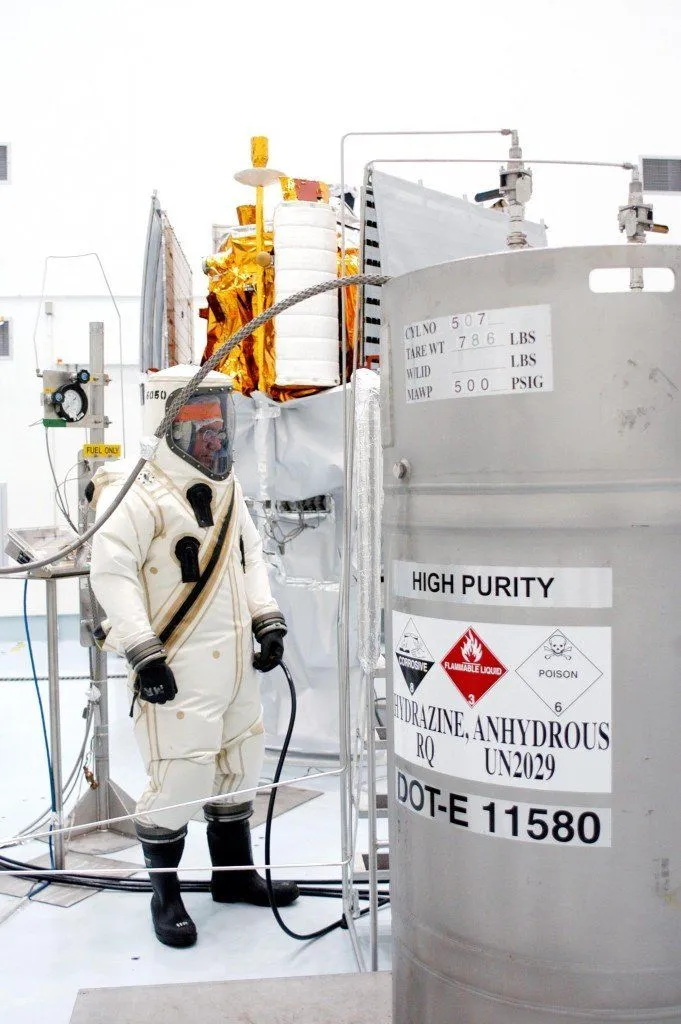
This is where hypergolic fuel comes into the picture. Hypergolic fuel is mostly used in rocket engines, where components simultaneously ignite when they come into contact with one another. It is also used aboard many geosynchronous satellites, which are typically commissioned for around 15 years of service in orbit. The two propellant components usually consist of a fuel and an oxidizer. Their main advantage is that they can be stored in liquid form at room temperature, so the engines they power can be easily be ignited and used. The most common hypergolic fuels are hydrazine, monomethylhydrazine, and unsymmetrical dimethylhydrazine. When it comes to the most famous and preferred oxidizer, it’s nitrogen tetroxide.
Hall Effect Thruster
The thruster that Iron Man used isn’t just science fiction; it’s a real-world piece of technology. In spacecraft propulsion, the Hall Effect Thruster is a type of ion thruster in which an electric field accelerates the fuel. An ion thruster or ion drive is a form of electric propulsion used for spacecraft propulsion. It creates thrust by stimulating cations (positive charges) through the utilization of electricity. An ion thruster ionizes a propellant gas (most commonly xenon, though cheaper krypton is now widely used, including on SpaceX’s Starlink satellites) by stripping electrons from its atoms. There is no air in space to draw on, so the propellant is carried on board as a tank of inert gas. This creates a cloud of positive ions, or cations, which the thruster then accelerates using electricity. These thrusters use the Coulomb force to push the satellite along.
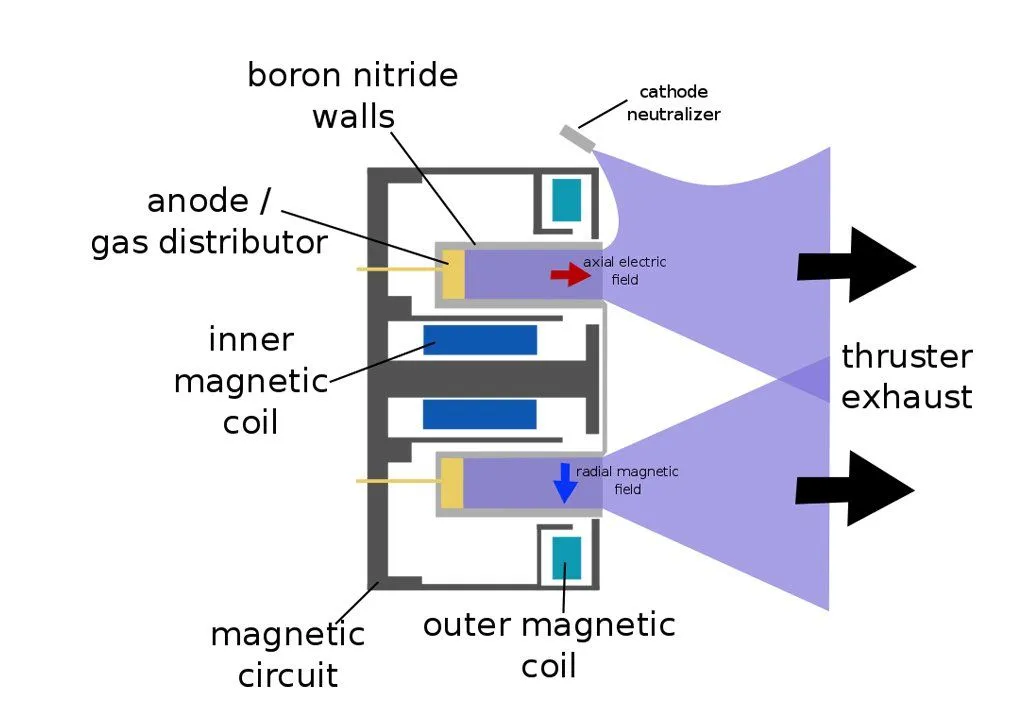
Coulombs force is the Law of Physics, defined as the force calculated in proportion to the product of electric charges divided by the square of the distance between them. The ions get accelerated away from the thruster, and by Newton’s third law that gentle push in one direction nudges the satellite in the other. Hall Effect Thrusters work on the same basic principle as gridded ion engines, but they tend to be more robust and produce a steadier outward plume of ions, which makes for smoother, more reliable thrust. In conclusion, these are just a few main methods that assist in the powering of satellites, but this field will certainly become more innovative and intriguing as we continue our journey out into the stars!
References (click to expand)
- What Powers a Spacecraft? NASA Space Place.
- Power Subsystems. State of the Art of Small Spacecraft Technology. NASA.
- Radioisotope Thermoelectric Generators. NASA Science.
- Cassini’s Radioisotope Thermoelectric Generators. NASA Science.
- Power Systems. European Space Agency (ESA).
- Hall-effect thruster. Wikipedia.