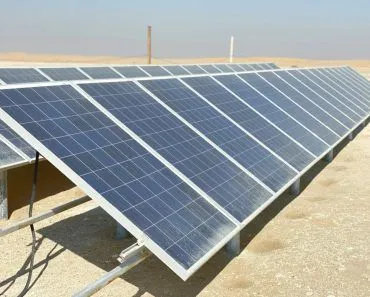
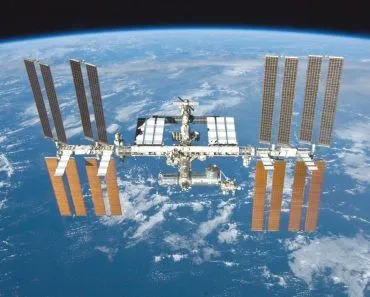
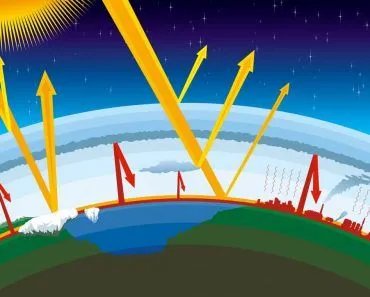
A standard single-junction silicon solar cell is limited by the Shockley-Queisser limit, which caps its theoretical efficiency at roughly 33.7%. Photons with too little energy pass through unused, while the surplus energy from high-energy photons is lost as heat. Everyday commercial panels convert about 20-25% of incoming sunlight into electricity.
“I’d put my money on the sun and solar energy. What a source of power! I hope we don’t have to wait until oil and coal run out before we tackle that.”- Thomas Edison
By now, most of us agree that renewable energy is the way forward when it comes to satisfying humanity’s ever-growing appetite for power. The science on climate change is settled, and the case for going green is about as strong as a scientific case gets. However, when it comes to the various greener alternatives on offer, each one comes with its own set of limitations.

Wind velocity fluctuates tremendously, making it unreliable for much of the day. You can build dams, but you can’t power the entire world with them. Sunlight, however, is freely available during the day across the entire planet, so one might wonder… what’s the objection there? Well, here’s the catch. A standard silicon solar cell, the kind that makes up almost every panel on the market, can only ever convert a slice of the sunlight that hits it. The theoretical ceiling for a single-junction cell is roughly 33.7% (a value known as the Shockley-Queisser limit), and the panels you can actually buy today land somewhere around 20-25%. This has been one of the biggest challenges for the solar industry, but why is there such a hard limit on the efficiency of a solar panel? We’ll get to that answer shortly, but first, it’s important for us to understand what exactly a solar cell is.
What Is A Solar Cell?
A solar cell is a device that captures the energy of the sun in the form of direct sunlight and converts it into electrical energy. A solar cell is also known as a photovoltaic cell, which implies that it converts the photons present in the light into a voltage difference (which essentially means “electrical power”). To understand the limitations of a solar cell, we must take a closer look at its construction.
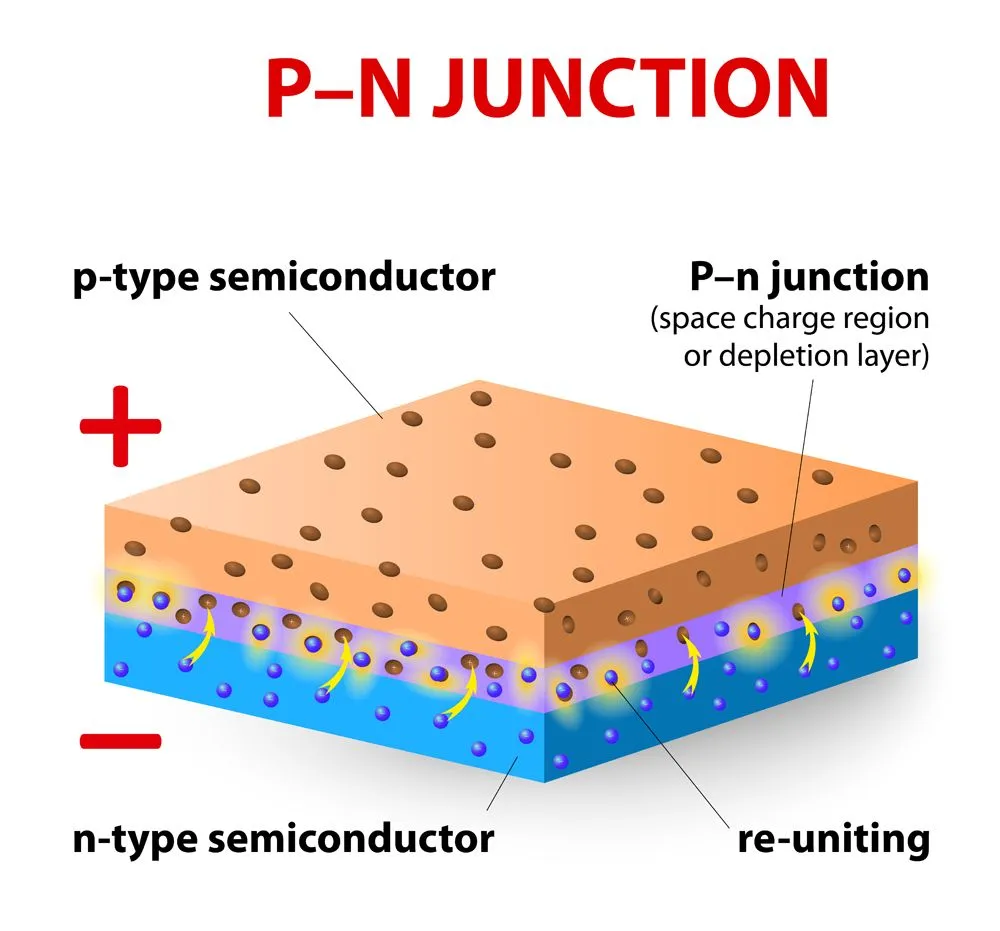
Solar cells are made using p-type and n-type silicon wafers. A p-type silicon wafer consists of more holes, meaning that it lacks in electrons, whereas the n-type wafer possesses an excess of electrons. The interface at which these two make contact is known as a junction (a PN junction, to be more precise). The PN junction is the primary building block of the solar cell.
What Do We Mean By The Efficiency Of A Solar Cell?
Every device that we use has a certain efficiency associated with it. Consider a machine that produces 10 balloons per hour. Out of these ten, two balloons turn out to have a hole or some other type of defect. This implies that the efficiency of the machine is 80%, because the machine takes in the raw materials required to produce 10 balloons, but converts only 80% of that into useful output. Thus, the efficiency of a device represents the amount of useful output produced per unit of input supplied to it.
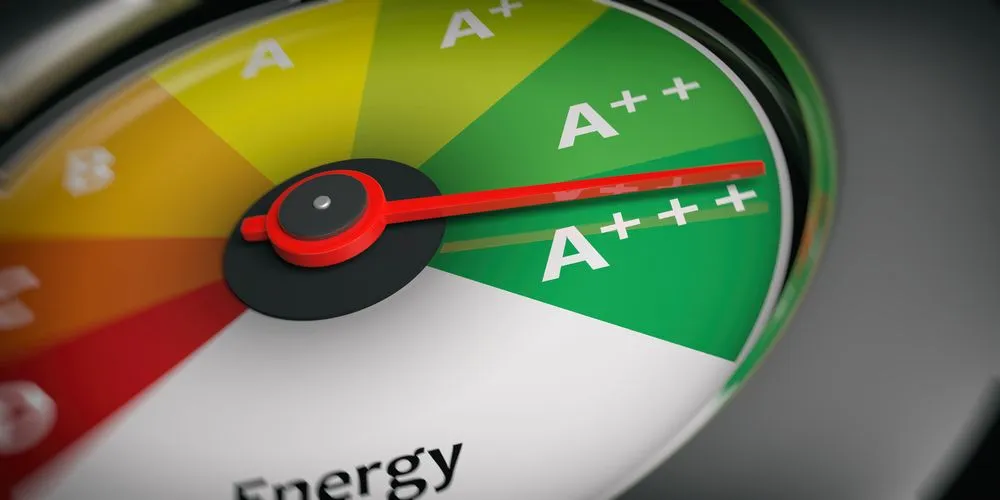
Similarly, the incident radiation on a solar cell is not entirely converted into electricity. Only a certain fraction of that energy (a much smaller fraction, as we already saw) can be extracted as useful work. A cell’s efficiency is simply the ratio of the electrical power it puts out to the solar power falling on it. But why is even the very best cell capped so far below 100%? The answer lies in a famous theoretical ceiling called the Shockley-Queisser limit.
What Is The Shockley–Queisser Limit?
The Shockley-Queisser Limit, more commonly known as the SQ limit, is the most prominent scientific measure for the efficiency of solar cells. First worked out by William Shockley and Hans-Joachim Queisser in 1961, it sets the theoretical maximum efficiency of a single PN junction solar cell under standard test conditions (STC). The STC approximate solar noon at the spring and autumn equinoxes in the continental United States, with the surface of the solar cell aimed directly at the sun (Solar Efficiency Limits).
The exact value of the limit depends on the cell’s bandgap. For the ideal bandgap of about 1.34 eV, the ceiling works out to roughly 33.7%. Silicon, the material in almost every panel you can buy, has a slightly less favorable bandgap of 1.1 eV, which pulls its theoretical limit down to around 32%. In practice, the very best laboratory silicon cells have reached about 28% (LONGi reported a certified 28.13% in 2026), while mass-produced commercial panels sit closer to 20-25%.
The limit is calculated under certain assumptions. The solar cell must be made of only one type of homogeneous material. There can be only one p-n junction per solar cell, and it is assumed that every photon possessing energy greater than the bandgap is converted into electrical energy. Don’t worry if you don’t know the meaning of photons or bandgap just yet, we’ll be discussing those below.
Why Is There A Limit To The Efficiency?
The process of generating electricity using solar cells depends primarily on one very important step: the jumping of electrons from the valence band to the conduction band inside the silicon. These bands are two ranges of energy that an electron can occupy within the material. In the valence band, electrons are bound to their atoms and cannot move freely. In the conduction band, they are free to roam through the material, and only then can they flow out as an electric current to power an external circuit, such as a battery.
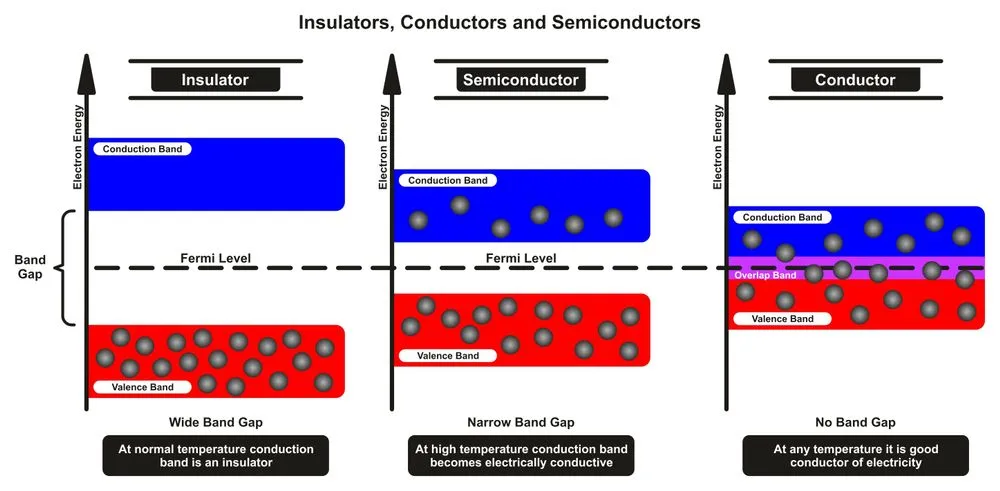
Electrons do not jump from the valence band to the conduction band by themselves. They must be handed at least a certain minimum amount of energy, known as the bandgap, to make the leap. For silicon, that bandgap is about 1.1 electronvolts (eV). A photon carrying less energy than this simply cannot kick an electron across the gap, so it passes through the cell without doing any useful work.
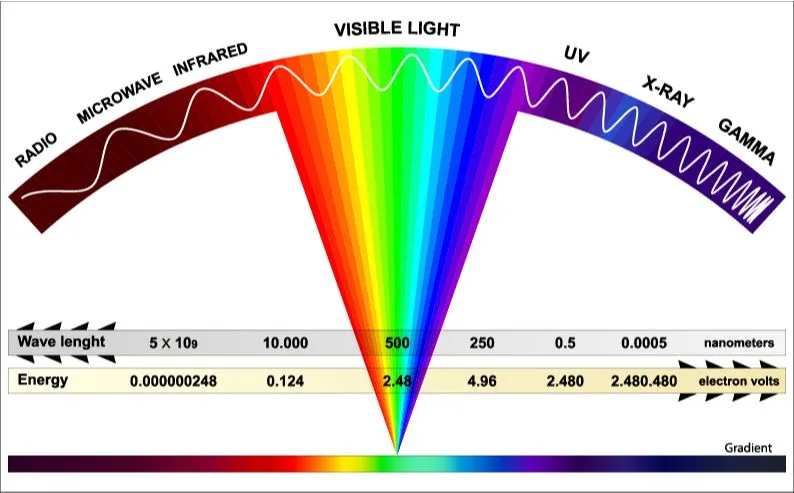
Now, the incoming solar radiation is composed of waves of many different wavelengths, as shown in the spectrum above. The longer waves toward the red and infrared end are the weakest (carrying less energy per photon), while the shorter waves toward the blue and ultraviolet end are more energetic. As a result, only some of these photons carry enough energy to push an electron across the bandgap.
To put numbers on it, the bandgap energy can be matched to a wavelength using E = hc/λ. For silicon’s 1.1 eV bandgap, that corresponds to a wavelength of about 1,100 nanometers (nm), which sits in the near-infrared. Sunlight with a longer wavelength than this (about a fifth of the energy in the standard AM1.5 spectrum) lacks the punch to free an electron and is wasted entirely.
There is a second, sneakier loss too. When a high-energy photon (say a blue or ultraviolet one) does free an electron, it usually carries far more energy than the bandgap requires. The electron only gets to keep an amount equal to the bandgap; all the extra energy is quickly shed as heat inside the cell. This process is called thermalization, and it is the single biggest loss for a silicon cell.
Let’s pull this together. Imagine 100 units of sunlight energy striking a silicon solar cell. Right off the bat, roughly 20 units are carried by infrared light too feeble to free an electron, so they sail straight through the cell. Of the energy that does get absorbed, another large chunk (around 33 units) is lost to thermalization as those over-energetic photons shed their surplus as heat. Add in reflection off the surface and a few other losses, and you can see why even an idealized single-junction cell tops out near 33.7%, and a real-world panel near 20-25%.
What Are The Other Factors Affecting Efficiency?
As we saw, the threshold energy barrier for electronic transition turns out to be the primary reason for low solar panel efficiency. However, it is not the only factor affecting it. There are numerous other elements that play a considerable role here.
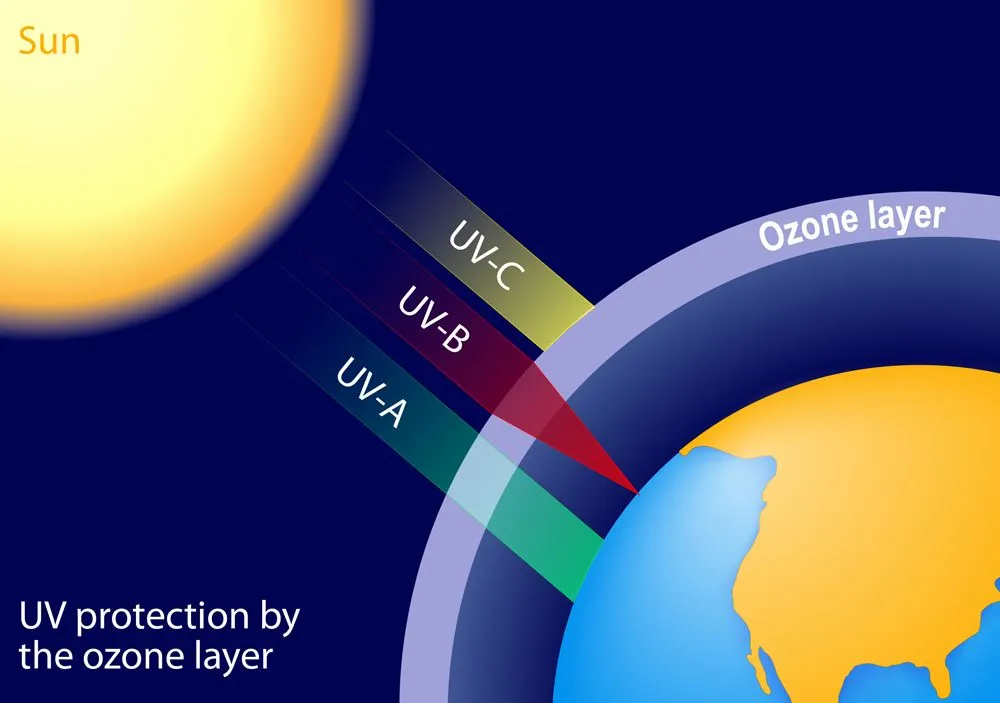
The energy leaving the Sun and the energy we actually receive here on Earth are not the same. That’s because the radiation has to travel through the thick atmosphere that encompasses our planet. Along the way, phenomena such as scattering, absorption, and reflection chip away at its intensity. The ozone layer, for instance, soaks up much of the harmful ultraviolet radiation (these high-energy waves can damage living cells, including those in our eyes), and water vapor and carbon dioxide absorb chunks of the infrared. By the time sunlight reaches a panel on the ground, its spectrum has been reshaped and weakened, which is precisely why solar cells are rated against the AM1.5 standard spectrum rather than the raw sunlight in space. Add in clouds, dust, and the angle of the Sun, and real-world panels deliver less than their lab-rated peak.
Is There Any Solution To The Problem?
Even though most commercial solar cells available to us today convert only about 20-25% of incoming sunlight, the future does look bright. One of the most promising avenues is the use of perovskite materials. Researchers at the University of Cambridge, working on perovskites for flexible LEDs and next-generation solar cells, found that these materials can actually become more efficient when their chemical compositions are slightly less ordered, a counterintuitive result that promises to simplify production and lower costs (Phys.org).
The other big idea is to sidestep the single-junction ceiling altogether by stacking several materials with different bandgaps on top of one another. These multi-junction (or tandem) cells use materials such as gallium arsenide, indium gallium phosphide, and germanium, each layer tuned to harvest a different slice of the solar spectrum that the layer above it missed. Because the Shockley-Queisser limit only applies to a single junction, tandems can legitimately blow past it. In April 2025, the manufacturer LONGi reported a perovskite-silicon tandem cell with a certified efficiency of 34.85%, independently verified by the US National Renewable Energy Laboratory (NREL), the first such device to officially break the 33.7% single-junction barrier. All in all, the future does look bright for the solar industry.
A Final Word
Record-breaking wildfires, from Australia to the Amazon to California, have pumped staggering amounts of carbon into the atmosphere over recent years. Global warming is no longer a future problem; it is a full-blown reality, and there is no use denying it. Scientists have spent decades telling the world that clean energy is the only sensible way forward, yet progress remains frustratingly slow.
The lower efficiency of solar cells has been commonly cited as the reason for not using them as substitutes for fossil fuels. However, the trouble is that multinationals and governments continue to put enormous sums into the research and development of petroleum and coal-based energy production, neglecting research and improvement to the greener and safer alternatives. For example, there have been discoveries of materials with a lower energy bandgap that can act as a possible remedy to the problem at hand, but we need the world to pay attention and invest in this type of research!
What the world needs to understand and accept is that there is only one way forward if we want our species to thrive, and that is the green and sustainable way!
References (click to expand)
- Solar Cell Efficiency - PVEducation. pveducation.org
- Standard Solar Spectra (AM1.5) - PVEducation. pveducation.org
- Solar Energy Efficiency: Beyond the Shockley-Queisser Limit. Solar Cell Central
- Tong, H., Tan, S., et al. (2025) Total-area world-record efficiency of 27.03% for commercial-sized single-junction silicon solar cells. Nature Communications.
- LONGi Breaks World Record (34.85%) for Crystalline Silicon-Perovskite Tandem Solar Cell Efficiency. LONGi.