Table of Contents (click to expand)
The Active Denial System (ADS) is a non-lethal, directed-energy, counter-personnel weapon owned by the US military. A gyrotron generates and focuses a 95 GHz millimeter-wave beam onto a target up to about 1,000 metres away. The beam heats the top 0.4 mm of skin and triggers an instant, intolerable burning sensation that makes people flee — with no lasting injury at safe exposure times.
I was recently watching a military film set during World War 2. It obviously featured a lot of weapons used on those battlefields, but one that specifically grabbed my attention was a ‘flame thrower’. As the name clearly signifies, it was a gun that spewed fire instead of bullets!
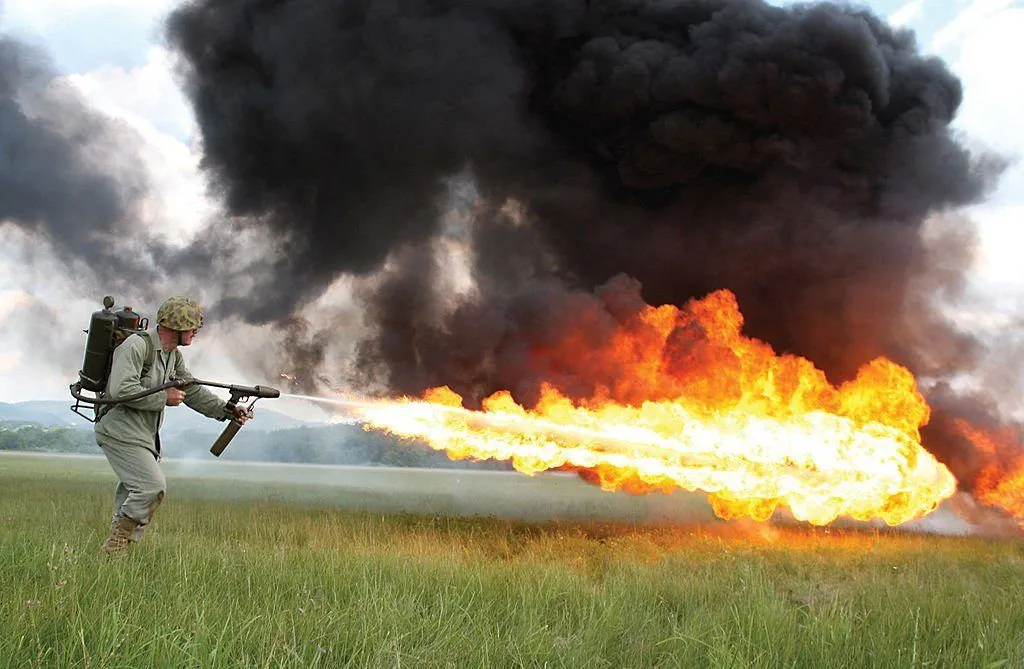
Although it could also be (and was) used in a direct assault on an enemy, it was primarily used to destroy bunkers and clear out hostile areas by setting them ablaze.
Fast-forward seven decades and those flame throwers have virtually disappeared from the battlefield. They might have been effective back then, but today, they have been replaced by far more sophisticated, sturdier and impactful weaponry. One of those specialized types of weapons used to disrupt a crowd of insurgents without causing fatalities are non-lethal weapons.
Non-lethal weapons provide military and other armed forces with an additional set of tools to engage in complex but sensitive environments. One of the new technologies serving this purpose is the Active Denial System (ADS). It sounds like a concept from psychology, but it is actually a newfangled military technology! Before going into details of ADS and how it works, let’s first understand why it is needed.
The Need For ADS
A modern battlefield often poses a challenge for troops if they need to, for example, disperse a group of rebels in a harmless manner or with minimal injuries. The US military’s engagement in Afghanistan, Iraq, Somalia, etc. has often presented such challenging situations.
Many times, military troops have only a few minutes or even seconds to make the daunting decision of using lethal weapons on rebels. However, the ramifications of resorting to brute force to deal with dissenters can be tragic. A lethal action by military forces may end up taking the life of an innocent victim, and that person’s family members, friends, and relatives may then develop a prejudice against the military. Previously, they might have been ‘neutral’, but such fatalities would inflict an agonizing amount of mental trauma, enough that they might change their allegiance. Being filled with a desire for vengeance, they might join insurgents or collude with them. This would erupt in more skirmishes in the future.
This is where non-lethal weapons come to the rescue. They can disperse a crowd of protestors and make them retreat from the site. Tear gas, electric stun guns, and pepper spray are some of the most commonly used alternatives in such situations, but the problem is that they have a limited range of 50m or less. This is where ADS proves its worth. They not only significantly improve the operating range (up to 1000m), but inflict a transient but sharp burning sensation in the target. The discomfort is such that they would be forced to leave the area.
The Active Denial System (ADS)
The Active Denial System (ADS) is a directed-energy non-lethal weapon system designed and developed by the US military. The Air Force Research Laboratory (AFRL) at Kirtland Air Force Base in Albuquerque is where ADS technology was first developed.
ADS is also known as a heat ray or pain ray. It is primarily designed for perimeter security and crowd control.
ADS is currently a vehicle-mounted weapon, meaning that it can only be used from a designated vehicle. It is currently not portable, although developments are ongoing to make it portable in the near future. That’s why it is sometimes also referred to as the Vehicle-Mounted Active Denial System (V-MADS). It emits a man-sized beam of millimeter waves that produces a hot, burning sensation in the skin when it strikes a (human) target.
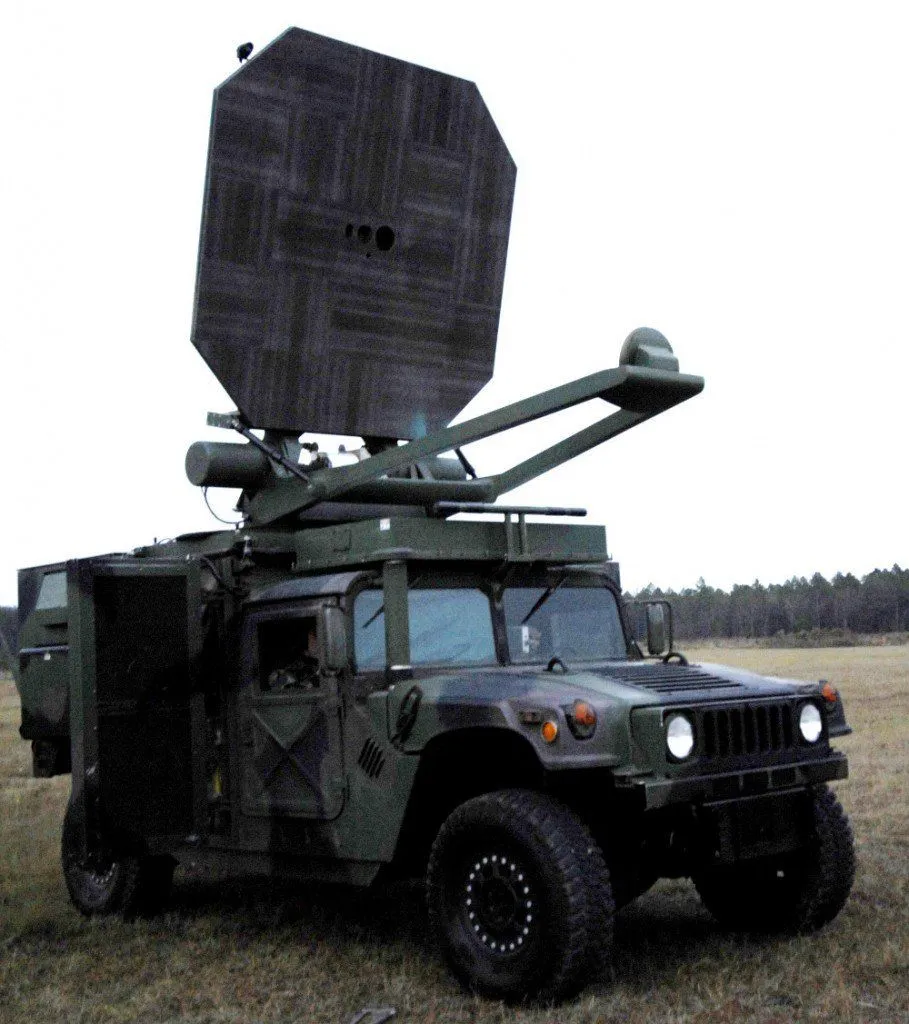
Although the use of millimeter waves as a non-lethal weapon is new, these waves have been studied by scientists ever since James Clerk Maxwell laid down the theory of electromagnetism in the 1860s and 1870s. Maxwell’s work opened the door to understanding the electromagnetic spectrum, which ranges from radio waves, microwaves, and millimeter waves to infrared, visible light, and X-rays.
How Does The ADS Work?
The working principle of the active denial system is similar to that of a microwave oven. Just as a microwave has a magnetron that emits microwaves and heats the food kept inside, the V-MADS system consists of a gyrotron that emits millimeter waves at a frequency of 95 GHz with the help of a reflector.
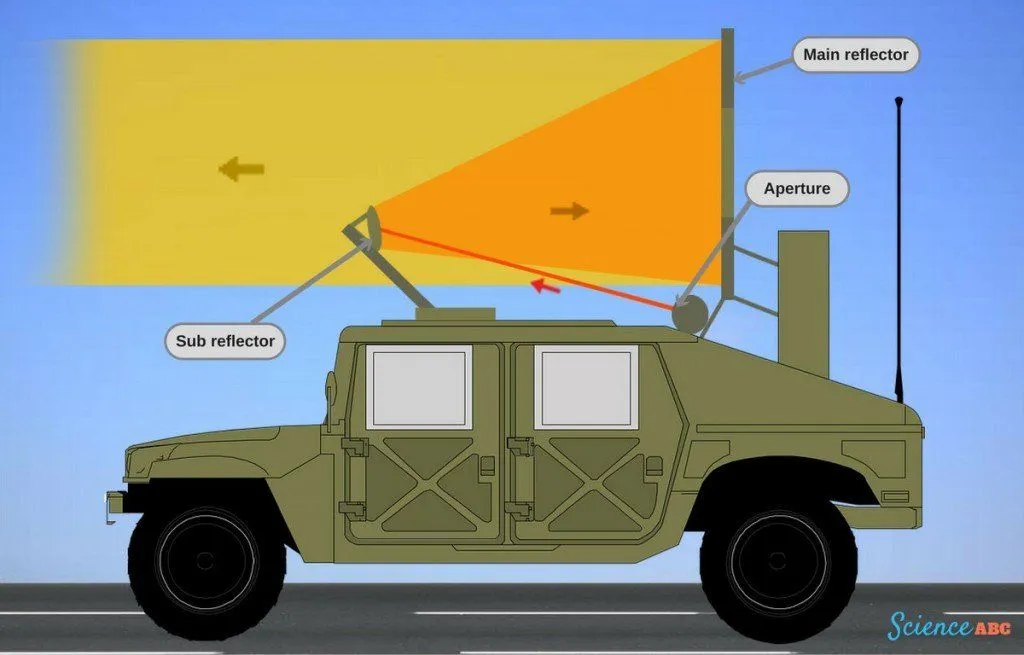
V-MADs has a video camera for day operations and an infrared camera for night operations, which allows the system operator inside the vehicle to direct these millimeter waves at a given target using a joystick.
These waves travel at the speed of light (since they’re part of the electromagnetic spectrum). When the focused high-energy beam strikes the target (i.e., human), it interacts with the tiny water molecules (or moisture) present on the surface of the skin and excites them. This interaction produces an unnerving, but non-lethal sensation of intense heat. This makes the person who is exposed very uneasy and uncomfortable. Exposure to the millimeter beam triggers a natural response to flee from the site and escape the burning sensation.
ADS’ Millimeter Waves Vs Microwaves
Although the working principle of the ADS is similar to a microwave oven, the two are actually quite different. A household microwave oven operates at about 2.45 GHz, which corresponds to a wavelength of roughly 12 cm (about 4.7 inches). ADS, on the other hand, operates at 95 GHz, so its wavelength is much shorter — about 3.15 mm (around 0.12 inches), roughly the thickness of a stack of 30 sheets of ordinary paper. Because millimeter waves are so short, they only penetrate the top 0.4 mm of skin. Microwaves at 2.45 GHz, by contrast, penetrate tens of millimetres into tissue — roughly 30–40 times deeper than ADS’s 95 GHz beam — which is why a microwave-frequency weapon could be much more dangerous and potentially fatal.
Is ADS Dangerous To Health?
95 GHz millimeter waves emitted by ADS are non-ionizing, i.e., these energy waves do not possess enough photonic energy to cause disruptions at the cellular level. They can penetrate only up to 0.4 millimeters of skin depth, but the energy is high enough to elevate the skin’s temperature. The heating sensation one gets upon being exposed to millimeter waves is intense, but it ends as soon as the exposure to the beam ends. That’s the whole purpose of ADS. Expose the beam to the insurgents so that they retreat to escape the burning sensation. The heating of the skin by the ADS beam basically produces an intolerable burning sensation and triggers a reflexive response to flee the site.
Health effects upon being exposed to millimeter waves have been studied for decades. One of the first studies to understand the health implications of millimeter exposure was done as early as 1947. This study by researchers Morit and Henriques studied the effect of increasing the skin temperature, including intense heating of the skin by radiation.
These human effect studies are usually conducted in a laboratory wherein subjects (humans) are exposed to a small spot of millimeter waves. They are told to sit on a stool and are then exposed to small millimeter waves from behind. Upon exposure, subjects are unsettled and their natural response is to move or escape the source of discomfort. The reaction time is recorded and the skin irritation is then medically examined.
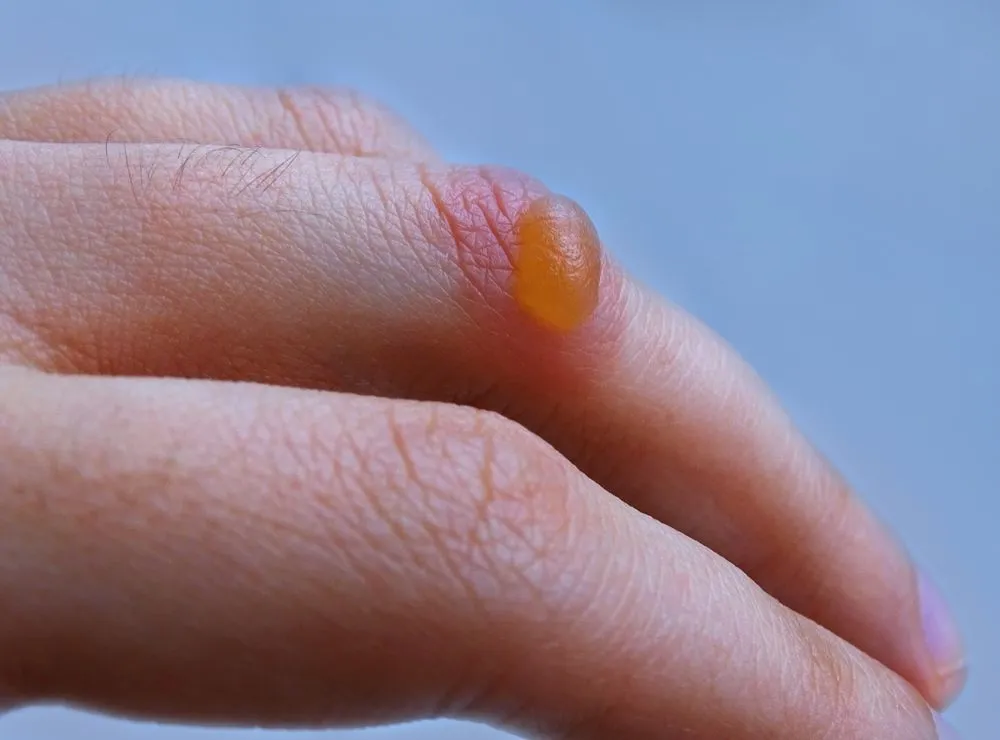
Research shows that there is some safety margin between the time it takes for the subject to feel the tingling heating pain and move away from the beam, as exposure immediately triggers the natural response to leave. Hundreds of people have been studied so far and thousands of exposures have been tested to understand the potential health effects of millimeter waves exposure. Studies done so far have found that the effect of such exposure is minimal and is limited to skin reddening and irritation. However, 8 people did get a more severe second-degree burn, consisting of a pea-sized blister.
Non-lethal directed-energy technologies like ADS have a profound impact on warfare and crowd-control capabilities, but their application is still a contentious issue. Forces could indiscriminately use this technology to curb any revolt or dissent under the pretext of maintaining law and order. The Pentagon briefly deployed ADS to Afghanistan in 2010 but withdrew it without firing in combat, and similar “heat ray” weapons have reportedly been considered (and rejected) for crowd-control use during civil protests — including discussions in 2020 around dispersing demonstrators near the White House. Before using it on any broad scale, we need a stringent legal framework to ensure that this technology is never misused by those in power.
References (click to expand)
- Joint Intermediate Force Capabilities Office. The Pentagon
- The Human Effects Advisory Panel. The Pentagon
- Brad Turner, Cooking Protestors Alive: The Excessive-Force Implications of the Active Denial System, 11 Duke Law & Technology Review 332-356 (2012) - Duke University School of Law
- Walters, T. J., Blick, D. W., Johnson, L. R., Adair, E. R., & Foster, K. R. (2000, March). Heating And Pain Sensation Produced In Human Skin By Millimeter Waves. Health Physics. Ovid Technologies (Wolters Kluwer Health).