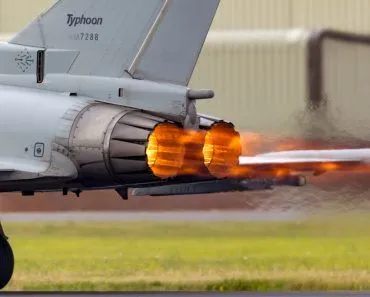
Decoy flares and chaff are countermeasures used to distract and confuse missiles. Decoy flares emit a bright heat source, while chaff creates a cloud of metallic particles to reflect radar signals.
Whenever I think or talk about flares, I am instantly reminded of an epic scene from the movie Behind Enemy Lines. In the scene, the protagonist and his friend are flying a reconnaissance mission when enemy forces fire two surface-to-air missiles (SAMs) at them.
When the pilot receives an alert that enemy forces are targeting their aircraft and a SAM missile is closing in on their position fast, the first thing he does is deploy decoy flares.
Here’s that particular scene to which I’m referring:
When I first watched the movie, I was fascinated by the shiny little fireballs that the aircraft fired at the oncoming missile. However, I did not understand what those little fireballs actually were, nor how they would prevent the missile from hitting the aircraft, given the fact that they were too small, individually, to account for the much larger SAM missile.
So, let’s start with decoy flares!
What Are Decoy Flares?
As a countermeasure, Decoy flares are released from aircraft to prevent incoming missiles from hitting them. These flares are burning objects made from unique materials that ignite instantaneously upon contact with the air. They are also known as pyrophoric flares. One type of decoy flare that is commonly used is the MU-27A/B flare.
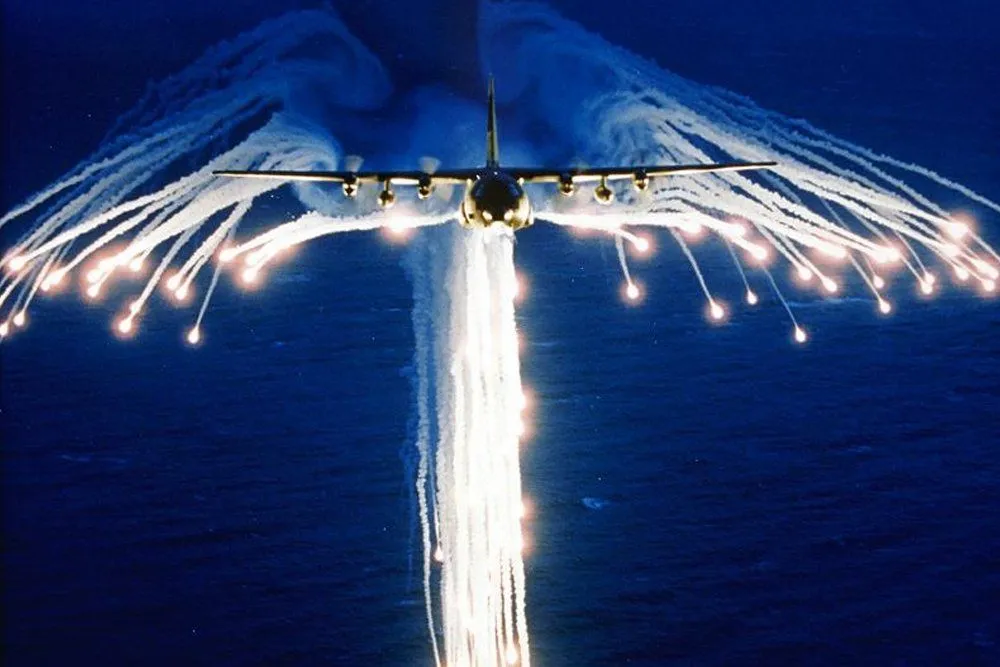
When a fighter jet is flying over enemy territory, and a heat-seeking missile is fired at it, the aircraft’s decoy flares can confuse the missile.
Since the missile is programmed to seek the heat released from the jet’s exhaust, the decoy flares are designed to burn at high temperatures. This confuses the missile as to the real position of its target.
After the decoy flares are fired, the aircraft should be pulled away at a sharp angle from where the flares were fired. The engine power should also be reduced to minimize the aircraft’s thermal signature.
This way, the missile would get ‘confused’ by the sudden change in temperature and the flurry of new heat signatures and, in response, will pursue the decoy flares rather than your plane itself.
The upshot? You and your plane would be saved!

It’s important to note that not all missiles are heat-seeking. Some missiles track their target using radar guidance instead of heat, so deploying pyrophoric flares won’t help you escape them. A different type of countermeasure is required to counter radar-guided missiles.
Enter… chaff!
What Is Chaff?
Chaff is a type of radar countermeasure commonly used in modern warplanes and other targets to protect against radar-guided missiles. Chaff is a cluster of small, thin pieces of aluminum, metallic glass fiber, or plastic. When deployed by the target aircraft, it appears as a cloud of small targets to incoming radar-guided missiles.
Both airplanes and missiles are made of metal, which means they have a radar signature that enemy radar can locate with reasonable accuracy. A typical radar-guided missile homes in on its target by following its radar signature.
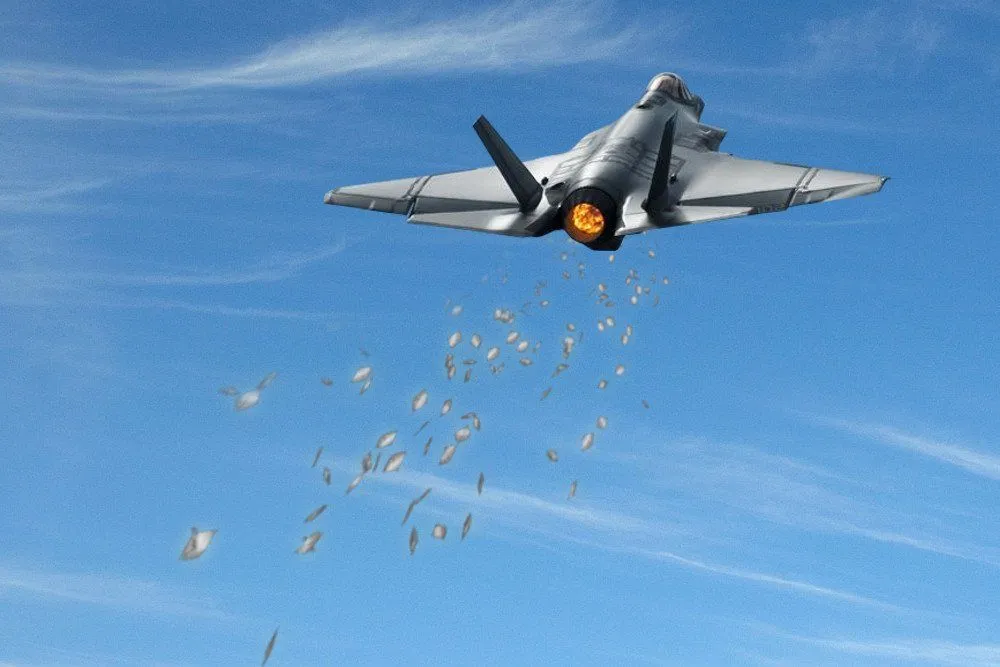
However, when a cluster of small metal pieces is jettisoned in the aircraft’s wake, the pursuing radar-guided missile gets confused by the sudden increase in the radar signature of multiple small, metallic targets. Consequently, if the aircraft is lucky, the missile will end up hitting one of the chaff targets, exploding, and no longer threatening the plane and its occupants.
However, the story doesn’t end here.
Modern-day missiles are equipped with advanced counter-countermeasure (CCM) systems. These systems are designed to ensure that the missiles can overcome any countermeasures they might encounter on their way to the target.
The weapons industry is essentially caught up in a perpetual war between missile and countermeasure engineers, each striving to create increasingly superior systems to outsmart the other.
What Are Flares And Chaff Made Of?
Back when I was wondering what those shiny fireballs in the movie actually were, the answer turned out to be surprisingly low-tech chemistry. A standard decoy flare is built around a pyrotechnic mix called MTV, which stands for magnesium, Teflon and Viton (Teflon is polytetrafluoroethylene, and Viton is a rubber-like binder that holds the pellet together). When the magnesium reacts with the fluorine in the Teflon, it burns ferociously hot, far hotter than a jet engine, and that is the whole point. A common example is the M-206 cartridge fired from many fighter jets.

Chaff is even simpler. It is essentially a bundle of millions of tiny metal threads, today usually aluminum-coated glass fibers. Each fiber is incredibly fine, on the order of 0.025 mm across (thinner than a human hair) and only a few centimeters long. The exact length is not random: each strand is cut to roughly half the wavelength of the radar it needs to fool, which lets it resonate with and re-radiate the radar signal. This is also why so many people search for what does chaff look like and assume it is glitter. A fresh burst really does look like a sparkling silver cloud, because that is more or less what it is: a fistful of metallic confetti tuned to a radar frequency.
How Many Flares And Chaff Does A Fighter Jet Carry?
This is one of the most common questions people ask about countermeasures, and the honest answer is: more than you might think, but still a finite supply. On many Western aircraft, expendables like flares and chaff are fired from a dispenser system such as the AN/ALE-47. A typical installation uses four dispenser assemblies, and each payload module holds up to 30 cartridges, which works out to a maximum of around 120 rounds in total.

That total is shared between chaff and flares, and the exact split depends on the aircraft and the mission. A pilot can program the system to release a single flare or to ripple out a whole salvo at once. Because each flare burns for only a handful of seconds, a real engagement can chew through a dozen or more in a few heartbeats, which is exactly why those dispensers are packed so densely. Once they are empty, that is it until the aircraft lands and the magazines are reloaded.
Flares vs. Chaff: What Is The Difference?
It is easy to lump flares and chaff together, since they are often fired in the same breath and stored in the same dispenser, but they defeat two completely different kinds of missile. The simplest way to remember it: flares fool heat, chaff fools radar.

A flare is a burning pyrotechnic decoy. It works against infrared (heat-seeking) missiles by burning hotter than the jet's exhaust, so the missile's seeker chases the brighter heat source instead of the aircraft. A chaff burst, on the other hand, releases no heat to speak of. It is a cloud of metallic fibers that throws back a huge, confusing radar echo, defeating radar-guided missiles by hiding the real aircraft inside a swarm of false targets. Because a pilot under attack often cannot be sure which type of missile is incoming, aircraft frequently dispense both at the same time, covering the heat-seeking and radar-guided threats in one go.
What Are Dark Flares?
There is a catch with ordinary flares: a brilliant fireball that fools a missile also lights up the sky, advertising exactly where the aircraft is to anyone watching from the ground. That trade-off is what gave rise to so-called dark flares, also known as spectral or covert flares.
A well-known example is the SPARC-3 / XM216 decoy made by Elbit Systems. Instead of producing a bright, broadband fireball, these flares use a tailored chemistry that pumps out energy in the specific infrared bands a missile seeker looks for, while emitting very little visible light. The result is a decoy that is described as virtually invisible to the naked eye, with the same spectral trick suppressing the tell-tale smoke trail in daylight. They are built to counter newer two-color infrared seekers, the very counter-countermeasures mentioned above, and are compatible with standard dispensers like the ALE-40 and ALE-47. In other words, dark flares are the latest move in that endless back-and-forth between missile and decoy: a flare that saves the aircraft without giving its position away.
Last Updated By: Ashish Tiwari
References (click to expand)
- Chaff Cloud Modeling and Electromagnetic Scattering ....
- Cheng, Chi-Hao, and James Tsui. "7 Chaff, Flare, and Decoys." (2021): 113-119.
- TITLE Principles of Guided Missiles and Nuclear Weapons. ....
- NASA Technical Reports Server (NTRS).
- Wu, Xianli, Zizhong Qi, and Teng Long. "Research on applications of chaff." 2006 8th international Conference on Signal Processing. Vol. 4. IEEE, 2006.
- Flares - Infrared Countermeasures. GlobalSecurity.org.
- AN/ALE-47 Countermeasures Dispenser System (CMDS). GlobalSecurity.org.
- Chaff (countermeasure). Wikipedia.
- SPARC3 / XM216 Spectral Flares. Elbit Systems.