Cosmic rays from space can cause data stored in computers to get bit-flipped. Fortunately, we have developed clever techniques to rectify this issue.
We’re all familiar with computers and their usefulness in our daily lives. We use them for many things, from entertainment and gaming to finances, accounting, and even performing complicated mathematical equations that can determine how galaxies form and model various biological systems.
Computers have integrated deeply into our lives, as our smartphones are essentially mini-computers.
But are computers 100% perfect?
Not really, right? Computers can crash, catch (computer) viruses, and be compromised in many different ways, such as with bloatware or ransomware.
Even the natural world has a way of messing with computers. In this article, we’ll explore how this happens: what are bit flips and how cosmic rays cause them, potentially leading to critical errors inside a computer. We will also briefly see how specialized computers employed inside spacecraft protect themselves from cosmic rays and prevent bit flips.
About Bit Flips
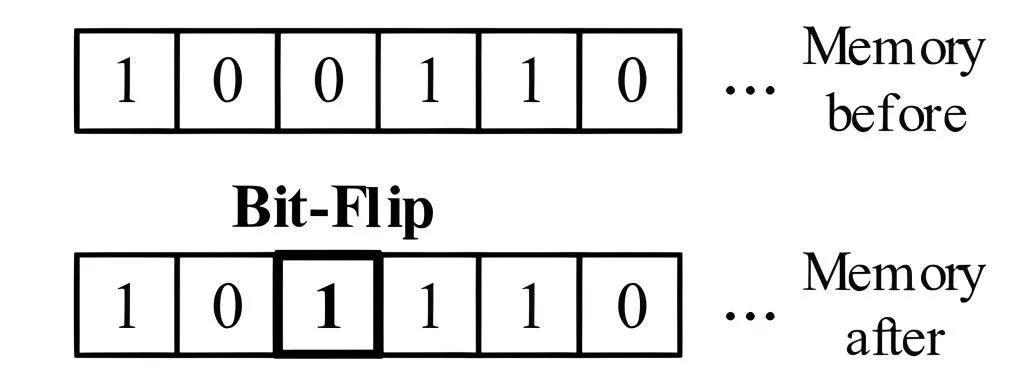
Bit flips are a type of unintentional changing of memory data. Computers store data in the form of bits as 0s and 1s. When a piece of data gets ‘bit-flipped,’ the value of this memory data changes or flips: a 0 becomes 1, and a 1 becomes 0.
This bit flip happens when a high-energy charged particle strikes the memory hardware. These particles could be an alpha particle or a cosmic ray originating from space. When such particles strike the memory hardware, they alter the properties of the electron used to store the data, causing the bit to flip.
Bit flips fall under the category of ‘soft errors’. When a soft error occurs, we can make the required rectification using codes to rewrite the bit value at the place where the fault occurred and get its correct value back. This is different from a hard error, which is usually the result of faulty or damaged hardware. When a hard error happens, the hardware itself needs to change.
As mentioned, cosmic rays are one of the reasons that bit flips occur in memory devices.
How Do Cosmic Rays Cause Bit Flips?
Cosmic rays are high-energy particles originating from outer space. They mainly consist of protons, along with small amounts of Helium nuclei and trace amounts of other kinds of heavier nuclei and quantum particles.
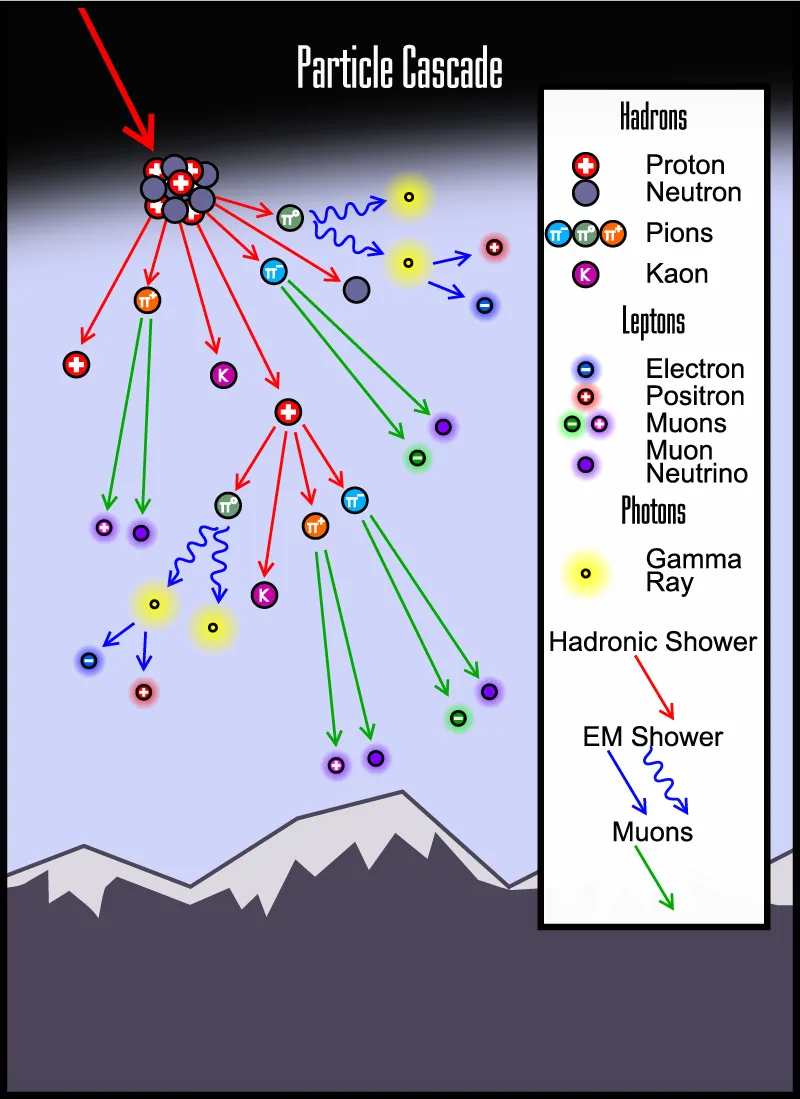
When these cosmic rays reach the upper layers of Earth’s atmosphere, they collide with the nuclei of the particles in the atmosphere. After that, the cosmic ray particles mainly convert into pions, which further decay into muons. Muons do not interact much with matter and effortlessly reach the surface of the Earth.
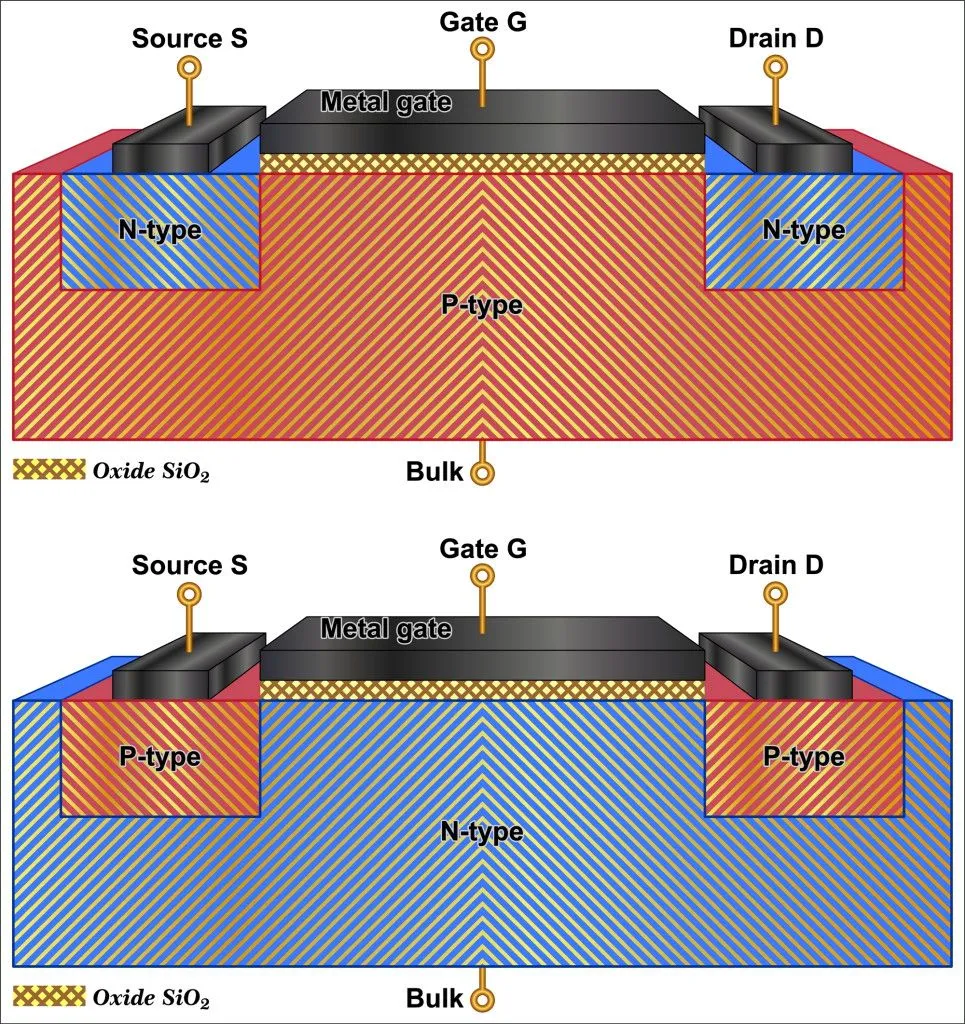
RAM and flash memory store data using transistors as one of their key components. These modern memory devices use metal-oxide semiconductor field-effect transistors or MOSFETs. The memory storage, in the form of bits, is done by applying voltage values across the transistor terminals.
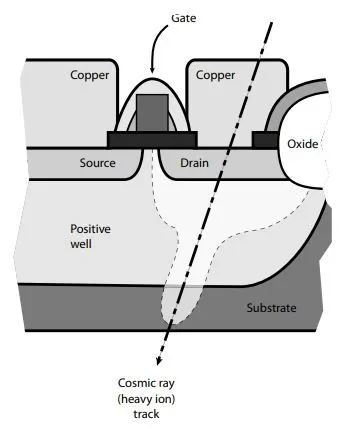
A bit flip occurs when an external charged particle, like a cosmic ray, interacts with the MOSFET and alters the properties of the electron flowing through it and, by extension, the voltage value across the transistor terminal.
Computers on the surface of the Earth are predominantly safe from cosmic rays, since most of them usually end up as muons by the time they reach the Earth’s surface. Therefore, computers on the ground don’t usually get bit-flipped, but this is not the case with spacecraft traveling in outer space. They are bombarded with cosmic rays, without the disruptive effect of Earth’s atmosphere, making them quite vulnerable to bit-flips.
Rectifying Bit Flips
While avoiding cosmic rays can be somewhat impossible for spacecraft once they’ve left Earth’s atmosphere, there are other things we can do to correct a bit flip once it has occurred. Sometimes, rebooting can indirectly clear up the bit-flipped data, resetting it to its original value via memory refresh and reinitialization. However, this technique does not always work, and more robust techniques may be needed.
Sometimes, we use error-correction codes (ECCs) to fix the errors created by bit flips. The codes can detect when a bit flip has taken place, which is usually done by determining the number of 0s or 1s the data contains (provided by the user). If the software detects that there is a mismatch in the number of 0s or 1s from what it received and what the user has provided, it detects the error.
More sophisticated ECCs, like Hamming codes, are also used to rectify the errors caused by bit flips.
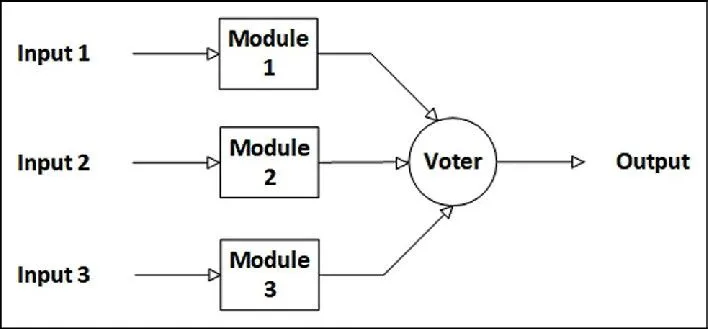
Another way that bit flips are handled and amended is by a technique called modular redundancy. Here, the correction is done by repeating the process from where we obtained the data and then conducting a majority vote.
For example, if the data obtained is ‘1,’ then by repeating it three times, we should get ‘111.’ However, suppose a bit-flip occurred, and the data obtained is ‘110’ instead. Since the ‘1’ is still the majority, modular redundancy would tell us that ‘1’ is the correct data for the bit.
Modular redundancy that uses three repetitions is called 3-way modular redundancy or triple modular redundancy.
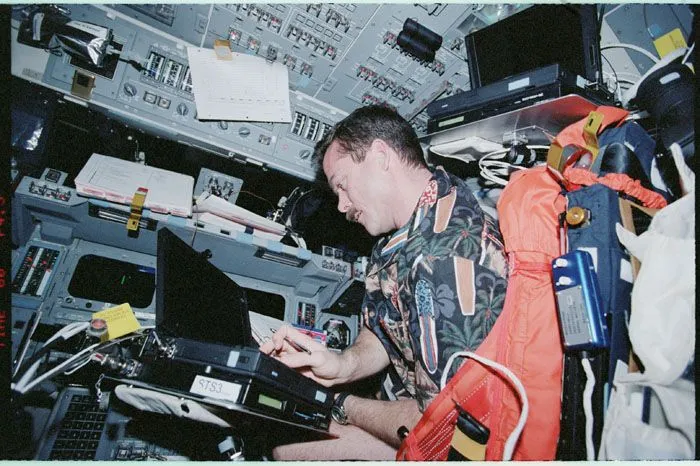
The Space Shuttle's avionics took a related approach: five redundant General Purpose Computers, of which four ran identical Primary Avionics Software (PASS) in lockstep and a fifth ran an independently developed Backup Flight Software (BFS) as a clean-room insurance policy. Modular redundancy is effective, but it requires significant mass and power, which makes it expensive to implement on smaller spacecraft.
How Often Do Cosmic Rays Actually Flip Bits?
So how worried should you be about a cosmic ray scrambling your laptop right now? Honestly, not very. Back in 1996, IBM estimated that a typical desktop computer would suffer roughly one soft error per month for every 256 megabytes (MB) of RAM it carried. For a single home machine that is reassuringly rare, but the rate climbs fast once you pile on memory or move to where the radiation is stronger.

And the radiation really does get stronger with altitude. The atmosphere is a shield, and the thicker the slice of it sitting above you, the better protected you are. At sea level in a city like New York, the relevant particle flux is only about 14 neutrons per square centimeter per hour. Climb higher and that number rises by a factor of roughly 2.2 for every 1,000 m (about 1.3 for every 1,000 ft) of altitude you gain. Denver, perched around 1.6 km (1 mi) up, gets about four times the bombardment New York does. A passenger jet cruising at 10–12 km (33,000–39,000 ft) can experience an upset rate more than 300 times the sea-level value, which is exactly why avionics and high-altitude supercomputers treat soft errors as a genuine design problem.
The Sun matters too. The flux of these particles rises and falls with solar activity, and a strong solar flare can fling its own burst of energetic particles at electronics. Out in space, where there is no atmosphere at all, both galactic cosmic rays and solar particles hammer a spacecraft’s memory around the clock, which is the whole reason engineers bother with the protections we just discussed.
Have Bit Flips Ever Caused Real-World Trouble?
Bit flips are not purely a spacecraft problem, and a couple of ground-level cases have become minor legends. The most famous unfolded during a Belgian election. On 18 May 2003, electronic voting machines in the Brussels district of Schaerbeek credited one party with 4,096 extra votes, a tally that was flatly impossible given the votes actually cast. Investigators traced it to the “spontaneous creation of a bit at position 13” in the machine’s memory. That position is the giveaway: in binary, bit 13 carries a value of 212, which is exactly 4,096. A single flipped bit had quietly inflated the count. A cosmic-ray-induced single-event upset is the leading suspect, although it was never definitively confirmed.

The second case is a gift to gamers. In 2013, a Super Mario 64 speedrunner known as DOTA_TeaBag was racing through the Tick Tock Clock level when Mario abruptly shot straight up through a floor, an impossible-looking warp that happened to save time. Analysts later showed that the very same glitch can be reproduced by flipping a single bit in the value that tracks Mario’s height, nudging him upward at precisely the right instant. The Super Mario 64 expert pannenkoek2012 went so far as to offer a $1,000 bounty to anyone who could trigger it naturally; years later, it remains unclaimed. A stray particle is the popular explanation, but to be clear, no definitive cause has ever been established, so the cosmic-ray story stays an intriguing hypothesis rather than proven fact.
A Final Word
Outer space is harsh on computers. Just as the atmosphere protects plants and animals on Earth from dangerous rays coming from outer space, it also protects computers and other electronic instruments. However, with the number of space missions increasing and with significant ones like the Mars mission on the books, cosmic ray bit-flipping is an area that must be accounted for very seriously. Outer space is not somewhere you want computers to develop errors and crash at unexpected times.
The good news is that we have found some clever ways to overcome these bit flip issues. Of course, errors in satellites, spacecraft, space telescopes and space stations due to bit-flips do not make any prominent headlines, so while they inevitably happen, we can correct them using appropriate techniques. This way, we can be sure that our space missions are safe, while respecting the undeniable fact that outer space is quite unforgiving to nearly everything!
References (click to expand)
- Single Event Effects.
- Single-event upset - Wikipedia
- Cosmic rays: particles from outer space.
- Soft Memory Errors and Their Effect on Sun Fire Systems.
- How to prevent our computers from crashing in outer space?.
- Soft error - Wikipedia
- Altitude and latitude variations in avionics SEU and atmospheric neutron flux - OSTI.GOV
- Electronic voting in Belgium - Wikipedia
- Pannenkoek2012 - Wikipedia