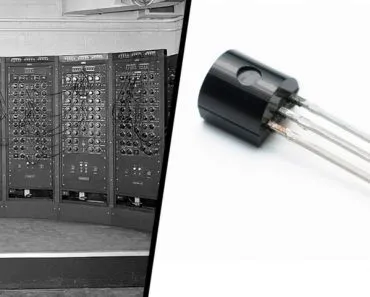
Computers cannot keep getting faster forever in the classical sense. Moore’s Law, which predicts that the number of transistors on a chip roughly doubles every two years, is dramatically slowing as transistors approach atomic dimensions. As of 2026, TSMC is in volume production of 2nm gate-all-around chips, and the industry has pivoted to chiplets, 3D stacking, AI accelerators, and quantum computing to keep performance climbing.
It seems like everything that we do these days is in some way linked to computers. Our financial systems, social connections, communication networks, entertainment…. our digital lives are rather incredible, right? Particularly since computers are a relatively “new” thing.
The first computer was made in 1946, and that was about as big as a house. It was called ENIAC, seen in the picture below, and was thousands of times slower than the worst dial-up connection to the Internet you can imagine!
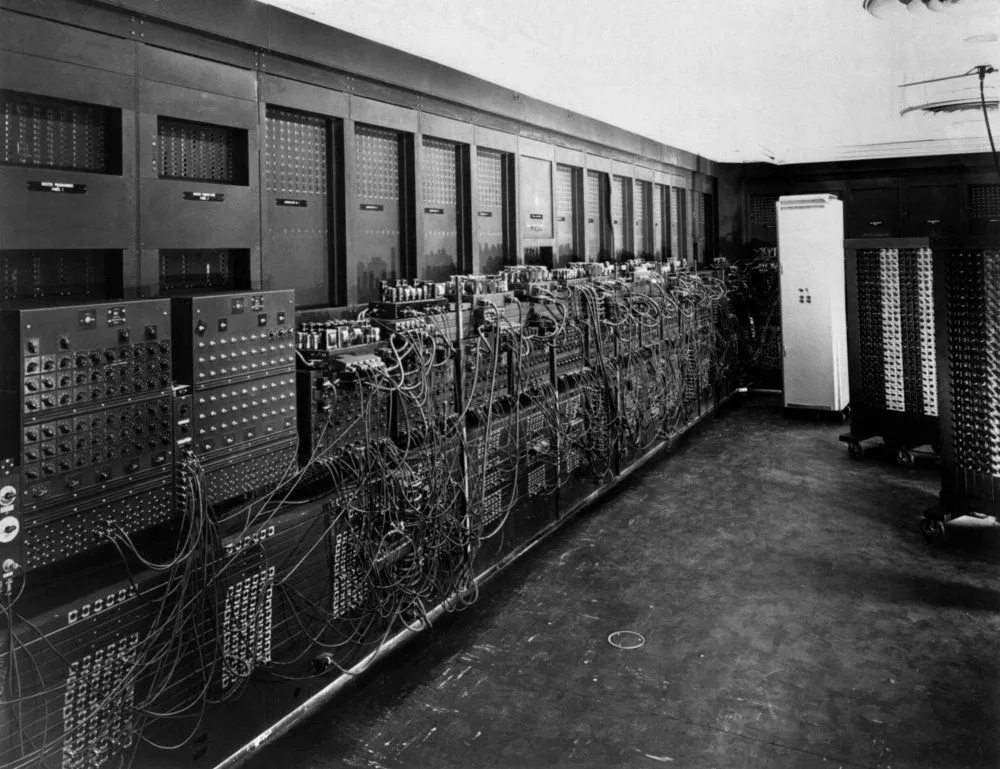
Think about how far we have come since then? We can compute millions of calculations in mere seconds, speak to and see people across the world instantaneously, and access any piece of information known to mankind with the swipe of a finger.
It sometimes seems like there is nowhere left to go! It seems like computer companies continue improving on every product they’ve developed, both in terms of functionality and speed, but is there a limit to our progress? Can Computers Keep Getting Faster Forever?
Moore’s Law Will Sort This Out…
The speed of computers is fundamentally linked to the microchips they use, and more specifically, to the number of transistors on those microchips.
Back in 1965, Gordon Moore, then director of R&D at Fairchild Semiconductor and later a co-founder of Intel, made a bold declaration about the speed of computers. In a paper for Electronics magazine, he predicted that the number of components on a chip would double roughly every year, a target he later revised in 1975 to a doubling every two years. At the time, this seemed astronomically optimistic, but for nearly five decades that is the rate of progress the industry actually delivered.
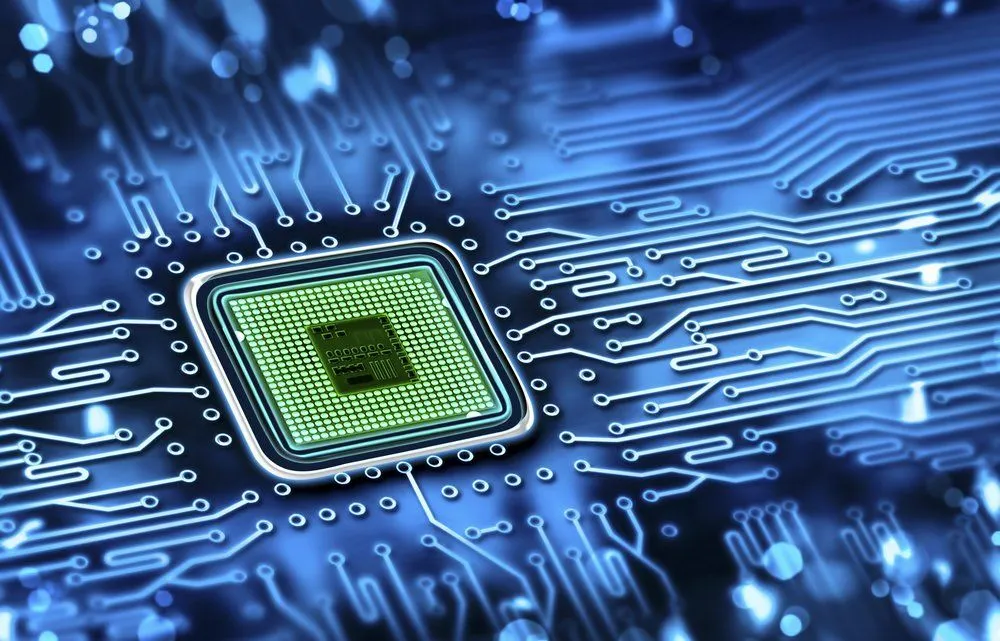
Constant advancements have allowed roughly twice as many transistors to be placed on chips every two years. It was an amazing prediction, and has since become known as Moore’s Law. Unfortunately, there are natural limits to Moore’s Law, which we are beginning to see evidenced in the world today!
We are already making transistors only a few nanometers across, with critical features that are just a handful of atoms thick, and it is becoming brutally hard to keep shrinking them further. So what happens when we hit the ultimate boundary of the atom? That is exactly why quantum computing has gone from a curiosity to one of the most heavily funded areas of research in computer science.
Built on the principles of quantum mechanics, a quantum computer uses qubits that can exist in a superposition of 0 and 1, and can be entangled with other qubits. This lets a quantum processor explore many possible solutions in parallel and, for certain problems like factoring large numbers or simulating molecules, deliver speedups that no classical computer can match. In December 2024, Google’s Willow chip, a 105-qubit superconducting processor, demonstrated below-threshold quantum error correction and finished a benchmark in about five minutes that the company estimated would take a leading supercomputer around 1025 years.
There is also a thermodynamic angle to the story. By Landauer’s principle, every bit erased in a classical computer dissipates at least kT ln 2 of heat, about 2.9 10−21 joules at room temperature. Today’s silicon runs several orders of magnitude above this floor, leaving room for reversible and quantum architectures, which compute via unitary operations and only pay this cost during measurement, to push much closer to the fundamental thermodynamic limit.
This would be a world where Moore’s Law almost never ends. This approach is criticized by some, who make a very different point, one that is closely linked to another hot-button topic in the tech community – artificial intelligence!
Can Robots Build Better Computers Than Humans?
The other predominant theory is that when we reach a certain level of manmade technology, we will essentially have created enough computing power and capacity to emulate the human brain – also known as creating a consciousness. Artificial intelligence is the more popular term for this, and while this is an exciting idea, it is also frightening in some ways.

If we create an artificial form of intelligence that can continue designing and innovating computers far past the level humans were able, then if Moore’s Law doesn’t break down, humanity could be in jeopardy, and our natural intelligence will be quickly surpassed by the computers, robots, and machines that we’ve imbued with a “consciousness”.
This first-generation robot computer would essentially create a computer twice as intelligent as the human brain – and who knows where that could lead? Two years after that? What about ten years later? Human beings might be completely unnecessary by that time, replaced by a far superior intelligence.
In other words, human beings have a limit when it comes to Moore’s Law (as of now), but maybe our artificially intelligent computers won’t. You’ve all seen the Terminator movies, right? Plenty of theoreticians have proposed what could happen if an artificial intelligence program were to access the Internet. Robotic takeover, the elimination of humanity, launching of nuclear weapons… the Hollywood effects go on and on.
However, it isn’t just Hollywood worrying about this. Elon Musk, co-founder of X.com (which merged into PayPal), founder of SpaceX, and co-founder and CEO of Tesla, has repeatedly warned about the dangers of artificial intelligence racing ahead of human oversight. He likened it to opening Pandora’s Box, as we have no realistic way of predicting what it could mean for our species and our future.
Are These Our Only Options?
It sounds a bit bleak when we look at it from those two perspectives, but are those really the only outcomes for our future?
Fortunately, no!
Researchers have also made impressive advances with graphene, the single-atom-thick sheet of carbon that has been touted as a potential silicon successor. In 2014, IBM scientists reported in Nature Communications the first multi-stage graphene-based radio-frequency integrated circuit, a three-transistor chip that performed roughly 10,000 times better than any previous graphene IC (not 10,000 times faster than silicon, as some headlines suggested). The chip successfully demodulated a 4.3 GHz signal carrying the text "I-B-M" while drawing under 20 mW. In a field where smaller and faster are the foundations of success, graphene may still be the next big thing.
By applying a thin layer of graphene as the final step in the microchip development process, engineers have been able to prevent the speed slowdowns as a result of graphene’s fickle, single-atom-thick nature (the problem in other graphene chip designs). While this unique physical property (single-atom sheet) of graphene is the reason that electrons (and subsequently information) can move quickly, it also makes graphene difficult to work with. Fortunately, IBM has managed to take the first steps towards fully utilizing graphene’s capacity.
This would extend the limits of Moore’s Law considerably, allowing us to use this one-atom-thick material as a crucial component in transistors and microchips that are light-years ahead of what we have in place now.
The Near Future… Or What’s Left Of It!
So where does that leave us in 2026? The classical version of Moore’s Law is clearly slowing. Dennard scaling, the partner law that kept power per transistor falling, broke down around 2006, and the International Technology Roadmap for Semiconductors formally retired Moore’s Law in 2016. Even so, leading-edge nodes keep advancing: TSMC began volume production of its 2nm process, the first to use gate-all-around nanosheet transistors, in late 2025, with the even denser A16 (1.6nm) node penciled in for late 2026. Intel introduced its own gate-all-around (RibbonFET) plus backside power (PowerVia) technology on its Intel 18A node in 2025. Beyond the smallest transistors, the industry now leans hard on chiplets, 3D stacking, and advanced packaging like TSMC’s CoWoS to keep gains coming.
The biggest performance jumps today, however, are not coming from general-purpose CPUs at all. AI accelerators like NVIDIA’s Blackwell (B200) GPUs, Google TPU v5/v6, AWS Trainium, and Cerebras’s wafer-scale WSE-3 are driving much of the speed growth that consumers feel through ChatGPT-style services. Neuromorphic chips like Intel Loihi 2 and IBM NorthPole hint at architectures that compute hundreds of times more efficiently than CPUs on the right kinds of workloads. And the world’s fastest supercomputer, El Capitan at Lawrence Livermore, broke the 1.8 exaflop barrier in 2024. So even when Moore’s Law finally taps out, computers as a class will almost certainly keep getting faster, just by very different means.

Regardless of how long it takes for us to reach the ultimate speed of computers, I don’t really mind, as long as I can keep streaming every football game on my smartphone! Who’s with me?
References (click to expand)
- Moore's law - Wikipedia. Wikipedia
- The end of Moore's Law? Why the theory that computer .... The Independent
- Waldrop, M. M. (2016, February). The chips are down for Moore’s law. Nature. Springer Science and Business Media LLC.
- The end of Moore's Law: Are we facing the creation or the apocalypse? | Michigan Engineering - www.engin.umich.edu
- Moore's Law - Intel Newsroom
- Han et al. (2014). Graphene radio frequency receiver integrated circuit. Nature Communications
- Willow processor - Wikipedia
- TOP500 November 2025 List