The Wilson Cloud Chamber is a particle detector that reveals the track of sub-atomic particles & radiation in the form of a mist trail; it was used primarily in the early 1900s.
Did you know that with just some alcohol, a transparent container, and dry ice, you can observe the passage of subatomic particles and radiation from the comfort of your couch?

This can be done by building a cloud chamber, which is a type of particle detector. Though primarily a thing of the past, the Wilson Cloud Chamber was a significant invention in particle physics. It helped discover positrons and muons, among other subatomic particles.
Construction Of The Wilson Cloud Chamber
In 1895, Scottish physicist Charles Thomson Rees Wilson began developing an apparatus called the cloud chamber. Originally designed to recreate miniature clouds and study optical phenomena like coronas and glories, it was soon discovered that the chamber could also be used to observe the movement of subatomic particles. Wilson continued to refine his design over the years, constructing a working cloud chamber in 1911 and perfecting it by 1912, eventually creating one of the world’s first particle detectors.
The cloud chamber consisted of three sub-chambers: the sensitive, control, and vacuum chamber. The sensitive chamber was a sealed enclosure filled with saturated air, meaning the air held the maximum amount of water vapor it could at the prevailing temperature and pressure. Subatomic particles could be seen passing through this section.
The control chamber contained a piston and a valve that opened to the atmosphere. When the valve was opened, air rushed into the control chamber, pushing the piston upwards and compressing the gas in the sensitive chamber.
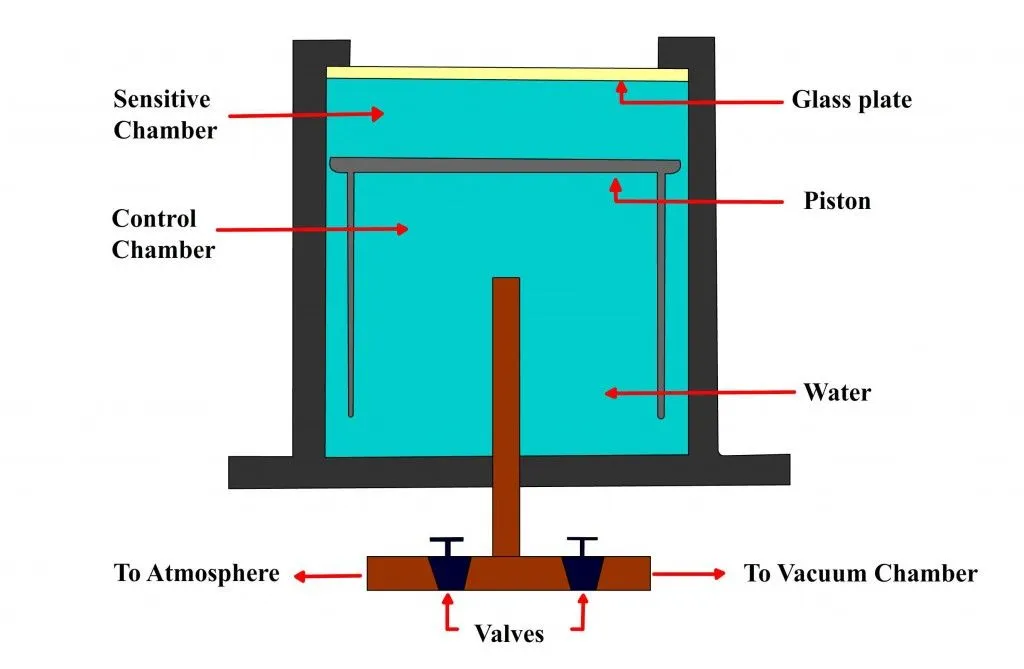
The closing of the air intake valve was followed by the opening of an exhaust valve installed between the control and vacuum chamber. The valve allowed the air in the control chamber to escape, which made room for the air in the sensitive chamber to expand and push the piston down. Due to this repeated compression-expansion cycle of the air, Wilson’s cloud chamber is also known as an expansion cloud chamber. However, the piston resulted in a jerky motion and was later replaced with a rubber diaphragm.
Working Of A Wilson Cloud Chamber
The cloud chamber does not display subatomic particles themselves but reveals their tracks in the form of a fine mist resulting from the condensation of the operating vapor.
Each subatomic particle passing through the chamber creates a unique trail of mist/cloud that helps scientists identify and study their properties and behavior.
The saturated air inside is expanded to operate the cloud chamber, and the piston is displaced downwards. According to the first law of thermodynamics, the air works on the piston, decreasing the air’s internal energy and temperature. This causes the air to become super-saturated, meaning that the vapor is just about to condense but requires an extra impetus to do so.
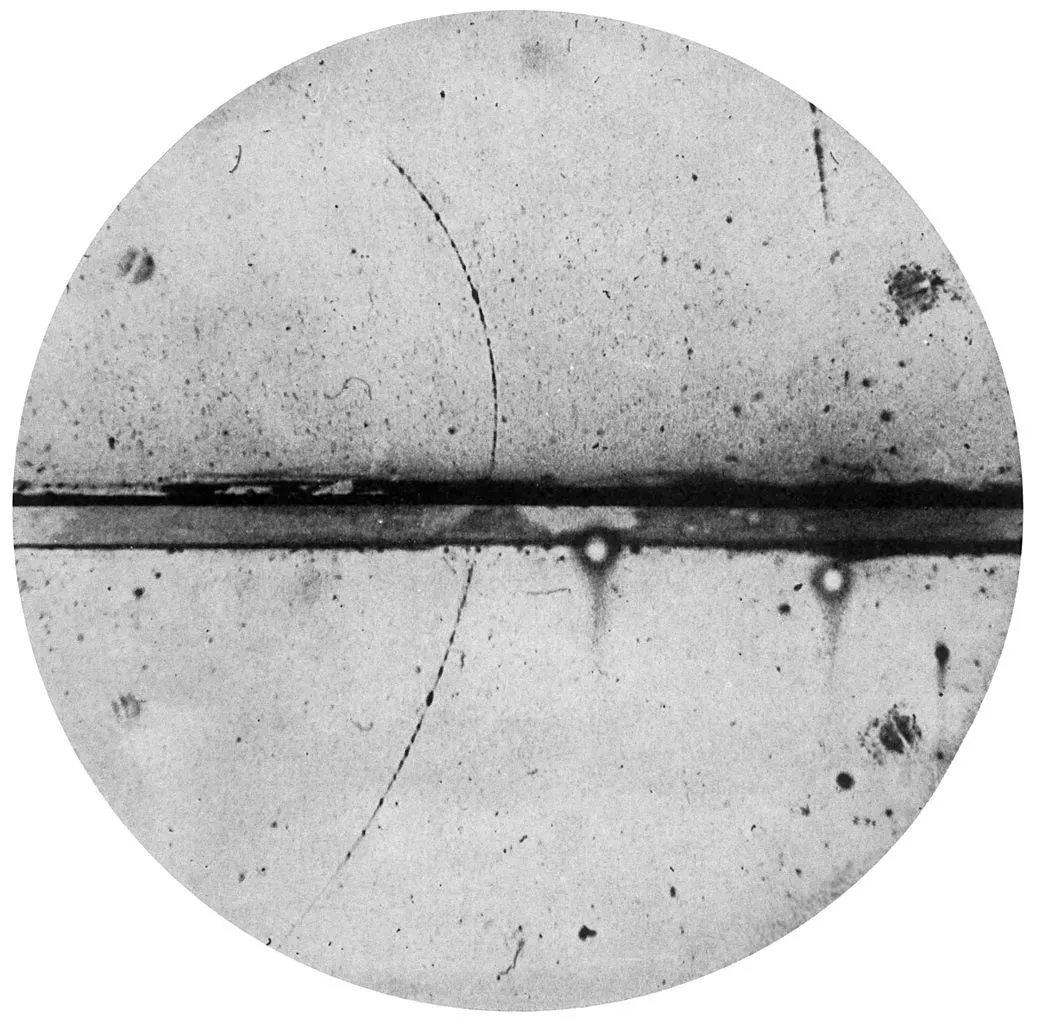
This extra impetus is provided by the crossing of charged subatomic particles through the sensitive chamber. As charged subatomic particles pass through the chamber, they ionize air molecules by knocking electrons out of their orbits. The ionized molecules attract one another and form a trail of ionized gas molecules.
This trail acts as a condensation center for the supersaturated vapor, and small drops of water condense, forming a misty trail before settling down in the chamber. These trails usually last for a few seconds, and their characteristics depend on the ionizing particle.
A source of radiation (a radioactive element) is normally used to obtain the best results. Still, the chamber works even without a source, as cosmic-ray muons continuously enter Earth’s atmosphere. The major drawbacks of Wilson’s original cloud chamber included a discontinuous flow of operation and the limited amount of particles it could detect per second.
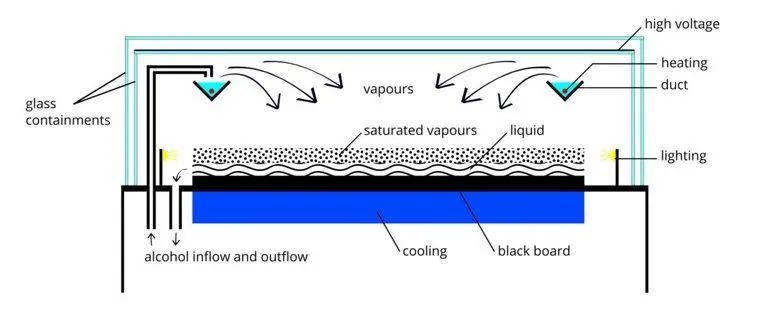
In 1936, Alexander Langsdorf created a diffusion cloud chamber that could detect radiation continuously. Langsdorf used alcohol instead of water vapor because alcohol has a lower freezing point. The diffusion cloud chamber was designed to simplify Wilson’s original cloud chamber. Langsdorf used a simple glass container with a warm top and a cold bottom.
Ducts on either side of the container helped to vaporize alcohol, while dry ice was used to cool the bottom surface.
The temperature difference between the top and bottom surface creates a steep temperature gradient, which causes the saturated vapor to become super-saturated. Since the temperature gradient is always maintained and the chamber does not use a piston to achieve this, the passage of radiation can be continuously detected.
The rest of the working procedure remains the same as Wilson’s original cloud chamber.
What Was The Wilson Cloud Chamber Used For?
At its heart, the cloud chamber is a radiation detector: a scientific device used to make the otherwise invisible tracks of charged particles visible to the naked eye. Place a small radioactive source inside, or simply wait for the radiation that is already around us, and the mist trails reveal where the particles went and what kind they were.

The shape of a track is a fingerprint. Alpha particles, being heavy and strongly ionizing, leave short, thick, dead-straight trails. Beta particles (high-speed electrons) are far lighter, so they leave thin, wispy tracks that zig-zag as they are deflected by collisions. If you add a magnetic field, the tracks curve, and the direction and tightness of that curve tell you the sign of the charge and the particle's momentum. This is exactly how the chamber earned its place in physics history.
The most famous result came in 1932, when Caltech physicist Carl Anderson photographed a track from the cosmic rays raining down on his magnetized cloud chamber. The particle had the mass of an electron but curved the wrong way, marking it as positively charged. He had found the positron, the first piece of antimatter ever observed, confirming a prediction Paul Dirac had made just four years earlier. In 1936, Anderson and his student Seth Neddermeyer used the same instrument to pick out the muon from cosmic-ray showers. Anderson shared the 1936 Nobel Prize in Physics with Victor Hess for the positron discovery, and a decade later the chamber kept giving, with George Rochester and Clifford Butler spotting the kaon in 1947.
Expansion vs Diffusion Cloud Chamber: What's The Difference?
There are two main types of cloud chamber, and the difference comes down to how they reach the supersaturated state needed to form tracks. Wilson's original is the expansion cloud chamber. It is sensitive only in brief bursts: a piston or diaphragm suddenly expands the saturated air, cooling it into supersaturation for a fraction of a second before it has to be reset. That short sensitive window, plus the long recovery between cycles, limited how many particles it could catch.

The diffusion cloud chamber, developed by Alexander Langsdorf in 1936, removed that bottleneck. Instead of a moving piston, it relies on a steep, permanent temperature gradient. Alcohol vapor (which has a much lower freezing point than water) is warmed at the top of the chamber and slowly diffuses downward toward a plate chilled with dry ice to colder than about −26 °C (−15 °F). A thin layer of supersaturated vapor sits permanently just above that cold plate. Because the gradient is always there, the diffusion chamber is continuously sensitive: radiation can be detected without interruption, which is why the alcohol-and-dry-ice version is the one you will find in classroom demonstrations and on the desk of a curious hobbyist today.
A Final Word
For nearly 30 years, the Wilson Cloud Chamber was the prime particle detector and stood at the forefront of research in particle physics. The chamber’s 30-year reign concluded with the invention of other superior chambers, namely, the bubble chamber, spark chamber, wire chamber, etc.
The bubble chamber shares the working principle of Wilson’s particle detector but boasts an enhanced structure and can reveal the tracks of more energetic particles. The wire chamber, an advancement of the spark chamber, can detect up to 1,000,000 particles per second, representing a thousandfold improvement over earlier detection methods.
The inventors of the above-mentioned particle detectors (Charles Wilson, Donald Glaser & Georges Charpak, respectively) were all awarded Nobel Prizes in physics for constructing the paraphernalia for multiple essential studies in the field. Without those men and their machines, much of what we currently know about subatomic particles and radiation would still be shrouded in mystery!
Last Updated By: Ashish Tiwari
References (click to expand)
- Hazen, W. E. (1942, June 1). Some Operating Characteristics of the Wilson Cloud Chamber. Review of Scientific Instruments. AIP Publishing.
- Cloud chamber experiment.
- Cloud chamber experiments: alpha radioactivity and ....
- CHALONER, C. (1997, September). The most wonderful experiment in the world: a history of the cloud chamber. The British Journal for the History of Science. Cambridge University Press (CUP).
- Carl Anderson discovers the positron. CERN Timeline.
- Carl David Anderson (positron, muon, 1936 Nobel Prize in Physics). Wikipedia.
- Diffusion cloud chamber (Langsdorf, 1936; continuous operation). Wikipedia.
- Wilson Cloud Chamber. The Wonders of Physics, University of Wisconsin–Madison.