Table of Contents (click to expand)
Welding is the process of permanently joining two materials (usually metals), known as the base metals or substrates, by melting them so they fuse into one piece as they cool. The heat is concentrated along the seam and can come from an electric arc, a gas flame, a beam of energy or electrical resistance. A filler material is often added, though not always.
As a kid, I remember my parents discouraging me from looking directly at men huddled over a piece of metal, doing something that would generate a very bright white light. My curiosity led me to learn that the process, known as welding, is used to join two or more pieces of metal for structural purposes.
Joining is required when it is either impractical or impossible to form continuous structures. However, using effective techniques to join materials is important, or else it detracts from the overall integrity of the structure.
What Is Welding And How Is It Done?
Put simply, welding is the process of joining two materials (usually metals), referred to as the base metals or substrates, by melting them so they flow together and fuse into a single piece as they cool. The American Welding Society defines a weld as a localized coalescence (a fancy word for ‘growing together’) of metals or non-metals, produced by heating them to the right temperature, with or without pressure, and with or without a filler material.
That last bit is worth unpacking. In most cases, you apply intense, concentrated heat right along the joint, or seam, until the edges of both pieces melt and merge. Often a third material, called a filler, is melted into the seam as well to build up the joint. As the molten metal cools, it solidifies into a continuous bond that is typically as strong as the parent material, which is exactly what separates welding from gluing, bolting or riveting (where the pieces stay distinct and are simply held together).
What changes from one welding method to the next is mostly the source of that heat: an electric arc, a burning gas flame, a focused beam of energy, electrical resistance, or even a runaway chemical reaction. Let’s look at each of those.
Various Welding Techniques And Their Applications
Holistically, welding techniques can be classified based on the source of heat that brings about fusion.
1. Arc Welding
Arc welding (the one our parents advised us to look away from) is the most common form of welding. It supplies high voltages and currents in varying combinations to the base metal through an electrode, which causes the melting.
Depending on the nature of the weld, filler materials may be used. These are supplied by the electrodes themselves and are consumed in the process.
Welds generated during this process are highly susceptible to defects and must therefore be protected by a ‘shielding’ medium that covers the weld until it cools down and solidifies.
Commonly used arc welding techniques include:
I. Shielded Metal Arc Welding (SMAW)

Commonly known as stick welding, this welding uses a consumable electrode to lay the welds. The electrode acts as the filler metal and is coated with a flux, which disintegrates into a gas that shields the weld.
Ii. Submerged Arc Welding (SAW)

The electrode is a consumable copper-coated wire that is supplied continuously to the seam of the work piece. The arc is shielded by ‘submerging’ it under a layer of powdered flux.
Iii. Gas Tungsten Arc Welding (GTAW)

Also known as tungsten inert gas (TIG) welding, this process employs a non-consumable tungsten electrode that is supplied in conjunction with an inert gas, such as helium or argon, to shield the weld. Filler metal is supplied externally.
Iv. Gas Metal Arc Welding (GMAW)

Also known as metal inert gas (MIG) welding, this technique is similar to GTAW except that the electrode itself is the filler material and does not have to be supplied externally.
Due to its hazardous nature, arc welding is largely robotized. It is the most versatile and cost-effective form of welding. It finds use in structural components and can be used on both ferrous and non-ferrous materials.
2. Gas Welding

Using oxygen and a fuel gas in an appropriate combustible ratio is often used to heat metals to their melting points. All techniques utilizing this to join metals fall under the “gas welding” umbrella.
A pressure-controlled torch dispenses the oxy-fuel mixture in the appropriate ratio, which is then ignited by a spark to start the flame.
In most cases, gas welding does not employ filler metals. Some commonly used gas welding techniques are oxy-acetylene and oxy-hydrogen flame welding. An oxy-acetylene flame is the hottest of the common fuel-gas flames, reaching roughly 3,160°C (about 5,700°F) at the tip of its inner cone, which is hot enough to melt almost all common metals.
Oxy-fuel torches are also used to cut metals when it is not possible to do so through mechanical means. Oxy-fuel welding is primarily for repair work, as well as joining thin and medium thickness sheets of metal.
3. Radiant Energy Welding

This form of welding concentrates a beam of excited electrons (electron beam) or electromagnetic radiation (laser beam) to melt the substrates along the seams. This system does not employ the use of filler metals.
The work pieces are usually held in a vacuum chamber, which eliminates the need for shielding media. The biggest advantage of using radiant energy welding is that it can be used to weld dissimilar metals and metals of varying thickness. While it is more expensive compared to other techniques, the welds it generates are among the strongest.
4. Resistance Welding

This form of welding employs pressure to hold the work pieces together and then passes electric current at the point of contact to fuse the surfaces. The advantage of resistance welding is that it does not use filler metals, and generates highly repeatable results in a very cost-effective manner. It is extensively used in the automotive industry.
5. Thermite Welding

This technique is used to join railway tracks. The rail ends are brought close together and enclosed in a mould, and a charge of thermite (a powdered mixture of iron oxide and aluminum) is ignited above them. The reaction is fiercely exothermic: the aluminum strips the oxygen from the iron oxide (Fe2O3 + 2Al → 2Fe + Al2O3), producing a pool of white-hot molten iron that pours into the seam, fuses the rail ends, and is allowed to cool into a single continuous rail.
Safety Equipment In Welding
Welding procedures are highly exothermic, releasing obscene amounts of heat, light and toxic gases, the repeated exposure to which can prove detrimental. Thus, all manual welding processes require the user to wear protective helmets that reduce the intensity of light visible to the eyes by using a special glass window. Purpose-built jackets, gloves and respirators are also used, which further prevent the user from coming in contact with harmful byproducts, such as stray sparks, molten weld spatter and harmful gases.
Modern-day Welding
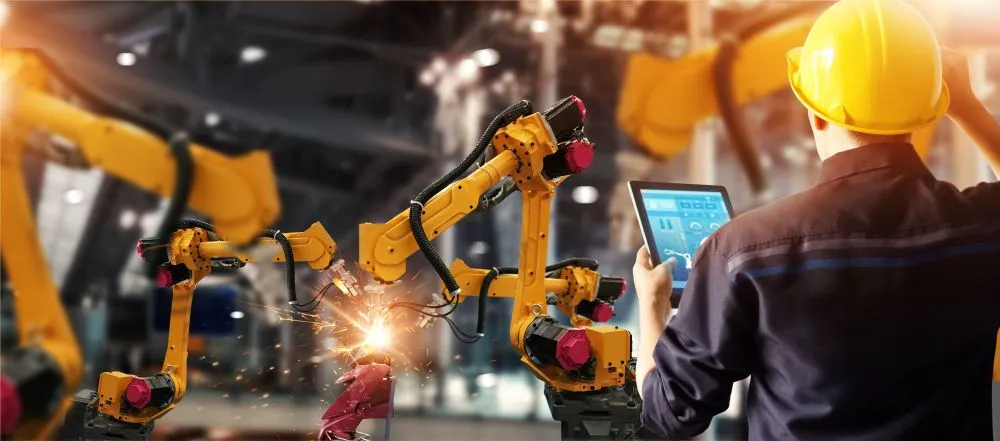
Due to its inherently hazardous nature, most welding has now been robotized. Specialty fabrication jobs involve human intervention, but these situations have also become safer over the years.
The evolution of newer materials, the compacting of electrical equipment, and better manufacturing techniques shall continue to shape the welding industry, an essential aspect of industrial structures and products both great and small.