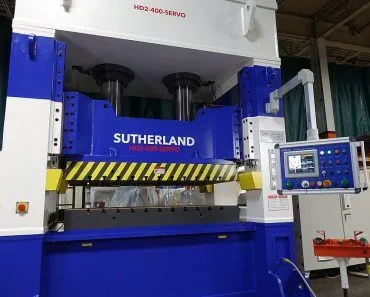
Yes, water can cut through steel and metal. A waterjet pressurizes water to roughly 60,000 psi (400 MPa) and fires it through a tiny nozzle at over Mach 2. To slice tough metals, garnet abrasive is mixed into the stream, turning it into a fast, cold erosive saw that cuts cleanly without heat.
The uses and benefits of water are almost impossible to quantify; apart from the fact that every living thing requires water to stay alive, water is a universal solvent, which renders it extremely functional. You certainly know dozens of uses for water, but I can bet that you don’t know about all of its magical traits. For instance, you might have heard (or seen) that water can cut through stones and rocks over time, or even very quickly, but do you think that water is strong enough to cut through things that epitomize strength, like metal?
Enter Waterjets
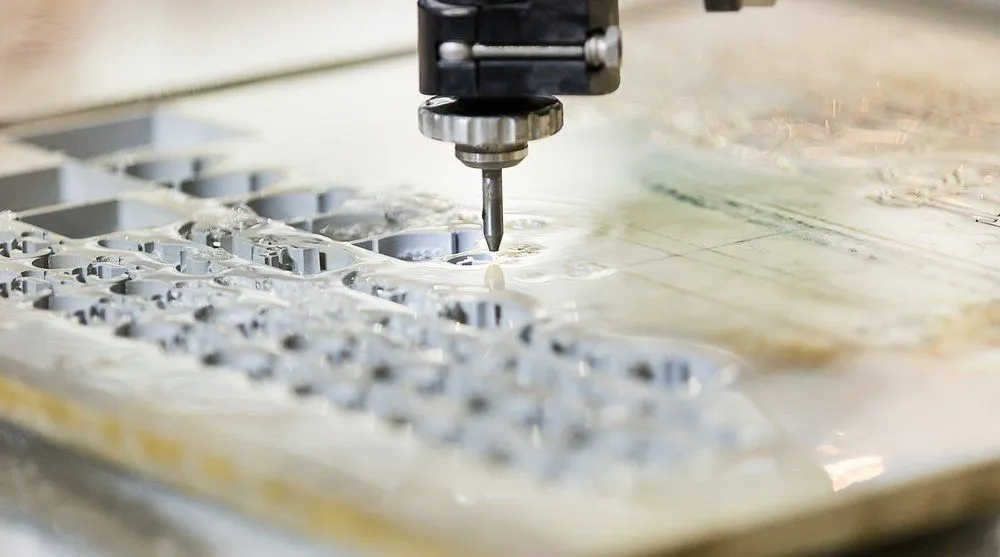
The answer, as you may have guessed, is Yes. Water can cut through metals! In fact, it has been used for this purpose for many years now. However, it’s not as though you can spray water on a metal rod and expect it to snap in half; water must be used in a specific way to make it strong enough to be able to cut through metal. This is where waterjets come into play.
A waterjet is a special tool used at machine shops and consists of a very high-pressure stream of water that is used to cut through metal. A high-pressure pump squeezes ordinary water to roughly 60,000 psi (400 MPa), which is around 30 times the pressure of the hose you see at a car wash, and then forces it through a tiny nozzle. Released through that pinhole opening, the water leaves at over twice the speed of sound (above Mach 2).
If you thought that waterjets were a groundbreaking technique that gained popularity only recently, you’re in for a surprise. High-pressure water jets were first used to wash gold out of California hillsides back in 1853, in a technique called hydraulic mining. After that, hot water jets were put to work for heavy-duty cleaning. The real leap came in 1980, when engineer Mohamed Hashish, working at Flow Research, mixed abrasive grit into the stream and turned the waterjet into a tool that could slice steel.
The Key To Cutting Metals
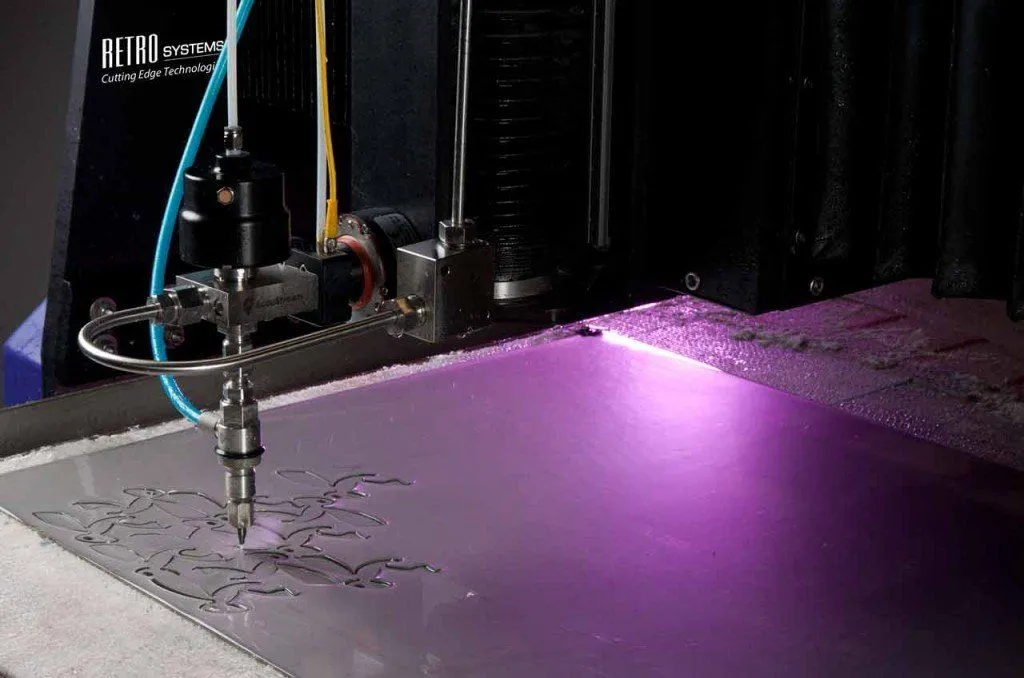
For water, the key to cutting metal is to keep its flow consistent and directed. If it isn’t carefully controlled, it wouldn’t be as effective. Think of cutting a piece of metal with a pleasant sprinkle of water; would that work? No, of course not. You need to have a jet that is channeled through a very narrow nozzle, which can leverage the full pressure of the liquid. For tough metals like steel, plain water alone is not quite enough, so a fine, hard abrasive (almost always garnet, the same gritty mineral used on sandpaper) is fed into the stream. The speeding water flings these tiny garnet particles at the metal, and they grind away an incredibly thin line, so the water is really acting as a carrier for a microscopic, high-speed saw. The good thing about using water to cut through metal is that, unlike a torch or a saw blade, the jet does not get the metal red-hot and does not pose as many logistical roadblocks. Older metal-cutting methods were also very expensive and difficult to handle.
Speed Of Waterjets
Waterjets are usually used for softer materials, whereas abrasive jets are used for harder metals. In earlier times, the speed of water leaving the nozzle of an abrasive water jet used to be a whopping 900 miles per hour (roughly 1,450 kilometers per hour).

However, equipped with the automated tools of our modern age, the latest abrasive waterjets reach a staggering 3,700 kilometers per hour (2,300 miles per hour), or more than three times the speed of sound! Paired with computer-controlled motion, that speed lets a waterjet cut metal to a tolerance of about 0.025 millimeters (0.001 inches). For a sense of how fine that is, a typical human hair is roughly 0.07 millimeters (0.003 inches) thick, so the cutting error is finer than the width of a hair.
Waterjets can cut through metal, stone, marble, stainless steel, granite and wood. Waterjets have been used to remove material inside train tunnels, bore deep into the ground, carve sculptures, and even shape titanium and composite parts for aircraft, including stealth aircraft!
You have probably heard about water being so “persuasive” that it finds its way through practically anything, but did you realize that water could be equally ‘penetrative?’ Who knows what wonders water will be able to work for us in the future, provided we still have enough of it around!
Pure Waterjet Vs. Abrasive Waterjet: What's The Difference?
So far we have been talking about waterjets as if they were all one machine, but there are really two flavors, and the difference comes down to a single question: is there grit in the stream or not? A pure waterjet uses nothing but ultra-high-pressure water, and it is reserved for softer materials like foam, rubber, gaskets, paper, thin plastics and even food. The water alone is enough to tear those materials apart along a hairline path.

The moment you want to slice through something genuinely tough, like steel, titanium, stone or thick glass, plain water no longer cuts it (pun intended). That is the job of the abrasive waterjet. Here the high-pressure water first shoots through a tiny jewel orifice (often a ruby or a synthetic diamond), and just past that opening it draws in a fine, hard grit, almost always garnet, which all mixes together in a focusing tube. The water is really just a super-fast delivery truck for millions of sharp garnet particles, and it is those particles that do the actual grinding.
Modern industrial pumps push the water to roughly 60,000 psi (about 4,100 bar, or 410 MPa), and the most powerful systems reach 90,000 psi (around 6,200 bar) and beyond. For a sense of scale, a typical fire hose nozzle runs at only about 100 psi (roughly 7 bar), so a cutting waterjet operates at hundreds of times that pressure. Because the abrasive does the cutting, an abrasive jet chews through hard materials far faster than pure water ever could, which is exactly why every shop slicing metal reaches for the garnet.
Is There Anything A Waterjet Can't Cut?
After all of this, you might be tempted to think a waterjet can slice through absolutely anything. It is an astonishingly versatile tool, and the list of things it cannot handle is genuinely short, but it is not empty. Two materials in particular trip it up, and for completely opposite reasons.

The first is tempered glass, the toughened safety glass used in car windows and shower doors. It is made by heating ordinary glass to around 620 °C (about 1,150 °F) and then blasting it with cold air. The surface freezes and locks into permanent compression while the core stays in tension, and that built-in stress is precisely what makes the pane so strong. The catch is that this balance is a loaded spring. The instant a waterjet breaches the surface, the stored stress releases all at once and the entire sheet bursts into thousands of tiny granular pebbles, exactly like the shattered pane above. You cannot cut tempered glass with a waterjet for the same reason you cannot trim it with an ordinary glass cutter; any cutting has to be done before the glass is tempered.
The second is the diamond, and here the problem is hardness rather than stress. An abrasive jet only works because its garnet grit (a hardness of about 7 on the 10-point Mohs scale) is harder than whatever it is trying to cut. A diamond sits at the very top of that scale at 10 and is the hardest natural material known, so much harder than the mineral just below it that nothing in the abrasive hopper can even scratch it. Throwing garnet at a diamond is a bit like trying to sand down a steel knife with a marshmallow. So the honest answer to "can water cut through anything?" is: very nearly, as long as you do not hand it a sheet of tempered glass or a diamond.
References (click to expand)
- Water jet cutter - Wikipedia. Wikipedia
- How can water cut through steel?. HowStuffWorks
- Waterjet Cutting - Michigan Technological University
- Benefits of Waterjet. Flow International
- What Is Waterjet Cutting Technology and How Does It Work. TECHNI Waterjet
- Mohamed Hashish - Wikipedia. Wikipedia
- Hydraulic mining - Wikipedia. Wikipedia
- Mohs Hardness Scale. Geology.com
- Tempered glass - Wikipedia. Wikipedia
- Nozzle Settings. Fire Engineering