A dielectric is the insulator between a capacitor's plates. Its main purpose is to raise capacitance: the field polarizes it, which weakens the field between the plates and lets them hold more charge at the same voltage. Capacitance grows by a factor κ (the dielectric constant), so C = κε0A/d. It also boosts the breakdown voltage and keeps the plates apart.
Dielectrics are basically insulators, materials that are poor conductors of electric current. Unlike the free electrons in a conductor, its electrons are tethered to its atoms. Consequently, no current can flow through it.
Such a material has no place in conductive devices, unless it is used to insulate itself, of course. However, if you think that dielectrics are despised by engineers, you are terribly mistaken. In fact, dielectrics are as ubiquitous as transistors. Between every capacitor is sandwiched a dielectric, the same capacitors without which your touchscreen would merely be a sheet of glass. But how does an insulator enhance the efficacy of a capacitor?
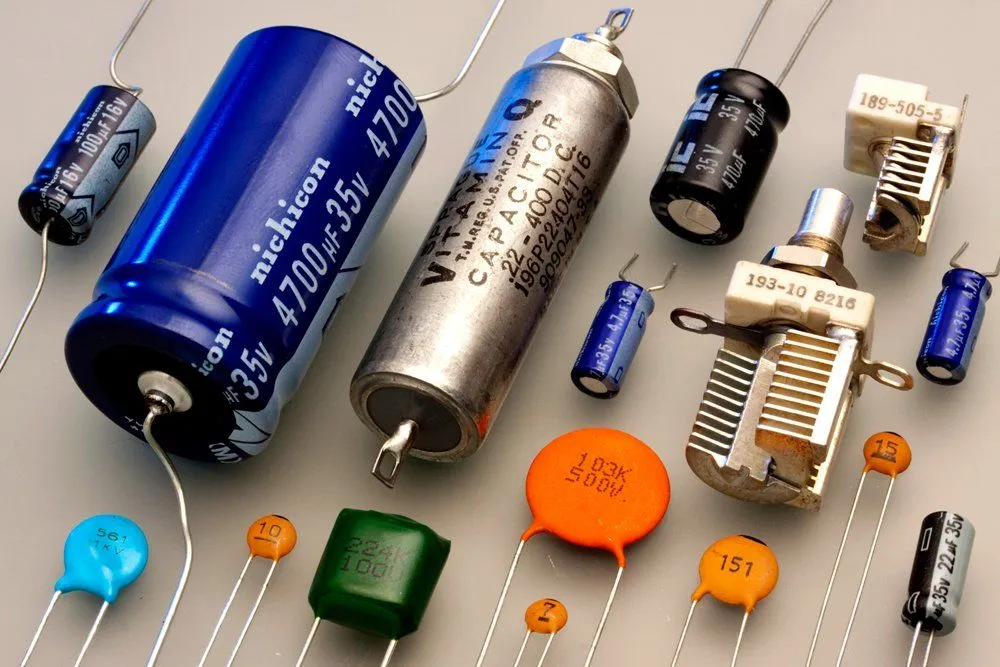
First we need to understand how a capacitor works.
The Capacitor
A capacitor is a device that consists of two parallel metallic plates placed extremely close to one another. The primary objective of a capacitor is to store charge. The charge can later be released to drive other circuits. This property renders it very useful in devices such as inverters. However, before releasing charge, it must first acquire it.
A capacitor is fed charge by connecting its plates to the terminals of a battery. Now, because metals are a sea of free electrons, when the electrons emanating from the negative terminal reach the metal, they violently repel the electrons on its surface. The repulsive force neutralizes the force exerted on the electrons by the battery, deterring them from accumulating on the plate.
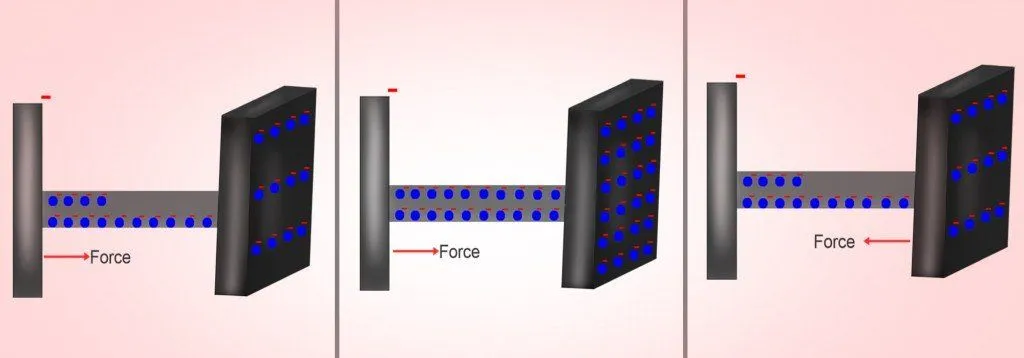
The extra electrons could be accommodated if they were somehow attracted by a force greater than the force of repulsion. This is achieved by placing another metal plate parallel to it. The parallel plate is connected to the positive end of the battery. At that point, the positive terminal attracts the electrons from the plate to which it is connected, rendering it positively charged.
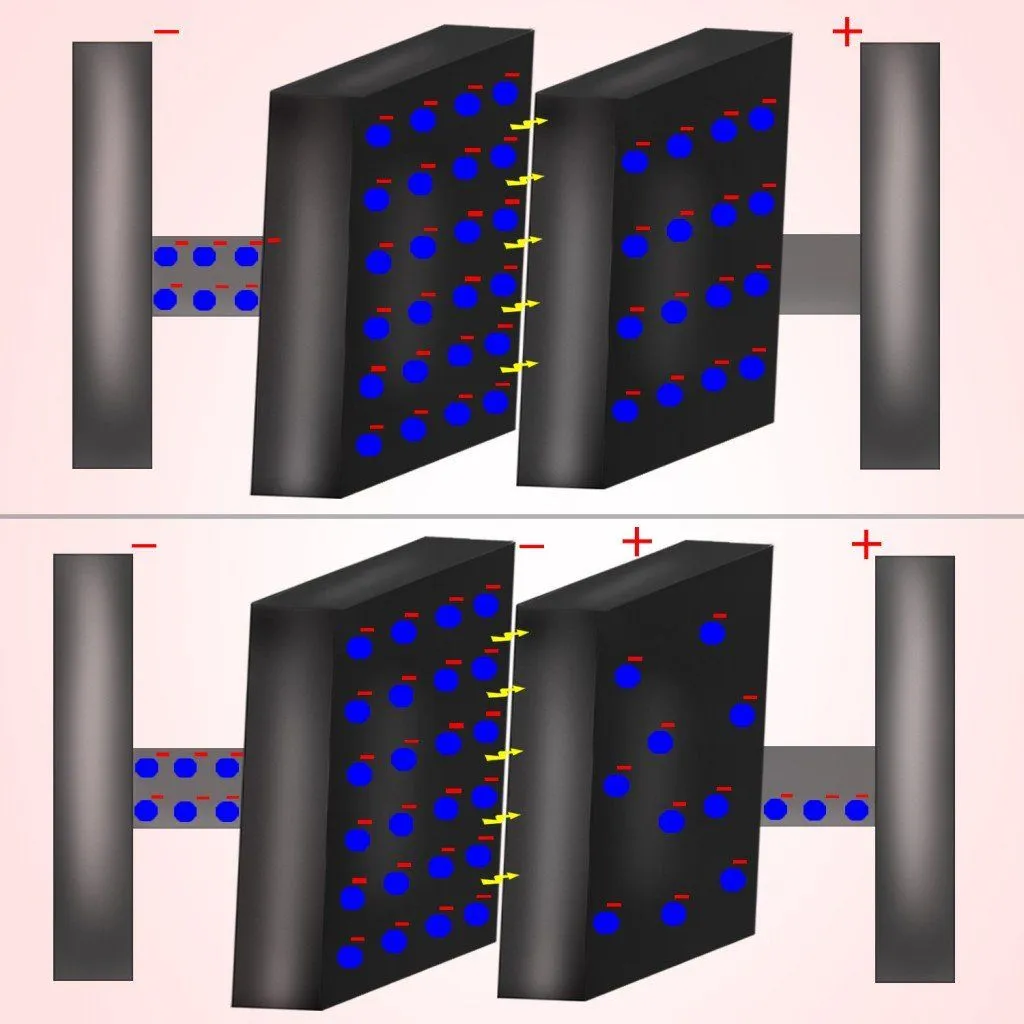
This positively charged plate will now provide the force of attraction we desired, meaning that it will attract the extra electrons transmitted by the negative terminal. In this way, the capacitor will store charge. This charge on the plate can be used to drive another circuit in the absence of a battery by simply connecting the wires to the negative and positive plates as they typically are to the two terminals of a battery.
How much charge a capacitor can hold for a given push from the battery is its capacitance, written as C = Q/V, where Q is the charge stored and V is the voltage across the plates. The higher the capacitance, the more charge the device banks at the same voltage. So anything that lets the plates pile up more electrons without raising the voltage is a win, and that is exactly where the dielectric comes in.
Why Dielectrics Enhance Capacitance
Even though atoms in a dielectric cannot be ionized to generate a current, they can certainly be polarized. Slip the dielectric between the charged plates and the field reaching across the gap tugs on every atom in it. The electrons are nudged toward the positive plate while the nuclei lean toward the negative one, so each atom stretches into a tiny dipole. This piles up a net negative charge on the face of the dielectric next to the positive plate, and a net positive charge on the face next to the negative plate.
Those induced charges set up their own electric field, one that points against the field of the plates. The two partly cancel, so the net field between the plates (and with it the voltage) drops. Now, because an army of positive charges faces the negative plate, the electrons on that plate are bound even more tightly, and the battery can push still more of them on before the voltage climbs back up. Since capacitance is C = Q/V, squeezing more charge Q in while holding V down means the overall capacitance shoots up!
Capacitance is given by the ratio of the plates’ cross-sectional area and the distance between them. Capacitance will increase if we increase the cross-section of the plate for the obvious reason that a larger plate can accommodate more charges. Capacitance decreases with an increase in the distance between the plates for the simple reason that an increased distance weakens the attractive forces that lure and bind the electrons to the second plate.
However, we have just found that capacitance also depends on the medium between the plates, specifically on how strongly that medium polarizes. That property is captured by the permittivity ε of the material. For an empty (vacuum) gap the permittivity is ε0 = 8.85 × 10⁻¹² F/m, and the capacitance is:
C0 = ε0A/d
Fill that gap with a dielectric and the capacitance grows by a clean factor called the dielectric constant (or relative permittivity), written κ:
C = κε0A/d = κC0
A vacuum has κ = 1 by definition and air is barely different at κ ≈ 1.0006, which is why the two behave almost identically. Solid insulators do far better: paper sits around κ ≈ 3.5, while water is a striking κ ≈ 80. So a parallel-plate capacitor that stored, say, 10 pF with an air gap would jump to about 35 pF (10 pF × 3.5) if you slid a sheet of paper of the same thickness between the plates, without changing their size or spacing at all.
So why bother with a dielectric at all? It earns its keep in three ways. First, as we have seen, it multiplies the capacitance by κ, packing more charge into the same volume. Second, a good dielectric is not merely an insulator but a material that refuses to ionize at any cost, so it withstands a far stronger field than air before it breaks down and arcs over. That higher breakdown voltage lets engineers push the plates closer together (a smaller d means yet more capacitance) and run the capacitor at a higher working voltage. Third, the dielectric physically keeps the plates apart, averting the short that would ruin the device. An even better dielectric is also robust and capable of working at higher temperatures.
Can You Use A Metal As A Dielectric?
If a dielectric earns its keep by polarizing, you might wonder why we do not simply reach for a conductor, which has electrons already loose and eager to move. It is a fair question, and the answer shows exactly why the dielectric has to be an insulator. In a metal, the outer electrons are not tethered to their atoms at all; they drift freely. Drop a metal slab into the field between the plates and those free electrons do not merely lean to one side the way a dielectric's bound charges do. They flood right across the slab until the field inside the metal is cancelled completely, falling to exactly zero. A conductor left like this carries all of its net charge on its surfaces, with a field-free interior.
That total cancellation is the whole problem. A dielectric only weakens the field, leaving plenty of it to keep doing useful work; a metal wipes it out. And if the slab is thick enough to bridge the gap and touch both plates, it hands the electrons an open path from one plate to the other. The capacitor simply short-circuits, and no charge is stored at all.
There is one neat wrinkle. Slide a metal slab of thickness t between the plates without letting it touch either one, and because the field inside it is zero, that slab effectively subtracts its own thickness from the working gap. The capacitance climbs to C = ε0A/(d − t), exactly as if you had nudged the plates closer together. Tidy on paper, useless in practice: the boost owes nothing to polarization, and the slightest wobble that lets the slab brush a plate destroys the device. A proper dielectric, by refusing to conduct, gives you the capacitance boost and keeps the plates safely apart.
How Much Voltage Can A Dielectric Take Before It Breaks Down?
No insulator holds out forever. Push the electric field high enough and even the most stubborn dielectric surrenders: its atoms are ionized, electrons are torn loose from their molecules, and the material that was blocking current abruptly starts to carry it. That collapse is called dielectric breakdown, and the field a material can endure just before it happens is its dielectric strength, the measure of how well a substance insulates charges from one another. It is quoted in kilovolts per millimeter (kV/mm), which is the same thing as megavolts per meter: divide the voltage at which a sample punctures by its thickness and you have it.

The numbers span a wide range. Ordinary air gives way at about 3 kV/mm, which is exactly why a spark can only jump a short gap and why lightning, the planet's most dramatic case of air breaking down, needs millions of volts to leap across the sky. Solid dielectrics do far better: waxed paper withstands roughly 40 to 60 kV/mm and mica around 118 kV/mm, soaking up fields dozens of times stronger than air before they fail.
This limit is why every capacitor carries a stamped voltage rating. Keep it below that figure and the dielectric quietly does its job; push past it and the field rips a conducting path straight through the insulator. In a gas the channel heals the instant the voltage drops, but in a solid the damage is permanent, sometimes leaving a beautiful branching scar known as a Lichtenberg figure, like the one frozen in the acrylic block above. A high dielectric strength is therefore prized just as much as a high κ: it is what lets engineers push the plates closer together for extra capacitance and still run the device at a healthy working voltage without inviting a breakdown.
What Materials Are Used As Dielectrics In Real Capacitors?
Paper and water are handy for illustrating κ, but the capacitors soldered onto the board inside your phone or television lean on a small cast of workhorse dielectrics, each picked for a different job. Tip out a bin of components and you will meet most of them.

Ceramic capacitors are the little discs and chips you see by the hundred on any circuit board. Their dielectric is a ceramic such as barium titanate, and it is astonishingly effective: the high-permittivity "Class 2" formulations reach dielectric constants of several hundred up to well over ten thousand, packing a large capacitance into a speck of a component. The catch is that this value drifts with temperature and voltage, so the steadier "Class 1" ceramics, with modest κ values of roughly 12 to 40, are used where precision matters.
Film capacitors sandwich a thin sheet of plastic between the plates, most often polypropylene (κ ≈ 2.2) or polyester (κ ≈ 3.3). Their dielectric constants are low, but the films are wonderfully stable and reliable, which makes them a favorite for precision and higher-voltage work.
Electrolytic capacitors pull a clever trick. Rather than slot in a separate sheet, they grow an ultra-thin oxide layer (aluminum oxide, κ ≈ 9.6, or tantalum pentoxide, κ ≈ 26) directly on a metal foil. Because capacitance rises as the gap d shrinks, and this oxide film is only nanometers thick, these capacitors squeeze a very large capacitance into a small can, which is why they dominate power-supply smoothing.
Mica, a natural mineral that splits into flawlessly flat, thin sheets, has a dielectric constant of around 5 to 8 and barely changes with age or temperature. That rock-solid stability makes silvered-mica capacitors a favorite in high-frequency radio circuits, the same territory once served by the older paper capacitors that modern plastic films have largely retired.
References (click to expand)
- Dielectrics - The Physics Hypertextbook. physics.info
- Chapter 5 Capacitance and Dielectrics. web.mit.edu
- 19.5 Capacitors and Dielectrics. College Physics (OpenStax). phys.libretexts.org
- Capacitor types. en.wikipedia.org
- 4.4 Conductors in Electrostatic Equilibrium. phys.libretexts.org
- Dielectric strength. en.wikipedia.org
- 5.21 Dielectric Breakdown. Electromagnetics I (Ellingson). phys.libretexts.org