Mercury was used in thermometers for three main reasons: it has a higher coefficient of expansion than water (so volume changes are easy to see), its boiling point of 356.7 °C is far above alcohol’s 78.37 °C (so it can measure much higher temperatures), and it does not stick to glass (giving sharp, accurate readings). Note that mercury is highly toxic, and most countries have now phased mercury thermometers out under the Minamata Convention, replacing them with digital or galinstan models.
In principle, any substance whose properties visibly change with temperature can be used to measure temperature. We could have used a material that changes color when subjected to heat. One could discern that the temperature is high when the material would radiate hues of blue and that the temperature is low when it would radiate hues of red.
Similarly, water in a narrow tube rises or falls when its temperature rises or falls. This is the working principle of every sealed, liquid-containing thermometer. However, if something as abundant and cheap as water works so well, why do we insist on snubbing it for something as extremely rare and expensive as mercury?
History
Mankind learned about thermodynamic temperature centuries after the first thermometer was invented. Therefore, initially, thermometers defined temperatures. The first thermometers, however, weren’t thermos or heat measurers, but thermo-scopes, devices that merely signaled whether the temperature was high or low. These devices weren’t calibrated to a standard scale; they would just make crude or vague assessments.
The earliest known temperature-sensing device, a thermoscope made from a tube of air dipped into a bowl of water, is usually credited to Philo of Byzantium (3rd century BC) and later refined by Hero of Alexandria. When the thermoscope touched a hot or cold surface, the air would expand or contract, causing the air-water interface to fluctuate. The first device that we would actually call a thermometer, however, is generally attributed to Galileo around 1592.
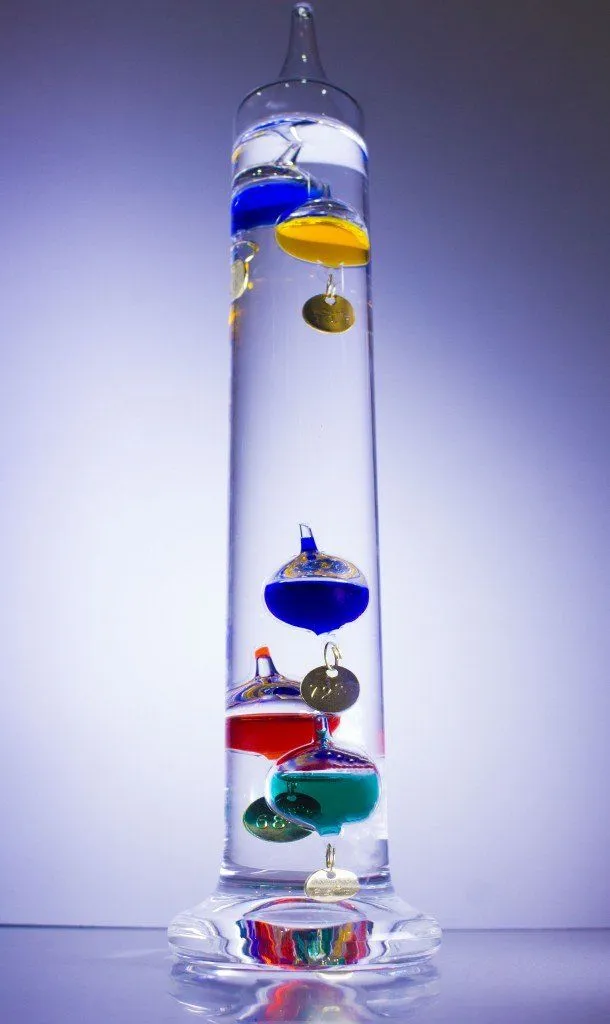
Galileo’s own invention worked on the same principle. However, not only were these developments bereft of any scale, they were also sensitive to the air’s pressure. The urge to develop a device that solely responded to heat led to the next leap: Joseph Delmedigo, a student of Galileo’s, published the first description of a sealed liquid-in-glass thermometer in 1629, and Ferdinando II de’ Medici built the first working version around 1654. The liquid sealed inside wasn’t water, but alcohol.
Coefficient Of Expansion
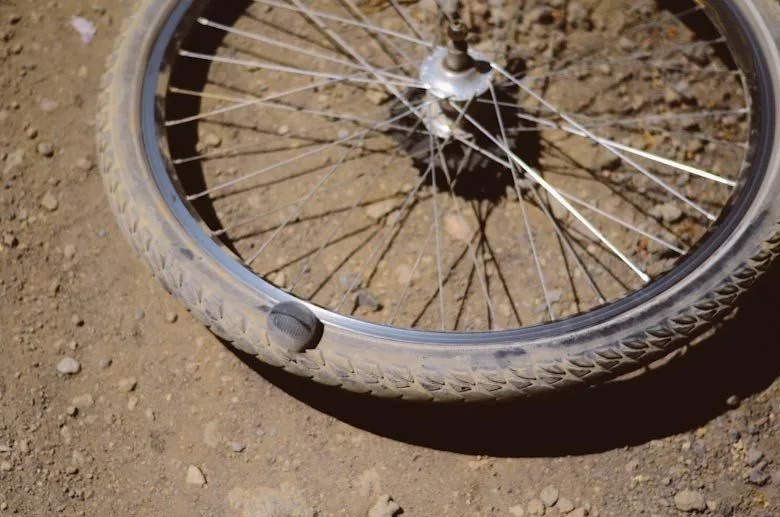
Materials, when under constant pressure, expand when subjected to heat because the heat elevates the kinetic energy of its atoms, causing them to violently move and therefore separate from each other. The increase in volume is evident in solids, such as metallic railway tracks, rubber tires and fluids like water, alcohol, mercury and halogen. However, the amount of expansion per degree increase in temperature is different for every material. This material constant is called the coefficient of expansion.
Alcohol is favored over water for the simple reason that it boasts a higher coefficient of expansion. Even a small change in temperature causes a drastic change in its volume along the tube. However, alcohol is so sensitive that these changes cause the alcohol in the tube to behave almost turbulently. The levels constantly waver with even minor changes in temperature. This capriciousness is disconcerting, as the reading would immediately change when, say, the thermometer is removed from a pot of boiling water whose temperature we wished to measure. It would then immediately reflect the temperature of its new environment.
To avoid this unreliability, Polish-born Dutch physicist Daniel Gabriel Fahrenheit replaced alcohol with mercury. Mercury is used in thermometers because of its high expansion coefficient, wide liquid range (-39 °C to 357 °C), and clean break from glass, though it is now being phased out. However, its value is almost six times less than that of alcohol. For perspective, the rise or fall in alcohol’s volume per degree rise in temperature would be six times greater than mercury’s volume.
This means that mercury in a sealed tube would rise at a much slower pace than alcohol, but it also means that mercury would fall equally slowly when the thermometer is removed from a pot filled with boiling water. The reading would be effectively undisturbed, making the thermometer superiorly reliable.
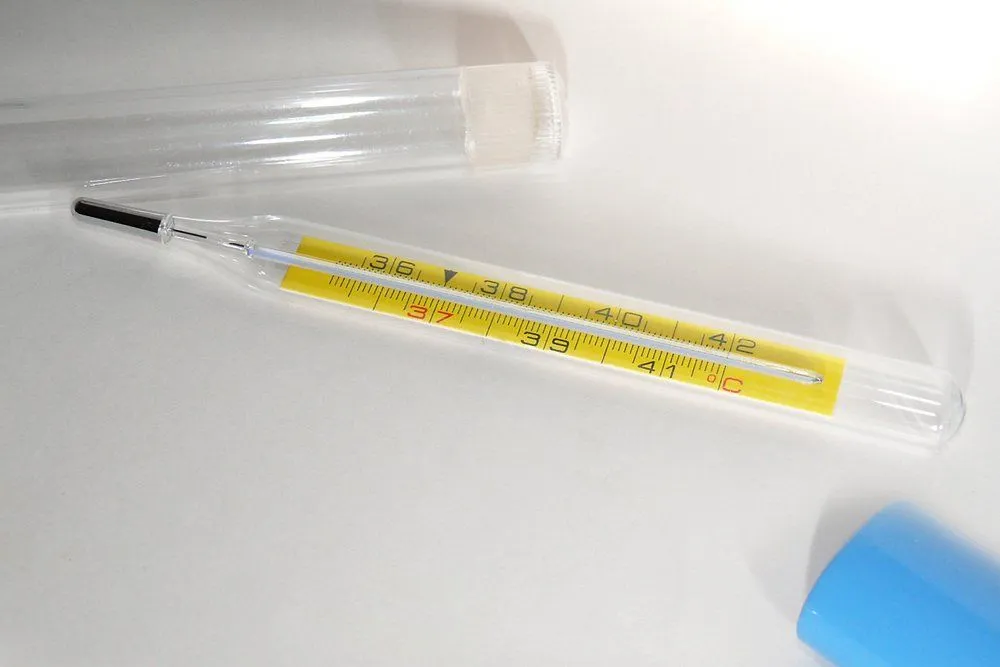
Thermometers before this invention were unique; their readings didn’t correspond to any standardized scale. However, Fahrenheit proposed a scale that was adopted by every manufacturer of mercury and eventually, every type of thermometer. This transition wasn’t exactly cumbersome, since for several decades after 1714 most precision mercury thermometers were made in Fahrenheit’s own workshop. The scale, which was slightly altered at a later date, now bears his name.
How Does A Mercury Thermometer Actually Work?
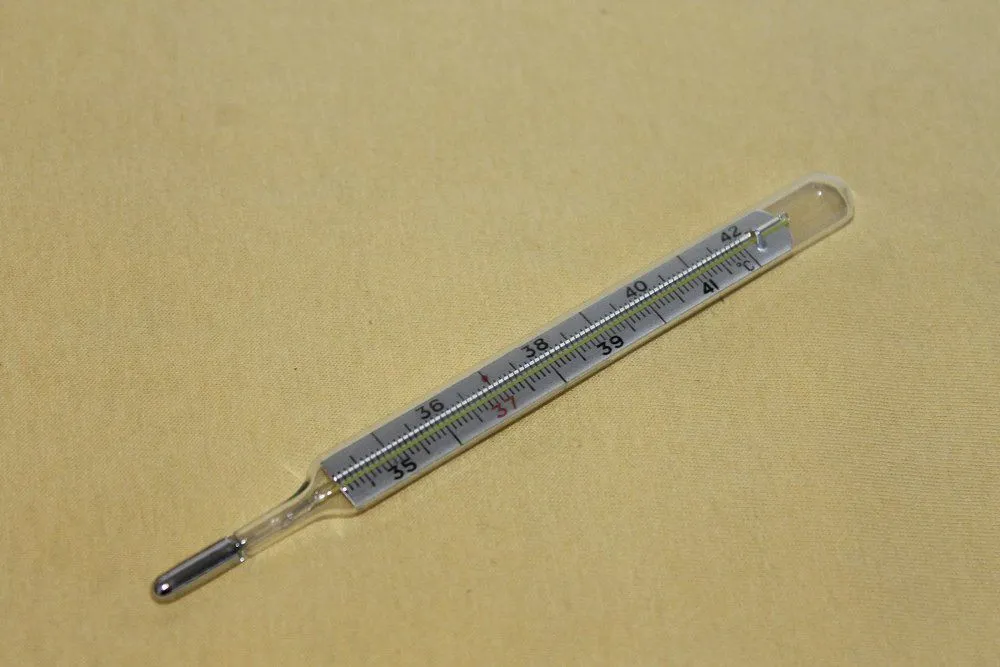
Strip a mercury thermometer down and it is a surprisingly simple device: a fat little reservoir of mercury, called the bulb, joined to a hair-thin channel that runs up the stem, called the capillary bore. When you press the bulb against something hot, such as a mug of boiling water, heat flows into the mercury, its atoms jostle harder and the liquid expands. Since the bulb is already brimming, the only place for that extra volume to go is up the bore, and that silver thread creeping up the scale is what you read as the temperature.

The clever part is the geometry. Mercury barely swells when it warms, only about 0.018% of its volume for every degree Celsius. But the bore is so much thinner than the bulb that this nearly invisible change is stretched into a column that moves a satisfyingly long way. The bulb supplies the mercury; the narrow bore magnifies the motion. (Non-contact designs such as the infrared temperature gun skip the liquid entirely and read the heat a surface radiates instead.)
There is a subtlety here that answers a question readers often ask: could you still build a thermometer if the glass expanded more than the mercury? The answer is no, and it explains why the glass matters as much as the liquid. The glass bulb also expands when heated, which enlarges the cavity holding the mercury. What you actually see on the scale is the difference between the two, the mercury's expansion minus the glass's, which physicists call the apparent expansion. Mercury's cubical coefficient of expansion is roughly seven to eight times that of ordinary glass, so the mercury comfortably outgrows its container and climbs. If the glass expanded faster than the mercury, the cavity would swell quicker than its contents and the column would actually sink as the thermometer warmed, which is useless. A working liquid-in-glass thermometer needs a liquid that outpaces its own tube.
Why Not Just Use Water?
If mercury is so rare and expensive, why not fill the bore with something free and abundant, like water? It seems obvious, and yet water is one of the worst thermometric liquids imaginable, for four separate reasons.

The deal-breaker is water's anomalous expansion. Almost every liquid contracts steadily as it cools, but water is famously contrary. It is densest at about 4 °C, and as it cools further toward 0 °C it starts to expand again rather than shrink. That means a given volume of water can correspond to two different temperatures, one on either side of 4 °C, so the column would no longer be a clean one-to-one map of temperature. Near freezing it would even creep the wrong way. A measuring liquid has to change in one direction only, and water flatly refuses.
The other three faults pile on. Water's usable range is pitifully narrow: it freezes at 0 °C and boils at 100 °C, so it cannot touch the sub-zero cold of a laboratory freezer or anything hotter than a pot of boiling water, whereas mercury stays liquid from about -39 °C to 357 °C. Water is also colorless, so a thread of it inside a glass tube is almost impossible to read without dyeing it first, whereas mercury is a bright, self-showing silver. And water wets glass, clinging to the walls of the bore in a smeared film, whereas mercury beads up and slides cleanly, leaving the crisp, sharp surface you need to read a precise value. Free and plentiful it may be, but as a thermometer liquid water is almost comically unfit.
Instances When Alcohol Fares Better
Alcohol’s hypersensitivity can be compensated by its virtues. Unlike mercury, alcohol is much cheaper and not as ridiculously rare. Also, it is not toxic. A lab might be required to be sealed for hours if a mercury thermometer breaks, considering that inhaling mercury can cause health serious problems. On the other hand, alcohol poses no such threat.
What’s more, alcohol’s freezing point is an astonishing -114 °C compared to mercury’s -38.83 °C. This means that mercury thermometers cannot measure temperatures below about -39 °C, a temperature not all that rare in science laboratories or superconductor manufacturing.
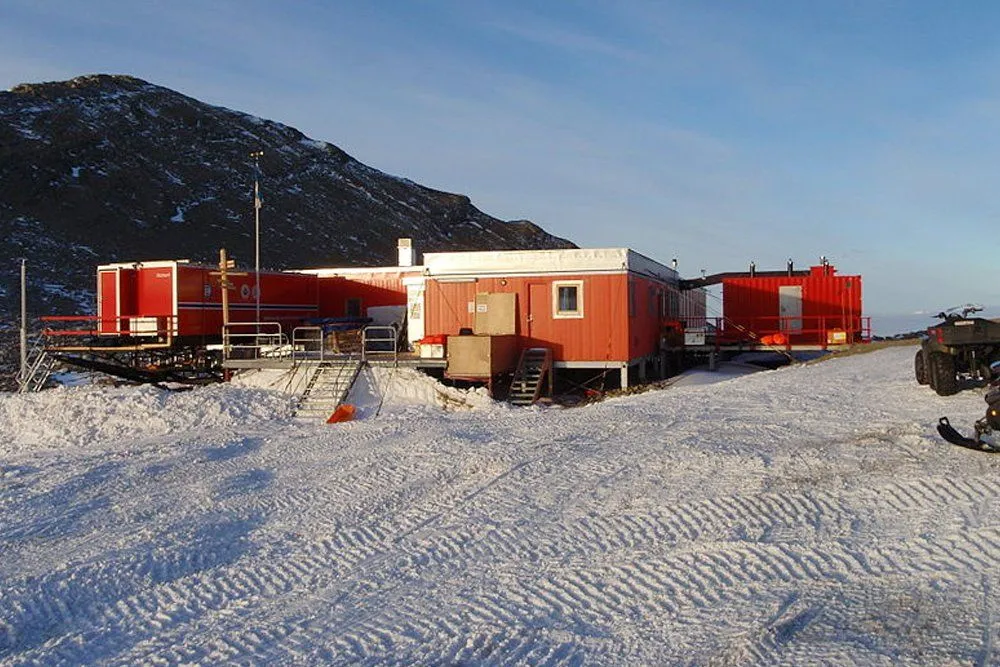
However, unlike alcohol, mercury isn’t colorless, a property that forces manufacturers to add artificial dyes to alcohol to make it clearly visible. Also, while alcohol can measure shockingly low temperatures, it is unable to measure temperatures greater than just 78.37 °C (173 °F), alcohol’s boiling point. Compare that meager boiling point to mercury’s incredible 356.7 °C (674 °F) boiling point!
While nothing can be done about mercury’s rarity, expensiveness and toxicity, one can still overcome its thermal limitations. To further increase its boiling point, mercury is often sealed with an inert gas, such as nitrogen. The inert gas increases the pressure on the liquid mercury, thereby increasing its boiling point even further.
One can also extend its freezing point by alloying it with thallium. The 8.5% thallium-mercury eutectic freezes at -61.1 °C, allowing these specialist thermometers to measure down to roughly -58 °C. Still, despite their small flaws, mercury thermometers are regarded to be one of the most accurate liquid-in-glass thermometers ever made.
Are Mercury Thermometers Still Used?
Not for much longer, at least in your medicine cabinet. Under the Minamata Convention on Mercury (adopted in 2013 and in force since 2017), most signatory countries have committed to phasing out the manufacture, import and export of mercury fever thermometers and blood-pressure cuffs. The EU banned new mercury-in-glass thermometers for general use back in 2009, and most US states have restricted retail sales since the mid-2000s. The driver here is health: mercury is a neurotoxin, and a broken thermometer can release vapor that lingers in carpets and floorboards for years.
That has left the field to two main replacements. The first is digital electronic thermometers, which use a thermistor (a temperature-sensitive resistor) and now dominate clinical and home use. The second is galinstan, a non-toxic eutectic alloy of gallium, indium and tin that stays liquid down to about -19 °C. Galinstan looks and behaves remarkably like mercury inside a glass tube but doesn’t poison the room when it breaks. It’s now the liquid of choice in modern clinical glass thermometers from manufacturers like Geratherm. Mercury thermometers do still hang on in some industrial and laboratory niches where their precision is hard to match, but their reign as the household standard is essentially over.
References (click to expand)
- Thermal Expansion - The Physics Hypertextbook. physics.info
- (2011) Thermoscopes, thermometers, and the foundations of .... Oklahoma State University–Stillwater
- Thermal expansion - Wikipedia. Wikipedia
- Mercury physical properties. NIST Chemistry WebBook.
- WHO calls for the phase-out of mercury fever thermometers and blood pressure devices by 2020. World Health Organization.
- Daniel Gabriel Fahrenheit. Encyclopedia Britannica.
- Mercury-in-glass thermometer. Wikipedia.