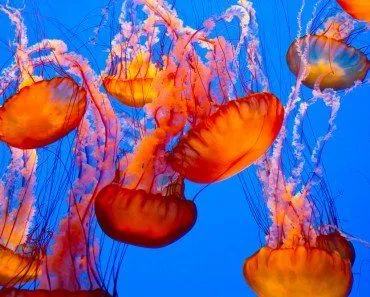
Yes, many animals are transparent, almost all of them in the ocean. Jellyfish, comb jellies, salps, glass squid, the glass octopus and larval eels become nearly invisible because their watery tissues barely bend light away from the surrounding water. On land, transparency is far rarer, but glasswing butterflies and glass frogs pull it off too.
All animals strive for one thing: survival. As humans, we might not always have to watch our backs, but other animals certainly do. This is particularly true for those who are at the top of the menu for predators that surround them. Survival is hard, as not everyone can be at the pinnacle of food chains.
Naturally, some animals found a smart way to trick their predators. They camouflaged, but that also comes with its own shortcomings: What if there’s no substrate to blend in against, leaving them with absolutely nowhere to hide?
To combat that crisis, some animals evolved to simply hide in plain sight!
See-through… But How?
If being transparent provides top-tier protection against predators that want to hunt you down, why is it that we aren’t constantly bumping into invisible creatures?
Animals are composed of many organs and tissues, which have their own thickness and chemical makeup. As a result, an animal’s body is far from something that would let light through it, without that light being reflected, absorbed, scattered or refracted first.
Water-dwellers have a clear advantage in terms of transparency, as their bodies are almost all water. A jellyfish is roughly 95% water; you and I are closer to 60%. Being transparent as a land-dweller is, however, a lot harder, and the reason comes down to refractive index (a fancy term for how much a material slows down and bends light passing through it).
Here’s the key: light only scatters when it crosses a boundary between two materials with different refractive indices. The trick to invisibility isn’t having a low refractive index, it’s matching whatever you’re floating in. The water inside an ocean animal has almost the same refractive index as the seawater around it, so light glides through with barely any bending or scattering. Air, on the other hand, has a very low refractive index, while living tissue sits much higher, so a land animal’s body stands out against the air like a glare on a pint glass on a sunny day. Drop that same glass into water, though, and call it a crystal, because it nearly vanishes. That mismatch is exactly why transparency is common in the sea but rare on land.
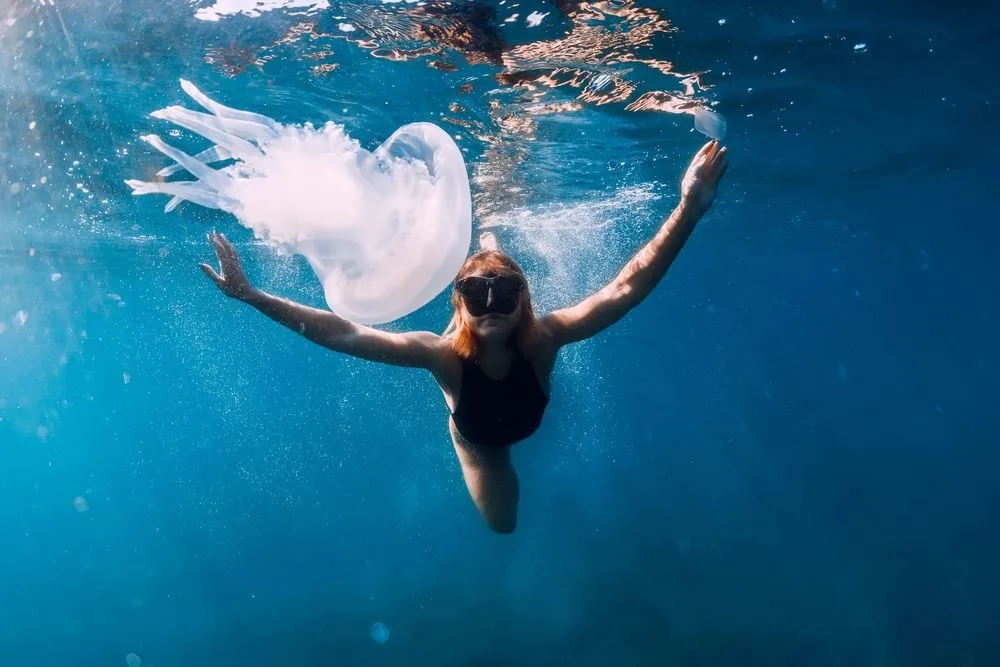
So when an ocean animal’s tissues are tuned to the refractive index of the surrounding water, there’s hardly any scattering of light at its edges. Suddenly, poof! You can’t see them anymore. The remaining giveaways tend to be the parts that simply can’t be made clear, namely the eyes (which must absorb light to work) and the gut (often full of recently eaten, very visible prey).
When you think about it, transparency is an ideal form of camouflage. Check these animals out, but you’ll have to look close, or you’ll miss them entirely!
Animals That Use Transparency To Hunt
The Spook-fish
Macropinna microstoma, also called a barreleye or spookfish, looks like it’s wearing a clear bubble helmet straight off an astronaut’s suit. About 15 cm (6 inches) long, this deep-sea fish has a dark, opaque body but a transparent, fluid-filled dome over its head, through which you can see its eyes and other internal organs.
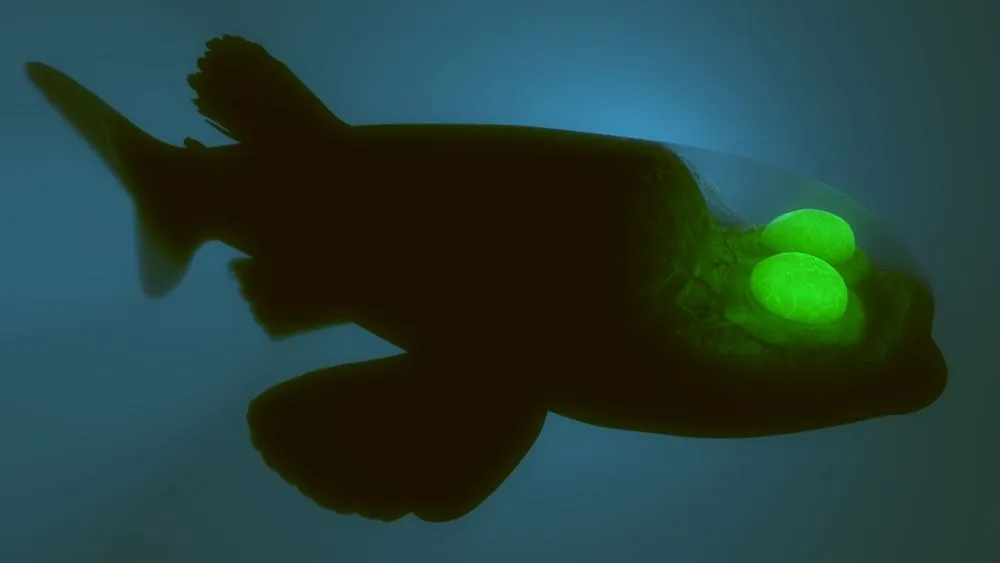
Spookfish have green glowing orbs for eyes and they always look upward, hoping to catch shadows cast by their prey (crustaceans), when shimmery sunlight hits them. Now, if you’re wondering how they eat with upward-looking eyes, they simply rotate them within their dome of transparent tissue. Feeling spooked yet?
Animals That Use Transparency To Escape Predators
European Eels
European eels (Anguilla anguilla) start life as flat, willow-leaf-shaped larvae called leptocephali, which are so see-through you can read print through them. As they drift from the Sargasso Sea toward Europe, they morph into pencil-thin but still-transparent juveniles known, fittingly, as “glass eels”. Only once they reach freshwater do their bellies and sides take on a brownish-yellow color, and after they mature, they’re called “silver eels”. Staying transparent through those vulnerable early years helps them survive until they can fend for themselves.
Salpa maggiore
Despite the “maggiore” (Italian for “bigger”) in its name, the salp is a barrel-shaped, gelatinous invertebrate, not a fish at all. Salps are actually far from rare: in the cooler waters of the Southern Ocean they can bloom into vast swarms that sometimes outnumber even krill. They drift near the surface filtering plankton out of the water, which leaves them badly exposed to predators, so a transparent body earns its keep. A salp is a jellyfish-like animal covered with a see-through sheath; underneath that sheath sit its muscles, intestines and other organs, which it pulses to jet itself along.
Transparent Immortal Jellyfish
Turritopsis dohrnii are also transparent and a bit smaller than your pinky nail (0.18 inches). A bright red stomach can be seen in the center of its transparent bell, the edges of which are lined with close to a hundred white tentacles.
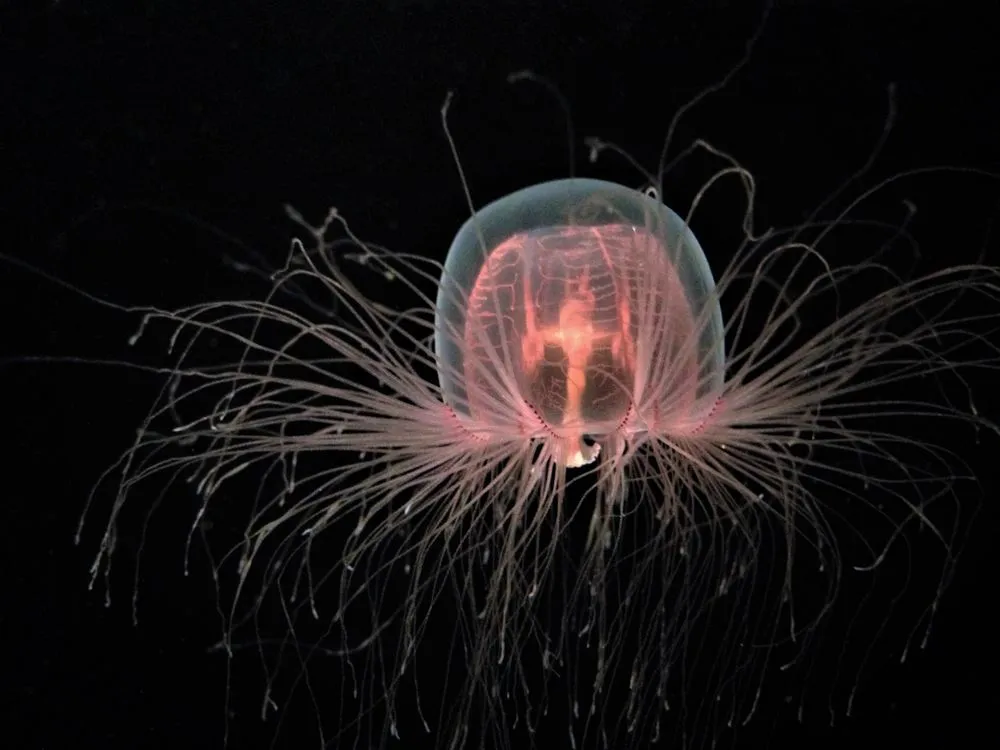
Not only do they exploit their transparency to escape predators, they have also hit the jackpot on survival. It’s one thing to come out alive from harsh environments, but quite another to hit the reset button when faced with your inevitable death. That’s right, these jellyfish never die, but are instead re-born as their polyp stage and go on living forever!
Ghost Shrimp
Ghost shrimp (Palaemonetes sp.) have a pretty sweet name, considering how transparent they are! One can only see an orange or yellow spot in the center of their tails. The females are so see-through that their green eggs are clearly visible within their bodies after breeding occurs.
Glass Octopus
Vitreledonella richardi, the rare glass octopus, is a nearly entirely transparent deep-sea species, with only its optic nerves, eyeballs and digestive tract giving it away. So elusive is it that researchers learned much of what they know from specimens found inside the stomachs of predators, until the Schmidt Ocean Institute captured striking live footage of one in 2021. It has long, elongated eyes with a centralized lens, which may help minimize the silhouette of the eyes when seen from below.
The Cockatoo Squid
Also known as the glass squid (family Cranchiidae), these cephalopods are so transparent that the only pops of color you’ll see in them come from their eyes and a few internal organs. What’s special about them is their defensive trick: when disturbed, many can inflate their bodies with water and pump ink into their own internal cavity rather than squirting it out, switching from nearly invisible to a dark, opaque blob in the blink of an eye!
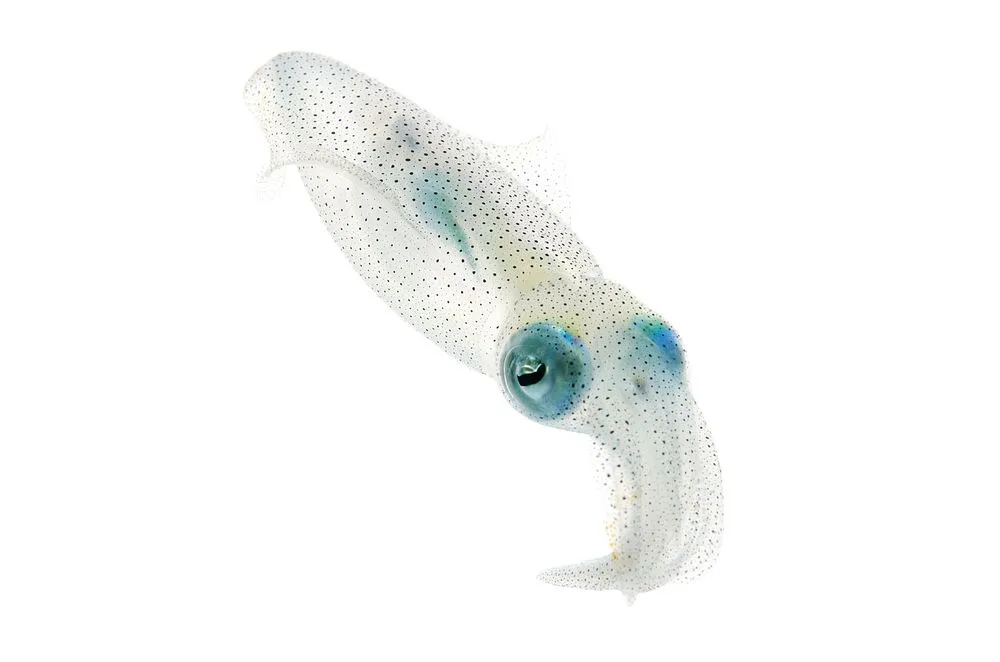
This impressive camouflage swap can be seen in both octopuses and squids, and is an adaptation that can keep multiple types of predators at bay. The first predators are those that lurk in the deep seas and perpetually look above them, hoping to snag any prey that show the tiniest sliver of shadow. The second predators are those that spotlight their prey in “biological” headlights, aka, bioluminescence.
By being able to change from invisible to opaque, octopuses and squids can trick both kinds of predators. Importantly, they have to do this swap in time, because if they don’t, and the bioluminescent light hits their transparent self, it would be like a flashlight shining on a windowpane at night, reflective and very obvious to observers and predators.
Why Is Transparency So Rare on Land?
So if turning see-through is such a brilliant disappearing act, why aren’t we forever tripping over invisible squirrels on the lawn? On land, the deck is stacked against transparency, and in more ways than one.

The first hurdle is one we’ve already met: refractive index. Air barely bends light at all, while flesh bends it a fair bit, so a land animal’s body flares against the air like glare on a windowpane. As marine biologist Kate Feller points out, even a plain sheet of glass all but vanishes once you drop it underwater, because the mismatch that causes that glare is suddenly gone. A sea creature can tune its watery tissues to the ocean around it; nothing in the air offers a body a matching backdrop.
Even if an animal cleared that hurdle, its own blood would give it away. Our red blood cells are packed with hemoglobin, a pigment that soaks up blue and green light so greedily that it’s a big reason light can’t travel far through our tissues (and the reason blood looks red in the first place). Every vertebrate is walking around with millions of these tiny, light-hungry parcels in circulation.
Then there’s the sun. Land animals live bathed in ultraviolet radiation, and one of the cheapest defenses is to load the skin with protective pigments such as melanin. The catch is that pigment is the very opposite of see-through, so staying protected and staying invisible end up pulling in opposite directions.
Add it all up and you get the punchline: glass frogs are probably the only truly transparent land vertebrate we know of, and even they only manage a translucent belly while asleep, by tucking most of their red blood cells out of sight in their liver. Insects cheat a little, as the glasswing butterfly above shows, but among backboned animals, near-invisibility on land is almost unheard of.
A Final Word
If you thought that finding Dory was hard, wait until you see how her newly hatched baby would’ve looked… nearly invisible! The larval forms of Pacific blue tangs and Atlantic blue tangs are just over a millimeter in length and are transparent, as are the larvae of Surgeonfish and moray eels.
Transparency might be much rarer on land, but as always, there are exceptions. Take the glasswing butterfly (Greta oto), whose wings are so clear it’s sometimes called the “espejitos”, or little mirrors. The trick is that the transparent patches are dotted with tiny, irregular nanopillars that suppress reflections from almost any angle, so the wing barely glints and the butterfly all but disappears against its background.
Then there are glass frogs, whose translucent belly skin lets you peer straight in at their intestines, bones and tiny beating hearts. For years it was a puzzle how a sleeping frog could be see-through when its own blood, packed with red cells, should give it away. In 2022, researchers solved it: a resting glass frog hides up to 90% of its red blood cells inside its liver, which is lined with reflective guanine crystals, draining the color out of its circulating blood and roughly doubling its transparency. When the frog wakes up and needs oxygen flowing again, it simply puts the cells back into circulation. Life on land, it turns out, has its own clever ways of vanishing.
Of all the superpowers that the animal kingdom enjoys, the ability to turn invisible is one of the coolest!
References (click to expand)
- Cronin, T. W. (2016, November). Camouflage: Being Invisible in the Open Ocean. Current Biology. Elsevier BV.
- Lisenkova, A. A., Grigorenko, A. P., Tyazhelova, T. V., Andreeva, T. V., Gusev, F. E., Manakhov, A. D., … Rogaev, E. I. (2017, February). Complete mitochondrial genome and evolutionary analysis of Turritopsis dohrnii, the “immortal” jellyfish with a reversible life-cycle. Molecular Phylogenetics and Evolution. Elsevier BV.
- Tamaki, A., Ingole, B., Ikebe, K., Muramatsu, K., Taka, M., & Tanaka, M. (1997, March). Life history of the ghost shrimp, Callianassa japonica Ortmann (Decapoda: Thalassinidea), on an intertidal sandflat in western Kyushu, Japan. Journal of Experimental Marine Biology and Ecology. Elsevier BV.
- Sidell, B. D., & O'Brien, K. M. (2006, May 15). When bad things happen to good fish: the loss of hemoglobin and myoglobin expression in Antarctic icefishes. Journal of Experimental Biology. The Company of Biologists.
- PACKARD, A., & TRUEMAN, E. R. (1974, October 1). Muscular Activity of the Mantle of Sepia and Loligo (Cephalopoda) During Respiratory Movements and Jetting, and Its Physiological Interpretation. Journal of Experimental Biology. The Company of Biologists.
- K Madin —. Transparent Animal May Play Overlooked Role in the Ocean. The Woods Hole Oceanographic Institution
- Blue Tangs - MarineBio Conservation Society. marinebio.org
- Researchers solve mystery of deep-sea fish with tubular eyes .... The Monterey Bay Aquarium Research Institute
- Taboada, C., Delia, J., Chen, M., et al. (2022). Glassfrogs conceal blood in their liver to maintain transparency. Science.
- Glassfrogs hide red blood cells in their livers to become transparent. U.S. National Science Foundation.
- Siddique, R. H., Gomard, G., & Hölscher, H. (2015). The role of random nanostructures for the omnidirectional anti-reflection properties of the glasswing butterfly. Nature Communications.
- Salp. Encyclopaedia Britannica.
- Leptocephalus. Wikipedia.
- Why do you get transparent animals in the sea but not land? The Naked Scientists.
- Organismal transparency: blood, metabolism and convergence. The Taboada Lab, California Institute of Technology.
- Hotta, K., Miyasaka, S. O., Oka, K., & Shito, T. T. (2024). Staring into a crystal ball: understanding evolution and development of in vivo aquatic organismal transparency. Frontiers in Ecology and Evolution.