In most cases, no. Venomous snakes have evolved built-in resistance to their own venom through small changes in the nerve and tissue receptors the venom is meant to attack, so a self-bite usually does not kill them. Swallowing venom is harmless, because stomach acid and enzymes break the toxic proteins down. A self-bite that drives venom deep into the bloodstream could still cause damage, but a confirmed snake-killed-by-its-own-venom case is rare.
The moment we think of the word ‘snake’, the thing that strikes most people’s minds is venom. While most of us have a good understanding that venom can be lethal or cause us harm, have you ever wondered whether a snake can be affected by its own venom?
If snake venom is produced in the mouth, can the snake be affected by swallowing it accidentally? And to top this all off, can a snake self-inject venom and harm itself? To answer these questions, let’s start with how and why snakes produce venom in the first place.
Role Of Venom
Snake venom is a fluid secretion produced in venom glands, which evolved from modified parotid salivary glands. The primary purpose of venom is to subdue and immobilize prey, with digestion being a secondary benefit, since the protein-degrading enzymes start breaking the meal down even before swallowing.
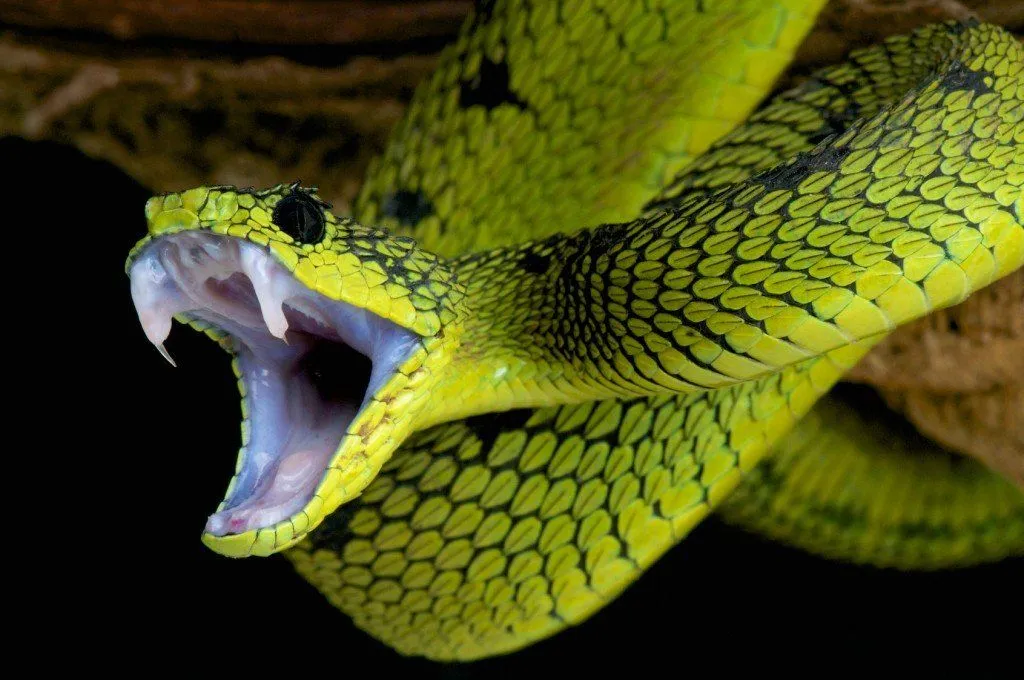
The central component of snake venom is protein. These toxic proteins are the cause of the harmful effects that arise from snake venom being injected into flesh. The venom also contains special enzymes that help break down large molecules at a fast rate, which further aids in snake digestion. The enzyme aids in the breakdown of carbohydrates, proteins, phospholipids and nucleotides in the snake’s prey.
An additional component present in snake venom are polypeptide toxins. These polypeptides are the elements that give such a poisonous punch to the venom. Polypeptides are chains of amino acids containing 50 or fewer of these base components. Polypeptide toxins disrupt cell function and can even lead to cell death. Specific toxic components of snake venom are found across all venomous snakes, in general, while certain toxins are particular to specific breeds of snakes.
Delivery Mechanism
The most common injection method for venom is the use of fangs. Fangs are highly effective in their delivery mechanism, as they are able to pierce tissue and allow the venom to flow into the inflicted wound. However, there are also other kinds of snakes that have developed different adaptions to deliver venom, such as spitting or ejecting venom. Spitting or ejecting venom serves the purpose of a defense mechanism, rather than a form of attack towards prey.
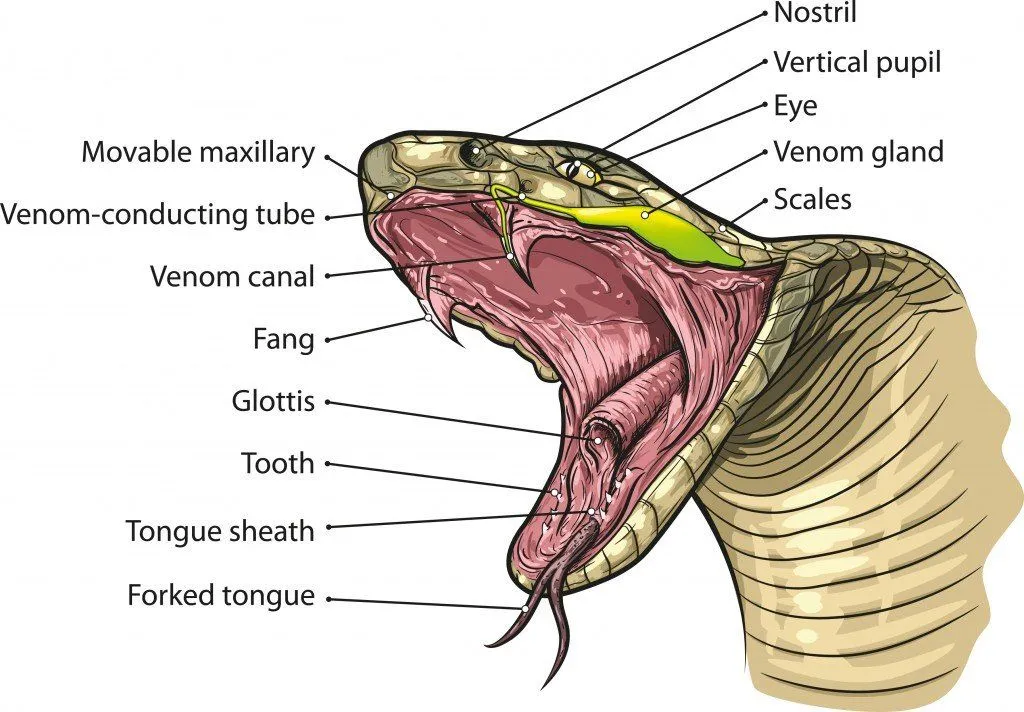
The venom injection mechanism in every snake is nearly the same and contains four main components. The first is the venom glands. These specialized glands sit on either side of the head, behind and below the eyes (not in the back of the throat), encased in a fibrous capsule. Their primary purpose is the production and storage of venom. Another major component are the muscles present in the head, which are powerful and serve a dual purpose. They help clamp down on and pierce the prey, while also helping to regulate the amount of venom being injected. The final two critical parts are the ducts and the fangs. The ducts provide a pathway for the venom from the glands to the fangs, while the fangs are modified teeth that have hollow canals through which the venom flows out.
Does It Kill Or Not Kill?
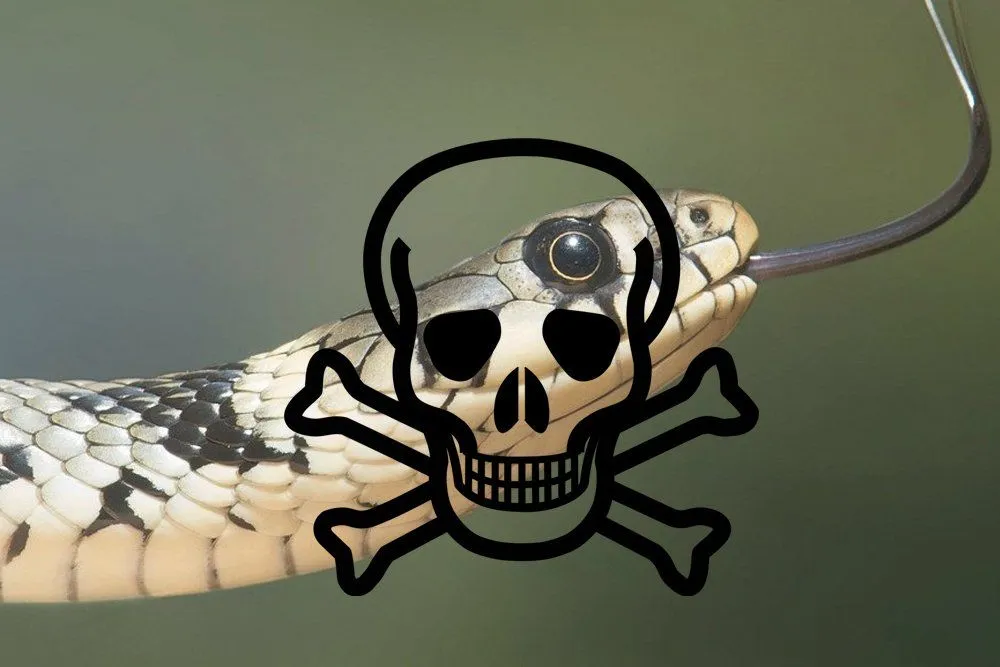
The first primary question is, since the venom is present in the salivary gland, what would happen if the snake digested it?
Well, the answer is that venomous snakes ARE NOT harmed by any venom when they digest it, because the primary component in venom is protein. For protein toxins to be potent, they must either be injected or absorbed into the body tissue or bloodstream. Ingestion of snake venom is not harmful for the simple reason that these harmful toxins will be broken down by the stomach acid and digestive enzymes into their primary harmless forms.
What about venom that enters the bloodstream directly, either through another snake biting it or the snake biting itself? Here the picture is more nuanced. Snakes have evolved built-in resistance to their own venom: research has shown small mutations in nerve cell receptors and circulating inhibitors in their plasma that blunt the effect of the toxins they produce. That resistance is strongest against their own species' venom, weaker against more distant species. So a snake biting itself is usually not fatal, and footage of snakes "killing themselves" by biting is more often explained by stress, mechanical injury, or post-mortem reflex movements than by self-envenomation.
In short: yes, a snake can theoretically be hurt by injecting a large dose of its own venom directly into the bloodstream, but in practice it is unusual for a healthy venomous snake to die from biting itself. Snakes are far more vulnerable to the venom of other species than to their own.
Why Do Snakes Bite Themselves In The First Place?
If self-bites are usually survivable, why does a snake ever sink its fangs into its own body? Almost always, it is not a deliberate act. Biting yourself is not a behavior that helps a snake survive, so it is best understood as a malfunction of an otherwise useful instinct rather than a strategy.

The most common trigger is a feeding-response mistake. Snakes have an extremely strong, almost automatic strike reflex, and species that hunt other snakes are especially prone to misfiring it. A hungry snake that catches sight of its own moving tail can react to it as if it were prey and start to swallow itself, a quirk that explains many of the "ouroboros" photos that circulate online. As University of Arizona research scientist Matt Goode put it, some snakes "have such a strong feeding response" that the wrong target gets seized before the animal can correct itself.
The other big trigger is stress and pain. A snake that is overheated, injured, frightened with no route of escape, or seriously ill can lash out blindly and bite whatever is closest, including itself. Bryan Maritz, a herpetologist at the University of the Western Cape, has noted that when snakes are in severe pain, "they just lunge out and they bite." In captivity, an enclosure that is too small, too hot, or too exposed is a frequent culprit, which is why a self-biting pet snake is usually a warning sign that something in its environment is wrong. Crucially, a snake biting itself out of confusion or distress is a very different thing from a snake trying to kill itself, which is not something snakes do.
Does A Snake Die After Biting A Human Or Another Animal?
A widespread belief holds that a snake dies, or at least exhausts itself fatally, after delivering a venomous bite to a person. This is a myth. Biting and envenomating prey or a threat is exactly what a venomous snake's anatomy is built to do, and it walks away unharmed.

Recall from the delivery mechanism above that venom is made and stored in glands inside the snake's own head, with the toxins held safely outside the bloodstream until they are injected through the fangs. Pushing that venom out into a victim does the snake no harm at all. The only real cost is metabolic: producing venom carries an energetic price, and a snake that has just emptied much of its supply needs time, often days to a couple of weeks, to replenish its glands. That replenishment cost is one reason snakes will sometimes "dry bite", delivering little or no venom, to conserve their store. Running low on venom is an inconvenience, not a death sentence.
What about the human on the receiving end? A bite from a large venomous species can certainly be life threatening without treatment, which is why prompt medical care and antivenom matter. But the snake itself is in no danger from the act of biting. The confusion may come partly from honeybees, which really do die after stinging because their barbed stinger tears free of the body. Snakes have no equivalent self-destructing weapon.
Can A Dead Rattlesnake Still Bite, And Is The Meat Safe To Eat?
Here is the genuinely alarming twist: a snake does not need to be alive to bite you. A freshly killed or even decapitated venomous snake can still deliver a serious, fully venomous bite, sometimes for an hour or more after death.

The reason is that much of a snake's behavior runs on reflex arcs rather than conscious control. A 2025 review of "dead snake" envenomations in the Transactions of the Royal Society of Tropical Medicine and Hygiene describes how the bite reflex in a recently killed or severed snake head stays intact and can be triggered by touch or heat well after the animal has died. Worse, a dead snake can no longer meter its venom: the muscular control that lets a living snake regulate the dose is gone, so a posthumous strike may dump the entire contents of the glands. Documented cases include a Texas man who was airlifted to hospital and needed many doses of antivenom after the severed head of a rattlesnake he had decapitated bit him. The practical lesson: never handle the head of a dead venomous snake.
This is also why people ask whether you can eat a rattlesnake that has bitten itself, or one killed by another snake. The answer is yes, with the standard precaution. As we saw earlier, snake venom is a protein that is only dangerous when injected into tissue or blood; swallowing it is harmless because stomach acid and digestive enzymes break the toxins down, and heat denatures them further during cooking. The real hazard in butchering any venomous snake is not the meat but the head: removing the head removes the fangs and venom glands, and it sidesteps the post-mortem bite reflex that makes a severed head dangerous to handle.
References (click to expand)
- Anatomy of Venomous Snakes - jrscience.wcp.muohio.edu
- ILM Junqueira-de-Azevedo. Colubrid Venom Composition: An -Omics Perspective. The University of Northern Colorado
- Stanford snake venom study shows that certain cells may .... Stanford University School of Medicine
- Revealed: How snakes defend against their own venom — BBC Science Focus.
- Snake venom — Wikipedia (overview of venom gland anatomy, composition, and snake resistance).
- Widespread Evolution of Molecular Resistance to Snake Venom α-Neurotoxins in Vertebrates. Toxins (Basel), 2020 (PMC, NCBI).
- Why Do Snakes Eat Themselves? Discover Magazine (quoting herpetologists on feeding-response and stress-driven self-biting).
- Naik BS. Envenomation by ‘dead’ snakes: a review. Transactions of the Royal Society of Tropical Medicine and Hygiene, 2025 (PubMed).
- Can a Severed Snake Head Still Kill? It's Possible. Live Science.
- Decapitated Snake Head Nearly Kills Man. National Geographic (Texas Western diamondback case).