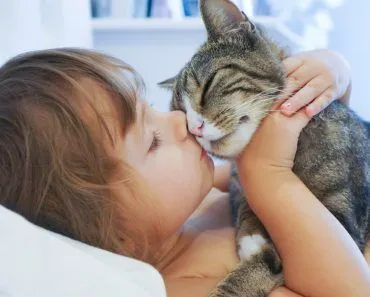
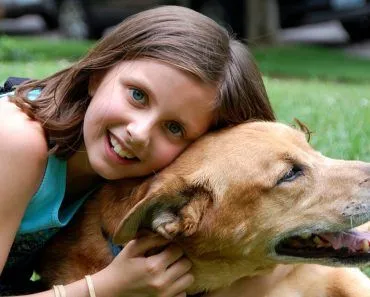
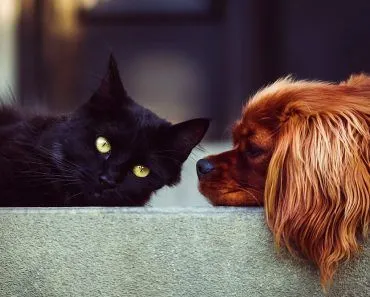
No, cats and dogs don’t innately hate each other. The “enemies” reputation comes from mismatched body language, not bad blood: a dog’s bouncy play-bow or high, wagging tail can read as a threat to a cat. In surveys of pets that share a home, most relationships are peaceful, and animals introduced young usually learn to get along.
Animals are social creatures. Sociality evolved as a response to evolutionary pressures. This is especially true for intra-species interactions. Think of wildebeests migrating in large groups or a pride of lions living together. It’s a beneficial interaction for every individual.

An under-researched facet of sociality pertains to inter-species interactions. Are animals sociable when they interact with members of other species?
We can’t force every animal in the world into a room with a member from every other species and observe them. Nor should we. What we can do is collect information from common inter-species interactions that already exist around us. To explore this theme further, we’ll try to shed light on these types of interactions between cats and dogs.
Why Cats And Dogs?
Dogs and cats are the most popular animals in the world. They are the poster children of the domestication process. They’ve wormed their way into our daily lives and our hearts.
They also increasingly co-habit the same spaces. Pet cats and dogs live in the same households. Feral cats and dogs share the same urban niches. In terms of inter-species interactions, they cross paths quite a lot.
How do these two animals communicate with each other? Do they even communicate at all? Let’s find out!
How Sociable Are Cats And Dogs?
Cats and dogs supposedly only interact negatively with each other, as popular culture and cartoons would have us believe.
However, this argument doesn’t hold water, and a study published in 2020 aimed to shed light on this myth.
Around 1,270 people participated in the study, and each individual had at least one dog and one cat cohabiting in the same household. Each participant filled out a questionnaire that detailed their pets’ behaviors and interactions. The results could not have been further from popular opinion.
Cats and dogs do not fight “like cats and dogs”. They fight sometimes, as all animals do, but most of their interactions are playful. A considerable amount of interactions were indifferent, or even indicated a lack of interest in one another.
Dogs are the more sociable of the two species. As a by-product of their domestication process, dogs evolved to gain skills that helped them “read” human emotions.

Cats, by contrast, are more autonomous.
They simply don’t depend on humans that much to keep them safe or fed. In fact, feral and free-living house cats can subsist by themselves, which they do by hunting.
This isn’t to say that cats are emotionless. They simply show their emotions differently than dogs. Cats do recognize and respond differently to their owners than they do to strangers. Cats often “meow” in specific ways to their owners in order to get their attention.
In fact, since cats don’t fully depend on humans for food or shelter, free operant assessments have shown that they prefer human company, rather than tolerate it for the sake of food or toys.
The one common element that defines sociality in both species is their formative months. The socialization period for dogs and cats begins at the beginning of their lives and is largely determined by how much human contact they receive during this time. Any behaviors they develop in these early months are based on what interactions they have with people.
What Do Cats And Dogs Do With Each Other?
The interactions come in two types, namely those between unfamiliar dogs and cats, and those between familiar dogs and cats. The aspect of familiarity here pertains to cohabitation or frequent interactions.
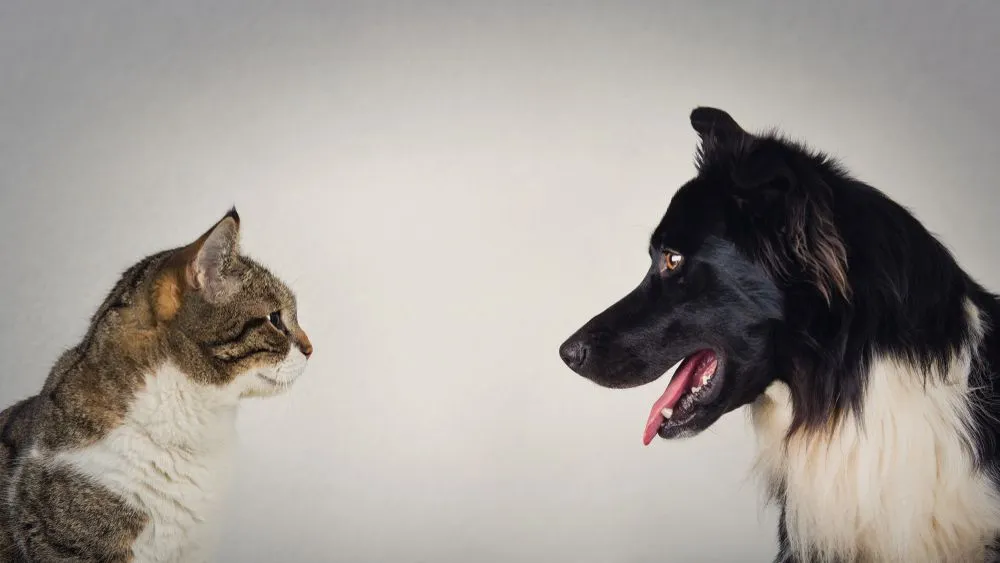
Unfamiliar dogs are more likely to attack, growl, or bark at an unfamiliar cat. However, a sizable percentage (20.5%) of dogs did wag their tails at the cats, indicating a probable friendly response.
Unfamiliar cats were more likely to ignore the dog or simply try to escape the situation. Similar to dogs, a sizable percentage (13.5%) of cats tried to approach the dog amicably. For feral populations, both species display very understandable trepidation towards other species. In fact, cats show particular trepidation towards unfamiliar dogs, but outright hostility towards other unfamiliar cats. This all circles back to a greater level of autonomy in every cat. In fact, multi-cat households report frequent fighting and aggression.
Why Do Cats And Dogs Seem To Fight, Then?
So if they aren’t born enemies, why does a first meeting so often go sideways? The honest answer is that cats and dogs are essentially speaking two different languages, and a lot of the “fighting” is really a misunderstanding.
Take the classic dog “play-bow”: front legs down, rear in the air, a clear invitation to play. A cat has no equivalent gesture, so it can read that sudden lunge as a threat and swat or bolt. Tail signals get crossed too. A dog wagging a high, fast tail is aroused or excited, while a cat holding its tail high and still is usually relaxed and friendly. A flicking, lashing tail means the opposite for a cat: irritation. Each animal keeps confidently “replying” with the wrong cue.
Instinct stacks on top of that. Dogs carry a built-in prey drive, so a cat that suddenly darts away can trigger an automatic chase. Cats, for their part, are territorial and dislike surprises, so a bouncy dog crashing into their space feels like an intrusion before any real grudge exists. None of this requires hatred, just two predators reading each other’s signals badly.
What About When Cats And Dogs Cohabit The Same Space?
Surprisingly, when cats and dogs habit the same spaces, the physical proximity, as well as playful interactions, breeds an inter-specific social bond between the two species. As the familiarity between the two increases, the social bond strengthens.
More than half of the participants interviewed stated that their pets engaged in positive and friendly behaviors. The most popular play the two engage in is often play-fighting. This involves a lot of chasing and ambushes between the two. This makes sense as this type of play is also very characteristic of the intra-specific interactions of each species.
However, the motivation for this type of play is very different for both species. Play engagement evolved as a consequence of the domestication of dogs. They use it to strengthen social bonds with their humans. The type of play they engage in with cats also serves the same purpose.
Cats, on the other hand, engage in this type of play because they find it similar to hunting.
Timing matters more than temperament. In a separate study of more than 200 households where cats and dogs lived together, over two-thirds of owners reported a friendly relationship, about a quarter were indifferent, and only around 10% saw real aggression. The strongest predictor of a peaceful home was early introduction: when the cat met the dog before about six months of age, and the dog before its first birthday, the pair usually learned to read each other’s body language and got along. In other words, those crossed signals can be unlearned if the animals grow up translating for each other.
Conclusion
“They fight like cats and dogs.”
Everyone’s heard the phrase. We can blame pop culture for that. Think of any Tom and Jerry episode and the visual of Spike (the large gray dog) bullying and chasing Tom comes to mind.
Cats and dogs are just victims of their popularity. It’s easier to say that dogs and cats fight with each other than it is to say that hyenas and lions do. This comes down to their distribution. We see cats and dogs every day, but we can’t say the same for other wild animals.
Feral dogs and cats are understandably stand-offish with each other, but this dynamic changes in house cats and dogs. As familiarity between cats and dogs increases, so too does the intensity of their social bonds. Many dogs and cats that live in the same house even sleep and play together.
It’s hard to define whether they develop fondness or love or even tolerance towards each other. However, what we can definitely conclude is that cats and dogs can co-exist with each other, and appear to understand each other to a certain extent.
They might not always be best friends, but they do make for good housemates!
References (click to expand)
- Menchetti, L., Calipari, S., Mariti, C., Gazzano, A., & Diverio, S. (2020, August 26). Cats and dogs: Best friends or deadly enemies? What the owners of cats and dogs living in the same household think about their relationship with people and other pets. (C. E. Ambrósio, Ed.), Plos One. Public Library of Science (PLoS).
- Miklósi, Á., Pongrácz, P., Lakatos, G., Topál, J., & Csányi, V. (2005). A Comparative Study of the Use of Visual Communicative Signals in Interactions Between Dogs (Canis familiaris) and Humans and Cats (Felis catus) and Humans. Journal of Comparative Psychology. American Psychological Association (APA).
- Feuerstein, N., & Terkel, J. (2008, September). Interrelationships of dogs (Canis familiaris) and cats (Felis catus L.) living under the same roof. Applied Animal Behaviour Science. Elsevier BV.