Table of Contents (click to expand)
No. Elephants are not domesticated. Unlike dogs, cats, or sheep, they have never been selectively bred over generations; most captive elephants are wild-caught and individually tamed. They cooperate with humans not because they were domesticated, but because they are highly intelligent and social animals.
Elephants are ubiquitous symbols of human civilization and society, and for good reason. Elephants have been part of safaris, royal ceremonies, and even war!
However, if you ever watch a mahout (an elephant handler) instruct an elephant, it’s natural to wonder when and how humans first began to interact with elephants.
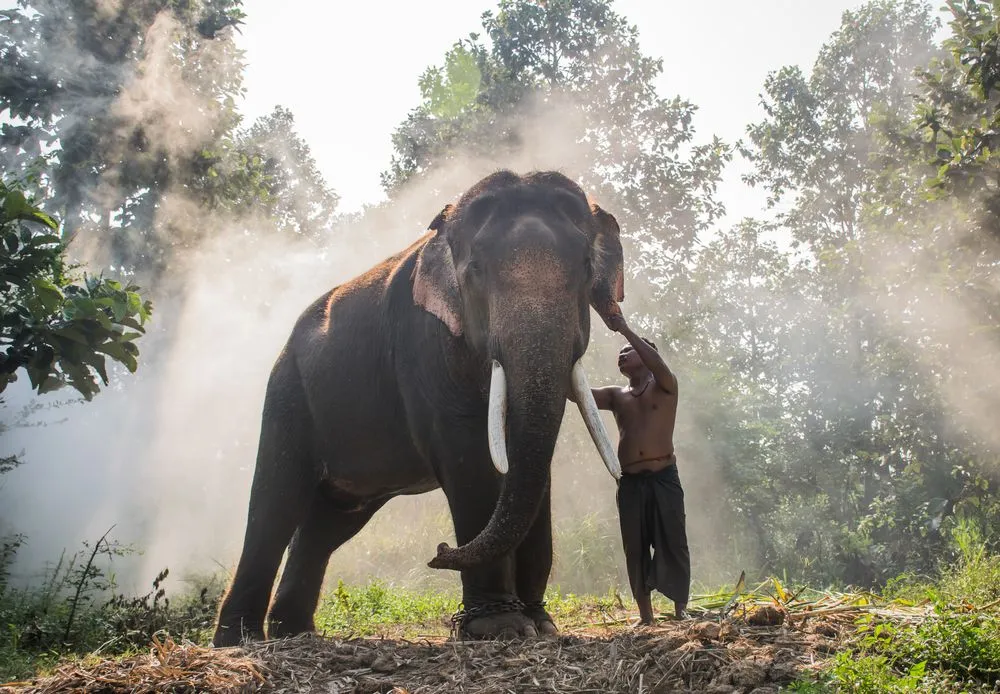
When Did We First Interact With Elephants?
This story begins a long time ago, in approximately 1500 BC, back in modern-day Afghanistan, Pakistan, and a few parts of India.
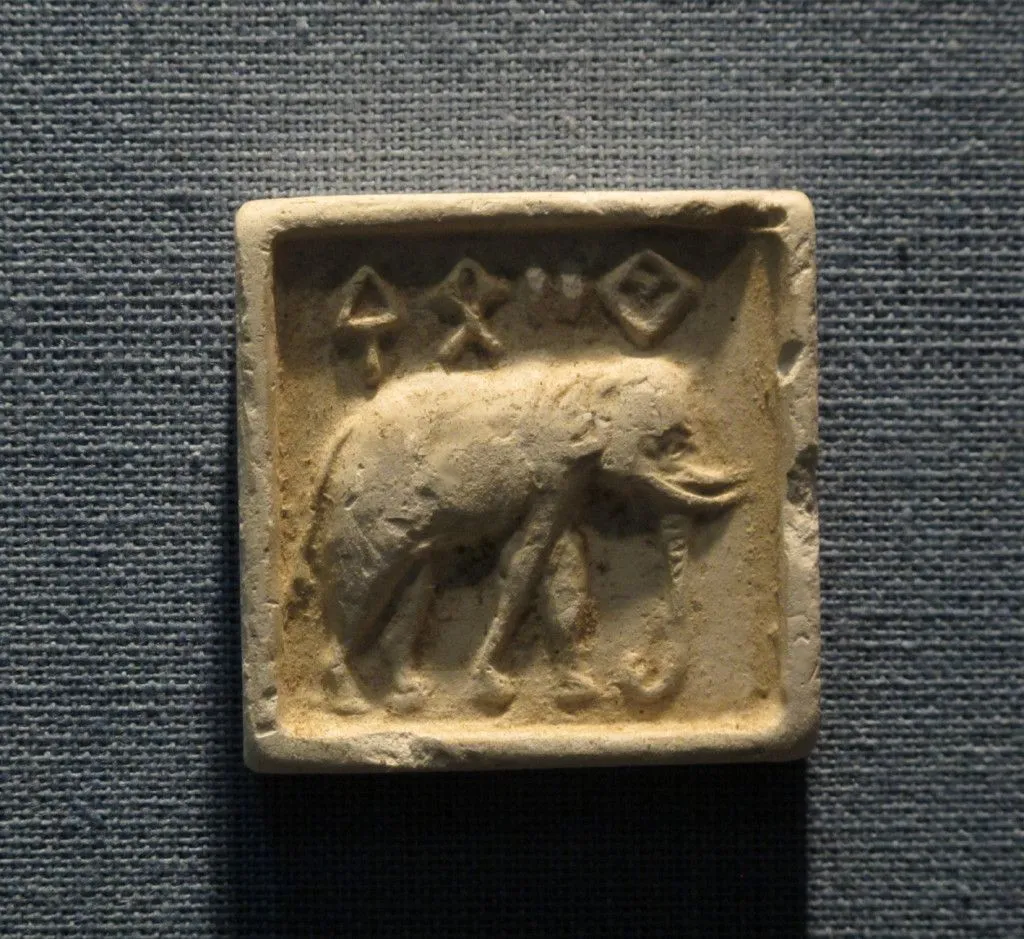
The Indus Valley civilization was one of the greatest and oldest ancient civilizations in the world. It is also where one of the first recorded interactions between humans and elephants is found. Recordings and illustrated seals found from archaeological expeditions indicate that elephants were part of that civilization’s life.
From that point on, elephants kept showing up in military history. One of their most famous early appearances was at the Battle of the Hydaspes in 326 BC, where the Macedonian conqueror Alexander the Great faced down the war elephants of the Indian king Porus. Instructions on elephant care were even set down in ancient texts, such as the Indian treatise Arthashastra.
Following such a long and fabled history of work and cooperation, it makes sense to say that humans must have domesticated elephants.
As it turns out, that’s not exactly true.
What Is Domestication?
Captive elephants are vastly misunderstood. When we think of captive elephants, the fact that they interact with humans disillusions us into believing that they are the products of domestication, but this couldn’t be further from the truth.
Domestication refers to a selection process that unfolds over decades, if not centuries. Wild species are bred to be tamer and are deliberately reshaped, trait by trait, over many generations.
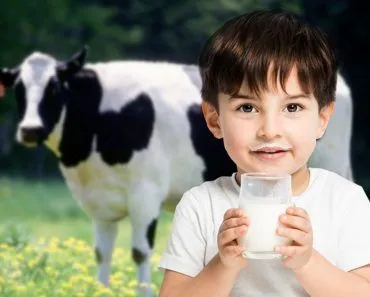
Additionally, they’re also bred to have a purpose. Domestic animals have tangible economic and social value to humans. Essentially, they become living commodities. Think of sheep and wool, cows and milk, or even just dogs, cats and companionship.
Elephants only satisfy one part of this definition. They are living commodities, yes. They have a massive social following and provide incredible economic value in terms of tourism, but they have never been selectively bred.
Domestic animals have lineages that have been selectively bred for at least 12 generations. From each of those generations, individuals are further bred to maximize or isolate desired traits, including appearance or behavior.
Additionally, wild “versions,” such as wolves, differ from their domesticated counterparts.
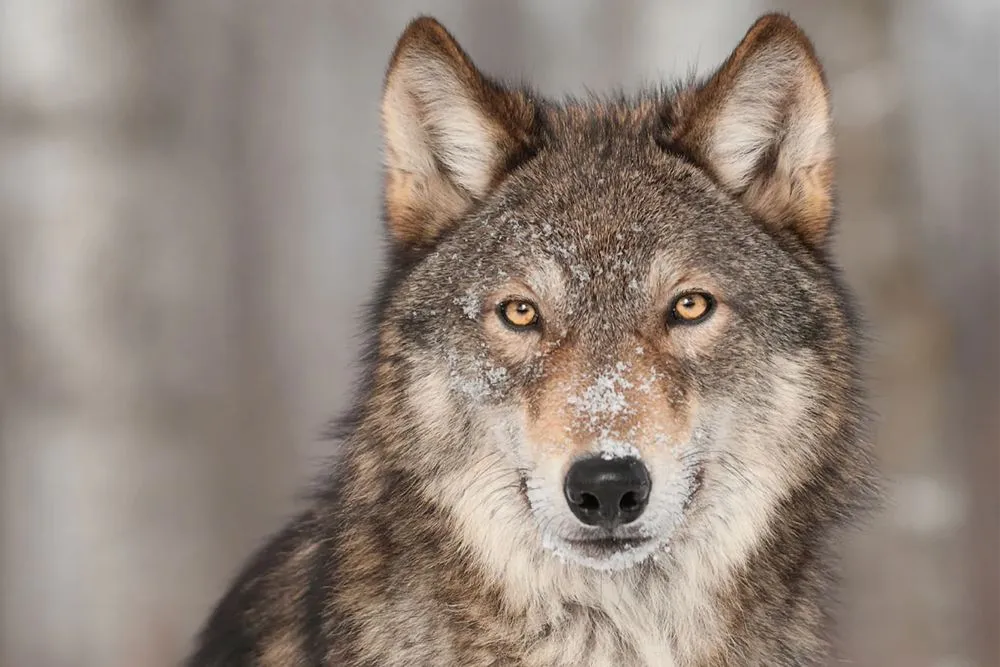
Think about it, while dogs retain some wolf-like traits (for example, Siberian huskies look very similar to wolves and have the same body plan) they are very much their own species.
The same applies to cats. Other than a shared habit of grooming themselves, the tiger (Panthera tigris) and the house cat (Felis catus) are worlds apart in terms of genetic compatibility.
Now, apply the same logic to captive herds of elephants and wild herds of elephants. They’re identical.
For the entirety of the roughly 3,500-year history of human-elephant interactions, most working elephants have been captured from the wild rather than bred. Captive births have always been rare: in North America, the first successful one didn’t happen until 1962, when an Asian elephant named Packy was born at the Oregon Zoo, the first such birth on the continent in 44 years.
Since 1962, there have been a few first- or second-generation captive-bred elephants, but not enough to earn the label of domestication. So, if we haven’t domesticated elephants, how and why do they listen to us?
Because they’re smart.
Why Does It Matter If Elephants Are Smart?
Elephants are incredibly intelligent, highly social, and even empathetic!
Elephants display a shockingly high level of cognitive ability. They’re also great at problem-solving, are able to use tools, and regularly cooperate with one another. They have very good memories and have developed an incredibly intricate language comprised of growls, squeaks, and snorts.
Contrary to popular belief, it is easier to tame or befriend a smarter, more social animal than an unintelligent, fearful, and unresponsive one.
Humans use the incredible cognitive prowess of elephants to form working relationships with them. A study on elephants interacting with humans recognized elephant cognition and recognition of humans as a key factor that enables them to initiate a human-animal bond.
Think about it, it would be much harder to train an unmotivated, antisocial, and uninterested sloth or Koala than a motivated and social animal like an elephant or a dolphin.
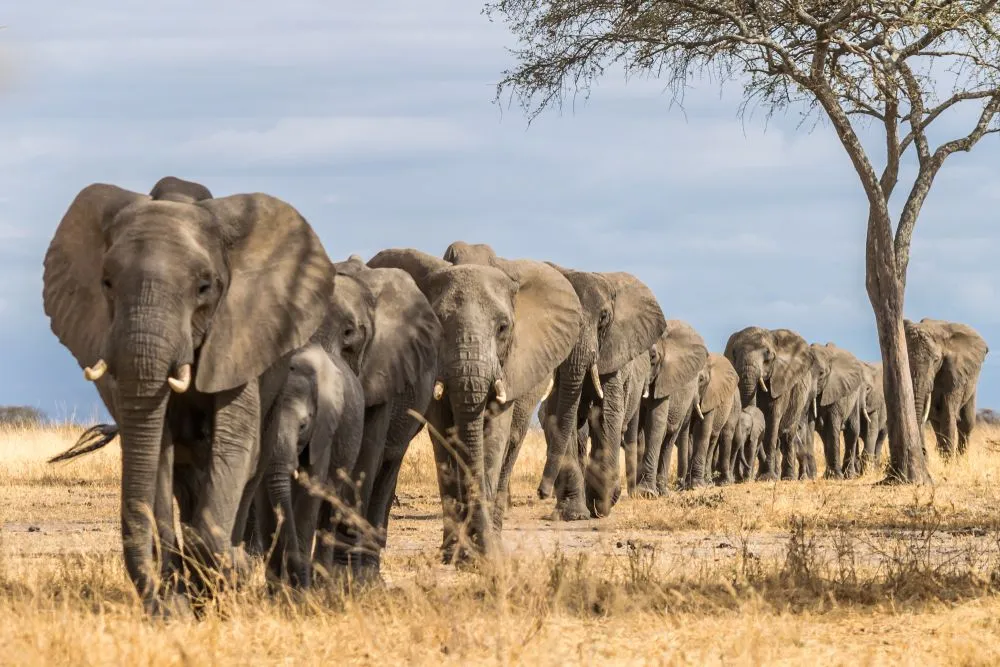
Let’s take, for example, Echo the matriarch. Echo was a female African elephant who was famously the first subject of the Amboseli Elephant Research Project, the longest-running study of wild elephants in the world.
When traveling with her herd through Amboseli National Park in Kenya, Echo and her herd came across the bones of Emily, another elephant that the herd knew and had interacted with.
Echo and the herd stopped to inspect and even caress the remains of their fallen friend. They were clearly grieving.
A lot of this cognition specifically comes down to their neo-cortex. Elephants are the largest living terrestrial mammals. Naturally, they also currently have the largest terrestrial brains. This also means that elephants have a very large cerebral cortex and a well-developed neocortex. The neocortex is often referred to as the thinking center in all brains and is used as a defining metric in examining cross-species intelligence.
A Final Word
It is the elephant’s strengths that humans exploit, as well as their weaknesses. Their incredible cognitive abilities and highly retentive memories make them ideally suited to receiving and implementing training.
Elephants are usually captured in the wild using Kheddas (pens), pits, and concealed nooses. Solitary male elephants are even lured using female decoys.
Captured elephants go through a long, drawn-out, intensive, and painful boot camp training experience. Even then, they still retain their wild instincts and are prone to aggressive and unpredictable behavior when exposed to extremely stressful and tense situations.
The numbers show just how far captive elephants are from a self-sustaining, domesticated population. Smithsonian reports that of the 38 Asian elephants born in North America since 1995, only 24 survive, while of the 17 African elephants born in the same period, only 6 are still alive (infant mortality in captivity runs above 30 percent). Compare that with a truly domesticated species: the USDA counted about 5.07 million sheep in the United States on January 1, 2022. While elephants might be successfully captured and tamed by humans, this is by no means equivalent to domestication.
References (click to expand)
- Great Expectations | Science| Smithsonian Magazine. Smithsonian
- Sheep and Goat Inventory. USDA National Agricultural Statistics Service
- Domestication. National Geographic Education.
- Barrett, L. P., & Benson-Amram, S. (2020, August 1). Can Asian Elephants Use Water as a Tool in the Floating Object Task?. Animal Behavior and Cognition. Animal Behavior and Cognition.
- Herculano-Houzel, S., Avelino-de-Souza, K., Neves, K., PorfÃrio, J., Messeder, D., Mattos Feijó, L., … Manger, P. R. (2014, June 12). The elephant brain in numbers. Frontiers in Neuroanatomy. Frontiers Media SA.
- (1963) The Elephant and the Aryans - jstor. JSTOR